

Originally published at Reckonin.com
Historians have found as a useful periodisation “the New South,” beginning with the withdrawal of the last federal occupation troops and the end of Reconstruction and ending with World War I and the election as President Woodrow Wilson, Southern-born and bred, although not very Southern in most of his thinking.
Speaking broadly of this period we can lay out some important characteristics.
Southerners regained political power in their own States, though this in part involved limiting the black voting population that had been used by the carpetbaggers. Toward the end of the period, segregation became more and more legalised and prevalent as it had long been in the North. With the rise of new black and white generations that had not known the ties of slavery, Southerners the races became less familiar and cooperative and tensions more evident.
This was not pervasive, as peaceful and friendly ties remained for many. The Southern black leader Booker T. Washington (autobiography UP FROM SLAVERY) urged his people to cooperate with whites and devote themselves to work to better their economic condition. Much white leadership reciprocated, supporting schools and colleges despite their own impoverished condition.
Some black people achieved prosperity, but most did not accomplish Washington’s hope. (See THE AMERICAN NEGRO, 1901, by William Hannibal Thomas.) During this period radical protest came only from a few mixed race people in the North. While wealthy Northerners liked black servants from the South, most black people were still to be found below the Potomac and Ohio rivers.
By far the most important aspect of this period was the continued poverty of the South. The destruction of invasion and the looting of Reconstruction left the once prosperous South the most impoverished region of the country, and it remains so to this day. (See PUNISHED WITH POVERTY by Donald and Ronald Kennedy.)
The majority of the black population and great numbers of the white population were reduced to farm tenantry and sharecropping – meaning they had to borrow from the landowners to get through the year till harvest, and often remained in permanent debt. For capital to get agriculture going, landowners were dependent on and in debt to Northern capital.
The capitalist lenders wanted cash crops like cotton. So the land was worked hard to produce cotton. This was no solution for the farmers because the more cotton that was produced the lower the price, the proceeds often not covering the debt. Only in a few years was the sale of cotton profitable and soil exhaustion became a problem.
On top of this was continual exploitation by the capitalists. The South was in fact a colony of the North – exploited for its abundant natural resources and cheap labour. There was some beginning of industry, but this was hampered by federal policy. There was the tariff. Railroad rates were rigged so that steel could be shipped more cheaply from Pittsburgh to Atlanta than from Birmingham.
At least some of the South regained prosperity in this period. The independent farmer and small businessman remained in considerable numbers. Oil and cattle brought some wealth to Texas and Oklahoma.
An important aspect of this period was a considerable reconciliation between North and South as Northerners began to realize the excesses of Reconstruction and to look for native allies in the light of the North being overrun by new ethnic immigrants from Southern and Eastern Europe and labour unrest.
Southerners began to feel and act in good faith as Americans. Northerners accepted Southerners as Americans, although of a different kind and agreed to respect the Confederacy’s heroism and sincerity, a compromise that remained dominant until the 1980s. Southerners remained more conservative in religion, manners, and attitudes.
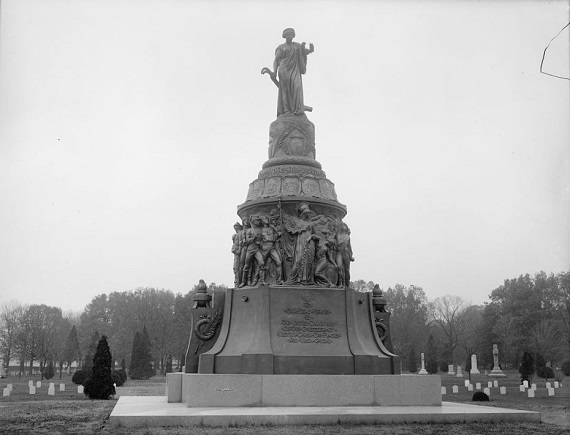
This reconciliation can be demonstrated in many ways. Joint reunion of Union and Confederate veterans at Gettysburg in 1903. Southerners volunteering for the Spanish-American War and World War I. The President attending the inauguration of the Confederate Monument at Arlington. Confederate battle flags returned the States. Personal friendships and family connections were restored. Theodore Roosevelt, after all, had a Confederate uncle.
Reconciliation on the cultural level was strong. Writers like Augusta Jane Evans Wilson, Joel Chandler Harris, Thomas Nelson Page, Grace King, and Mary Johnston, who portrayed the Southern experience favourably but in a spirit of sectional reconciliation, became popular with Northern readers. The Philadelphia aristocrat Owen Wister called his epic Western novel THE VIRGINIAN, and wrote an admiring book about old Charleston called LADY BALTIMORE. In 1914, D.W. Griffith, son of a Confederate soldier, produced the first great American film, BIRTH OF A NATION. It portrayed both a sympathetic view of Southerners and an admiring view of Lincoln. Jazz and ragtime began their popular movement from New Orleans north up the Mississippi river.
A common historical interpretation is that the leaders of the New South for their own profit collaborated with the corrupt corporate interests that controlled the country. There was some of that, but there remained a strong Jeffersonian undercurrent in Southern politics. Many leaders continued to be strongly against the tariff, favoured regulation of corporate power, and opposed U.S. imperialism. Populism is usually considered a Midwestern movement, but its membership in the South was strong and produced its greatest national leaders, like Tom Watson of GA and Leonidas Lafayette Polk of NC.
The New South was a period of often uncomfortable change for the South, creating conditions that became the basis of continuing Southern history. There is still a lot to be learned about if it is to be researched by fair and talented historians.
The views expressed at AbbevilleInstitute.org are not necessarily those of the Abbeville Institute.





“… if it is to be researched by fair and talented historians.”
A task and vocation purloined by something called the “media.” For the most part these are people who write and “report,” not history, but comic book histrionics, embellished with presentism and pseudo-intellectual kindergarten play-kits before the lights and camera; and preen they do. Where I come from, we call them DUMB-ASSES!
Where they come from, that’s what they are!
So many things contributed to the relative poverty of the South after Lincoln’s War in addition to those Wilson mentions. A couple that were subtle and not intentional: Federal taxes paid by Southerners went North to pay for Union soldier pensions (none to Confederates). The National Banking Act made it extremely hard to start a bank in the South; as late as 1906, the South had 18% of the population of the US but owned only 6% of the bank deposits.
Is there a comprehensive list somewhere of historical southern writers?
Air conditioning saved the South. Black migration allowed yankees to demonstrate their love for the ones they supposedly went to war to free. I mean, the war wasn’t to elevate the fedgov over the States permanently…right? Right.