

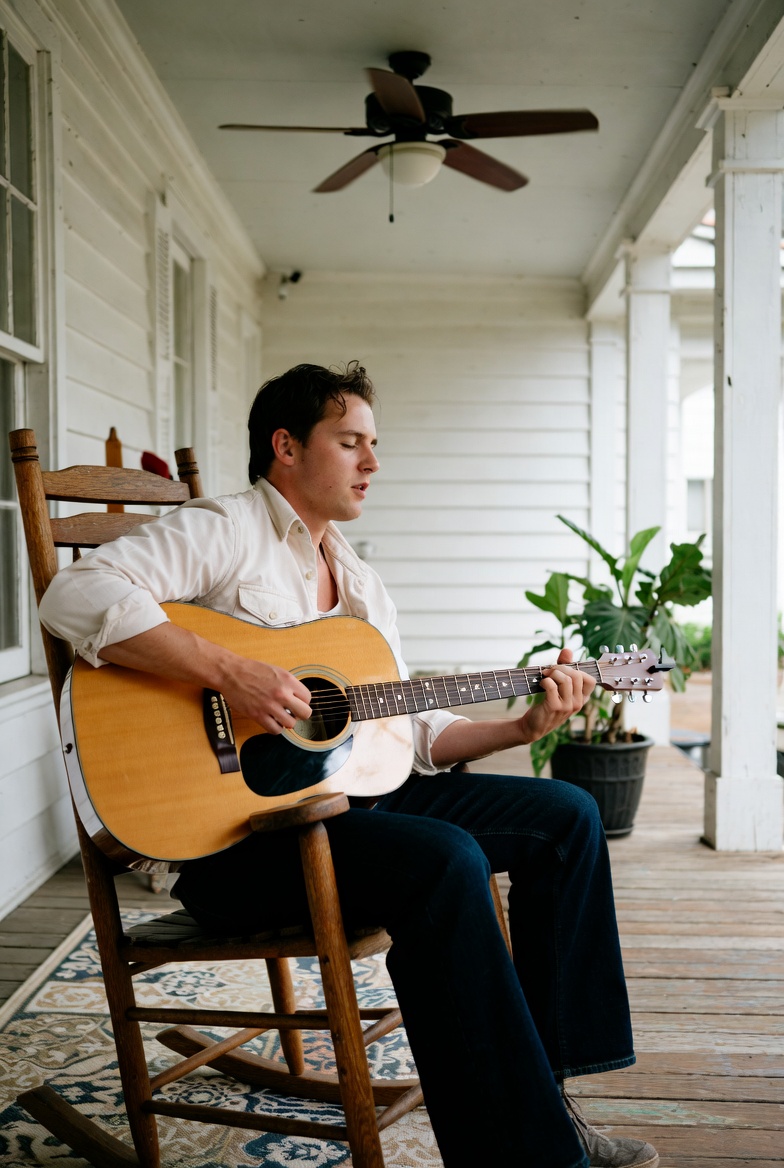
When people talk about the history of American music, they almost always picture a stage, with a spotlight and a performer separated from an audience by footlights and distance. We imagine these grand, almost sacred spaces designed for reverence and applause. Of course, those places definitely matter, but they come late in the story. Southern music did not begin on stages or radio broadcasts, and it definitely did not begin in concert halls. It did not begin with people sitting sedately in proper rows. Southern music began at home, and more specifically, it began on front porches, with family, neighbors, friends, dogs, cats, and chickens who weren’t an audience. They were just sharing the space where the music was happening.
For most of Southern history, music was not something you went to. It was something that happened where you already were. You didn’t buy a ticket or dress up for the occasion, and you didn’t applaud politely at the end. You leaned back in a chair, balanced it on two legs, and listened while the locusts, crickets, and frogs kept time. Music was not set apart from the ordinary rhythm of the day, but was woven into it.
The front porch was one of the most important cultural spaces in the South for generations. It was not just an architectural feature but a social one: a threshold space that was neither fully private nor fully public. Neighbors stopped without invitation, family gathered without planning, and music lived comfortably without needing to be announced. That distinction matters more than we usually acknowledge, because music that grows in those conditions behaves differently.
Porches had something else going for them as well: acoustics. Wooden floors reflect sound, overhanging roofs provide gentle resonance, and open air prevents buildup and distortion. A fiddle, a banjo, or a guitar does not need amplification on a porch; it only needs space. The porch provided Southern musicians with an informal, forgiving soundstage where precision mattered less than presence.
No one was required to impress anyone else, even though, in practice, plenty of musicians enjoyed showing off. The difference was cultural rather than technical. Porch music was not organized around virtuosity but around participation. If you could play three chords, you were welcome. If you could sing harmony of any kind, you were needed. If you could not sing at all, you could still keep time with your foot, clap along, or simply listen, which was also considered contributing.
On the front porch, there was no audience because everyone present was part of the event. That single fact explains more about Southern music than almost any genre label ever could.
Is the front porch a uniquely Southern thing? There is an observation that occasionally surfaces in discussions of American culture that can sound exaggerated at first hearing: that the prominence of the front porch as a lived cultural space is historically unusual, particularly in the South. At first glance, the claim seems overstated. Many cultures around the world have outdoor living spaces—courtyards, patios, balconies, verandas. Thresholds between inside and outside are nothing new.
The distinction lies in how those spaces are used. Lots of societies have front porches, but nobody uses them quite like the South. In many cultures, outdoor spaces are secondary or seasonal. They are private, decorative, or functionally separate from the street and the surrounding community. In the South, the front porch was different. It faced the street, was elevated, and was used daily. More importantly, it was not optional.
The porch was not simply attached to the house; it was the house’s public voice. It was where you were seen, where you greeted passersby, where neighbors stopped without knocking, and where news traveled. It was where children learned how adults talked and where music spontaneously happened. Architectural historians have long noted that, at scale, the South treated the porch not as an accessory but as a primary living space. In the South, the front porch was a social room that happened to be outdoors.
That combination of visibility, regular use, social expectation, and cultural function is unusually rare worldwide. Other cultures had thresholds, but the South built a way of life on one. When that context is understood, much of Southern music begins to make sense. It was not written for privacy or distance. It was written to travel across yards, through hollers, down streets, and into other people’s evenings. That was not accidental; it was architecture shaping culture.
When we talk about blues, country, gospel, folk music, or bluegrass, we tend to categorize them by style. What they really share is origin. All of these genres grew in spaces where the line between performer and listener did not exist. On a porch, a song never stops just because someone makes a mistake. It keeps going. People incorporate the mistake into the song as a happy accident. Someone laughs, someone corrects a lyric, someone comes in late on the chorus, and the music adapts to the people rather than the other way around.
That flexibility shaped the sound itself. Southern songs repeat because people come and go. Verses stretch because conversation happens mid-song. Tempos breathe because no one is playing to a metronome. This is also why Southern music tells stories so well. Porch music is not in a hurry. There is no race toward an ending. The song unfolds the way stories unfold when no one needs them to be short.
One of the clearest popular images of this older musical reality doesn’t come at all from folklore archives or field recordings, but from television. Sheriff Andy Taylor, sitting on his front porch in the evening, guitar resting easily across his lap, singing without effort or display. Aunt Bee stays occupied nearby, Opie listens close enough to feel included without being put on the spot, and Barney half dozes in a rocking chair while supplying a dreamy high harmony. Nothing about the moment is presented as a performance. No one applauds. No one quiets the house. No one says, “Oh, Andy, you really should try your hand at Nashville and become famous.” The music exists simply because the people are there.
Andy does not announce a song or prepare the space. He strums because the evening allows it. His playing is competent but unshowy, rhythmically steady, harmonically simple, and socially grounded. Aunt Bee does not stop her needlework to listen more closely; she remains present in her work, which is itself a form of listening. Opie learns through proximity, not instruction. He absorbs timing, tone, and the unspoken understanding that music belongs where life is already happening.
What matters about this scene is not nostalgia but the musical ethic it models. Music is not treated as an interruption or an event. It is just part of the household’s breathing. Andy is not performing for Aunt Bee and Opie so much as with them, even though he is the only one holding an instrument. The boundary between musician and listener dissolves into shared time and shared space. That is front porch Southern music in its purest form.
And all the while, the porch itself reinforces the idea. It faces outward toward the town and the street, but it remains intimate. The sound would travel if anyone happened to be passing by, and that possibility is accepted and left open. Music is allowed to drift without being packaged or announced. It belongs to whoever happens to hear it, including no one at all.
In that sense, Sheriff Andy Taylor represents a distilled version of how Southern music long functioned. It was not reserved for stages or special occasions. It lived in the margins of the day—after supper in the evenings or after dinner on Sundays, while hands were busy and minds were unguarded. The guitar on the porch is not a symbol of virtuosity so much as continuity. It signals that nothing urgent needs to happen next.
Television rarely captures cultural truth by accident, but this image endured because it resonated with lived memory. Viewers recognized the posture, the sound, and the social arrangement. Non-Southerners were fascinated by it without offering ridicule. Andy’s porch felt familiar even to people who had never lived anywhere like Mayberry. It looked like home, and it sounded like the way music once belonged there.
Across television, film, and literature, there are several other examples of Southern characters enjoying music on the porch. In The Waltons, John-Boy, Grandpa, and family members regularly sing or play instruments. Like Andy Taylor, the music is not framed as performance. People come and go, conversations continue, and the songs function as social glue rather than entertainment. The porch is explicitly a threshold space between family, neighbors, and memory.
In the film O Brother, Where Art Thou?, while much of the music occurs in public or semi-public spaces, several scenes deliberately blur performance and presence—songs emerge organically, without introduction, and are absorbed by whoever happens to be nearby. Though stylized, the ethos remains porch-adjacent.
In literature, music appears quietly and indirectly throughout To Kill a Mockingbird. Hymns drift, radios play, and voices carry songs across porches and streets. While not guitar-centered, the porch remains a sonic space where sound belongs to the neighborhood rather than the individual.
However, what distinguishes Andy Taylor from many of these examples is regularity and restraint. The guitar is not set up as a narrative device or emotional punctuation, but as routine. Andy is not marked as “the musical character.” He is simply a man who sometimes plays in the evening on the porch, and others are welcome to join in.
The front porch was not the only place this kind of music happened, though it was the most common. Another crucial space in the South was the church steps. Inside the sanctuary, music followed rules. Hymns were selected, keys were chosen, and words mattered deeply. Inside the church, music was sacred and intentional.
Outside—on the steps, under trees, beside the building—music loosened its ties. People lingered after services, someone began humming, another found harmony, children played, and adults talked. Songs drifted between sacred and secular without asking permission. This is where gospel learned how to swing.
Church-step music retained the communal structure of worship while shedding formality. Call-and-response flourished, improvisation became natural, and tempo adjusted itself to the people singing rather than the people leading. The church steps functioned like a porch with a theological accent, and once again, there was no audience, only participants.
Another overlooked musical space was the work camp: railroad crews, timber camps, turpentine camps, road gangs, and farm labor crews. These were not places of leisure, but music lived there anyway because it had to. Work songs were functional. They regulated movement, synchronized effort, reduced fatigue, and turned labor into a shared experience. At night, music brought together the workers who might have otherwise remained separate.
Call-and-response was not decorative in these settings; it was structural. A leader sang to set the pace, and the group responded to confirm cohesion. Lyrics were improvised because conditions changed. Humor crept in, complaints surfaced, and stories emerged. This music was not written to be preserved but to get through the day, and yet its influence is everywhere.
Blues phrasing, gospel rhythm, country storytelling, and even rock and roll’s sense of drive all owe something to music that learned how to keep people moving together. Once again, there was no stage, only people, work, and sound.
If the front porch was music at home and the church steps were music in transition, the juke joint was music after hours. These informal, often improvised spaces—converted buildings, back rooms, or standalone shacks—were places where music happened without institutional oversight. They were not built for prestige but for release.
Musically, juke joints functioned like indoor porches. There was no separation between performer and crowd. People talked back to the music, danced close to the sound source, requested songs, interrupted, and participated. Blues did not merely play in juke joints; it learned there. Timing adjusted to dancing feet, volume adjusted to room size, and lyrics adjusted to who was listening.
If a song did not connect, it did not survive the night. That immediate feedback sharpened the music, rewarding honesty over polish and feel over perfection. The crowd applied immediate pressure to the music, and from pressure comes diamonds. Once again, Southern music was being shaped by proximity.
It’s not the architecture that all of these spaces share—front porches, church steps, work camps, juke joints—but social structure. They are small-scale, participatory, informal, and responsive. They require music to adapt to people instead of demanding that people adapt to music.
And here’s the critical part of that condition that shaped everything – when Southern music eventually moved onto stages, it carried these habits with it. Performers talked to audiences, told stories between songs, invited call-and-response, and treated silence and sound as shared property. Even today, when Southern musicians perform on the largest stages imaginable, they often sound as though they are still playing for people sitting close enough to talk back.
When those walls do go up—when the music becomes sealed, distant, and untouchable—it loses something essential, because Southern music was never meant to be admired from afar. It was meant to be shared up close.
Cultural shifts eventually pulled people indoors. Industrialization moved labor off farms, air conditioning changed domestic life, cars replaced walking, and radios replaced neighbors. Music became something people consumed rather than something they made together.
Radio did not erase the porch so much as translate its values into a new medium. Early Southern radio sounded like a porch because that is what it was trying to recreate: live performances, loose structures, familiar voices, and mistakes left intact. Programs felt communal rather than polished, and even when listeners were alone, the radio tried to make it feel as though other people were nearby.
To understand Southern music, it’s better to start with places than with charts or concert halls: a wooden porch at dusk, a set of church steps after Sunday service, a work crew keeping time, or a juke joint humming late into the night. These were spaces where music functioned as shared property among those present. That is where the sound came from, and in many ways, it never really left.
The views expressed at AbbevilleInstitute.org are not necessarily those of the Abbeville Institute.







Southern music was just as much in the living room as on the front porch. I grew up in the country and neighbors would get together to make music. It was ALWAYS in someone’s living room, NEVER on a front porch. Sometimes it was in an old schoolhouse used as our community club.
The South is the true “Music of the Spheres”
That’s a lot more in line with what I remember from “The Waltons.”
Conditioned air ruined the South.
Great article. Nostalgic, reminiscing, and sorrowful in a way, yet uplifting.