

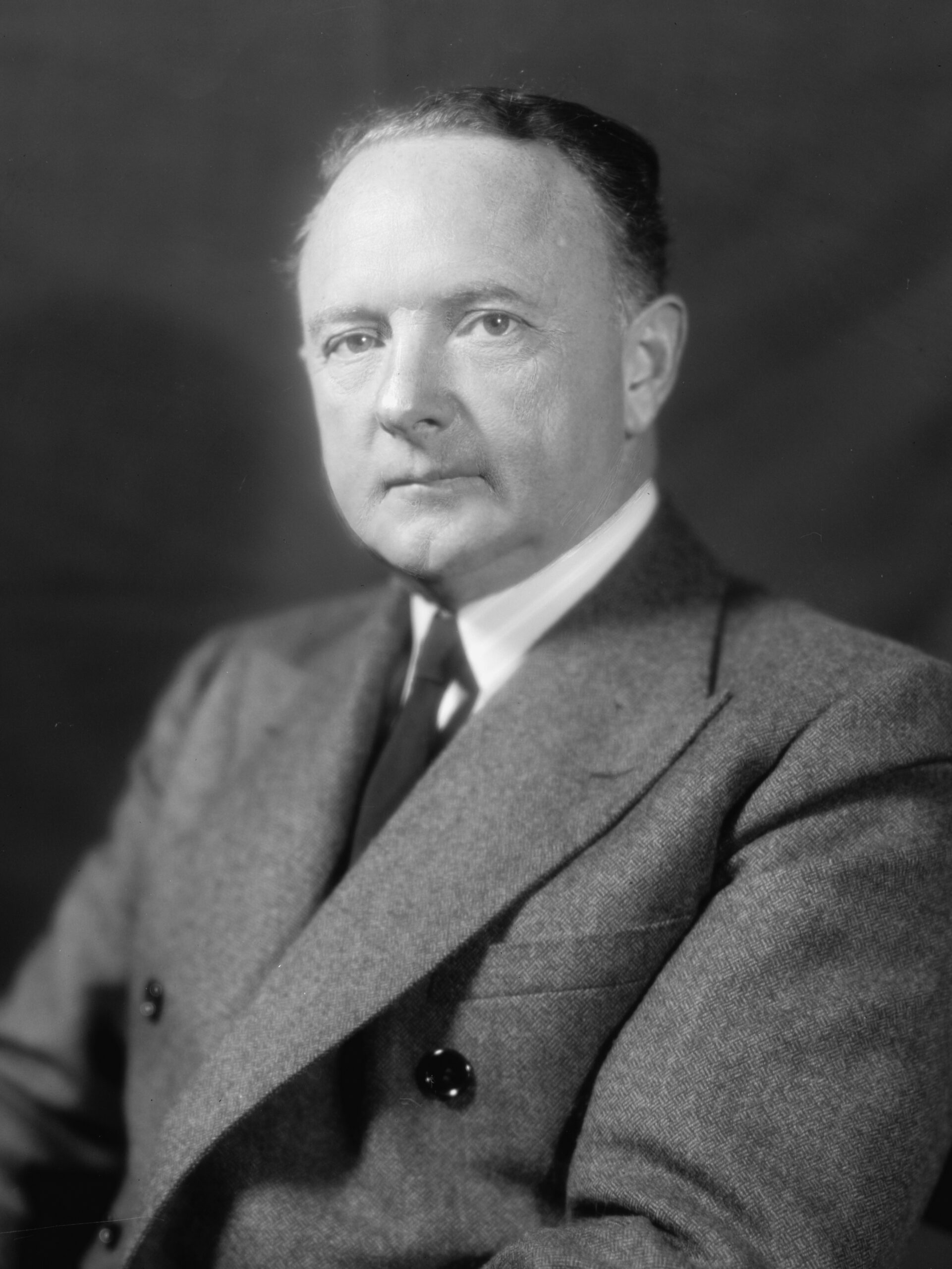
In the words of one scholar, “the years from Reconstruction to the late 1950s witnessed Virginia’s fall from prominence.” This statement is true in many respects, as the South suffered greatly after the war and Reconstruction, not only in an economic sense but a political one as well. No Southerner could hope to win the presidency or vice presidency in those long, lonely years. But they concentrated on accruing seniority in Congress, to eventually control major committees and wield power behind their gavels. Yet left out of this era are the crucial years of the 1930s, when Virginia led the way in resistance to an increasingly encroaching federal government.
The presidential election of 1932 brought Franklin Delano Roosevelt to the White House, pledging a “new deal for the American people.” The country found itself in the midst of the Great Depression, a severe contraction that pushed unemployment to a record 25 percent. FDR sought a new approach to fighting the downturn, taking a page from John Maynard Keynes, who theorized that a mature economy, in times of depression, needed government stimulation to right itself. Gone was the old approach of laissez faire.
Herbert Hoover actually got the ball rolling on government action, with the Agricultural Marketing Act, the Reconstruction Finance Corporation, and higher taxes and tariffs. Spending greatly increased, so much so that FDR went on the offensive against Hoover for failing to balance the budget during the 1932 campaign. Yet Hoover’s policies would pale in comparison to Roosevelt’s.
With the economic crisis in full swing, the nation’s political pundits backed increased federal power. Walter Lippman, writing two months before FDR’s inauguration, predicted that Congress, “an excitable and impetuous body,” would “respect only a President who knows his own mind and will not hesitate to employ the whole authority of his position.” So, members should give the new President “the widest and fullest powers possible under the most liberal interpretation of the Constitution.” Even a Republican Senator from Michigan, Arthur H. Vandenberg, stated, “I think we need a dictator. But a dictator is of no use unless he dictates.”[i]
And Roosevelt was not shy about asking for broad powers. In his inaugural address, he asked for new powers “to wage a war against the emergency as great as the power that would be given if we were in fact invaded by a foreign foe.” And Congress was generous with those powers handed to the new President. One veteran reporter noted that “all my adjectives are exhausted in expressing my admiration, awe, wonder, and terror at the vast grants of power which Roosevelt demands, one after the other, from Congress.”[ii]
Congress, strongly in the hands of Democrats, most being enthusiastic Roosevelt backers, readily complied, causing some journalists to begin referring to pro-administration members as Roosevelt’s “lackeys,” “errand boys,” and “rubber stamps.” The New Deal passed with little real opposition, with the House pushing through eleven major bills with only 40 total hours of debate. The Emergency Banking Act passed the House after just 40 minutes of debates. Most members had not yet been given a copy, yet passed it anyway. Republicans were heavily outnumbered, with one Democrat noting that just a “few years ago you had to use the whole house for your caucus,” he said to the House minority leader, “now you can hold it in a phone booth.”[iii]
Conservatives in Congress, though fewer in number since the onset of the depression, fought back, challenging increased federal power. In the words of James T. Patterson, “Opposed to heavy government spending, fearful of the spread of federal bureaucracy, loud in defense of states’ rights and individual liberty, these men composed the earliest conservative force in Congress under Roosevelt’s administration.”[iv]
Virginia’s two US Senators were instrumental in pushing back against FDR. In fact, of the five leading Senate opponents of Roosevelt’s New Deal, Virginia claimed two spots – Harry F. Byrd and Carter Glass. Byrd voted against 65 percent of FDR’s program, while Glass was the most conservative Senator, opposing 81 percent of the New Deal.[v]
Carter Glass was born in Lynchburg, Virginia on January 4, 1858. His father, Robert Henry Glass, served in the Confederate army, including time on the staff of John B. Floyd, who had served as Virginia’s governor before the war and Secretary of War under James Buchanan until December 1860. The elder Glass schooled his son in the history of the “Lost Cause” and taught him to loathe Yankees. FDR would later refer to the younger Glass as an “unreconstructed rebel.” Carter Glass never attended college but started early in the newspaper business, first as a printer’s devil, then a reporter, before becoming editor of the Lynchburg News. He would eventually own two newspapers.[vi]
He was not a large, physically imposing man, standing just five feet, four inches in height, and maybe one hundred pounds, but possessed a first-rate mind. Glass served in the Virginia Senate from 1899 to 1902; the US House of Representatives from 1902 to 1918, where he chaired the banking committee for five years and helped construct the Federal Reserve System; Secretary of the Treasury under Wilson from 1918 to 1920; and a US Senator from 1920 until his death in 1946. In the Senate he chaired the appropriations committee for more than a dozen years, and served as Senate President Pro Tempore from 1941 to 1945.[vii]
Glass, though, did not start out as an opponent to Roosevelt’s program or to FDR himself. He had been concerned for several years that the party had been inundated with too much “La Follette-ism and Bryan-ism.” In 1928, he actually pushed a Roosevelt presidential candidacy against Al Smith, since Glass, like most southerners, was a “dry,” and when the New Yorker seemed more conservative. And although he wanted Newton D. Baker as the candidate in 1932, he supported FDR’s nomination, at a time when Roosevelt was running to the right of Hoover. In fact, Glass even got out of a sick bed to give a ringing national radio address in favor of FDR. “Holding fast to sound Jeffersonian principles, we shall hope to rescue the government and the country from the unendurable confusion and distress into which the Republican maladministration has thrust us,” Glass said. Roosevelt sent Glass a telegram after the speech, “Wonderful speech last night … sincere appreciation.”[viii]
Described by Arthur Schlesinger, Jr. as the Democratic party’s “expert on public finance,” and another writer as the “leading financial mind in the Democratic caucus,” Glass was offered the post of Secretary of the Treasury by Roosevelt after the election, which he declined, having already served a stint in that post but mainly because he had concerns about Roosevelt’s likely inflationary currency policy if the prices of commodities continued to decline. Glass wanted a strict guarantee that FDR would not pursue a policy of inflation, which a Roosevelt aide, Raymond Moley, relayed to the President-elect. Roosevelt responded, “So far as inflation goes, you can say that we’re not going to throw ideas out of the window simply because they’re labeled inflation. If you feel that the old boy doesn’t want to go along, don’t press him.” Moley didn’t press him but Glass eventually declined the offer, citing health reasons as well his concerns about inflation.[ix]
Very early in the administration, though, he supported the Tennessee Valley Authority and was the author of a major piece of banking legislation, the Glass-Steagall Act, which separated investment banks from commercial banks and established the FDIC. But his inflation fears were well-founded. When the Senate was debating whether or not to give Roosevelt the authority to cut the gold content of the dollar, Glass pleaded with his fellow Senators not to do it. But FDR eventually took the nation completely off the gold standard.[x]
Glass admired Wilson, was one of his strongest allies in the House, and gladly served in his Cabinet. He worked closely with Wilson on reforming the nation’s banking and currency system, making him a father of the Federal Reserve System. But there was a limit to how far he would go. He knew there needed to be reforms but he worked to keep those changes on a more conservative basis. For instance, he envisioned the Federal Reserve as solely in the hands of private bankers, not the government. He had supported Wilson’s New Freedom and some aspects of Hoover’s program when the depression hit, but Hoover went too far with increased taxes and tariffs to suit Glass, who noted that the “minions of Federal bureaucracy are given full sway to distribute huge sums of money picked from the pockets of the American people.” FDR, though, pushed things to a whole new level, much too far for Glass. So, it didn’t take him long to jump off the train. He was fiery and combative, and began attacking the New Deal in the strongest of terms, writing to Walter Lippman that he considered it “an utterly dangerous effort of the federal government to transplant Hitlerism to every corner of the nation.”[xi]
A few years into the New Deal, Glass assailed the program in a private letter. “Now is about as good a time as anybody could find to die,” he wrote, “when the country is being taken to hell as fast as a lot of miseducated fools can get it there. Nevertheless, it would be interesting to live long enough to see the thing tumble so that nobody could long doubt the infinite folly of what has been done for the past three years.”[xii]
One of his first targets was the NRA, the National Recovery Administration, part of the NIRA (National Industrial Recovery Act), and its blue eagle symbol, signage of which would hang in businesses nationwide, providing proof that they were complying with the agency’s price-setting policies. Glass wrote to the administrator, Hugh S. Johnson, a West Point graduate and former brigadier general with service in World War I. “I just want to tell you, General, that your blue buzzard will not fly from the mastheads of my two newspapers.” The new agency, Glass wrote a friend, “was unconstitutional, and tyrannical and literally brutal.”[xiii]
In addition to the legislation itself, Glass hated the bureaucrats implementing the New Deal, many of whom came from academia, people like Rexford Tugwell. “The sooner Washington is rid of impatient academicians whose threatening manifestos and decrees keep business and banks alike in suspense, if not in consternation, the sooner and more certain will we have a complete restoration of confidence and resumption of business in every line of endeavor,” he wrote in a private letter. He closed with a Latin quote, which translated as “They are all mixed up. They condemn what they can’t understand.” Ironically, one economist has written that Glass’s FDIC “socialized” the bank’s losses and “ultimately made DC bureaucrats responsible for the integrity of the banking system.”[xiv]
In another private letter, Glass attacked Roosevelt for his increased powers over the banking system, specifically his declaration of a bank holiday, shutting the doors on every institution in the country. “I think the President of the United States had no more valid authority to close or open a bank in the United States than my stable boy,” he said. “It looks to me as if Hoover carried the country to the edge of the precipice and this administration is shoving it over as fast as it can. I predict the righteous failure of every damned project that these arbitrary little bureaucrats are vainly endeavoring to put into effect.” Exacerbated over the direction Roosevelt had taken the party, Glass exclaimed, “Why, Thomas Jefferson would not speak to these people.”[xv]
And Glass was obstinate, to put it lightly. Words often used to describe Glass were stubborn, inflexible, irascible. Once he made up his mind, changing it was next to impossible. “No one can help but like that old rooster,” said Vice President John Nance Garner, who served in the House with Glass, “but once Glass gets a notion in his head, neither hell nor Woodrow Wilson could change him.” Another agreed, writing that Glass “is too indissolubly wedded to his own opinions and accomplishments of the past to tolerate any changes that might be considered, even as natural evolutions.” A newspaper story from 1937 relayed the tale of Senator Glass once moving out of a Washington hotel, where he had stayed for 25 years while working in the Capitol, because the owners remodeled the lobby.[xvi]
He could cut an opponent down to size with mere words and often did so, with no thought towards the feelings of others. Senate Majority Leader Joe Robinson of Arkansas, working closely with FDR to push the New Deal through the Upper House, once tried to gain sympathy from Glass for the tough job he had. “Oh, you can’t imagine the hell I have to go through,” Robinson said to Glass. There was certainly much opposition in the South to the New Deal but the President was using massive amounts of federal money and patronage to win support. Knowing this, Glass was unimpressed with Robinson’s effort at empathy. “In your case, Joe, the road to hell seems to be lined with post offices.”[xvii]
Nor did Glass care that Virginia was a very Democratic state with strong support for President Roosevelt. No one thought FDR would lose in 1936, much less fall in Virginia. “Every section of the state has been so well watered with federal benefits and federal money that potential votes lie out there in bunches,” wrote a commentator in the New York Times. But would Glass have problems with his vicious opposition to the New Deal, which was responsible for the money and benefits flowing into Virginia, when he stood, alongside FDR, for re-election in 1936?[xviii]
In the end, Glass sailed to re-election with nearly 92 percent of the vote, far outpacing Roosevelt, who won just under 69 percent. Glass was the beneficiary and one of the leaders of what has been described as “the most powerful state machine in the nation.” It was known as The Organization and headed by Virginia’s other US Senator, Harry F. Byrd, who, like Glass, was in opposition to Roosevelt’s expansion of government. “I derive some satisfaction from the thought that if Virginia wants two rubber stamps in the Senate it would be better not to select us. I would rather be remembered, if at all, for intellectual integrity then for party subservience,” Glass wrote Byrd.[xix]
Born on June 10, 1887 in Martinsburg, West Virginia, Harry Flood Byrd moved with his family to Virginia before his first birthday. Byrd family lines included some of Virginia’s most prominent leaders, including William Byrd II and Robert “King” Carter. His uncle, Henry D. Flood, served in Congress for twenty years and ran the state’s Democratic political machine during the Wilson years. Byrd’s father was a prosperous apple producer in the Shenandoah Valley and also owned a newspaper, the Winchester Star. Most of Byrd’s education came in private schools but he eventually followed his father’s footsteps in the family fruit business and as a newspaper publisher. Byrd entered politics in 1915 at age 28 when he was elected to the Virginia state senate, where he served for a decade, then a term as governor from 1926 to 1930. When FDR appointed Senator Claude A. Swanson to head the Navy Department in 1933, Virginia governor John Pollard appointed Byrd to the US Senate, where he would serve until 1965.[xx]
During the first hundred days, Byrd supported some of the New Deal program, but soon turned against it just as Glass had, as well as many more conservative members of Congress. He criticized the increase in spending, particularly the deficits, and eventually took aim at two of the most prominent New Deal laws. Like Glass, he opposed the NRA, with its wage and price controls, but also the Agricultural Adjustment Act (AAA), notably the processing tax, which hurt his apple business. Roosevelt thought he understood Byrd’s motives, being more than economic, but personal. Writing to Rexford Tugwell, the assistant Secretary of Agriculture, “He’s afraid you’ll force him to pay more than ten cents an hour for his apple pickers.” But Byrd’s position was clear: The government has no authority to force employers to pay certain wages. The AAA was eventually ruled unconstitutional by the Supreme Court.[xxi]
By the end of 1937, conservatives in the Senate were feeling better about their chances against Roosevelt’s New Deal. The President had utterly humiliated Alf Landon the year before, winning all but eight electoral votes. But his long honeymoon with Congress seemed to be coming to an end, as his court-packing plan and a major labor bill had gone down to defeat. That December Byrd held a luncheon in a private dining room in the Capitol for conservative Senators, including Glass, that featured Lewis Douglas, a former director of the Budget Bureau before he resigned in 1934, mainly because of massive deficit spending. Byrd, Glass, and the conservative coalition believed the tide was turning in their favor.[xxii]
Roosevelt was angered by the congressional opposition to his program and in the 1938 midterm elections, sought revenge. In fact, the President had a “purge list,” and Byrd was on it. Roosevelt was particularly annoyed that many of these conservative Democrats ran with him early on but turned against him once in office. He was looking ahead to 1940 and realized that if Southern conservatives kept gaining momentum, they could control the Democratic National Convention and nominate one of their own to turn back the clock. He couldn’t allow that to happen. There were a few in his crosshairs that he could go after relatively easy. But to take aim at Byrd and Glass would be very difficult in 1938 because neither Senator was up for re-election. Roosevelt, though, had other ideas about how to get at the Virginians.[xxiii]
The Virginia Democratic Party was split in the same way the National Party found itself divided, into progressive and conservative, pro-New Deal and anti-New Deal factions. In 1937, James H. Price won the governorship despite opposition from The Organization. One congressman from Virginia warned that “Price and his miserable gang, abetted by the White House” was after Byrd. Rumors were swirling that FDR was grooming Price to challenge Byrd in 1940. To do that he needed to weaken The Organization. And the way to do that was to deprive Byrd, and Glass, of their control over federal patronage.[xxiv]
The big fight in Virginia was over the appointment of a federal judge. Roosevelt was determined to name his own candidate to the bench without consulting Byrd and Glass, which had always been tradition and senatorial courtesy dating back to George Washington. “I am not going to let Glass or Byrd make any appointments in Virginia,” Roosevelt said. If he prevailed, not only would it teach Virginia’s Senators a very powerful lesson, but it would also send a very strong message across the country, especially in the South, that there were consequences to opposing Roosevelt and his New Deal.[xxv]
On July 7, 1938, President Roosevelt nominated Floyd Roberts to a new federal district judgeship in Western Virginia. One Virginia paper called it a “slap at Senators Glass and Byrd.” To Glass it was more than that; it was a violation of the Constitution itself. Byrd called it “the first step – the first shot – in the purge of 1940.” Both Senators dug in their heels, and in the end, Roberts went down to defeat by an overwhelming vote, 72-9. The Roanoke World News called it largest vote against a presidential nominee in the history of the Senate. Members of the Upper House circled the wagons and protected their prerogatives.[xxvi]
In 1938, Virginia voters stood with Glass and Byrd in the fight over the Roberts nomination and supported The Organization in every single congressional election that year. In his re-election campaign in 1940, Byrd triumphed with more than 93 percent of the vote. The “purges” in Virginia only made Byrd’s machine stronger. The brief progressive surge in 1937 was stopped and never rose again.[xxvii]
After a brief fight with the federal government over Civil Rights in the 1950s and 1960s, culminating in Harry Byrd’s campaign of “Massive Resistance,” and the “Southern Manifesto,” outlining the constitutional arguments against the Court’s Brown v. Board of Education decision, which every member of Virginia’s congressional delegation signed, the Old Dominion has fallen in its leadership role at the forefront of safeguarding America’s constitutional republic of republics. Yet without Virginia, America would most likely never have achieved its independence nor fashioned a government based on the consent of the governed. That legacy of great statesmen should be secured forever.
****************************************************************************
[i] James T. Patterson, Congressional Conservatism and the New Deal (Lexington: The University of Kentucky Press, 1967), 1-2.
[ii] Ibid., 3-4.
[iii] Ibid., 3-5.
[iv] Ibid., 13.
[v] Ibid., 348.
[vi] Ibid., 18.
[vii] Ibid.; Arthur M. Schlesinger, Jr., The Age of Roosevelt, Vol. 1: The Crisis of the Old Order (Boston: Houghton Mifflin Company, 1957), 468.
[viii] Susan Dunn, Roosevelt’s Purge: How FDR Fought to Change the Democratic Party (Cambridge, MA: The Belknap Press of Harvard University Press, 2010), 66; Schlesinger, Crisis, 379, 103.
[ix] Schlesinger, Crisis, 468-469; William E. Leuchtenburg, Franklin D. Roosevelt and the New Deal (New York: Harper & Row, 1963), 38.
[x] Dunn, 66, 49; Arthur M. Schlesinger, Jr., The Age of Roosevelt, Vol. 2: The Coming of the New Deal (Boston: Houghton Mifflin Company, 1959), 44, 195.
[xi] Schlesinger, Crisis, 416.
[xii] Patterson, 20.
[xiii] Ibid., 19.
[xiv] Ibid., 15; Robert P. Murphy, The Politically Incorrect Guide to the Great Depression and the New Deal (Washington, DC: Regnery Publishing, 2009), 124.
[xv] Leuchtenburg, 253.
[xvi] Patterson, 21.
[xvii] Dunn, 57-58.
[xviii] Patterson, 20.
[xix] Ibid., 16.
[xx] Ibid., 29-30.
[xxi] Ibid.
[xxii] Dunn, 81.
[xxiii] Alvin L. Hall, “Politics and Patronage: Virginia’s Senators and the Roosevelt Purges of 1938,” The Virginia Magazine of History and Biography (July 1974, Vol. 82, No. 3), 333.
[xxiv] Ibid., 334.
[xxv] Ibid., 338.
[xxvi] Ibid., 340.
[xxvii] Ibid., 349.
The views expressed at AbbevilleInstitute.org are not necessarily those of the Abbeville Institute.





A new biography of Carter Glass is long overdue.