
The recent decapitation of a World War II memorial in Virginia provoked widespread outrage. Even CNN, the notorious liberal rag, disapproved, reporting that,
The Battle of Iwo Jima monument in Quantico, Virginia, has suffered hundreds of thousands of dollars in damage after a man beheaded one of the statues Wednesday evening, police said.
Officers responding to a report of destruction of property at Marine Corps Base Quantico around 10:31 p.m. saw a man “actively damaging the statue with a sledgehammer” and detained him without incident, Prince William County police said last week.
According to a court document released Monday, police reported seeing a man atop the monument “attempting to remove the American flag.”
The outrage focused on the brazen criminality involved in attacking these revered symbols of patriotism. This sledgehammer-wielding vandal had no right to destroy a war memorial or remove the American flag. He was, accordingly, arrested and charged with criminal trespass and “felony injury to a monument”
The suspect, 27-year-old Miguel Alonso Maldonado Soriano of Stafford, Virginia, has been charged with felony destruction of property, trespass with intent to damage, and felony injury to a monument, court records show.
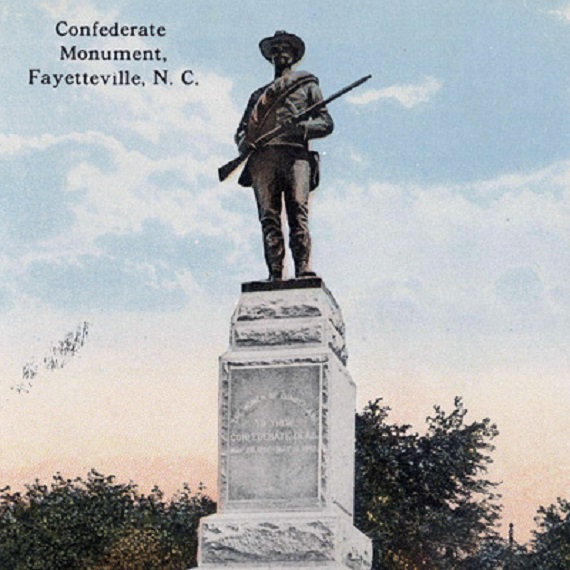
Yet we do not see similar levels of outrage when Confederate memorials are targeted. Recently in Tampa, Florida, the memorial to a Confederate soldier was decapitated. CNN was not interested in that and did not bother to report it. We heard from the local press that, “Between Sept. 5 and Sept. 15, unknown suspect(s) entered the cemetery and removed the head of one of the soldier figures, according to Crime Stoppers of Tampa Bay … The sheriff’s office did not provide further details on the case.”
Confederate memorials are seen as fair game. For example, as reported in the New York Times, in June 2021 the House of Representatives voted “to remove statues honoring Confederate and other white supremacist leaders from public display at the United States capitol.” On that occasion, the NYT was dismissive of the procedural objections raised by a few courageous Republicans – it certainly took courage to speak against this tide of iconoclasm during the George Floyd mania that swept the globe in a wave of fire and destruction. NYT said,
Many of the Republican arguments against it on Tuesday, though, focused on complaints about the removal process Democrats had proposed, not their goal.
“It would mean a whole lot more to this body, as well as the American people, if the states who originally put those statues in here were the ones who now ask that they would be removed,” said Representative Barry Loudermilk, Republican of Georgia.
NYT emphasized the fact that the conservatives did not attempt to argue against the goal of removing Confederate monuments but merely insisted that the removal process could only properly be set in motion by the Southern states. While lack of due process is a reasonable, and indeed persuasive, point, it shows weakness in avoiding the principled ground. It implies – as, indeed, the NYT highlighted – that there is no objection, in principle, to such destruction as long as the democratic process is followed.
Among the “white supremacist leaders” selected by Congress for the purge was Chief Justice Roger Taney of Maryland, who was accused of displaying his “white supremacy” by upholding the original meaning of the Constitution. According to his critics, Justice Taney should instead have embraced the progressive “living tree” method of interpretation. The term living tree means that it keeps growing, changing, evolving. What the founders meant becomes as irrelevant to the current meaning of the constitution as the contours of an acorn are to the current needs of a giant oak tree.
This approach is sometimes called “purposive interpretation” because the words are taken to mean what will best suit the purpose sought to be achieved. Historical documents mean what enlightened liberals now believe they should mean, not what the writer himself intended them to mean and was understood at the time to mean. Justice Taney failed this test and was cancelled forthwith. Down came his statue.
Another distinguished statesman denounced for showcasing his “white supremacy” was John C. Calhoun of South Carolina. The rationale given for purging him was that the only reason he was honored by South Carolina was for defending slavery. This was confirmed by a Democratic representative from South Carolina who said, “His contribution to the national discourse was in defense of slavery – that’s why he’s here.”
The notion that Calhoun was only ever revered for his defense of slavery is, of course, false. It would have made no sense for him to be selected in 1957 as one of America’s five greatest senators of all time, if the only thing Americans knew about him was that he defended slavery. Yet, until the rise of the cultural Marxists, he remained on the list of all-time greatest senators.
In a similar pattern to the slander of Thomas Jefferson and Robert E. Lee, who were revered by Americans for decades, it only emerged that we are now meant to view American heroes merely as “slavers” when instructions to that effect were issued by the Marxist historians and their liberal admirers.
It is noteworthy that when the English liberal politician and philosopher John Stuart Mill expressed admiration for Calhoun, nobody interpreted that as a defense of slavery. Mill was no defender of slavery – on the contrary, he was exactly the type of liberal who is greatly admired by NYT and CNN liberals. As said by another liberal platform,
It should, perhaps, not be too surprising that as an advocate of equal rights for women and a defender of individual liberty against the tyrannies of either minorities or majorities, John Stuart Mill was, equally, a demander for the end to human slavery and its accompanying attitudes concerning associative relationships.
Professor Paul Gottfried aptly described Mill as “a feminist and social democrat” who nevertheless “admired Calhoun.” Referring to A Disquisition on Government, Mill described Calhoun as “a man who has displayed powers as a speculative political thinker superior to any who has appeared in American politics since the authors of the ‘Federalist’”. Mill particularly admired Calhoun’s “general principle of limiting the tyranny of the majority, and protecting minorities by admitting them to a substantial participation in political power.” Professor Gottfried adds that “Calhoun’s theory of concurrent majorities was debated among European political theorists well into the twentieth century, and by people who had no conceivable interest in reviving slavery.”
A principled defense of these alleged “white supremacists” must therefore emphasize the regard in which they were held in their own time and for over a century afterwards. Yet, instead of mounting a principled defense, we often see people taking refuge in debates about democratic process or the benefits of learning from history.
Debating “good democracy” and “learning lessons from history” feels safe. As someone who has often framed my defense of Confederate monuments that way, I believe we do so in hope that the cancel mob will not come after us if all we are saying is that democracy is good and history lessons are enlightening. Who could object to that? After all, liberals also purport to believe in democracy and academic freedom, so by taking this line of defense we hope to find some common ground with our opponents.
But the democratic process is no bulwark against tyranny. When Calhoun’s statue was taken down from Charleston, South Carolina, the local news reported that, “The spot that once held the monument of John C. Calhoun high in the sky is now nothing more than a bunch of rubble and dirt.” Presumably, that was not deemed outrageous because, after all, the City Council had voted democratically to do it. Sometimes, the majority are the very tyrants against whose machinations a robust defense is needed. Sometimes, we must defend the truth because it is true, not because someone might learn a history lesson thereby.
When another cancelled son of Virginia, Professor Robert L. Dabney, wrote his defense of Virginia he certainly did not hold out any hope that his opponents might learn some valuable lessons from it. On the contrary, he opened by stating:
To the conquerors of my native State, and perhaps to some of her sons, a large part of the following defence will appear wholly unreasonable … The few among them who do not pass me by with silent neglect, I am well aware will content themselves with scolding; they will not venture a rational reply.
Dabney warned that procedural fulminations about democratic processes do not suffice to mount a robust defense of the truth. It is also necessary, he insisted, to stand firmly on the moral high ground. If one deems that there is no principled defense of one’s own position, then he ought not to thwart his opponents, but should instead bow out and rest content that the right argument triumphed. But if he believes his opponents to be wrong, as Dabney did, the defense must be rooted in moral principle and in truth.
This was precisely Calhoun’s argument in the debate on the abolition petitions, when he admonished his Virginia counterparts that if they felt unable to make a principled defense of the constitutionality of slavery then they should abolish it immediately. As I have previously observed,
Mr. Rives, a Senator from Virginia, thought the matter could be resolved by receiving the abolition petitions and then just saying no on grounds that although slavery was “an evil,” it was a “necessary evil.” Why not just accept the premise of perpetuating evil and hide behind practicalities?
Calhoun did not agree. He took a principled view, arguing that if Congress truly considered the petitions to be well founded then the only honorable response would be to abolish slavery immediately. But this premise was not correct, in his view.
Dabney made the same principled argument in his post-war defense of Virginia, saying,
With the exception of Mr. Calhoun, (whom events have now shown to have been the most far-seeing of our statesmen, notwithstanding the fashion of men to depreciate him as an “abstractionist” while he lived,) Southern politicians usually satisfied themselves with saying, that the whole matter was, according to the Constitution, one of State sovereignty; that Congress had no right to legislate concerning its merits; and that therefore they would not seem to admit such a right, by condescending to argue the matter on its merits.
As Dabney went on to argue, if they genuinely did not believe that the matter ought to be debated on its merits, they should have held firm to that cause and absolutely refrained from debating it. But if they inevitably acquiesced in debate, as one often must to avoid appearing recalcitrant, then they could not simply cling to their jurisdictional arguments. They would have to face the moral dispute head on. This is what is meant by having the courage of one’s convictions, as exemplified by both Dabney and Calhoun.
In the contemporary context, the moral principle is that it is wrong to destroy historic war memorials – a principle which no one has any difficulty understanding when World War II memorials are attacked. Everyone knows that the pros and cons of WWII are still debated, but reasonable people do not see that as justification for taking a sledgehammer to the war memorials under cover of darkness, like a thief in the night.
We should read both Calhoun and Dabney, and indeed Chief Justice Taney and all the other cancelled “white supremacists”, as men writing in their own time and context. We know that liberals understand this because they never seem to experience any difficulty viewing Abraham Lincoln as a man of his own time when he said that the black and white races are not equal and could never co-exist. Yet the same liberals suddenly experience great difficulty in understanding simple points when presented with the great Southern statesmen, philosophers, jurists, and historians.
We can only assume that the asymmetrical failures of historical comprehension which liberals suffer in relation to the South pertain because it suits them not to understand any arguments that do not promote their own worldview. They have elevated their hero Lincoln to “a Platonic empyrean”, as M.E. Bradford put it. They inhabit that idealized realm themselves and do not deign to hear any arguments that undermine their position.
As Clyde Wilson has previously explained, “we are not in a fight over historical interpretation.” Our opponents are the very same cultural Marxists who destroy Confederate memorials then pretend not to understand why their conduct is outrageous. The same people had no difficulty understanding why it was outrageous for a vandal to decapitate the Iwo Jima memorial. Their brazen hypocrisy is, once again, on display.
The views expressed at AbbevilleInstitute.org are not necessarily those of the Abbeville Institute.





Thanks for your defense professor and exposing this hypocracy.
Thanks so much for this informative, nuanced article, Dr. Njoya. How interesting that John Stuart Mill admired Calhoun. And Robert Dabney’s “silent neglect” quote is charming and so nicely satirical.
nyt isn’t “outraged”…nothing in the quotes provided from that commie rag suggested “outrage”.
When Calhoun called Slavery indeed a positive good, he was, indeed, facing the multi cultural, multi ethnic middle ground. Not pointing toward it but facing it.
When I was in the Sonoran desert years ago, I learned of Ira Hayes, a full blood Tohono O’ Odham Indian who was the first to reach the top of Iwo Jima with the flag, and in the tradition of his people, handed the flag to his compatriot who planted it. A more modern day middle ground.
That soldier whose head was beaten off.
Forgive them for they know not what they do. Stand, so that some day, they may