This piece was originally published at A Memoir of the Occupation.
(Wars in the age of mass democracy are waged over ideas, a wise man once said (maybe Collingwood, though I can’t find the quote). So, yes: I’m happy to grant that slavery was a cause of the War Between the States. Or, rather, the portrait of slavery conjured by William Lloyd Garrison from the depths of his ugly and twisted soul. But slavery wasn’t the only cause, nor was it the primary cause. There were constitutional issues (state’s rights) and economic ones (tariffs).
And the fact that the people of the South and the people of the North were simply two different peoples and had never much liked one another.
But looming larger: the “ultimate questions,” matters of existential import. The nature of man, yes, and the proper order of society, but also his destiny, and that of humanity and civilization itself. Or, in a single word, Time: how man lives amid the relentless decay and corruption of time, if he is capable of shaping outcomes or is at the mercy of blind impersonal forces. And history itself: does it have purpose, does it have an ultimate end, does it have meaning.
The South and the North held completely opposing views on the matter. The South clung largely to views inherited from Greek tragedy, Roman history and early Christianity; the North, a theory of progress derived from the Italian Renaissance and the optimism of the Enlightenment. A collision was inevitable, but the conflict is not yet over.
This essay is the first in a series. I’m going to look at how Classical and early Christian understandings of history, then move to distortions produced by eschatological writings. Then to the early middle ages, where all our problems began.
What is all our histories, however God showing Himself, shaking and trampling over everything that He has not planted?
– Oliver Cromwell
There was one day on earth, and in the middle of the earth stood three crosses. One on a cross believed so much that he said to another: ‘This day you will be in paradise.’ They both died, the day ended, went, and did not find either paradise or resurrection. What had been said would not prove true. Listen: this man was the highest on all the earth, he constituted what it was to live for. Without this man the whole planet with everything on it: madness only. There has never been one like Him before or since, not ever, even to the point of miracle. This is the miracle, that there has not been and never will be such a one. And if so, if the laws of nature did not pity even This One, did not pity even their own miracle, but made Him, too, live amidst a lie and die for a lie, then the whole planet is a lie, and stands upon a lie and a stupid mockery. Then the very laws of the planet are a lie and the devil’s vaudeville.
-Alexei Nilych Kirillov, in Demons by Fyodor Mikhailovich Dostoevsky.
In north Brooklyn there’s a plaza, shaped like an elongated egg, where Flatbush Avenue, the great corridor of Gotham’s “most vibrant borough,” bounces across Eastern Parkway on its jarring, asphalt-patched rumble from the river (East) to the sea (Atlantic). Flatbush evokes the Brooklyn of myth, the lost Brooklyn: When Brooklyn Was The World in tones of sepia and black-and-white and Kodachrome. The great bridge remains, and maybe there’s still a guy in a shiny suit and pinky ring who will sell it to you, but Ebbets Field is long gone and forgotten and Dem Bums no longer the plucky soul of a borough. There’s no more stickball or skinny kids laughing and leaping through the spray of a NYFD hydrant or Italians doing four-part harmonies under the flickering glow of streetlights or Irish kids considering the NYPD Academy or Sr Joseph’s Seminary up in Dunwoodie. Steam rising from the sewer grates and the rumble of subways underground are all that remains of the lost Arcadia.
Back to the plaza. It is called Grand Army Plaza and from it rises a triumphal arch, a monument to an ancient war of little interest to the Turchinite excess elites able to afford living in Park Slope and among whom it is not safe to assume a blue toboggan left in a playground belongs to a boy. It’s called the Soldiers and Sailors Arch. A monument in Cuyahoga County also bears the Soldiers and Sailors name, as does another in Indianapolis. So for the avoidance of confusion, I’ll call Brooklyn’s by the words carved on the attic: To The Defenders of the Union 1861-1865.
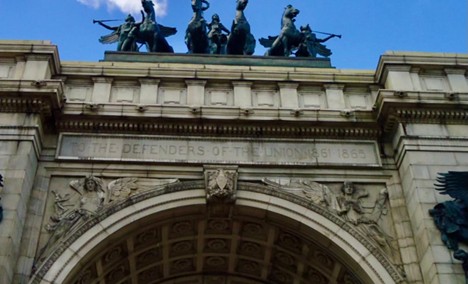
The idea to plant some sort of monument in Brooklyn for the brave boys in blue emerged more or less immediately after the war. A group of veterans began raising funds in 1866 and soon the munipal government and private individuals got involved. Then, as now, the wheels of bureaucracy proceed according to their own unique laws. “Stakeholders,” as I believe they’re called today, agreed on a triumphal arch in 1888. They held a design competition, which was won by John Hemingway Duncan. Duncan is also responsible for Grant’s Tomb up on Morningside Heights, best known in New York as the component of an old vaudeville gag (“Who’s buried in Grant’s Tomb?”) and (for a time) a good place to score crack and get shot, or at least shot at. The gangstas, generally speaking, were less adept with firearms than, say, a redneck from Georgia.
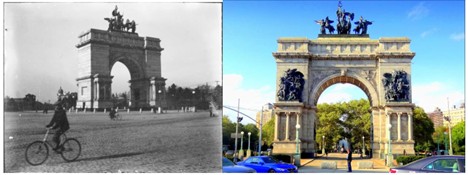
Back to the Defenders. Fundraising took forever and involved the usual squalid corruption and shameless characters that define the political order of American cities. Here is an amusing summary. The monument was finally dedicated in 1890, although the Quadriga, or four-horsed chariot group, was not added until 1898 and the statue groups on the pedestals – the “Grand Army” on the left and the “Grand Navy” (one assumes) on the right – did not join the fun until 1901. Below, on the left, is a view from perhaps 1900: after the Quadriga but before the pedestal installations. On the right is a post 9/11 view. The traffic blocks are a post-9/11 addition, if I remember correctly.
Duncan took inspiration from la belle France, specifically the Arc de Triomphe de l’Etoile in Paris. Napoleon Bonaparte – rather, Emperor Napoleon I, as he styled himself those days – commissioned it in 1806 to celebrate his stunning, almost effortless defeat of the Austrian-led Third Coalition at Ulm and Austerlitz.
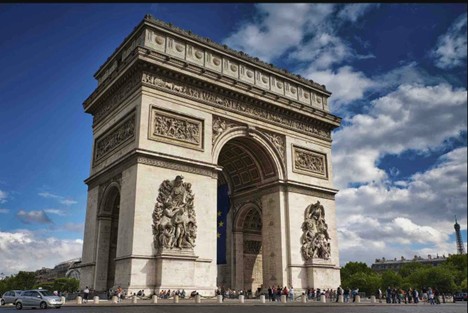
The Arc stands at the western terminus of the Champs-Élysée, the point where three arrondisements meet and twelve avenues converge. Avenue Friedland commemorates Napoleon’s 1807 victory – his only indisputable one – over the Russians; Avenue Wagram a more crushing defeat of the Austrians in 1809. The Arc is in all the guide-books, it’s a must see for anyone “doing Paris” so it’s always surrounded by the flotsam of the globalization project: dutiful Asians with selfie-sticks, Nigerians hawking cheap t-shirts, Algerians trying to pass off oregano as heavy-duty chron. Yet the Arc rises above the wreckageof the American Century and stands as judgment on this present evil age. It’s an eikon, one might say, of an archtype in Valhalla or the Kingdom of God, a Kairos free of the world’s worry and decay where the valiant of all times and peoples reside in la glorie enternale. The Emperor ordered it made, but it’s not all about him. The names of his marshals are there: the brilliant Davout, the impetuous Lannes and the tragic Ney, “bravest of the brave.” And of coure the soldiers of France: the grumblers, the grognards, who followed Napoleon’s star from Montenotte to Waterloo, whose prodigies of valor belong to eternity itself.
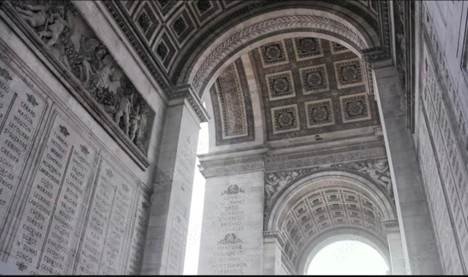
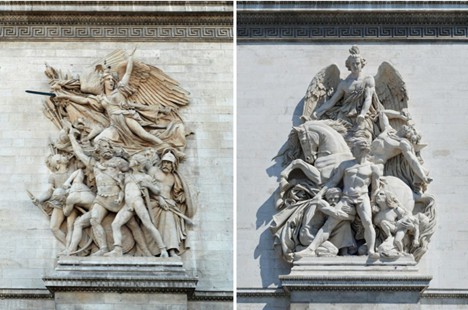
The attic bears the names of thirty major victories, from Lodi (1786) to Ligny (1815) (but not Mont St Jean, which is what the French call Waterloo; Moscowa is what they called Borodino). Ninety-six lesser clashes on the inner facades under the great arch; 660 marshals and generals on the facades under the minor arches. Reliefs on the facades remember key events of the Revolution and the Napoleonic era, including a young General Bonaparte leading a storming party across the bridge at Arcole and the capture of Alexandria in Egypt. Each pillar bears a statue group; one depicts the volunteers of 1792 marching to defend la revolucion from the monarchies of Europe, another the youth and National Guardsmen who rallied to Napoleon in 1814 as the armies of the Sixth crossed the Rhine into la patrie. Napoleon fought one of his most brilliant campaigns: outsmarting, outmarching and outfighting an Austrian-led force of Prussians and Russians. He still terrified them. And the end came only with with his abdication, not a battlefield defeat. That would come in 1815 at Mont St Jean in Belgium.
The Defenders is altogether more modest, but most other arches of the triumphal sort will by necessity pale next beside Napoleon’s Arc. Yet the Defenders certainly has more gravitas and dignity than the statue of “Cump” Sherman in Manhattan, which in its obstreperous gilded tastelessness could have come from the mind of Trump:
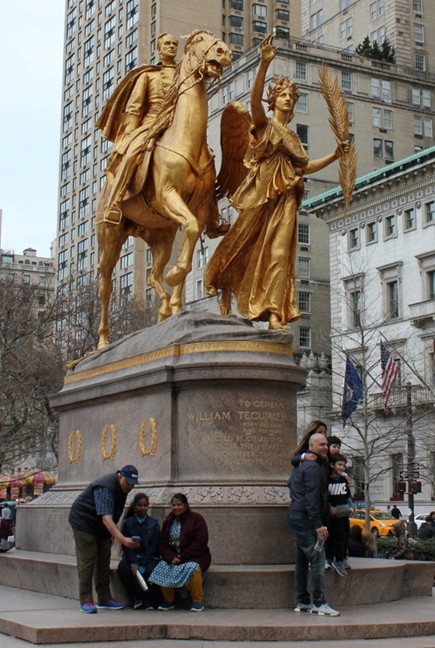
The Cump, which was my name for it stands at the intersection of 60th Street and Fifth Avenue in Manhattan. It, too, is a plaza, which also rejoices under the name “Grand Army Plaza.” The Grand Army of the Republic, or GAR, was as it happens a fraternal organization formed and named by the stout warriors in blue who put Atlanta, Charleston and Jackson to the torch, threw dead horses into the Vicksburg water supply and lobbed grapeshot the beleaguered city, among other things. The GAR became America’s first lobbying organization, dedicated to securing massive and federally pensions for Union heroes[1] and became something of a political force, favoring Republican candidates. Now, “Grande Armee” is of course more often associated with armies led by Napoleon. Some partisans for the Emperor might find that a little much. The march from Atlanta to the sea was hardly a test of soldierly courage and endurance as was the retreat from Moscow to the Nieman. And I mean no dishonor to the women of the South when I suggest that as opponents, they were somewhat less formidable than the warriors of Holy Russia faced by Napoleon and his men. And, of course, Sherman’s rabble had firearms.
Napoleon’s Arc (below left) is where twelve great avenues of Paris begin, and end. So it’s is simultaneously origin and destination, a theosophist might say, making a case for cosmic significance. Others may dismiss it as a Masonic-Kabbalist plot. The Defenders (on the right) is in contrast tucked away in a corner, an element in a larger scheme which, alas, has little to do with Union heroism. The Defenders . . . well, “defend,” I guess, the northern entrance to Prospect Park, a mere six or eight terrifying lanes away during rush hour.
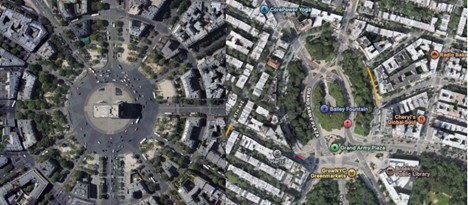
New York City in the 1860s undertook to provide a distant glimpse of Nature and the chance of fresh air to the children grinding away at workshops and “dark satanic mills” throughout the growing metropolis. The name most associated with effort is the well-known Frederick Law Olmstead, said to have invented urban architecture, with the assistance of with partners Calvert Vaux and Stanford White. Olmstead also created Manhattan’s Central Park, but Prospect was his favorite. Olmstead once fancied himself a journalist and journeyed through the South; his observations are available as The Cotton Kingdom, considered an unimpeachable source by everyone from Ivy League academics to Bill O’Reilly and Dennis Prager. As for Prospect Park, it is indeed a notable work of engineering to wrest from the wastes of Brooklyn acre after acre of verdant rolling meadows, a Connecticut Yankee’s version of the English countryside.
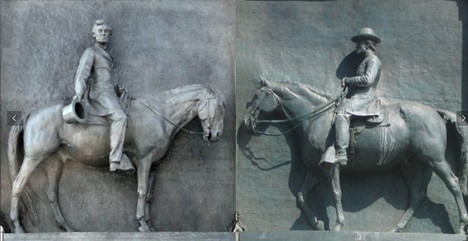
If Napoelon’s Arc deals with the concrete – the names of places and people, actual events described in the language of classical statuary — the Defenders is altogether abstract. Here, for example, are its two depictions of actual historical personages: Grant on the right, Lincoln on the left. Neither are identified. A Brooklynite — let’s say a Somalian, or an Afghan — may very well assume that these are local deities, or perhaps America’s Principles, anthropomorphized or archetyped. I told visitors Grant was engaged in a death-struggle with a deadly hangover and that old Abe was displayed at the Red Hook waterfront, welcoming a fresh cargo of Germans to America, and please go that way to be fitted with uniform and rifle.
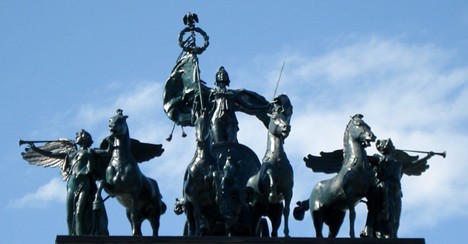
The aforementioned Quadriga and the statue groups on the pedestal are the work of sculptor Frederick MacMonnies. Columba is the gal in the chariot; she is a feminized abstraction representing the Sweet Land of Liberty. In her right hand is an escutcheon topped with a Roman or Napoleonic Eagle. That means Victory. In the left hand is a sword. More Terrible Swift Swording? No, as it’s in the non-dominant hand, it’s about to be beaten into a plowshare. So the Quadriga signals that the war is over and the good guys won. Not sure about the gal with the trumpet (to be honest, I never really cared enough to look up her function, or maybe I forgot).
America loves a winner, so let’s give them a look. Here’s the U.S. Navy, which stands atop the left one.
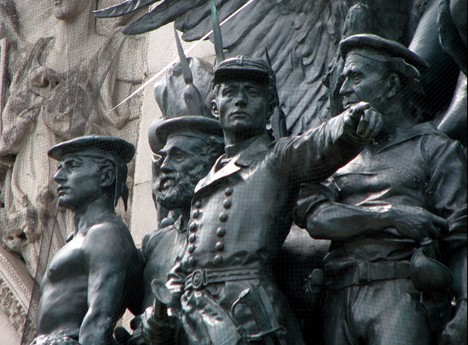
The tars are standing at attention; “eyes in the boat” as I believe it’s called. Maybe they’re getting their asses chewed by the captain. The officer, with that stern military glower, is pointing at something in the middle distance. An undespoiled plantation, perhaps, with bales of cotton there for the liberation (cash for the officers) and no doubt plenty of loot for the sailors’ seabags.
But the U.S. Army group on the left pedestal. Look at those guys. Thundering Jaysus, they look . . .
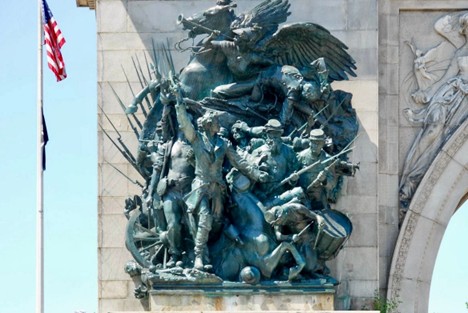
Well, they’re not defending. The officer’s sword is in his right hand, meaning war; the one Billy Yank is rarin’ to trod all over the drummer boy, who looks to have dropped something, on his way to close with the foe. The other Billy, the one with the kepi, has his grimmest of war faces on. There’s a horse caught up in the mess, and a guy clapping his forehead as if to say, “Mother was right. This is a terrible mistake.” Looks like the officer has caught a bullet, but he’s dying heroically, like Laurence Olivier in something by Shakespeare. And that thicket of bayonets eager to cut through this Gordion knot and unleash its full and righteous. Which is in and of itself mystifying because that is not exactly the sort of élan, attaque à outrance, berserker joy of battle generally associated with the U.S. Army. Weird.
Elsewhere about the arch are lozenges (if that’s the right term) showing the badges of the various Union Army corps. General “Fighting Joe” Hooker cooked them up as a morale booster for the hard-luck Army of the Potomac and Army of Virginia after their rough handling in the Valley, the Peninsula, Manassas (again) and Sharpsburg, where McClellan’s clumsy troop-handling helped ruin his one chance to capture General Lee.
And that’s about it. There are no statues on the north pedestals; a plan to carve the names of the Union’s greatest victories came to naught. And you will have noticed that there is no reference to the sufferings of the slaves – those two hundred and fifty years of “unrequited toil” Old Abe moaned about in his Second Inaugural, and how the the “blood drawn” with the lash must be repaid by “blood drawn by the sword.” Of all Lincoln’s harangues, it most shows the benefit he obtained from reading the King James, as it’s packed with verbiage about the mysterious ways of Providence and there’s a reference or two to the “living God.” The Claremont Institute treats it as an equivalent to the Sermon on the Mount, but it’s really nothing more than an unpopular president seeking to explain to mothers across the north why he sent their sons to die.
Far as the unrequited toilers go, you wouldn’t know Blacks existed but for this, down in the corner of the Navy statue:
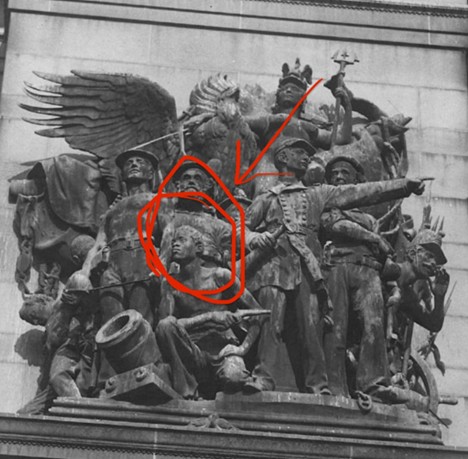
No one in either army hated and loathed and feared blacks more than “Cump” Sherman, who thought them utterly unfit for military service. He was the guest of honor at the laying of the cornerstone ceremony in 1889; maybe the sight of a Black soldier on a monument to his boys would have occasioned another nervous attack like the one in 1861. But it’s more likely that since most Brooklynites didn’t sign up for the Liberation, it didn’t occur to anyone that Black Experience should be central to their monument.
For some fifteen years the Defenders was my neighbor. I lived a scant four blocks away in a postbellum and ante-20thcentury brownstone, bought in the mid-Nineties at a very reasonable price back before Brooklyn was a brand. Park Slope was no more than da hood, its crumbling townhouses divided into apartments and inhabited by the Hispanic population, the former Irish and Italian residents confined to small blocks near their churches. Retail opportunities were limited to dusty bodegas with a few cans of Goya habichuelas on the shelves and a sullen cashier behind bullet-proof plexiglass. Some, I understood, discreetly retailed crack; at least one provided sexual services, fulfilled by women in the storeroom.
I’d often visit the Defenders in the wee hours, when the drunks were staggering home from the bars on Flatbush and the whirligig of traffic ad diminished to the occasional gypsy cab or drunk Long Islanders swerving home from a Rangers game and the local were shambling to their rough sleep on the subway platform. I’d take a seat on a traffic block and light a cheap cigar. And I’d sit and study the thing, like King Priam at the ruins of Troy. So this is how those people chose to remember what they did.
—
Defenders of the Union. That one was strange, simply because the Union wasn’t attacked. But Fort Sumter! thunders the Republican with the PhD from Prager University. The Democrats attacked Our Democracy, just like Obama. Yeah, okay. It’s well known that old Abe rejected Southern proposals to discuss a peaceful separation and more or less tricked us to firing that first shot, just as FDR did with the Japanese at Pearl Harbor. So, again: defending the Union from from who or what? H.L. Mencken once said, pace the grand gasbaggery of Father Abraham’s claim in his “Gettysburg Address” that the Union soldiers fought for “self-determination.” “It is difficult to imagine anything more untrue.” The Southern soldiers fought to the right to rule themselves; Lincoln, the genius politician and devoted party man, merely inverted the order of things and as the wicked tend to do, claim the virtues of its enemy as its own. He sent them down here initially to repossess the “forts, places and property seized” from their precious Union and “suppress” the rebellious states of the Deep South. Liberation became policy only in in late 1862 with the publication of the Emancipation Proclamation, now celebrated as one of the supreme achievements of the human spirit. The truth is more prosaic. Old Abe and his vaunted “team of rivals” hoped to provoke a slave insurrection in the South, a John Brown/Nat Turner slaughter of women and children against which the slaughter of the white population in Haiti would seem a Sunday school picnic. And liberation as a war aim would preclude Greart Britain from recognizing the Confederacy – public opinion would never allow it, although it wasn’t overly troubled by the brutal treatment of the Irish peasantry by absentee landlords.
But the Grand Army statue group: I couldn’t figure it out. That sense of tension, of aggression barely restrained, righteous fury waiting the moment of release. So who, or what, are they after? A convoy of sutler wagons with cheap popskull, canned lobster and spicy lithographs of women revealing their ankles? Did their three-year or ninety-day enlistments expire?
Or perhaps it was simply the Spirit of the Age: history demanding the institution of new ways, new ideas, a new political order. Hegel, then a professor, saw Napoleon and his staff clatter by on their way to defeat the Prussians at Jena and Auerstadt. “The soul of the world,” he enthused to a friend, who “stretches over the world and dominates it.” Science, discovery of nature’s principles, the steam engine: everything was moving faster and to destinations unknown – but there was the general idea that things would be better, more reasonable, more scientific. In the 1840s intellectuals in St Petersburg, including a young Dostoesvky, debated how best to reconstitute society and rid Russia of its peasant barbarism. Nikolai Gogol caught a whiff and in Dead Souls (1842) described it as follows:
And you, Rus, are you not also like a brisk, unbeatable troika racing on? The road smokes beneath you, bridges rumble, everything falls back and is left behind. Dumbstruck by the divine wonder, the contemplator stops: was it a bolt of lightning thrown down from heaven? What is the meaning of this horrific movement? And what unknown force is hidden in these steeds unknown to the world? Ah, steeds, steeds, what steeds! Are there whirlwinds in your manes? Is a keen ear burning in your every nerve? Hearing the familiar song from above, all in one accord you strain your bronze chest and hooves, barely touching the ground, turn into straight lines fluing through the air, all inspired by God it rushes on! . . . Rus, where are you racing to? Give answer!
Well, now we know, don’t we? Straight into the nets of the Bolsheviks: the torture chambers of the Lunyanka, the Arctic hell of the “re-education camps” on the Kolyma river. Still, the statue group seemed to be drinking from that same well. I visited the Brooklyn Historical Society – the Internet wasn’t as helpful for research then – and that’s where it fell into place. where I learned that
But the Question answered, you might say: revolution, the complete reorganization of society as demanded by the dialectic of History, a motion described by Hegel but stripped of its lightheaded abstrationist spiritualist by Mr Marx. I visited the Brooklyn Historical Society and there all was revealed. MacMonnies studied in Paris. His mentor was Augustus Saint-Gaudens, the sculptor responsible of the gilded Sherman monument. One of the wounded soldiers carries his face; Saint-Gaudens; others the faces of MacMonnies and his friends. MacMonnies modeled the entire tableau on the famous painting Liberty Leading the People, by Eugene Delacroix:
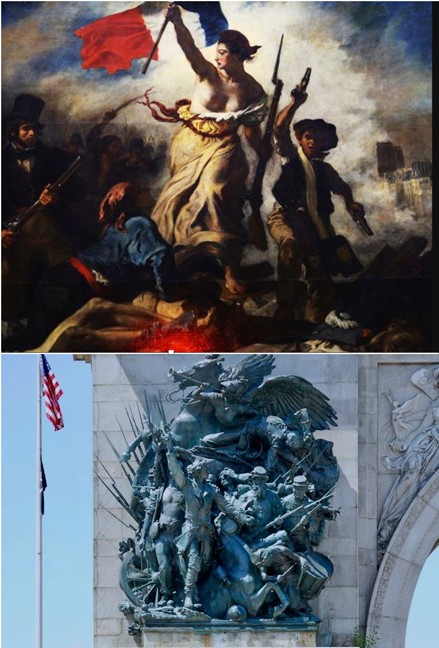
So yes, it is the spirit of the age: specifically, the Spirit that informed the theories of various bewigged fops about the nature of man: “born free but everywhere in chains,” downtrodden and humiliated; the Spirit demanding, with fierce moral urgency, liberty and equality now, immediately; the Spirit fueling the mighty host which marches forth from one hundred circling camps to pronounce righteous judgment against the enemies of God. And then – a new birth of Freedom. A refounding of America, and a new morning – not just for the U.S., but the whole of Creation.
Old Abe didn’t care much for the God-bothering. He was likely an atheist, but read the Bible to improve his vocabulary, knowing that he could trick the rubes better if his cornball bullshit was delivered in the solemn cadences of the King James. Once he made the claim that Americans are “an almost chosen people,” whatever that means; I strongly doubt it was for him any more than a clever bit of rhetoric. But the Northern victory convinced Americans that God, or History, was on their side. So too the surges in industrial output and gross domestic product; transcontinental railroads; refridgerated boxcars; the Taylor system for achieving maximum manufacturing efficiency. The Americans, it was clear, were not merely the almost-chosen people; they were the chosen people: a light unto the nations like the Israelites of old, a moral exemplar for the rest of the world. Which, by the way, better get off its ass and start getting with the program.
And thus, half a century after Appomattox, our friend Major Robert Woods, commander of the Grand Army of the Republic, explained the workings of the “Divine Power that rules and regulates the destinies of nations” to a gathering of Southern women in Chicago:
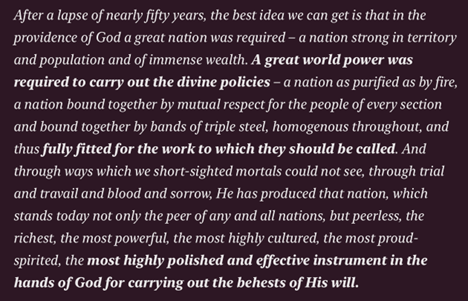
There’s a certain pathos in the naïve optimism, but it cannot but generate a sense of discomfort. Because the United States means to conquer Time itself: guide the nations in their progress to Utopia, to their ultimate destiny: a Kingdom of Heaven here on earth. No more a moral coil or vale of years, but a bright and shining, land where all social ills have defeated. A permanent Morning in America, a Union that is truly Eternal, where the relentless tick-tock of Time, and its unpleasant adjuncts of decay, corruption, degeneration and death will end forever.
That’s why the Defenders are so taut with rage and fury: to be about the work to which they should be called, which is nothing less than a New World.
A new world. That’s not the same, by the way, as the “all things made new” of Revelations. Who needs the detritus of barbarism and superstition when the chosen are upgrading God’s creation – fixing His work. The end of history: made in America.
We’ve all heard some version of this, the American Imperial Theology. Perhaps in the general notion of “progress,” that things always “get better” over time. Or what’s left of the American Dream which exists, if at all, only in the vulgar Tony Montana “The World is Yours” sense.
But its origins are way older, and can only be understood in light of what it replaced: a more sober, even pessimistic view of the nature and destiny of man and the meaning, if any, of history, held by the Greeks, Romans and early Christians. Because the American theology isn’t Classical, and it certainly isn’t Christian, although both Christians and their enemies think that it is.
It is, rather, anti-Greek, anti-Roman and anti-Christian to a profound degree, and over time it has degenerated to a sinister, even demonic inversion of everything bequeathed us by our ancestors. This new world of theirs is a failure, a disaster of grotesque proportions. And they know it. Their Beast is dying, and they know that too and are engaged in a last desperate attempt to maintain power, but that too will fail.
The Beast remains dangerous in its death-throes. And its helpful to understand its origins, and the wisdom it corrupted.
We’ll resume in the new year with the Greeks.
******************************
[1] In the general air of “reconciliation” that prevailed around the turn of the 19th century, someone proposed a bill securing Federal pensions for Southern soldiers. Most members of the United Confederate Veterans rejected the idea with cold contempt. Confederate pensions were funded by the individual states.
The views expressed at AbbevilleInstitute.org are not necessarily those of the Abbeville Institute.






This post is epic. Going back to reread it again for deeper analysis. Keep posting!!! I totally get your writing style!!!
“So, yes: I’m happy to grant that slavery was a cause of the War Between the States.”
Oh, Enoch, NO, … not on this web site. We here know that this is NOT REALLY TRUE . Good grief, Charlie Brown. Slavery was an issue for the South seceding – it was a nuanced/complicated reason, not a direct primary cause that elementary school kids can understand, or the average Yankee. The WAR however, which was “caused” by Lincoln and the North, had nothing to do with slavery – as Abe and Congress both stated officially. The WAR was caused when Lincoln directed Union troops to invade the South. FT. Sumter was a set up, for the Yanks reading this. Lincoln intentionally provoked the Confederates to fire on the fort so Abe could drum up support for his wanted/planned invasion. Up to that point enthusiasm for stopping the Confederates from leaving lagged. The Confederates had peacefully departed several months previously. The Northern MSM of the day pushed the story. It was the Russian Collusion treatment of that time. There are already too many ignorant, self righteous Yankees in the country, and you Enoch only continue to foster that ignorance with your statement. The WAR, started by Lincoln, was about collecting taxes, economics, and personal enrichment of numerous GOP operatives, including Lincoln. The North never fought to free the slaves or over slavery, despite the misinformation spun for 160 years about the Emancipation Proclamation which never freed any slaves and that Lincoln admitted was just intended to ignite a slave insurrection to undermine the Confederate war effort. Up to that point the North was basically losing the war, hence the EP might benefit the North.
There are Yankees/leftists who do read this site, Enoch, but don’t play into their delusions or lies, not here, … please. The Righteous Cause believers who also believe the Confederacy was an un-Holy proto-Third Reich absolutely need to hear the truth and should never receive coddling at all. By coddling them you are enabling them to continue believing and spouting fake ‘facts’ that ultimately support centralized power in D.C. Conservative web sites – more accurately self-styled conservative sites – already overflow with hysterical historian Karens blubbering and melting down about all manner of non-factual ‘history’ about the war and the South. These people need to be corrected, and it will take a good factual spanking, repeatedly, because they are slow learners due to limited IQ’s, psychological fragility, and very effective brainwashing – very effective – by the Northern school system throughout the U.S. To paraphrase Gen’l. Jackson: We must give them the historical bayonet; which means it’s going to hurt, bad, but it is necessary. So please Enoch, just say NO to conceding any non-factual Yankee versions of history. If you truly believe slavery caused the war at all you should definitely read this site, but post your uneducated opinions at American Greatness, or American Thinker, or Gateway Pundit, and I’m sure numerous other ‘conservative’ sites. Those places love publishing this kind of bogus ‘history’
PS: for the Yanks and other deniers the things I stated are all true and based on proven objective historical research and primary documents.
The yankees hated the South for freeing mankind from the tyranny of kings. The yankees had quit fighting the redcoats in the Revolution…just as in the War of 1812, the War would have to be won in the South. The last two years of the Revolutionary War, there were ZERO major engagements in the north. It is too bad the western States sided with the damx yankees in the second Revolutionary War…without the West, there would have been no War Between the States as the New England States never had the stomach for it; ever.
White Southern Males freed the world. We whipped the king. The king had to sue us for peace. The king surrendered to the 13 Free, Independent, Sovereign States making up the said United States. General George Washington swore to overthrow the king in defense of the 13 Free, Independent, Sovereign States making up the said United States.
At this time of year, it is crucial we do not forget the past and the debt owed to White Southern Males who ended the reign of monarchs on this planet.