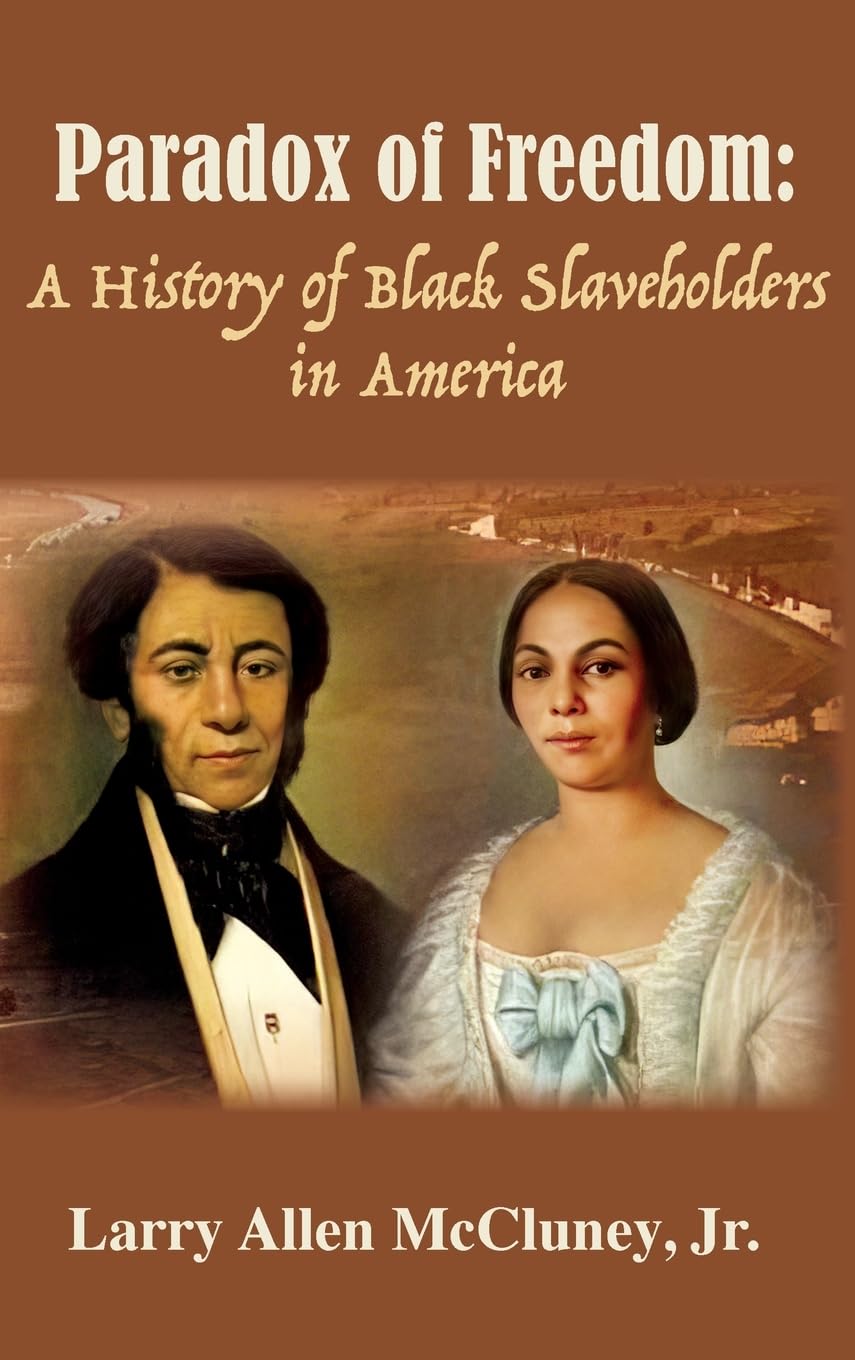
A review of Larry A. McCluney, Jr., Paradox of Freedom: A History of Black Slaveholders in America (Scuppernong Press, 2025)
While working several years ago, a Black friend informed me that she was taking her family to a reunion at a plantation in the Cane River area of Northwest Louisiana. As a longtime resident of north Louisiana, I understood something that this person of color did not seem to understand. Not all, but many, plantations in the Cane River area were owned by people of color. Before I spoke, I thought, “What is the chance that her family was related to slaveholders”? I refrained from saying anything. After the reunion, this lady came to me with the shocking news that her family owned that plantation and they were slaveholders. She was impressed that the “slave quarters” had brick cabins for each family. She also informed me that her son was beyond stunned. She said that her son remarked that he “grew up hating white people for owning black people, and now he finds out my own family were slaveholders!” The shock displayed by this young American of African descent is not unique to his family and associates. Most Americans do not understand the complexity of slavery worldwide, and surely not slavery in these United States. If knowledge can banish ignorance about slavery, hope is on the way.
In his book Paradox of Freedom: A History of Black Slaveholders in America, Larry A. McCluney, Jr. has produced an account of Black slaveholders that will enlighten the open-minded and enrage those holding to the leftist woke view of slavery. Mr. McCluney, the Past Commander-in-Chief of the Sons of Confederate Veterans (2020-22) and author of several works on the life of General P. T. G. Beauregard and the Vicksburg campaign during the War for Southern Independence, points out that Africans in the United States, “bought and sold other Black people, and did so at least since 1654 and continued…through the Civil War.” As a longtime educator, McCluney notes that the topic of Black slave ownership “is left out in many curricula or is not revealed to students, thus creating the perception that the institution of slavery was only practiced by Whites and only in the southern United States.”
In Paradox of Freedom, McCluney demonstrates that ownership of slaves by Black Americans began early during the colonial period. McCluney picks apart the idea that Black slave ownership was merely benevolent acts of a master securing the life of his family members from abusive slave masters. Yes, such benevolent acts did happen, but for the most part, Black slave holders bought slaves for the same reason their White counterparts did, i.e., to increase their wealth.
A representative sample of Black slave holders is given in Paradox of Freedom. Men such as Andrew Durnford, owner of St. Rosalie Plantation, near New Orleans, La., were influential figures. Durnford was a physician who operated a plantation with no fewer than eighty slaves. Durnford, a free man of color, traveled from New Orleans to near Richmond, VA, to secure slaves for his plantation. While in Virginia, he wrote back to a White friend in New Orleans complaining about the high cost of slaves. Another free man of color that destroys the woke concept of Antebellum slavery, is William Johnson of Natchez, MS. Johnson not only owned a large plantation with over 20 slaves, but also owned a barber shop in downtown Natchez and one in Port Gibson, MS. Johnson loved hunting, yes, people of color did own firearms at that time, and he followed politics with a keen eye. Not only was his business in downtown Natchez, but his home, with neat slave quarters in back, is in the heart of downtown Natchez. The life of these men, and others from across the South, adds fuel to the flame of cognitive dissonance of those who see only racism (White people enslaving Black people) and downtrodden Blacks in the antebellum South.
The story told in this book and many other such stories must be boldly proclaimed. Stories such as Anthony Johnson of Virginia, a free man of color, who in 1655 brought a case before a Virginia court that made chattel slavery common throughout Colonial America; stories of free women of color who prospered owning and running their plantation in Louisiana; and Representative John Harris, a Black Confederate Veteran who promoted the building of a monument to Confederate Veterans in Mississippi; these stories must be told. While Africans owning Africans in Africa is slowly becoming common knowledge, the act of Americans of African descent owning Africans in the United States very often goes untold. Recognition of the fact that slavery is not an institution of White against Black seriously undermines the justification of a political system based upon “hurt feelings” and victimhood. The concept of Blacks owning fellow Blacks “is a prime example of a hidden history begging to be unearthed.” McCluney succinctly notes, as we expose the fact of Black slave holders, “we gain a more nuanced understanding of the complexities of slavery’s impact on Black communities and the wider American landscape.” The idea that “my feelings are hurt” because I saw a display of cotton plants in a hotel is hilarious and ridiculous—but not uncommon. After all, Mr. or Mrs. Hurt Feelings, some of your ancestors picked cotton while some of them owned the slaves doing the picking!
The views expressed at AbbevilleInstitute.org are not necessarily those of the Abbeville Institute.




Tuskegee Institute was funded AFTER Reconstruction by an Alabama legislature composed entirely of former Confederates.
The Tuskegee Airmen are the Confederate Air Force.
Great review. Excellent points made concerning real American history versus the fairytales told in public schools and universities.
“…concerning real American history versus the fairytales told in public schools and universities.”
Public and private (especially). Not to mention monsters like Victor Davis Hanson. Only a couple of days ago my son sent me a link (recent comment) by this historical midget referring to the Confederates “succeeding” from the union and attempting to destroy the nation. Yes, he actually said “succeeding.” This is something a ten-year-old might stumble over. Hanson might have an I.Q. of 10, but chronologically he’s a shade beyond that.
This sort of sophomoric foolhardiness is common (unfortunately) among many, many teachers, commentators and media-types today.
It is sad to say that such nonsense has its modern (post 1960 at least) blathering coming from such “conservatives” as Rush Limbaugh (and, I did listen and agree with him quite often). But some of his leftovers such as Hanson, Mark Levine, Sean Hannity (good grief) and a host (dozens and dozens) of others, including so-called conservative websites, ezines or whatever continue with the COMPLETE misunderstanding of federalism, etc. And of course there probably isn’t one in a hundred who realize and/or understand the Declaration of Independence!
Hanson is an idiot. He’s an “expert” in military history who has never worn a uniform.
Then there’s Dinesh D’Souza who crows about how the Republicans “freed the slaves” but it evidently ignorant that it was founded by socialists, Communists and delusional Congregationalists and Presbyterians who thought they had higher morality than the law and the Bible they claimed to preach.
Amen! My Black cousins in Virginia taught me of their Black, and Red forebears owning Slaves.
Something way above Victor “the stanford” Hansens capacity
Every stripe on the US flag represents a slave State.
Kennedy made a post on FB and so I had to get a copy myself! I am still working through it, but it is a great work. Recommended, and a great review.
This is not news. It is a recorded fact that the first slave owner in Virginia was a former indentured servant from Africa who bought black indentures then refused to free them at the end of their indenture. It’s been awhile since I’ve read the data but there were either four thousand black slave owners in 1860 or four thousand slaves owned by blacks. Some black historians acknowledge this also they attempt to explain it away by claiming freed blacks bought other members of their own family. The Root acknowledges that there were black slave owners as well as the fact that black Africans captured other blacks and sold them into slavery.