

This is a true story where music, memory, and mass murder meet beneath the Southern sky. I’ve said before that my family tree may have tangled roots, but this time, it’s got blood in the branches.
I want to tell you a story that winds through the bare winter trees of Stokes County, North Carolina… a story that runs like blood through my own family tree. It’s about one of the most haunting crimes in Southern history — the Lawson Family Murders of Christmas Day in 1929 — and the ghostly murder ballad that turned the story into legend. And I believe that’s when the whole genre of Southern True Crime really began — not in newspapers, but in ballads and bootlegs.
And yes, I’m connected to this tragedy on my mother’s side. The Lawson family is a branch deep in my own family tree, as my maternal grandmother was a Lawson from Society Hill, Alabama. I believe my common ancestor with the murdered Lawson family must be my 4th great-grandfather, John Thompson Lawson, but I haven’t been able to lock it down completely because several of the Lawson men had, uh, shall we say, illegitimate children? Just a few. I know for certain that I am a DNA match with 12 half-cousins who have the murdered family in their trees, but it’s difficult to make sense out of a lot of the official records that seem to contradict themselves. Although I’m still working on it, the only thing I know for sure is that blood doesn’t lie.
On the morning of December 25th, 1929, in a small tobacco-farming community near Germanton, North Carolina, snow dusted the ground, and folks everywhere were finishing breakfast and getting ready to open up their Christmas presents. But inside the Lawson house, the holiday would turn into something out of a nightmare and become a story so brutal it would echo across generations. At the same time other families were opening their presents, the Lawson family was getting murdered by their Daddy.
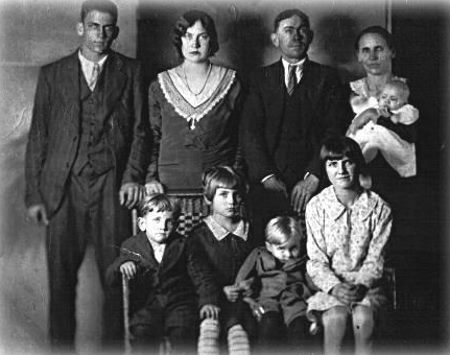
The Lawson family — Charlie, his wife Fannie, and their seven children — had seemed, by all accounts, like a happy, humble, working-class family. Charlie was a 43-year old a tobacco farmer who’d worked hard to provide, though times were tight. After years as a tenant farmer, Charlie had finally squirreled away enough money a couple of years earlier for the family to buy their own farm, and this would be their 3rd Christmas there. He’d recently come into a little more money, either from selling part of his tobacco crop, or from an insurance policy, and just before Christmas, he took his whole family into nearby Winston-Salem to have a professional family portrait taken.
That might not sound strange now, but in 1929 rural North Carolina, it was odd. Professional photography was very expensive, and Charlie was known to be tight. He even bought the whole family new suits and dresses for the occasion. It’s that photo you’ll see in all the old newspaper clippings, with the family standing stiff and solemn in their Sunday best, the children lined up like little dolls, Fannie holding the baby, and Charlie standing tall.
At the time, nobody thought much of it. But in hindsight, that photo took on a terrible meaning. Some believe it was a family memorial in advance, and a photograph Charlie knew would be their last.
Later that Christmas morning, Charlie sent his oldest son, 16-year old Arthur, into town on an errand, and that act alone is what saved Arthur’s life. Once Arthur was gone, Charlie took his 12-gauge shotgun, walked out behind the tobacco barn, and waited for his daughters Carrie (12) and Maybell (7) to pass by. They were on their way to visit an aunt and uncle for Christmas, and he shot them both. Then he beat them just to ensure they were dead. And then, he quickly dragged their little bodies into the barn, placing stones beneath their heads, like crude pillows.
From there, Charlie went to the house, where he shot his wife Fannie on the front porch. Their 17-year old daughter Marie screamed and tried to run, but he caught her inside in the kitchen and killed her, too. Then he moved through the house and killed James (age 4) and Raymond (age 2), likely in their beds. Finally, he went to the crib and beat the infant baby Mary Lou, just four months old, to death.
Charlie Lawson murdered his wife and six of their seven children.
After that, he walked into the woods, where he stayed in the trees for several hours. He was seen by neighbors pacing in a circle around a single tree, muttering to himself. He left notes in his pockets that were mostly short, incoherent phrases. One read simply, “Trouble can cause…” and that was it.
By the time neighbors heard the shotgun blast that finally ended his own life, Charlie had positioned himself with two notes folded inside his coat, two empty shotgun shells, and two letters addressed to no one. For years, the number one question that haunted everybody, from family to neighbors to folklorists: Why?
Charlie was not a violent man. There were no prior signs of domestic abuse, no criminal record. He was religious, highly respected in town, and hardworking, but something certainly cracked.
Here are the three most prominent theories, some of which are deeply disturbing.
1. Head Injury Theory
Earlier that year, Charlie reportedly suffered a severe head injury while digging a ditch. Some neighbors said he was never really the same after that, becoming moody, withdrawn, and prone to strange behavior. A 1929 medical examiner noted the possibility of brain trauma.
However, when his body was exhumed in 1978 and his brain studied by Johns Hopkins, no significant injury was found. So, for this theory to hold any weight, it would have to be in terms of psychological trauma, not physical.
2. Financial or Mental Breakdown
Some believe Charlie suffered a mental collapse triggered by financial stress and the weight of providing for a large family during the Great Depression. Although the stock market crash had only recently occurred, tobacco prices were already unstable almost immediately.
There were rumors Charlie had recently taken out life insurance policies on the family in the form of policies that would pay out even in the case of suicide. That led to speculation about motive, but no clear financial reason ever emerged.
3. Incest and Abuse
This is, by far, the darkest theory, and one that emerged much later through oral history, particularly from Charlie’s extended family and neighbors. The claim is that Charlie had been sexually abusing his daughter Marie, and that she was possibly pregnant with his child at the time of her death. The story goes that Marie had confided in a friend, or perhaps a cousin, about the abuse. Some versions say Fannie found out and confronted Charlie.
If this is true (and that’s a big if, since it’s based on secondhand stories), then the murders might have been Charlie’s attempt to silence the truth and save face in a deeply religious and honor-bound community.
This theory has gained traction in recent decades, in part because it answers what so many other explanations can’t: Why would a man kill his whole family in cold blood like that? And that’s where this story picks up again with a fiddle, a 78 record, and a song that refuses to die.
How many Southerners does it take to change a light bulb? Three. One to change the bulb, and two to sing a murder ballad all about it. Almost immediately after the murders, a North Carolina fiddler and textile worker named Walter “Kid” Smith teamed up with a banjo picker named Red Thompson. They were part of a mill-town string band called the Carolina Buddies, and in the early days of 1930, they recorded a ballad that would carry the Lawson story far beyond Stokes County. It was called “The Murder of the Lawson Family.”
It’s really a creepy little song. Not just the lyrics, but the flat, matter-of-fact delivery, like reading a coroner’s report with a melody. That’s what makes these old murder ballads so chilling. They weren’t written to entertain, they were meant to warn, to preserve, and to exorcise the unspoken demons.
The Carolina Buddies started it, but that song has been recorded by The Stanley Brothers, Doc Watson, Max Wiseman, the Blue Sky Boys, Spencer Moore, the Henry Brothers, and many others. I’ve heard it played several times at bluegrass and folk festivals. Everybody that records it and everybody that performs it changes it just a little bit each time.
The original Carolina Buddies recording was made just a couple of months after the killings, and not decades later like the true crime documentaries of today. The story was still fresh, and still very raw. Many folks in North Carolina were outraged about it, and thought it was disrespectful. Others thought it was a public service as a way to make sense of the senseless.
Either way, the song sold really, really well, and it became the most talked-about murder ballad of the time. Local radio played it everywhere, and it was passed around like an obituary wrapped in guitar strings. People would gather on porches and sing it with fiddles and dulcimers, and then they’d whisper about the story to each other. Sometimes, they’d even pass along the unofficial verses that never made it onto the record, like the ones about Charlie’s secrets, or Marie’s pregnancy, or Fannie’s prayers.
Because that’s how these songs worked. The printed version was only half the story. The other half was passed ear to ear, like a bottle in the night. Some might believe it’s wrong to turn a tragedy into a tune, but Southerners believe it’s just the way we know how to grieve.
However, this story doesn’t just end with a funeral and a song, because in the South, the dead don’t always stay quiet. The Lawson family home, now long gone, became a magnet for the curious, the brave, and the brokenhearted. It was opened as a murder museum, and folks would pay admission just to walk through the death house. Inside, they saw blood stains still on the floors. Marie’s Christmas cake, the one she’d baked the night before, was sealed under glass in the parlor, still decorated and untouched. Visitors swore the cake never molded, like some kind of unholy relic. Charlie’s brother Marion even sold souvenirs on-site such as postcards, shell casings, and bits of wood. The public couldn’t get enough.
But then, there were other, stranger stories. A neighbor claimed she heard Marie crying at night from the woods. A hunter passing through the area said he saw a man in overalls with no face, just standing still under the trees. Others spoke of cold spots in the barn where Carrie and Maybell were found. Local boys dared each other to spend the night on the property. Even in the modern day, paranormal investigators have gone out there with EVP recorders and infrared cameras. Some claim they picked up voices and faint whispers saying “Arthur…” or “Forgive me.”
The surviving son, Arthur Lawson, never really escaped the shadow of that gruesome event. He grew up, got married, and had kids, but he always refused to talk about that day. He turned bitter and drank to try and drown it all out, but then, he tragically died in a car crash in 1945 at the age of 32, almost like a second curse.
Speaking of Arthur, isn’t it suspicious that he was the only one to survive? I mean, how do we know it was actually Charlie that killed everybody? The short answer is that all the physical evidence, witness reports, and circumstances pointed directly to Charlie Lawson.
There are several reasons why Charlie Lawson was firmly believed to be the killer:
Charlie Was Found Dead by Suicide Nearby
After the murders, Charlie was found in the woods behind his property, with a self-inflicted shotgun wound to the chest, lying near a tree. Near him were:
Two empty shotgun shells.
Several handwritten notes with cryptic phrases like “Trouble can cause…”
His two shotguns, which matched the wounds on the victims.
Footprints in the snow going around and around the tree, showing a pattern of pacing.
No Signs of Forced Entry or Struggle with an Outsider
The murder scene inside the Lawson home showed no forced entry, no signs of a break-in, and no evidence that someone had fled or fought Charlie. Victims were taken by surprise. Some were killed in their beds, one while even preparing food.
Weapon Ownership and Familiarity
The shotgun used in the murders was definitely Charlie’s, and he regularly used it for hunting. He had cleaned and loaded it days before, and like most Southern men, was known to be proficient with firearms.
Charlie’s Behavior in the Days Leading Up to the Murders
Friends, relatives, and neighbors all said he seemed anxious and withdrawn. They also recalled that he had been acting strange, muttering to himself, and keeping watch at night.
He unexpectedly paid for expensive family portraits just days before the massacre.
Positioning of the Bodies
After killing his family, Charlie took care to arrange the bodies — folding their arms and placing rocks over their eyes or pillows under their heads, almost as if laying them to rest.
However, alternate theories have still emerged over the years, including the whisper of cover-ups and the possibility of a second killer. There are three main alternative theories, though none of them have ever had strong supporting evidence, and most rely on speculation or hearsay.
1. The “Unknown Killer” Theory, not Charlie
Some people have wondered if perhaps someone else killed the Lawsons and framed Charlie, especially since no one witnessed Charlie committing the murders, he left no clear confession, and the shotgun could theoretically have been turned on him. However, it’s unlikely because no one else had a motive. The property wasn’t robbed. The crime was intimate, slow, and deliberate, and not the kind of vicious attack that would have been required of a stranger.
2. The Incest Retaliation Theory, not Charlie
As mentioned earlier, a long-standing family rumor of incest emerged years later that Charlie had been abusing his 17-year-old daughter Marie, and she may have been pregnant with his child. In this version, someone who knew the secret, like a relative, neighbor, or even Arthur may have murdered the family out of revenge or shame.
However, it’s unlikely because of several problems:
Why kill the whole family?
The evidence shows it was Charlie’s own shotgun used in the killings,
The eyewitness timeline (he was seen by neighbors pacing in the woods afterward, and not fleeing the scene).
The much more likely variant of this theory would still have Charlie committing the murders because he was exposed, or feared being exposed, and not because of insanity or financial stress.
3. Arthur as the Real Killer Theory, not Charlie
This is a fringe theory not supported by any evidence, but some have speculated that Arthur, the surviving son, might have played a role or even committed the crime himself. However, it’s highly unlikely because he was seen in town during the timeframe of the murders, and he had no motive.
Also, Charlie’s grief appeared authentic, and he never profited from the tragedy. His Uncle Marion did, but he didn’t. Plus, he died young, and his story never changed.
So, do all roads lead to Charlie Lawson as the killer? Was he definitively proven guilty in a modern forensic sense? Not exactly. It was 1929, and there were no fingerprints, no DNA, and no ballistics reports as we know them today. It has never been possible to match shotgun pellets to a specific shotgun. By the standards of the time, and even by today’s common sense, all physical, circumstantial, and behavioral evidence points directly to Charlie as the killer, and when he pulled that trigger on himself in the woods, that act sealed the case in the eyes of the public. Whether from guilt, madness, or shame, Charlie didn’t walk away.
So, what do we make of all this? A man kills his family, a town preserves the bloodstains, and a song keeps the story alive. And now, almost a century later, people are still drawn to it, because deep down, we know this wasn’t just about one man’s madness. It was a crack in the mirror and a glimpse into how fragile anybody’s family can be. One bad storm, one dark thought, one trigger pulled, and the whole family tree comes crashing down. Charlie Lawson’s crime wasn’t just a family tragedy, but was a glimpse at the darkness that can grow in the most ordinary soil.
And like a good ballad, the Lawson murder story refuses to be buried. It’s passed down. Sung. Investigated. Feared. And in some branches of my family tree, it’s remembered not out of horror, but out of a strange kind of kinship. It’s simply a need to say, “We didn’t forget you, cousin.”
The views expressed at AbbevilleInstitute.org are not necessarily the views of the Abbeville Institute.





A similar story is the true story of the Bigham family, murdered by one of their own, love on Old River Road in Pamplico, SC, a story chronicled by Katherine Boling in “A Piece of the Foxes Hide.”
Heartbreaking. What a sad but lovely ballad. God rest their souls.