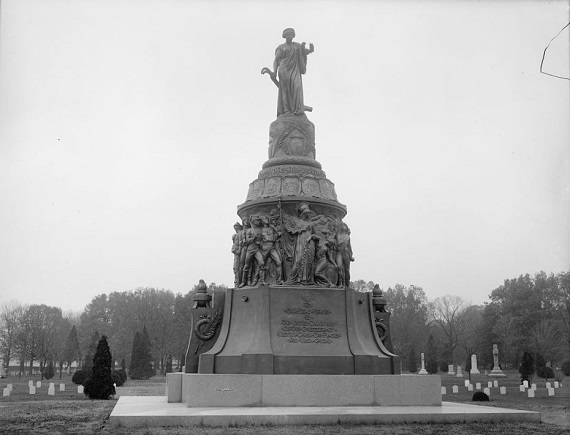
Kevin Levin’s recent Substack screed, “Stop Referring to the Confederate Monument in Arlington National Cemetery as a ‘Reconciliation Monument,'” is a masterclass in selective historical cherry-picking, ideological bias, and outright fabrication. Levin, a self-styled Civil War memory expert whose work has been accused of perpetuating an anti-Southern narrative that borders on hostility, peddles the absurd notion that the Arlington Confederate Memorial—unveiled in 1914—was never about reconciliation. Instead, he claims it was a sneaky UDC plot to glorify slavery and the Confederacy, commissioned to sculptor Moses Jacob Ezekiel with no reconciliatory intent. This is nonsense, propped up by Levin’s twisted interpretations of inscriptions and imagery, while ignoring mountains of evidence from Northern presidents, the sculptor himself, and the monument’s very approval process. Levin’s argument isn’t just wrong; it’s a deliberate smear that erases the genuine spirit of national healing in the early 20th century, all to fuel modern culture-war grievances.
Let’s start with Levin’s core falsehood: that the United Daughters of the Confederacy (UDC) handpicked Ezekiel to craft a “non-reconciliation monument” celebrating the Lost Cause. This ignores the fact that the memorial’s creation was a federally sanctioned endeavor, requiring explicit approval from Northern Republican leaders who were no friends of Confederate nostalgia. President William McKinley, a Union veteran, kicked off the process in 1898 by authorizing the reinterment of Confederate dead at Arlington, explicitly framing it as a step toward reunion. Theodore Roosevelt continued this, and William Howard Taft—then Secretary of War—personally greenlit the monument in 1906. A letter from Taft, published in the Washington Times on April 8, 1906, makes this clear: “I have the honor to inform you that the design for the monument to be erected in the Confederate section of the Arlington National Cemetery has been approved.” Taft didn’t just rubber-stamp it; he met with Ezekiel, as detailed in historical accounts and later in Ezekiel’s memoirs, praising the sculptor’s work, saying, “You have contributed a great deal to the peaceful solution of our nation’s affairs.” Taft even insisted that the War Department approve all inscriptions, thwarting any supposed secret plot by the UDC. If this was a covert Confederate propaganda op, why did a parade of Northern presidents—McKinley, Roosevelt, Taft, and even Woodrow Wilson, who spoke at the 1914 dedication—sign off on it? Levin’s conspiracy theory crumbles under the weight of these facts; the Yankees weren’t duped—they were active participants in a reconciliatory effort.
Levin’s mangling of the inscriptions is even more egregious. He fixates on the Latin phrase “Victrix causa diis placuit sed victa Catoni” (“The victorious cause pleased the gods, but the lost cause pleased Cato”), twisting it into a defiant endorsement of the Confederacy’s righteousness. But this is a classical reference to moral integrity in defeat, not a battle cry for slavery. Levin conveniently ignores the adjacent inscription that directly undercuts his narrative: “Not for fame or reward, not for place or for rank, not lured by ambition or goaded by necessity, but in simple obedience to duty as they understood it.” This phrasing echoes Theodore Roosevelt’s own words from his 1905 Richmond speech: “All Americans, North & South, must ever render high honor, to the men of the civil war, whether they wore the blue or whether they wore the gray so long as they did their duty as the light was given them to see their duty.” Roosevelt’s relativism—”as the light was given them”—aligns perfectly with the monument’s emphasis on subjective duty. Contrast this with Jefferson Davis’s unyielding view of duty, as seen in his writings: Davis framed duty as an ironclad imperative, without the qualifier “as they understood it.” In fact, in 1878, Jefferson Davis stated, “Let not any of their survivors impugn their faith by offering the penitential plea that ‘they believed they were right.’ Davis presented duty as an objective truth, not a matter of personal perception. The monument’s inscription, leaning toward Roosevelt’s nuanced take, rejects Davis’s absolutism and embraces a reconciliatory acknowledgment that both sides fought honorably based on their convictions. Levin’s interpretation? He calls the Lost Cause quote a “vindication,” but it’s merely an affirmation that Confederate soldiers believed their cause just—hardly a radical claim in an era of sectional healing.
Other inscriptions reinforce peace: The base bears “And they shall beat their swords into plowshares and their spears into pruning hooks,” a biblical call for harmony. Levin waves this away, but it directly contradicts his slavery-glorification thesis. Then there’s Ezekiel himself, whom Levin paints as a die-hard Confederate plotting to subvert reconciliation. This is laughable. Ezekiel, a Jewish Confederate veteran and Virginia Military Institute graduate, explicitly stated in a 1914 interview that the memorial “means, primarily, peace.” Reported in the Washington Post on May 24, 1914, this quote reveals the sculptor’s intent: not division, but unity.
Levin ignores this, fixating on imagery like the “faithful Mammy” figure to claim it erases emancipation and the Union’s role in ending slavery. But this monument stands in Arlington’s Confederate section, honoring Southern dead—not a comprehensive history of the war. If Levin insists on this critique, he should apply it consistently: There are over 2,100 Union Civil War monuments across the U.S., and less than 5 percent of their inscriptions explicitly refer to the abolition of slavery. Virtually all emphasize preserving the Union, bypassing emancipation altogether. Shouldn’t Levin save his outrage for these Northern memorials that “erase” slavery’s end? He won’t, because it would force him to admit his modern interpretation—that the war was primarily about slavery—clashes with how Union veterans themselves viewed it: as a fight for the Union, not abolition. In fact, General Washington Gardner, Commander-in-Chief of the Grand Army of the Republic (GAR), the premier Union veterans’ organization, spoke at the 1914 dedication of this very memorial! Levin’s selective fury exposes his bias: attacking Southern memory while shielding the North’s commemorations.
In this article, Levin cherry-picks to fit an agenda: Union veterans’ occasional gripes about Arlington’s Confederate section become proof of “incomplete reconciliation,” while he ignores Wilson’s dedication speech praising the monument as a symbol of “one people.” This isn’t scholarship; it’s activism masquerading as history. Calling the memorial non-reconciliatory erases the real story: a monument born of compromise, approved by Northern leaders, inscribed with calls to peace, and intended by its creator to heal wounds. Levin’s attack isn’t just harshly wrong—it’s a petty attempt to rewrite history for clicks and clout. The Arlington Memorial stands (or stood) as a testament to reconciliation’s triumph over division. Levin’s drivel? Just another Lost Cause—of intellectual integrity.
Levin’s original article can be read here.
Originally published as an essay on X by the “Jefferson Davis” account.
The views expressed at AbbevilleInstitute.org are not necessarily those of the Abbeville Institute.




Kevin Levin is an execrable liar. Thank you for calling him out!
Kevin Levin and his ancestorial stripe is the reason for a desire of the South to secede in the first place.
Trash such as Levin is the sort who after the surrender in 1865 many, many Southerners never would want to share a foxhole with in the many U.S. wars the South stood in line with and shed Southern blood for. Many would and did, yes. But with his ilk—including me– would only say hell no!
May you rot in your lying cowardly soul, Miss Levin!
A man cannot reconcile with evil, nor can thieves be trusted.
Is Kevin any relation to that well known, execrable, virulent anti-Southern bigot Mark? Y’all know, the legal eagle who can’t seem to do historical research, but allegedly can do legal research. Hmm, I don’t think I would hire Mark to be my lawyer, his track record for researching, like lawyers are supposed to be able to do, isn’t stellar. Kevin appears to be the quintessential Yankee – he’s from MA where being a Yankee reached its zenith. Definition: Yankee – money grubbing, unscrupulous, unethical, dishonorable person who will do anything, say anything, and betray anyone for the almighty dollar. Kevin, it seems, is cashing in on Yankees’ appetite for ‘history’ that heaps lies, damn lies, and Yankee lies on and about the South so ole Kev can pull in some Benjamins. The market for these kinds of lies up North never seems to diminish and a Yankee sucker/bigot is born every minute.
The yankees changed their military officers’ oath of office in 1862…requiring support of the CONSTITUTION of the United States. Prior to 1862, military officers swore to defend the United States and protect THEM from THEIR enemies…leven is just trying to make some bread in the modern era by being a fool.
Good article. I disagree with what Levin has to say about the Reconciliation monument.
Regarding the verse from the Bible on the monument, that should not have been put there.
“…The base bears ‘And they shall beat their swords into plowshares and their spears into pruning hooks,’ a biblical call for harmony.”
That verse in Isaiah is not a Biblical call for harmony.
That verse and its context has to do with the peace which will be forced on to the world by the King of kings when He returns and takes over His earth. Interestingly, the inscription on the monument and the one on the U. N. building leave out “He,” and His “rebuke.”
Isaiah 2:4
“…he shall judge among the nations, and shall rebuke many people: and they shall beat their swords into plowshares, and their spears into pruninghooks: nation shall not lift up sword against nation, neither shall they learn war any more.”
Verse 2 says:
“…it shall come to pass in the last days, that the mountain of the LORD’s house shall be established…and shall be exalted…and all nations shall flow unto it.”
Verse 3 says:
“…many people shall go and say, Come ye, and let us go up to the mountain of the LORD, to the house of the God of Jacob; and he will teach us of his ways, and we will walk in his paths: for out of Zion shall go forth the law, and the word of the LORD from Jerusalem.”