
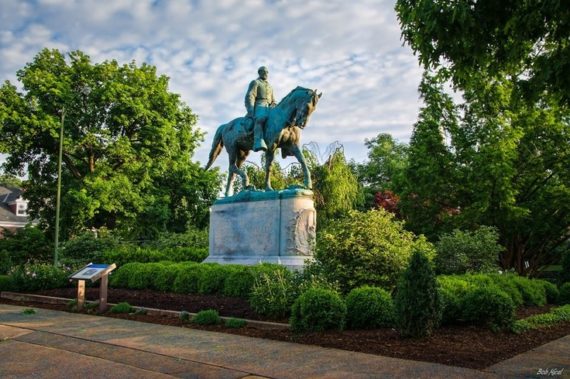
In the wake of the 2017 Unite the Right rally in Charlottesville, Virginia, activists and some “historians” propagated a series of claims about the city’s Robert E. Lee statue, framing it as a symbol of white supremacy, Jim Crow, and racial intimidation. These narratives often distorted historical facts, ignoring the context of its erection in 1924 and cherry-picking evidence to fit a modern agenda. Drawing on primary sources, dedication speeches, and contemporary records, it is easy to refute key falsehoods: that the statue was solely about Confederate glorification and racial oppression; that its donor was fixated on the so-called “Lost Cause;” that the artist was a Southern partisan; that the monument represented division rather than reunion; that Robert E. Lee opposed all Confederate monuments; and that it was erected at the peak of lynchings to terrorize Black communities.
The Donor: A Philanthropist Honoring Exploration and Unity, Not Just the Confederacy
One common narrative portrays the statue’s donor, Paul Goodloe McIntire, as a Confederate nostalgist intent on perpetuating white supremacy through public art. In reality, McIntire was a Charlottesville native and successful financier who funded a broad array of civic improvements, including parks, libraries, and statues commemorating American history beyond the Civil War. McIntire commissioned four major sculptures in Charlottesville between 1919 and 1924 as part of the City Beautiful movement, which emphasized aesthetic and communal enhancements in urban spaces. Among these was the Robert E. Lee statue, but he also donated monuments to Stonewall Jackson, George Rogers Clark, and, notably, Meriwether Lewis and William Clark in 1919. The Lewis and Clark statue, located at Midway Park, depicts the explorers with Sacagawea and cost McIntire $20,000. This gift honored westward expansion and Native American contributions, far removed from Confederate themes. McIntire’s philanthropy extended to funding the University of Virginia’s art department and other non-Confederate projects, reflecting a vision of civic pride and historical breadth rather than racial exclusion. By selectively focusing on the Lee and Jackson statues while ignoring McIntire’s Lewis and Clark gift, critics misrepresent his intentions as narrowly ideological.
The Artist: A Northerner Known for Honoring Union Heroes
Another falsehood implies Southern sympathizers crafted the statue to embed “Lost Cause mythology.” The primary artist, Henry Merwin Shrady, was a self-taught sculptor from New York City—a quintessential Northerner—born in 1871 and raised in a Union stronghold. Shrady is best remembered for co-designing the Ulysses S. Grant Memorial in Washington, D.C., a massive tribute to a Union General. Shrady’s equestrian depiction of Lee astride Traveller was his final major work; he died in 1922 before completion, and Italian-American sculptor Leo Lentelli finished it. Shrady’s Northern roots and portfolio, which included honors for Grant, undermine claims that the statue was a product of Southern bias. It was art commissioned for reconciliation, not revanche.
The Statue’s Purpose: Symbolizing Reunion, Not Division
Activists often assert that the Lee statue was erected to assert Jim Crow dominance and intimidate Black residents. Contemporary records tell a different story: the monument was unveiled amid celebrations of national reunion and healing, nearly 60 years after the end of the Civil War. The dedication on May 21, 1924, coincided with the annual reunions of the United Confederate Veterans and Sons of Confederate Veterans in Charlottesville. Headlines from the era emphasized reunion; for instance, Washington & Lee President Dr Smith, in his acceptance speech, proclaimed “It is not only my purpose to speak today of Lee the Soldier, the hero of a hundred battlefields, the demigod of war, but of Lee the hero of peace, the Christian saint, the peacemaker between North and South, the educational statesman, the victor over defeat, whose life after Appomattox, when all its manifold results are finally summed up by Heaven’s unerring calculus, will outshine, outweigh and outlast all the more spectacular glories of his military career.” The event included parades and tributes to all Civil War veterans, framing the statue as a bridge between North and South rather than a tool of segregation. No dedication remarks referenced Jim Crow or racial superiority, contradicting modern reinterpretations.
Refuting the Claim: Lee Did Not Oppose Monuments—Only Their Timing
A persistent myth, amplified by media outlets, is that Robert E. Lee himself opposed Confederate monuments. This stems from a selectively quoted 1866 letter where Lee declined a proposal for a Gettysburg memorial. The full quote reveals his concern was practical and temporal, not principled opposition: “As regards the erection of such a monument as is contemplated: my conviction is, that however grateful it would be to the feelings of the South, the attempt in the present condition of the Country would have the effect of retarding, instead of accelerating its accomplishment; & of continuing, if not adding to, the difficulties under which the Southern people labour. All I think that can now be done, is to aid our noble & generous women in their efforts to protect the graves & mark the last resting places of those who have fallen, & wait for better times.” Lee wrote this amid Reconstruction’s hardships: Virginia had not yet been readmitted to the Union, Southern economies were devastated, and federal occupation loomed. He advocated waiting for “better times” to avoid inflaming tensions or misallocating scarce resources. Outlets like Time magazine in 2017 omitted the final sentence, splicing the quote to imply blanket opposition and make the monuments seem unnatural. In context, Lee’s words supported memorials once conditions improved—precisely what occurred by 1924.
The Lynchings Falsehood: Peaking Decades Earlier, and Virginia Leaders Opposed Them
“Historian” Ty Seidule, in a 2021 appearance on the “Nobody Listens to Paula Poundstone” podcast, claimed the Lee statue was erected in 1924 “during the height of lynchings with KKK all around,” linking it to racial terror. This is demonstrably false. Lynchings of Black Americans peaked in 1892 with 161 recorded cases; by 1924, the number had plummeted to 16, reflecting a decline over three decades. Seidule’s assertion misaligns the timeline to portray the statue as intimidation amid violence, but the data shows otherwise. Moreover, Virginia’s leadership actively condemned lynchings during their actual peak. In his December 6, 1893, address to the General Assembly, Governor Philip W. McKinney decried “lynch law” as a dangerous expedient born of post-war chaos, urging citizens to trust courts instead: “The recent experience at Roanoke is a fearful example of the dangers of mob law. Lynching is an expedient which has been often appealed to as a remedy, but it has never proven a preventative… I would appeal to the people to await a trial of all offenders, by the duly constituted courts. This is the safest and is the best because it is the law.” McKinney’s speech, delivered at the height of lynchings, emphasized legal order over vigilante justice, countering narratives that Southern officials universally endorsed racial violence. Seidule’s broader claims, including equating Confederate memorialization to “white supremacy, just like…lynching, like Jim Crow segregation,” ignore the factual timeline and the opinions of Virginia’s leading politicians.
Conclusion: Reclaiming History from Distortion
The Charlottesville Robert E. Lee statue was not a Jim Crow-era intimidation tactic but a product of early 20th-century reconciliation, funded by a philanthropist who honored diverse American figures, sculpted by a Northerner, and dedicated amid calls for unity. Lies about Lee’s opposition, lynchings’ timing, and the monument’s intent crumble under scrutiny of full quotes, speeches, and records. By confronting these fabrications, we honor truthful history over activist revisionism.
The views expressed at AbbevilleInstitute.org are not necessarily the views of the Abbeville Institute.





Maybe we need to coin a new phrase: ‘Lies, Damn Lies, and Yankee Lies’ since that is all they seem to ever do, especially about the war, the South and segregation/Jim Crow.
“…wait for better times.”
What General Lee said there concerning a monument at Gettysburg, was so well said. So well said