

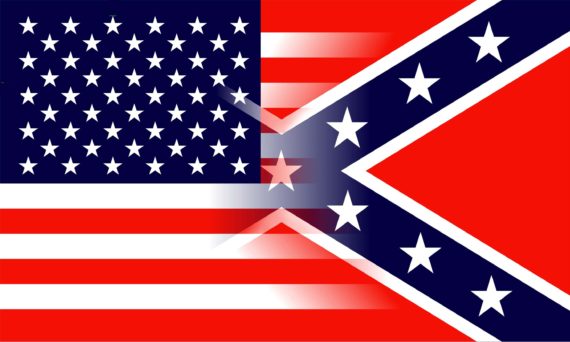
It is unsurprising to see the United States flag flying on the 4th of July. It is the day of the colonies’/States’ separation from Great Britain, and the beginning of their existence as countries on an equal footing with the others of the world.
And yet something is missing. The Southern cultural element that should be present in Louisiana and the rest of Dixie has been cut out. And one of the key components of that is the Southern flag, also known as the Confederate battle flag.
That might sound strange to some folks, but when one actually reads what Southerners of that day said and wrote, rather than the distortions and misrepresentations of it, they believed that their secession from the United States was an act of the same kind as their forefathers’ in 1776. That is, the government in DC in 1861 had become an endangerment to them and the culture they wanted to preserve: deeply rooted in agriculture, Christianity, the family, and good manners – values which are held in honor by both blacks and whites at the South.
The North at that time did, and still today does, live by the opposite values: enamored with technology and industry, with various heresies, with the redefinition of the family, and personal behavior that is rude and disagreeable.
The typical Southerner continues to show his difference from those Northern values by his love for the outdoors, for pretty flower and vegetable gardens, for hunting camps and fishing ponds, by his Yes Ma’am and No Ma’am, by his intense desire for Christ, by his family reunions, by his rejection of the LGBT cult, etc.
The Southern flag is a good symbol of those values because it is a distinctly Christian flag. The cross depicted on it is the Cross of St. Andrew the Apostle, who was crucified on an X-shaped cross in Patras, Greece. This cross was chosen for the Southern flag thanks to the influence of the large numbers of Scottish people who made up Dixie’s population. The Scottish highly venerated St. Andrew; their national flag in Scotland also features St. Andrew’s Cross.
The Confederate flag, furthermore, has flown proudly at momentous events around the world. During World War II, it was the first flag hoisted after a US victory on Okinawa on 29 May 1945. At the dissolution of the Soviet Union and the fall of the Berlin Wall, Southern flags were also waving.
Slavery existed in both North and South when independence was sought by the colonies in 1776, and it existed in both sections when Dixie declared her independence in 1861, so the issue of the moral superiority of one over the other in this regard is rendered moot and will not detain us here.
Southern secession in 1861 was no different than colonial secession in 1776. A people who felt threatened by a government that represented values and beliefs opposed to their own wanted to peacefully leave it and form one more congenial to their own way of life. They were prevented from doing so, in violation of the very principles to self-determination spelled out in the Declaration of Independence.
For these reasons and others, the Southern flag ought not to be hidden away, nor banned, as though it were an emblem of wickedness. It is a symbol of secession and self-determination, just like the United States flag, and ought to be flown proudly on patriotic days along with the former.
The views expressed at AbbevilleInstitute.org are not necessarily the views of the Abbeville Institute.







It flies its flag within its heart.
And hears that Rebel’s cry—brave shout,
In spite of those who hate
This valiant land of love and hope.
Oh, Dixie land
From “I Love Old Dixie”
“It is unsurprising to see the United States flag flying on the 4th of July.”
I find it extremely surprising, as this ‘50’ star flag is the current symbol of the imperial police state ruled by war-criminals that has not the slightest resemblance to the country formed by the seceding colonies in 1776. The flag that symbolizes that country is the 13 star ‘Betsy Ross’ flag. It also seems appropriate to fly the confederate battle flag on the anniversary of the date; February 4th, 1861, when the formal secession of states to form the confederacy was made.
The fact that both of these political assemblages formed by secession no longer exist should just further accentuate the importance of their continued remembrance.
I’ve never felt or thought of any ambiguity in flying the U.S. flag and Confederate flag simultaneously. Never a notion. They mean different things.
Then, the Reconciliation Memorial at Arlington was removed and I’ve thought about it. Things are pending but I’ve lately thought more fondly of one than the other. The other reminds me of obligations of citizenship from which some advantage is enjoyed. Sort of a business agreement – or a political agreement. We’ll see.
“we mutually pledge to each other our lives, our fortunes, and our sacred honor”
The same could be said for Jeff Davis, Robert E. Lee, Stonewall Jackson, and many others. The spirit of ’76 was with our Southern people.
No true Southerner can celebrate the 4th of July without tears. Vicksburg fell…
I have to keep my Confederate flag, “Defiance” (aka. the Confederate Battle Flag) hidden away these days in a cupboard. My children have fallen prey to the ideology of the schools they have attended. It’s a nice flag, brilliant colors and made from 100% cotton. I bought it years ago from the Capitol Flag company in Houston, Texas, before leaving the United States. As the woke ideology becomes more pervasive here in France with the ressurection of the “values” of the French Revolution and conservative voices in the media become fewer and fewer, it has become quite in vogue to equate the Confederate Battle flag with the Nazi swastika. When I first arrived here many years ago, the United States was undergoing a form of socialist wave under Jimmy Carter and Valery Giscard d’Estaing was the moderately conservative French president, I met many of the older generation and even many of my age who had a keen awareness of the history of the American South. But that generation passed away or left the region of Ile-de-France. I’m in the process of writing up a will, and will probably ask that the flag be buried with me when I check out.