

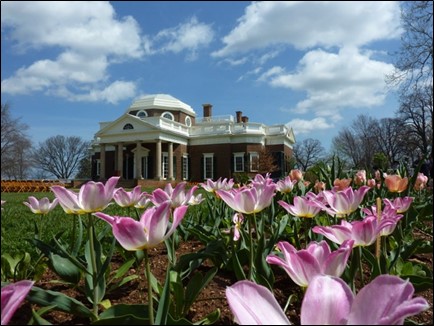
“I cannot live without books,” Jefferson confides in a letter to John Adams (10 June 1815). The statement today is well-known and readily available on coffee mugs, book bags, and tee-shirts, for anyone willing to pay an inflated price. What is seldom recognized is that the statement is part of a larger sentence, which continues concessively, “but fewer [books] will suffice where amusement, and not use, is the only future object.”
The sentence was written to John Adams shortly after Jefferson sold his library of some 6,500 books to the U.S. government to replace those lost in the British burning of the Library of Congress in 1814. Taken as a whole, the sentence implies that Jefferson values books not because of amusement or ostentation, but because of their educative value. The sentiment is reminiscent of the Stoic Seneca’s second letter to Lucillius, in which the former warns against the acquisition of books for display, not use:
Nothing is so useful that it can be of any service in the mere passing. A multitude of books only gets in one’s way. So it is, if you are unable to read all the books in your possession. You have enough when you have all the books you are able to read. If you say, “But I feel like opening different books at different times,” my answer will be this: “Tasting one dish after another is the sign of a fussy stomach. Where the foods are dissimilar and diverse in range, they lead to contamination of the system, not nutrition.”
For Seneca, books are valuable only if they can be put to use. Their principle use is moral betterment, and moral betterment does not value a fussy stomach.
Jefferson owned some 10,000 books in his lifetime. His first collection, comprising perhaps a mere 40 books, were those books he inherited from his father. They were lost, when his home at Shadwell burned to the ground on February 1 of 1770.
Thereafter, motivated by a passion for learning that was second to none, he began collecting “useful” books of all sorts. In 1815 he “ceded” his library of some 6,500 books to the government of the United States to replace its library of books that the British burned in an 1814 assault on the capital. Though riddled with debt, it was not an act that was designed to ease his debt, but “the act of a public-spirited citizen unable to make an outright gift and yet unwilling to make any profit on the public treasury.” It was, perhaps, the finest library of its day at the time in America and is the backbone of today’s Library of Congress.
From 1815 until his death in 1826, he began once again collecting books—now a more personal library for his own enjoyment—and had a library of nearly 900 titles and some 1,600 volumes at the time of his death.
As Jefferson’s interest in books was practical, he scrupled to buy the best or rarest volume. That too often is overpassed or unknown by biographers, intent on painting Jefferson as prodigal. His library, though large, “was not sumptuous,” as A. Hyatt Mayor says. He often got the most of his money by buying the cheapest editions. As Jefferson writes to a London agent:
Sensible that I labour grievously under the malady of Bibliomanie, I submit to the rule of buying only at reasonable prices, as to a regimen necessary in that disease.
Mayor sums, “His love of books … was like a workman’s love of his tools. Thus, Jefferson would not hesitate to rip out an illustration, if it could help with a job.
It is indubitable that Jefferson got the most out of his library to advance his personal affairs. Knowledge of most subjects—whether law, philology, farming, art, or architecture—he learned from his beloved books. Slave Isaac Jefferson recounts:
Old Master had abundance of books; sometimes would have twenty of ’em down on the floor at once—read fust one, then tother. Isaac has often wondered how Old Master came to have such a mighty head; read so many of them books; and when they go to him to ax him anything, he go right straight to the book and tell you all about it.
The picture one gets is that of a man, pathologically addicted to books and whose every action is dictated by something on a printed page. Still, Isaac Jefferson’s recollection shows that his master’s library was foremost a functional library.
Nonetheless, it is difficult to grasp how Jefferson could have put such a massive collection of books to use in his personal affairs, although his interests were extensive and varied. How could the majority of his books be anything but mere ornament? If the value of books lies in their use, how could he have put so many volumes to use in his lifetime?
There can be little doubt that Jefferson’s libraries over the years were themselves a source of pride and, like any other collector of books, he did not, could not, and never intended to put all books to full use for himself. The collections, independently of the contents of each volume, must been a source of gratification for its owner at some visceral level. That notwithstanding, the principal value of books was their practicality and the practicality of his massive collection was not merely its capacity to advance his personal affairs.
First, books were an invaluable asset in Jefferson’s letter writing, which was prodigious and motivated by anything but self-interest. He was, as a consequence of his experiences, a recognized authority on a large number of issues—including books. Visitors and correspondents would often ask for his opinion on matters ranging from philology, philosophy, and political matters to agriculture, natural history, and exploration. His replies required a considerable library, from which he could do research. Thus, it contained dictionaries in various languages and even reference works, like Plato’s and Aristotle’s works, which were not suited to his taste. Consequently, a single could take him several hours to compose, because he would have to refer to several books in its composition.
Second, his books were not only for his use, but for the use of others. His library was readily available for use by family and trustworthy friends and acquaintances. For instance, in reply to a request from Robert Skipwith concerning suggestions for books to compose a gentleman’s library in 1771, Jefferson gives a much long list of books that exceeds Skipwith’s wherewithal. He also extends an invitation for his friend to visit him and make use of the library at Monticello (3 Aug. 1771). Again, as Douglas Wilson notes, even as president, Jefferson continues to expand his library, which he acknowledged was too extensive for personal use. Wilson concludes, “By this time [roughly 1803] his grand plan included creating a collection that was intended to have a utility well beyond what was required for his personal use.” He had in mind a congressional library.
Finally, in setting up the University of Virginia as a secular, liberal, and progressive institution, Jefferson wished—at least indirectly, by choosing the right sort of instructors—to have some say in the books to be used for the courses of instruction. Instructors and books, with “toryist” or religious biases, were not to be chosen. Capacity to choose the right sort of books required familiarity with the first tier of books on all subjects to be taught at the University of Virginia, hence the need of, or at least access to, a considerable, updated library. Moreover, Jefferson also wished that the university should have a library, stocked with the foremost books on the arts and the best and most recent books on the sciences, that was serviceable for the students of his new university. He had planned, upon his death, that his most recent collection of some 1,000 books be donated to the University of Virginia.
In short, Jefferson was obsessed not with books per se, but with useful books. Useful books could not only improve one’s character and advance one’s personal affairs but also the character and affairs but also of one’s fellow human beings, both locally and globally. Books for Jefferson, like letters, were vehicles of learning. Jefferson utilized the abstract domain of the printed page—what might be called “ideational space”—to bring to fruition numerous ideas in real space for his benefit as well as for the benefit of his fellow human beings. Acknowledging that America was in his day a backwater—especially his native Virginia—books for him were significant conveyances of advances in agriculture, botany, natural history, ethics, and chemistry, among other disciplines, to be put to use for human flourishing.
Jefferson realized the backwardness of his embryonic country during his stay in Europe. While in Paris, Jefferson writes to Charles Bellini (30 Sept. 1785) that the French literati are some six years ahead of their American counterparts. Nonetheless, he perhaps rationalizes, really good books take about six years to acquire just reputation. It follows implicitly, insofar as assimilation of their contents is concerned, that the lag is not so deleterious. Moreover, he adds, “Is not this delay compensated, by our being placed out of the reach of that swarm of nonsensical publications, which issues daily from a thousand presses, and perishes almost in issuing?”
Outside of giving persons useful scientific information for, say, farming or commerce, books also engendered human flourishing by encouraging morally correct behavior.
To his physician Vine Utley (21 Mar. 1819), Jefferson states:
I never to bed without an hour, or half hour’s previous reading of something moral, whereon to ruminate in the intervals of sleep.
The implicit conclusion is that assimilation of good philosophical literature—like Seneca’s Letters to Lucilius, Cicero’s Tusculan Disputations, Plutarch’s Lives, or his own version of the Bible, bereft of supernaturalism—encourages morally correct action.
In his 1771 letter to Robert Skipwith, Jefferson mentions that even books of fiction—which Jefferson generally believed were brummagems—cannot just be pleasant, they must also useful.
Everything is useful which contributes to the principles and practices of virtue. When any original act of charity or of gratitude … is presented either to our sight or imagination, we are deeply impressed with its beauty and feel a strong desire in ourselves of doing charitable and grateful acts also.
Despite his late-life disinclination to read fiction, Jefferson suggests that fiction is needed.
Considering history as a moral exercise, her lessons would be too infrequent if confined to real life.
Usefulness goes beyond the moral benefit of assimilation of virtue. Repulsion to vice is equally felt in well-written books. Such valuable works of fiction are, as is the case today, rare, but Don Quixote and Tristram Shandy were favorites.
A second way in which books can be useful for Jefferson is through squaring one with reality—in effect, the aim of Stoic sagacity. In that regard, Jefferson asserts baldly that most novels are a waste of time—a “mass of trash.” He says to Nathaniel Burwell (14 Mar. 1818):
A great obstacle to good education is the inordinate passion prevalent for novels, and the time lost in that reading which should be instructively employed. When this poison infects the mind, it destroys its tone and revolts against wholesome reading. Reason and fact, plain and unadorned, are rejected. Nothing can engage attention unless dressed in all the figments of fancy, and nothing so bedecked comes amiss. The result is a bloated imagination, sickly judgment, and disgust toward all their real business of life.
Novels are perhaps not his chief concern. History, which has a special place in Jefferson’s educational scheme, presents a more pestiferous danger. In a letter to William Duane (12 Aug. 1810), Jefferson writes of the potential danger of ingestion of history, badly written. He speaks of the delight with which he “devoured” Hume’s history, while young, and the deep and lasting impression the work made on him. It took years of “research and reflection” to “eradicate the poison,” once recognized as such. His implicit message is that history, if written with a political agenda, can do much harm. If written aright—e.g., Middleton’s life of Cicero or the works of Tacitus—they are guides for moral improvement.
Similarly, in a letter to John Adams (11 June 1812), Jefferson mentions two objectionable accounts of the history of the American Indians.
First, he criticize Lafitau’s account of American Indians, in a manner eerily reminiscent of some of the revisionist historians’ accounts of Jefferson today.
Lafitau had in his head a preconcieved [sic] theory on the mythology, manners, institutions and government of the antient [sic] nations of Europe, Asia, and Africa, and seems to have entered on those of America only to fit them into the same frame, and to draw from them a confirmation of this general theory. He keeps up a perpetual parallel, in all those articles, between the Indians of America, and the antients of the other quarters of the globe. He selects therefore all the facts, and adopts all the falsehoods which favor his theory, and very gravely retails such absurdities as zeal for a theory could anyone swallow.
Second, he castigates Adair, who maintains that American Indians are descendants of the Jews in that they have the same laws, usages, rites, ceremonies, sacrifices, priests, prophets, fast, festivals, and, almost, the same religion. What is most criminal is that, having familiarity only with the Indians of the south, Adair generalizes to all American Indians, as if it is unquestioned that the hundred languages, each differing from many others as “Greek from Gothic,” have a common prototype.
Despite their recognized potential for harm, the greatest harm comes not from the hooey, seductions, or moral entrapments of bad books, but from the censorship of books. In a letter to N.G. Dufeif (19 Apr. 1814), Jefferson speaks of the censorship of books in America apropos of a cosmogonic work by M. de Becourt titled Sur la Création du Monde, un Systême [sic] d’Organisation Primitive. He says he is mortified to discover that, in the United States, the sale of the wrong sort of book can come before the civil magistrate as a crime against religion.
Is this then our freedom of religion? And are we to have a censor whose imprimatur shall say what books may be sold, and what we may buy?
He concludes cynically and perhaps rhetorically.
Whose foot is to be the measure to which ours are all to be cut or stretched?
If Becourt’s book is filled with falsities, he adds, then that is a matter for refutation, not censorship. All in all, Becourt should have his say; so, too, should they, who would censure him.
Enjoy the video below….
The views expressed at AbbevilleInstitute.org are not necessarily the views of the Abbeville Institute.






The late Baptist pastor Peter S. Ruckman of Pensacola, FL, said, and I heard him say all this on audio, that soon in his adult life he read an average of one book a day for decades; read the Harvard five foot shelf books of classics (I had never heard of that until I heard Ruckman mention it). I think he also said he had read the Encyclopedia Britannica straight through, every page, every volume. I know he also said he read quite a few of the major philosophers, Nietzsche, Spinoza, Hegel (in Ruckman’s opinion no one exceeded Hegel’s pondering and conclusions).
Obviously, Ruckman had an exceptional gift for reading. He was an interesting, and controversial, man to say the least. I think I’m a fairly good reader, but I’m not close to anyone like Ruckman. It was a challenge for me to read Shelby Foote’s three volumes. That’s not a negative comment, at all, on Foote; any negativity is on me. But, I was very glad I read his three volumes; though a lot of reading, once I started and got a way’s, it wasn’t too difficult, because it was too interesting. And I also found it very interesting that the writer Foote found the most exceptional was Marcel Proust. Of course, Foote gave much praise to William Faulkner, a few other’s. I don’t know if I should be a little embarrassed to say I had never heard of Proust. Well, I just hadn’t. But, I know of him now, when I heard Foote talk about him.
To quote Winston Churchill: “What shall I do with my books?” was the question; and the answer, “Read them,” sobered the questioner. “But if you cannot read them, at any rate handle them and, as it were, fondle them. Peer into them. Let them fall open where they will. Read on from the first sentence that arrests your eye. Then turn to another. Make a voyage of discovery, taking soundings of uncharted seas. Set them back on their shelves with your own hands. Arrange them on your own plan, so if you do not know what is in them, you at least know where they are. If they cannot be your friends, let them at least be your acquaintances. If they cannot enter the circle of your life, do not deny them at least a nod of recognition.”
(From a column by Ross MacKenzie, longtime editor of the editorial pages for the much lamented Richmond News Leader, defunct for thirty-some years, and the equally lamented, though not defunct, Richmond Times-Dispatch.)
Jefferson in his library did not have superfluous books–all useful, or potentially so. When I read Seneca on books, I got rid of 80 percent of my library–filled with books I knew that I would never read. I used to buy on impulse and without consideration for when I might read a book I bought.