Imagine a world where radio wasn’t just background noise, but was a powerful force across an entire region of the country. I want to look into the dusty dials and glowing tubes of early Southern radio, and explore all about some of the stations that didn’t just play music, but changed culture, identity, and race relations in the American South and beyond. From high-powered towers in Nashville to shady border blasters out of Mexico, from the cries of the Delta to the choirs of Sunday morning, these stations gave voice to a people, a culture, a sound, and a spirit. Specifically, I’d like to focus on five stations in particular, although the list is much longer than this.
Before I begin, I need to explain the entire radio business model, here, because it’s crucial to understanding how radio works. The most important things broadcast on any radio station are the advertisements. Period. Radio stations exist to sell ads. That’s the only way they make money. Radio stations are like audio billboards, but instead of seeing the ad, you hear it. However, stations know that you’re never going to tune in to the station just to hear an unending slate of ads. Therefore, they also play music, which brings me to my second bit of radio gospel. The ONLY reason radio stations ever play music is to entice you to listen to the station long enough to hear the ads. Music is not provided to the listener out of some altruistic expression of cultural giving – it’s there to lure you into listening to hear the ads. End of story. The more people who listen, the more the station can charge for advertising, the more successful is the station. Knowing all of that will help you for the remainder of this blog post.
In 1925, a quiet revolution began in a Nashville insurance office. The National Life and Accident Insurance Company decided to start a radio station to promote their business. They named it WSM, short for “We Shield Millions.” What started as a corporate promo turned into the heartbeat of American country music.
Just months after launching, WSM began broadcasting a barn dance hosted by announcer George D. Hay. But when he heard the down-home sounds of a fiddler named Uncle Jimmy Thompson, he knew something special was happening. The radio program that aired right before his was called “The Grand Opera.” Therefore, with tongue in cheek, he renamed his show The Grand Ole Opry.
What followed was a sonic gold rush. String bands, harmonica blowers, old-time singers, and Appalachian storytellers streamed into Nashville. Artists like Roy Acuff, Minnie Pearl, Ernest Tubb, and later, Hank Williams, all became household names through the Opry’s weekly broadcast. And then came DeFord Bailey, a Black harmonica wizard from Smith County, Tennessee. In the 1930s, he became the first African-American performer on the Opry, mesmerizing listeners with renditions like “Fox Chase.” His presence challenged the racial norms of the South, even if the station, sadly, would later remove him under complex and painful circumstances. WSM’s 50,000-watt signal could be heard in 30 states, and eventually, worldwide via shortwave. It created a new musical identity – Country Music, born from folk, blues, gospel, and mountain ballads. For millions of Americans who were White, Black, rich, poor, urban, and rural, WSM was the sound of home.
Now, heading a little bit to the west, there was WDIA in Memphis, a station that did something no one else had dared to do yet – program a format specifically for a Black audience. Founded in 1947 by White owners John Pepper and Bert Ferguson, WDIA was not an instant success. Since it was their second radio station, they called it “We Did It Again,” or WDIA. Their original format was all mainstream middle-of-the-road, pop and light entertainment, and it barely made a dent in ratings. That all changed when they hired Nat D. Williams, known on the air as “Nat D,” who was a high school history teacher and columnist for the Black newspaper The Memphis World. When he took to the microphone with a blend of jive talk, local commentary, and rhythm & blues, the airwaves caught fire. His show, “Tan Town Jubilee,” connected with Black listeners like nothing before it. He called it “Good music for good people,” and suddenly, advertisers realized there was a powerful untapped market.
Soon, WDIA became the first station in the country to feature all-Black on-air talent and program for a Black audience 24 hours a day. The playlist expanded to include gospel choirs, gutbucket blues, and the earliest stirrings of soul. A young B.B. King even got his start there, spinning records and doing radio spots as “Beale Street Blues Boy.” It is estimated that at one time, 10% of the entire Black population of the United States was listening to Nat D on WDIA. Beyond music, WDIA offered news, public service announcements, funeral notices, and educational programming — all geared toward Black communities who’d long been ignored by mainstream media. Its signal reached deep into the Delta and up through the Midwest, giving African-Americans a sense of cultural ownership and pride in the airwaves. In the days before Civil Rights legislation, WDIA gave its listeners a voice — and a vision — of freedom.
Now, things get wild. Down across the border into Villa Acuña, Mexico, an American entrepreneur named Dr. John R. Brinkley set up a radio station in the 1930’s that practically melted the airwaves. His station, XERA, operated with a whopping 1,000,000 watts of power, which was far more than was legal in the U.S. It was so powerful, legend says you could hear it through barbed wire fences or even fillings in your teeth. But Brinkley wasn’t just pushing raw power. He was pushing everything from miracle cures, goat gland transplants, baby chicks by mail, and even phony medical degrees. Don’t forget, the primary purpose for the existence of radio was to sell ads. However, tucked in between the quackery was some of the most legendary music ever broadcast anywhere, and that is what stuck. XERA became an unlikely platform for artists who couldn’t get airtime in more respectable markets, including traveling quartets, gospel ensembles, and brand-new recording stars. The Carter Family and Jimmie Rodgers were recorded in Bristol, Tennessee in 1927 by Ralph Peer, and those sessions were pressed into records. But who played them on the radio? XERA, of course. That’s how those legends of Southern music were launched directly into American homes.
Since Brinkley needed content to fill hours of airtime, he gave slots to anyone who could play and draw a crowd. Often, these were rural musicians who were poor, Southern, and raw, and they brought mountain songs, spirituals, and early honky-tonk music to an international audience. For many mainstream Americans, this represented their only doorway into Southern music. XERA, and other border stations like it known collectively as “Border Blasters,” operated just outside U.S. regulation, yet they shaped the tastes of millions of Americans. They were outlaw, yes, but they were also equal-opportunity for welcoming voices and sounds the FCC wouldn’t touch. Without XERA and its kind, we might never have heard The Carter Family singing “Keep on the Sunny Side” under a Mexican sky.
Now, headed back up to Nashville, another station was also shaking things up, but only after dark. WLAC, a CBS affiliate, aired network news and talk shows by day, but once the sun went down, their signal carried something much more radical: WLAC played the newest Black music spun by White DJs. Personalities like John Richbourg, better known as John R, along with Gene Nobles, and Hoss Allen, embraced rhythm & blues long before it became “safe.” They spoke in jive slang, mimicked Black vernacular (sometimes controversially), and played records by Little Walter, Big Mama Thornton, Bo Diddley, and many more. It was wild, it was raw, and it was real, especially to the Southern White teenagers and Northern Black night shift workers who made up its sprawling, multi-racial audience. WLAC helped R&B cross over to the mainstream, laying the groundwork for rock ’n’ roll. Elvis Presley, Jerry Lee Lewis, Buddy Holly, and practically every other rock ‘n roll pioneer was listening to WLAC, in addition to future Motown founder Berry Gordy. The DJs at WLAC blatantly took payola, ran wild ads for mail-order goods, and stirred the pot of race and class, but they also championed music no one else would touch. In doing so, they helped launch a movement. By the time the rest of mainstream radio caught up, WLAC had already seeded a musical revolution.
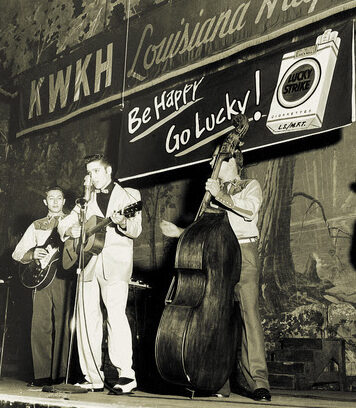
If the Grand Ole Opry was the front porch of country music, being stately, tradition-bound, and a little uptight, then the Louisiana Hayride was the back porch. The Louisiana Hayride was wild, loud, and open to anybody with a guitar and a dream. Broadcast out of KWKH in Shreveport, Louisiana, the Hayride started in 1948 and quickly earned the nickname “The Cradle of the Stars.” KWKH had been on the air since the 1920s, founded by oilman and self-styled eccentric W.K. Henderson, who used the station to rail against everything from big government to chain stores. But by the late ’40s, the station had refocused, and that’s when things got exciting. KWKH launched the Louisiana Hayride as a live Saturday night show, broadcast from the Municipal Memorial Auditorium in Shreveport, and beamed across a multi-state region. It certainly wasn’t as polished as the Opry, but it had energy, it had risk, it had hunger, and it had lots of screaming teenage girls.
Unlike the Opry, the Hayride welcomed newcomers even if they weren’t polished or well-connected. And that meant it became a proving ground for some of the upcoming biggest names in American music. Let’s start with a kid named Hank. In 1948, Hank Williams stepped onto the Hayride stage, not long after the Grand Ole Opry had rejected him. At KWKH, they totally didn’t care. They just knew he could sing the pain out of a song like nobody else. He performed “Lovesick Blues” on the Hayride, and the crowd went berserk. The Hayride embraced Hank Williams — and gave him a huge audience.
Then came Elvis. A shy young truck driver from Tupelo auditioned for the Hayride in 1954. The Opry had also turned him down flat, and said he’d never make it. But at KWKH, producer Horace Logan heard something magical in that hip-shaking gospel boy. Elvis debuted October 16, 1954, singing “That’s All Right Mama.” At first, the crowd didn’t know what to make of him, until he started moving. Then the girls screamed, the boys hollered, and Southern radio would never be the same again. Elvis played the Hayride almost every Saturday for the next year and a half, and it was the launchpad that took him to national fame.
But the Louisiana Hayride wasn’t just Hank and Elvis. It featured Johnny Cash, Kitty Wells, George Jones, Slim Whitman, Johnny Horton, and a teenage Wanda Jackson all before they were stars. It was also integrated in its own way. Although the official lineup was largely White, Black artists and musicians were allowed to play in the bands onstage. And KWKH’s reach, stretching from Texas to the Carolinas, brought R&B and gospel influences to audiences who might never have tuned into WDIA or WLAC. The Hayride’s success came from its rough edges. It welcomed originals, such as singers with weird voices, strange phrasing, and wild energy. If the Opry was country music’s cathedral, the Hayride was the tent revival. One night, when Elvis left early to sign with RCA and hit the national stage, Louisiana Hayride announcer Horace Logan famously told the crowd, “Elvis has left the building!” That wasn’t just a line. That was the sound of a new America, walking out the back door of a Southern radio station and into history.
These stations didn’t just change music, they changed people. They cracked open the Southern soul and let it pour out into the world: The rest of the world got to know all the things we already knew, like the pain, the joy, the twang, the shout, and the groove of Southern music. They gave names and sounds to movements that had long gone unrecorded, both literally and figuratively. They brought down walls between hillbilly and bluesman, preacher and picker, sharecropper and city slicker. And maybe most importantly, they democratized the music. No matter how poor you were, or how far from the city, if you had a tin roof and a radio, you could tap into a living, breathing world of music.
Keep that dial turned low and warm, my babies…
The views expressed at AbbevilleInstitute.org are not necessarily the views of the Abbeville Institute.




As a youngster in the 1960’s, I collected “QSL” cards, which were a verification that you received the signal of a given station from your location. I suppose the stations did this to measure the strength of their signal as a means to attract advertisers. Anyway, my most prized QSL card cam from WSM, which billed itself as “the air castle of the South” and was signed by a Dave Overton who I believe was the station manager. I also remember WBT in Charlotte. These southern voices filled my head while, as a lonley kid “up north” I spent my late nights cruising the world with an old tube type AM radio.
As a lonely kid in Virginia I spent my late nights with an old tube type radio listening to “Cousin Brucie” on WABC in NY and Garner Ted Armstrong on WLS from Chicago.
Fortunately, I spent the morning, days and evenings hearing Southern voices – still do where I can find them.
“The rest of the world got to know all the things we already knew, like the pain, the joy, the twang, the shout, and the groove of Southern music.”
Yep. But a bunch of the “rest of the world” forgot where they got it and forgot what to do with it. But if Yankees didn’t forget a lot, they wouldn’t be what they are!
Spectacular, riveting piece. Thank you Mr. Daniel.