

When Yale history professor David Blight wrote Race and Reunion in 2001, he argued that his attempt to discuss how Americans “remembered” the Civil War offered a new interpretation of the conflict.
He termed it “memory studies.”
Blight thought that Southerners—and for a time Northerners as well—remembered it wrong, and they did so consciously:
Reconciliation joined arms with white supremacy in Civil War memory at the semicentennial in an unsteady triumph. Just how enduring that triumph would be was a matter of degree, time, and place. Beleaguered but hardly invisible, emancipationist memory lived on to fight another day. The ‘”peace among the whites” that Douglass had so feared in 1875 had left the country with a kind of Southern victory in the long struggle over Civil War memory. But because of the enduring significance of race in American society, and because it would take another political revolution and the largest mass movement for human rights in our history to crush the nation’s racial apartheid system that had been forged out of the reunion, the first fifty years of remembering the Civil War was but a prelude to future reckonings. All memory is prelude.
Blight later won a Pulitzer Prize for his biography of Frederick Douglass. It’s easy to understand why from the above passage, a conclusion filled with so many inaccuracies that only historians would believe it.
But his logic is simple: white Americans lied about the War to both themselves and the public, and it was only through the work of people who truly remembered it correctly that modern Americans have been able to overcome their pernicious fabrications.
Blight did discover something incredible. He verified what honest historians had already known for generations. As John Lucas wrote, “History is the remembered past.”
In other words, Blight wrote a history of history. We used to call that historiography. I wish I had known this secret. I could have worked at Yale, too. So could anyone who took traditional historiography courses in graduate school. My degree granting institution eliminated those courses around the time I finished my doctorate. Clyde Wilson taught the American historiography course. It’s not a coincidence that they scrapped it.
I laugh any time I hear someone say they are focusing on “memory studies.” I’ve been doing that my entire career.
Blight did not pave any new ground in Race and Reunion, though he did kick-start the false argument that some South Carolina freedmen were responsible for the first “Memorial Day.” Yet, his conclusion that the South won the War has become a standard argument for the historically ignorant profession.
Anyone who has spent time with the primary materials knows that Southerners (and many Northerners) had the same arguments both before and after the War. The only people who changed their tune were the “emancipationist memory” advocates who turned the War into a holy crusade. This is why Douglass worried about the “peace among whites.” He knew that their (correct) version of the story would become the standard interpretation once Reconstruction came to an end.
These “Righteous Cause” advocates lied for political gain, and activists like Blight have become their most important propagandists.
The “Summer of Love” in 2020 would have been impossible without these “historians.” They have thoroughly erased any vestige of traditional history from most American classrooms.
Anyone who contradicts their claims or offers an alternate, i.e. traditional, interpretation is labeled a “history denier” or a “Lost Causer.” These are meaningless emotional terms designed to stifle debate, much like the use of “racism” in modern discourse.
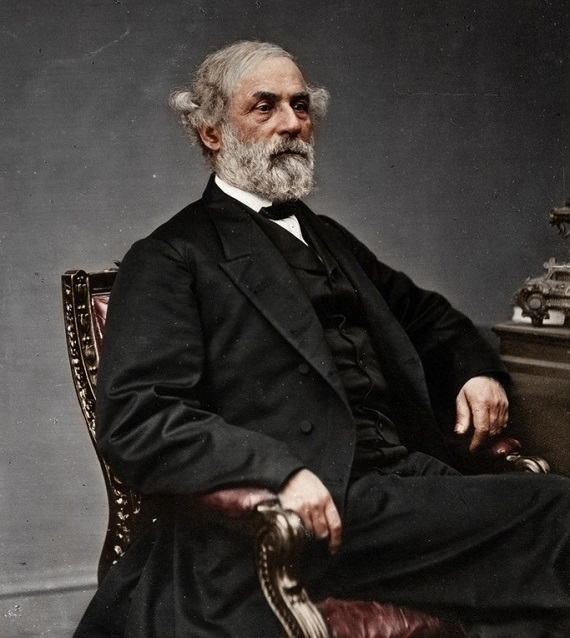
Those who described Robert E. Lee as a great American, who argued that the central theme of the War was not slavery, or who correctly understand that Southerners were not traitors expressed positions consistent with the memory of many Americans at the time.
When Blight argued that “all memory is prelude,” he correctly identified that historical interpretation is fluid, but in his mind, some memories need to be buried and others promoted.
While history is the “remembered past,” the historian has the obligation to “understand” that past and to let the actors speak for themselves. Historians have never been objective, but they should be honest.
And if they are being honest, then the fact that for generations most Americans remembered Lee with respect and admiration should be the standard interpretation of the man. Anything less would be a lie and a conscious attempt to rewrite the collective memory of the United States.
The views expressed at AbbevilleInstitute.org are not necessarily those of the Abbeville Institute.





The “Righteous Cause” (myth) advocates and other leftists continually bear false witness against the South and her heroes. Bearing false witness…hmm…isn’t that one of the big ten? Not that they care, of course…
The 14th Amendment to the US Constitution disenfranchised White Southern Males who had supported the Confederate States of America. It’s the only reason General Robert E. Lee did not become Governor of Virginia or President of the United States. He may not have wanted the titles…but the people wanted to give them to him, and besides, the railroads had already been given the land equivalent of the State of Texas, so there was little reason for the megadonors to disappoint the people. We could have had Lee instead of Grant.
May God bless General Robert E. Lee and all of the Southern patriots who fought to keep an oppressive federal government in its cage.
How did the people of Lee’s time, the people who knew him infinitely better than we do…how did they judge him? When a modern presentist “historian” changes that interpretation 180 degrees, he is exposing himself as manipulative and dishonest.
Some of the coming together of North and South stemmed from Northerners recognizing the disaster of “Reconstruction”–what an inaccurate euphemism. The Southerners’ term for it, “Negro rule,” wasn’t accurate either, as Carpetbaggers merely used blacks to rule. But it was a destructive time for the South, characterized by pervasive corruption and leading to numerous states declaring bankruptcy a 2nd time. The destructiveness of Reconstruction contributed to the South’s decades of poverty after Lincoln’s War. Many Northerners observed this.
Anyone who contradicts their claims or offers an alternate, i.e. traditional, interpretation is labeled a ‘history denier’ or a “Lost Causer.” These are meaningless emotional terms designed to stifle debate, much like the use of “racism” in modern discourse.”
Some of the worst have been or are the so-called “conservative” talk-show bloviators. Including Limbaugh, Wilkow, anybody on Fox, The Righting, Clay and Buck (The Tennessee scalawag and carpetbagger). They seem to truly never have studied any history but that which feels to them like that “shining city on a hill” drivel. They now believe that they will climb the hill of glory singing their so-called “National anthem,” while never understanding The “Star Spangled Banner” nor “Dixie.”
And they dang sure will never understand why there is chaos in Minnesota.
Remember Lee? I doubt most of those could spell his name.
Pity them? Maybe-maybe not.
I believe Rush Limbaugh consciously skirted denigration of the South and Southerners, having near Southern ancestors. He had a wide scope of understanding. Having begun actively pursuing interest in Southern history at the time I first heard Rush, I never heard any slight of Southerners, the closest being defense of contemporary Republicans with an incredulous, “BUT! BUT! Republicans freed the saves!”
Looking back, I can’t believe I payed attention to most of them. Rush was different.