

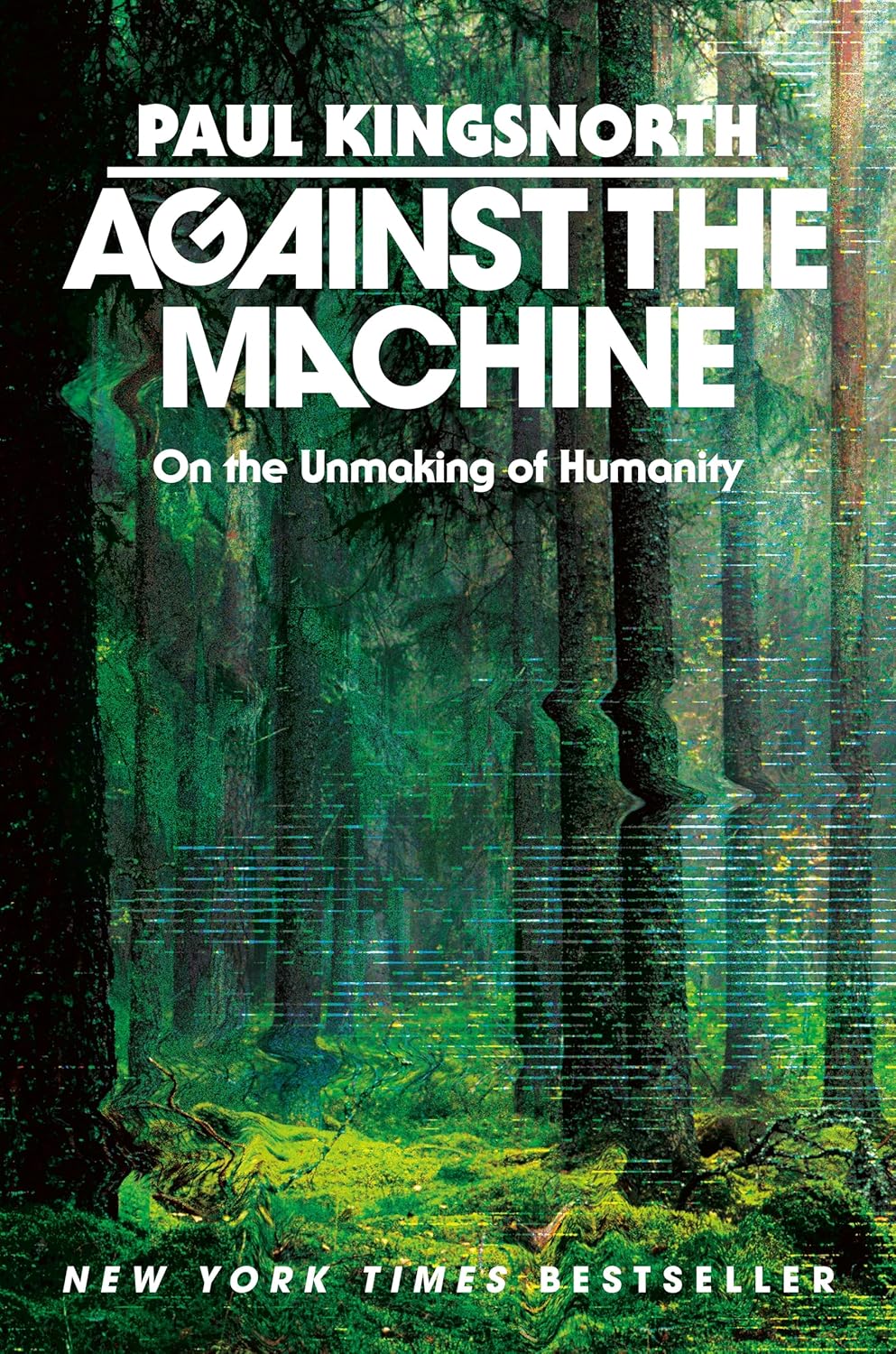
A review of Against the Machine: on the Unmaking of Humanity (Thesis, 2025) by Paul Kingsnorth
In an interview included in the press handout for Against the Machine, Paul Kingsnorth is asked why he wrote this book now. Good question. “The rise and triumph of the Machine,” he says, “is becoming increasingly obvious in the 2020s, so the moment seems right.”
Oh, Paul. Where have you been? The moment was right maybe a century-and-a-half ago, when Samuel Butler in England wrote Erewhon (1872), a work about a Utopian society where machines are considered a danger to the social order and have been outlawed. Notably, Butler anticipated the development of what we call Artificial Intelligence.
It was right in the 1930s when the Nashville Agrarians resisted the Industrial Age with a defense of the southern agrarian tradition in their heroic I’ll Take My Stand (1930) and, a few years later, Who Owns America (1936).
It was certainly right 75 years ago, when Lewis Mumford began turning out various volumes against the postwar world of technology and what he called the “Megamachine,” particularly his masterful two-volume Myth of the Machine (1967).
And even righter in the 1990s when a group of people self-identified as Neo-Luddites launched a campaign to oppose the technologies of “modern Western societies that are out of control and desecrating the fragile fabric of life on earth,” as one of them put it, including the new machines of the computer and the internet.
Among the books produced in those years (and leaving aside my own Rebels Against the Future) was a 400-page work called, amazingly, Against the Machine (2004), a work Kingsnorth apparently never read in which author Nicols Fox does a comprehensive job of describing the history and ideology of the anti-machine writers and activists over the last two centuries—a list that includes a sizeable number of prominent people, many of them well known, such as Thomas Carlyle, Henry Thoreau, John Muir, William Morris, Jacques Ellul, E. F. Schumacher, Doris Lessing, Kurt Vonnegut, Wendell Berry, and Bill McKibben.
In other words, Paul, your book has already been written.
Kingsnorth has provided a fat book that, he says, “seeks to tell the tale of this Machine: what it is, where it came from, and where it is taking us next.” But we already know that—he has nothing really to add to the copious literature. Why take up pen?
And it’s not as though he has come up with any new ways we might have to do anything about the out-of-control technologies swamping our societies. In this Machine Age, he says by way of conclusion, “we have to understand it, challenge it, resist it, subvert it, walk through it to something better.” And how shall we do that? Rely on “people, place, prayer, the past.” What’s that? “Human community, roots in nature, connection to God, memories passed down and on.”
Are you listening, Luddites? Butler? Mumford? Fox?
No, I thought not. You’ve heard it all before.
The views expressed at AbbevilleInstitute.org are not necessarily those of the Abbeville Institute.






The purpose of humanity besides to worship God is to return CO2 into the atmosphere.
David slew the “giant” with a leather strap and a stone.
FDR used an atomic bomb to slay his “giant.”
Many said God bless America.
David gave thanks to God.