

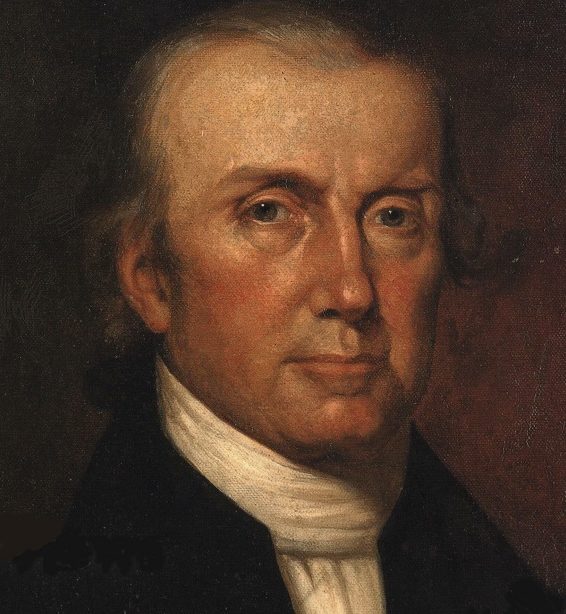
Originally published at From the Desk of Jon Harris.
I recently recorded a podcast on John Taylor of Caroline’s important but often neglected book New Views of the Constitution (1823). I initially believed that the most compelling way to introduce this work to modern audiences would be to highlight how Taylor, writing from a federalist perspective, disagreed with Joseph Story’s nationalist view of the Union.
However, the account of how the nationalist position came to dominate is far more interesting. Taylor presents it as a secretive conspiracy involving powerful banking interests and foreign ideas. When I think about it, that angle does seem more in line with what is currently popular, yet for some reason no one of significant public influence is talking about it, even though it lies at the foundation of who we are as Americans and explains why we have been strangled both socially and financially by the interests of those “rich men north of Richmond.”
What the Founders Debated and What We Forgot
We are accustomed today, largely because of the mythos around figures like Alexander Hamilton and Abraham Lincoln, to think of America as one consolidated group of individuals under a national government. We do not often consider the older understanding of a federal arrangement between many peoples acting in their sovereign capacities as States, who, as James Madison said, came together for “few and defined” purposes.
Hamilton wanted to “annihilate the state distinctions” and adopt a British, almost monarchical, form of government at the Constitutional Convention. He lectured for hours on his plan for America’s future, only for it to die for lack of a second on June 18, 1787. Yet in the Federalist Papers, which were intended to sell the Constitution to the State ratification conventions, he repeatedly referred to the federal arrangement as “national,” even though that term had been deliberately removed by the Constitutional Convention one week after Hamilton’s failed speech in favor of the term “United States.” Taylor remarks that the “style was adopted, not to establish the idea of an American people, but to defeat it” (29).
The Nationalist Turn and Its Architects
What occurred next could be the material for a History Channel documentary, minus the aliens and with credible evidence of course. Taylor, writing in 1823, reflects on the way the central government had grown by that time. He highlights developments such as the National Bank, protective tariffs that enriched commercial interests at the expense of agriculture, pork barrel spending, and the extension of the federal judiciary over State matters. He argues that these destructive outcomes would have been avoided if the federal arrangement had been upheld. Instead, those most responsible to defend it, and those who presented themselves as the most ardent guardians of the Constitution, were actually subverting it in order to bring about this destructive situation.
The people in America were not aware of the proceedings of the Constitutional Convention until it was too late to correct the inaccurate nationalist interpretation they were given. Some of this was circumstantial, and some of it, according to Taylor, was intentional. Because the proceedings of the Convention were kept secret, the Federalist Papers were virtually all the public had to guide them in interpreting the document. The notes of Robert Yates and Luther Martin were incomplete and gave the impression that the nationalists held the upper hand. A redacted official journal of the proceedings was not published until 1819, and Madison’s notes did not appear until 1840.
When Joseph Story published his Commentaries on the Constitution of the United States in 1833, there is no evidence that he interacted with New Views, except to dismiss Taylor’s work based on its title, which he thought novel. Story relied heavily on the Federalist Papers and worked to enshrine John Jay’s overreach. He argued that the phrase “We the People” proved that the Constitution of 1787 represented a departure from the Articles of Confederation by eliminating the compact between the States (§ 463). He claimed that from its very origin it represented a national government (§ 906). He partly based this conclusion on the fact that Congress initially called for the establishment of a national government. Yet every State that sent delegates made clear that they were not there for that purpose, but instead to repair the federal arrangement.
Lincoln went even farther than Story when he concluded, “The Union is older than any of the States, and, in fact, it created them as States.” This incorrect assumption passes for common knowledge even on today’s Right.
Yet there were three identifiable groups represented at the Constitutional Convention, and the truly federal and republican delegates were the ones who secured an arrangement closest to their desires, only to be forgotten by history, perhaps intentionally. Luther Martin wrote that one of the other groups, the monarchical, joined with a third group, the self-interested, in an effort to destroy the State governments even though they knew that the people of America would reject their system if it were proposed openly. Figures such as Edmund Randolph, Charles Pinckney, James Madison, and Alexander Hamilton all made statements toward the end of either annihilating State distinctions or placing them, in Madison’s words, “under the control of the general government.” Taylor argues that this move was disingenuous and that what these political leaders could not obtain during ratification, they chose to pursue through later reinterpretation.
The Federalist Papers contributed to this by promoting ideas such as federal judicial review over conflicts involving States. Yet at the Convention itself, efforts to grant federal branches the power to nullify State laws were repeatedly denied, including elements of Randolph’s Virginia Plan and Pinckney’s draft. Later nationalists tried to locate their preferred arrangement in the Supremacy Clause, but as John Taylor pointed out, “The supremacy of the constitution is an admonition to all departments, both state and federal, that they were bound to obey the restrictions it imposes. It neither enlarges nor abridges the powers delegated or reserved” (23).
The Path Back: Local Communities and True Exceptionalism
What Taylor was concerned with is the very world we inhabit today, full of red tape and an entrenched administrative state. He believed that recovering what made America truly exceptional required a return to the federalist arrangement with its checks, balances, and localism, rather than an appeal to a universal principle of equality. The Treaty of Paris of 1783 was made with separate “Free sovereign and Independent States.” The Declaration recognized the colonies as united but also as “free and independent states.” The Articles of Confederation stated that each State “retains its sovereignty,” and this arrangement was not altered prior to the adoption of the Constitution of 1787. The Constitution used terms such as federal, state, and congress. The ratification of both the Articles and the Constitution was undertaken by State representatives. And the Constitution cannot be amended without the approval of three fourths of the State legislatures or State conventions.
Despite all of this, the United States has become the United State and has moved toward ever greater consolidation as the government increasingly acts as a God-like problem solver for every issue. Taylor, the agrarian sage of Virginia, issued his warning in 1823, and it rings even truer today than when he first wrote it:
If [federalism] is lost, the subjugation of the people to some despotick form of government will be more probable here, than in countries where equivalent auxiliaries for political vice do not exist. (258)
If we are to recover anything of American exceptionalism, it will be found on the local level, where it has always lived. At this time of year especially, people dream of a local place filled with loving people. Perhaps it comes in the form of a Hallmark movie or a vintage Christmas decoration, but in either case Americans instinctively recognize that what is best about their country is expressed in local displays of patriotism and neighborliness. In some places, it is now a forgotten dream, but it remains a dream nonetheless, and we must work toward the goal of securing and stabilizing our local regions against the forces of globalism and modernity, forces that have conspired to drain us of our vitality.
The views expressed at AbbevilleInstitute.org are not necessarily those of the Abbeville Institute.






“Lincoln went even farther than Story when he concluded, ‘The Union is older than any of the States, and, in fact, it created them as States.” This incorrect assumption passes for common knowledge even on today’s Right.”
AMEN!
Excellent Mr. Harris. That there were those among the designers of the constitution that intended from the outset to create a centralized State through ‘interpretation’ is now undeniably apparent. Any devolvement of authority to lower levels is plainly the proper path to alleviating the abuses we now suffer under. I, for one, would like to see that conducted down to the level of the individual. No Rulers!
George Washington, in his oath to become Commander-in-Chief, swore to defend the free, independent, sovereign States that compose the “said” United States.
Anyone who says the nation came before the States is a fool.
https://www.archives.gov/dc/highlights/washington-oath
Probably they are. But I suspect that many, many of them are just liars!
Excellent essay! I will refer to it when debating liberals and Lincolnites regarding so-called Federal supremacy.