

Originally published at Mises.org
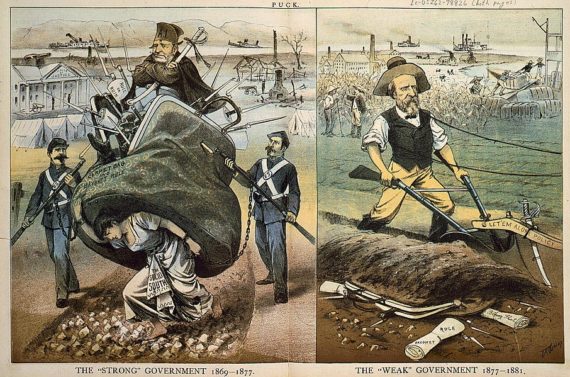
In his book Reconstruction: America’s Unfinished Revolution, 1863-1877, the Marxist historian Eric Foner advances a revisionist history of the Reconstruction Era. In his preface, he explains why revisionist history is important:
Revising interpretations of the past is intrinsic to the study of history… Since the early 1960s, a profound alteration of the place of blacks within American society, newly uncovered evidence, and changing definitions of history itself have combined to transform our understanding of race relations, politics, and economic change during Reconstruction.
Murray Rothbard distinguished between revisionism whose aim is to expose the truth about history, and revisionism designed merely to promote the official version of history: “A venerable institution, furthermore, is the official or ‘court’ historian, dedicated to purveying the rulers’ views of their own and their predecessors’ actions.” Foner’s task in revising the history of the Reconstruction Era is, as he sees it, “to produce a coherent new portrait,” one that is more in line with “a profound change in the nation’s politics and racial attitudes.” In this sense, he may be described as a court historian promoting the official vision of racial diversity and integration. The “unfinished revolution” of his title emphasizes the radical transformation in race relations in the South. To further advance the revolution, he set out to displace the historians associated with “William Dunning, John W. Burgess, and their students.” In his book he argues that there is a need “to deal the final blow to the Dunning School.” More recently, he said his intention in writing about the Reconstruction era was to “put the final nail” in the Dunning School,
Reconstruction is one of the most misunderstood periods of American history, and I hoped my work would put the final nail in the Dunning School [a cadre of scholars whose work promoted the idea that Reconstruction ruined the South, and freedmen were incapable of self-government].
The problem with the Dunning School historians, as Foner sees it, is that they interpreted historical facts in a manner that is “racist.” He criticized them for failing to appreciate the contributions made by freedmen to reconstructing the South, and took umbrage at their racially insensitive turn-of-the-century language. They used words like “negro” which are now prohibited by the political-correctness manual. The Dunning School historians were not hugely interested in Foner’s main subject, namely, race relations and socialist revolution. He therefore criticizes them for failing to center blacks in their historical narrative, remarking that “blacks in fact played little role in the [Dunning School] narratives.” According to Foner, by failing to give due accord to the role of black people, the Dunning School fails to align with the eradication of “white supremacy” and, therefore, almost by default, it helps to entrench white supremacy. He therefore blames the Dunning School for racial segregation in the South, forgetting that racial segregation was invented in Connecticut and Massachusetts in the 1830s.
Dunning School historians aimed to document the history of the South at a pivotal time. For example, in Civil War and Reconstruction in Alabama, Walter L. Fleming observes that black legislators and voters were easily manipulated by Northern “carpetbaggers” and corrupt officials. Court historians argue that in this way Fleming implies that black people inherently lack the capacity for independent political thought. They see it as racist to observe that black people “were the tools of the Radical leaders” because, in their view, it dehumanizes black people and implies that they are racially inferior. It is “racist” to state that black people in the “carpetbagger” government were self-serving or corrupt, or that they made decisions purely to curry favor or for financial reward. Court historians argue that such interpretations marginalize the agency of black people, portraying them as unfit for political roles. Minimizing the contributions they made to the reconstruction government in turn justifies white supremacy as necessary to restore and maintain law and order. Arguing that blacks made little significant contribution to society and governance during Reconstruction, or even questioning their loyalty or intentions toward the South, is “racist.”
Double Standards
Eric Foner is a favorite of court historians, who have showered him with accolades for displacing the “racist” Dunning School. But the same court historians have a completely different perspective on “racism” in the context of another contested issue of black history, namely, black Confederates. Court historians reject the notion that black people played any important role in the antebellum South—other than their role as unpaid slave labor. In this context, we hear nothing about the need to center black people—unless we are centering them as slaves. The court historians’ exhortation concerning black Confederates is the precise opposite of that advanced concerning Reconstruction—in understanding the Confederate era we must marginalize and even erase the role of black men.
Court historians do not accept that black people could possibly have seen the South as their home. After all, as the New York Times 1619 project reminds us, they were kidnapped from Africa and regarded by Southerners as nothing but slaves. Marxist theories of exploitation teach that slaves were so brutalized that they had no feeling of loyalty and certainly no conceptualization of home and hearth. In relation to black men like Harrison Berry who rejected the abolitionist adventurers of the North, they argue that such men were merely expressing the opinions of their masters. They believe that black people inherently lacked the capacity for independent political thought, and men like Charles Benger or Holt Collier who marched with Confederates were merely the tools of Confederate officers. Black men who expressed devotion to Confederates did so for self-serving reasons—perhaps to curry favor with Confederates or even in hope of financial reward.
These double standards infuse the discourse on black Southerners. Court historians do not worry that their interpretations may dehumanize blacks or imply that blacks are inferior, nor are they concerned that it marginalizes the agency of black people, portrays them as unfit to serve in important roles, and minimizes their contributions to the Southern cause. In this context court historians are noticeably blasé about what might seem “racist.” After all, unlike the Dunning School, court historians are the self-appointed good people so nothing they say could possibly be perceived as racist. They innocently demand strict proof that blacks made any significant contribution to the Southern cause. The emphasis is on the word “significant,” as all evidence that goes against the official narrative can readily be dismissed as trivial.
For example, Foner says there may have been a few black Confederates, but nothing significant: “It’s no surprise that a few did [bear arms and fight], but there is little evidence for the combat role of blacks in the Confederate army,” says he. Any stated loyalty or intentions of black people—which were widely reported in the newspapers of the era—must therefore be met with skepticism and questioned unless there is conclusive corroborative evidence such as photographs and official Confederate government records. Do you have primary source evidence of a Confederate government meeting where the minutes record the Confederate President himself extolling the significance of Holt Collier, the black Confederate cavalryman and sharpshooter? Do you have photographs of Holt Collier on the battlefield, at the front, actively shooting at Yankees?
It so happens that none of the available historical evidence—whether from the Official Records of the war or from other reports of the time, suffices to satisfy the court historians. The presumption that black Confederates made no significant or valuable contribution to the Southern cause, and were of little benefit to the Southern war effort or the broader Southern society, is deemed to be so strong that it is all but impossible to displace. Although Foner acknowledges that “slaves have often taken up arms on the road to citizenship, and it would be foolish to think slaves could not bear arms and fight for their owners’ side”, he insists that “we find more acting as personal servants, cooks, laundresses in Confederate camps, not being armed for battle.” Laundresses? We are to believe black men were only in the army to cook for soldiers and launder their uniforms. Charley Benger—who was described by his captain as “a faithful old soldier and a devoted old friend”—is typically depicted in derisive terms as a man who “claimed” to be a free man who served in the Georgia armies. He “claimed” to be free? It seems he was not capable of being quite certain whether he was free or not, or at any rate we should not take his word for it as to whether he was free.
Benger claimed to be a free African American man who served when the British invaded Darien, Ga. … Benger was well-liked among his comrades and soldiers would roll him around in a wheelbarrow to camp where he was greeted with cheers.
We also learn that Benger “was a side clown show” and should therefore not be memorialized among the “real” soldiers: “Mayor Lester Miller has opted to not authorize the donation of a plaque in honor of a Black Confederate fifer.”
The fact that the Macon Volunteers buried him with full military honors is deemed to be irrelevant, because playing the fife is considered insignificant. The official narrative is that black men who marched with Confederates merely did housekeeping chores and rolled around in wheelbarrows to entertain the troops. That is not worthy of a memorial plaque. Only white men count as “real” soldiers. These are the messages brought to us by court historians who denounce the Dunning School for referring to blacks, as Foner puts it, “as passive victims of white manipulation or as unthinking people.” Yet, it is not racist or white supremacist at all when court historians do precisely that of which they accuse the Dunning School. It seems that double standards are acceptable if they help to advance the establishment narrative.
The views expressed at AbbevilleInstitute.org are not necessarily those of the Abbeville Institute.





Thank you for this piece, Dr. Njoya. Eric Foner is the worst kind of historian, one who insists that seeking historical truth is really just a power game in which one side tries to define its narrative as “true” and the other side’s narrative as “false,” (which, he says, is just like politics). Why truth is superior to falsehood he does not explain; given that he is a postmodernist as well as a Marxist, I suppose he does not have to.
Anyone who thinks Eric Foner is in any way trustworthy should remember that he urged Gorbachev to hold the Soviet Union together by force in an article published by The Nation magazine in February (I think it was 11 February) 1991. It was entitled “Lincoln’s Lesson.”
If these people did not have double standards, they would have no standards at all.
The first black military officers in the New World were those from the 1500 free, black men in the Louisiana Confederate Native Guard. These men volunteered to form a Confederate militia. After New Orleans fell, they were conscripted into union service, stripped of officer rank and used as cannon fodder at Port Gibson.
See Department of the Gulf, General Order 63. Of course, the American Battlefield Trust doesn’t understand what to disobey an order while under martial law implies for the rebellious…
That Black people could not possibly see the South as their home. That’s a good one, one that comes the roots of racism – Foner. Beautiful letter here
Looking forward to becoming more familiar with the “Dunning School”
Add Ken Burns and his upcoming series on the American Revolution 250 years, on PBS, beginning in November. Watched the preview last week, as he did “highlights” of the 7-part Series. NOT as I have read, heard and seen in the past 60 years, since I was 10 years old. The series IMHO…garbage.
Frederick Douglass despised slavery…said you cannot imagine the horrors of Massa buying you weeks’ worth of cake and whisky at the holidays…but still…he clung to the “horror” story…just read his autobiography and try to overlook the contradictions…and never forget, slavery was so horrible; he got into a fistfight with his Massa and whipped ole Massa good…and somehow…lived to write an autobiography.
Man, slavery sucks. I never have seen an easy way out, as evidenced by continued poor condition of slave descendants after summary freedom in 1865. We aren’t, either, allowed to utter the truth of their advantage over kinsmen in Africa. Further undeniable is there was no moral element in the United States’ war against the Southern states. They missed their chance to proclaim it, instead proclaiming “For the Union” in their insistence on dominion over Southern ports and coastline for trade, security and empire.
Nevertheless, a man shouldn’t deny another’s will, own the product of his labor, or sell him as farm implement or animal. Read a few volumes of the current publication of the Slave Narratives, interviews of former slaves from the 1930s. There were countless variations of experience. There are, indeed, many who remembered better times with Ol Massa and Missus, many stayed with their “white folks” after freedom. Many friendships are recounted. Yet, even some of the fortunate ones had seen or knew of barbarity. Many witnesses experienced it themselves. Whippings with “cat’o’nines” followed by salt in the wounds; processions in chains from North Carolina to Richmond for the auction block; there, pleadings by young mothers for their purchasers to buy their children only to have then wrested from their arms. The subtitle admonition on each volume of the series reads:
“Tisn’t he who has stood and looked on, that can tell you what slavery is – ’tis he who has endured.” (John Little, fugitive slave, 1855)
There was once a War where one side invaded with millions of men; lost hundreds of thousands of lives on battlefields, lost tens of thousands of weapons on battlefields policed by slaves and actively encouraged slaves to rise up and kill their masters’ wives and children which resulted in ZERO slave uprisings.
The lie of “the grapevine” was invented to pretend aggrieved blacks were merely “more informed” as to the eventual disposition of the War, which is the reason presented why they remained FAITHFUL to their masters. But “the grapevine” is now discredited by the revelation of JUNETEENTH with slaves in Texas being neither in a state of uprising nor informed. I am sure after the Battle of First Manassas, the grapevine was very conflicted, and yet still, the slaves did not revolt.
BT Washington said, in Chapter 1 of UP FROM SLAVERY, “we loved our masters”. BT Washington exact quote was, “to protect the women and children left in our care when the White men went to war, the slaves would have laid down their lives”. Greater love hath no man than to lay down his life for a friend, which is from a book well known by the readers of UP FROM SLAVERY. Of course, blacks do not name schools for BT Washington these days, as they did back when they were happy to be lifting themselves up by their own bootstraps.
I have read thousands of the Slave Narratives. I worked for Citigroup when Citi bragged on digitizing these Slave Narratives so everyone could see how poorly the enslaved were treated. I laughed when I realized what Citigroup had actually accomplished. Citigroup had presented a buried fedgov document that ran counter to the NARRATIVE, which is why NONE of us had seen these made public prior.
Tens of thousands of free blacks fought for the Confederacy. A free black man in Mississippi in 1860 could move about, own businesses, own slaves while that same man could not MOVE to Illinois, nor could he LIVE in Oregon, which entered the union in 1859 as a Whites-Only State. Said union being controlled by yankees intent upon enlarging their control over the Houses of Congress. I suppose you could say the slaves knew nothing of these realities, but free blacks knew the truth. Perhaps these two groups passed information to each other.
The stewpot or the slave ship. One was a death sentence, the other was passage out of the Stone Age. If blacks had been mistreated, they would have jumped on the yankee offer to exact revenge. The Five Civilized Tribes weighed their options and went with the Confederacy. So, we have evidence of two “suffering” groups supporting the War for Southern Independence, because no one wants to live under an oppressive federal government.