

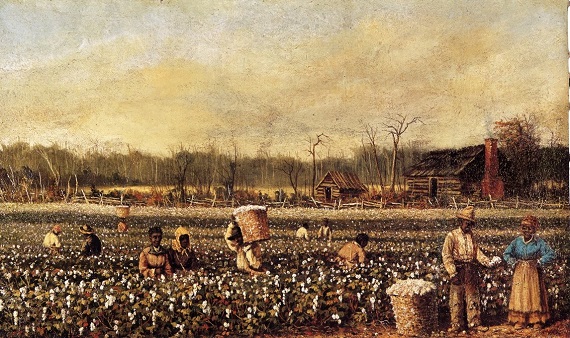
No topic of importance in the Old South may be handled rightly without dealing with the Peculiar Institution, slavery. The holy Sabbath was no exception. Embedded in the Ten Commandments, the fourth commandment (according to Protestant enumeration) – to remember the Sabbath day to keep it holy – called for a weekly day of public worship and rest from secular labor and activities. The first day of the week, the Christian Sabbath, was a cultural pillar of British colonial society. It continued as such well into the nineteenth century in both “the American States” and England itself. On the western shores of the Atlantic and below the Mason-Dixon Line, a number of those who were considered professors of Christianity, and some non-professors, viewed the Sabbath’s observance by whites as inextricably linked with that of blacks. Moreover, some commentators who addressed the topic showed that each group’s practices regarding the day of worship impinged on the other, with resulting implications for the local society.[1]
The desire of Southerners to maintain social harmony could hardly be divorced from their anxieties related to blacks. In July 1829, William B. Beverley of Blandford, in Essex County, Virginia, wrote to his father, Robert, of business and other matters, adding: “This county & the three below are in a state of considerable excitement, under the apprehension of a rising of the slaves. The insurgent spirit is so manifest in Mathews, Middlesex & Gloucester, it is said the 99th Regiment have been called out for safety.” Such concerns were of course heightened after Nat Turner’s short-lived slave revolt in Southampton, Virginia, in 1831. Within a few years, as the utopian radical – or immediate – abolitionist impulse gained ground and became more aggressive, southerners’ anxieties increased still more. In 1835 in Madison County, Mississippi, a planned slave insurrection apparently came to light just in time to prevent likely bloodshed. According to one of the convicted slaves who confessed freely, arms and ammunition had been procured “and deposited in various secret places,” and other essential arrangements made with the assistance of several whites. An attack on the white inhabitants of the town of Vernon had been planned for the night of July 4th. “The whites, thus taken by surprise, were to be indiscriminately slaughtered.” Upon capturing the town’s arms and ammunition, the insurgent force “was to be directed against the town of Livingston where similar proceedings were to be had.” From there, the attacks and slaughtering might continue to Clinton and beyond. Thankfully, the plan was never executed. But regardless of Southampton, Madison, and other cases of actual or suspected slave conspiracy during the period, a small number of Christian Sabbath reformers expressed their concerns for the day’s observance by both whites and blacks.[2]
Critique of “LOOKER ON,” 1828
In August 1828, a writer using the pen name “LOOKER ON” sent two letters to the Presbyterian-affiliated Richmond, Virginia, weekly, The Visitor and Telegraph, on the subject. In his first letter, addressing the Sabbath transgressions of white youths, he noted with satisfaction the formation in New York of a national Sabbath reform society, the General Union, for “the suppression of Sabbath breaking.” LOOKER asserted that most of the “vices and immoralities” threatening to engulf communities everywhere “may be clearly traced back to their source in the [wasted] and desolated Sabbath. Thus, children, and many . . . of professedly pious parents—are allowed to spend the day in their ordinary amusements—in hunting, strolling the fields, &c.,” soon losing “all idea of its sacredness” and engaging in activities “the most fitly suited to drive their thoughts from heaven.”[3]
LOOKER then moved to his main topic: promoting Sabbath schools for teaching piety to children. Noting the “flood of moral pollution” which LOOKER attributed to “the want of proper restraint in families,” he proposed the forming of “Family Sabbath Schools” by private Christians. If a pious man or woman “would set apart a few hours on the Sabbath, invite the children for a few miles around, to come in and read, recite lessons—and receive elementary and religious instruction, they would do an incalculable amount of good.”[4]
LOOKER’s first letter indicated his deep concern for the Sabbath day activities of the children in the community—white children—but his second letter emphasized the practices of adults, white and black, on that day. The writer complained of the habit of some people, who, “. . . if they have a little neighborhood business to attend to . . . set apart the Sabbath for accomplishing it.” There also were many, who, “. . . when they have occasion to take a journey for purchasing goods” or selling their crops, “. . . make it their almost invariable rule to start from home on Sabbath morning.” By the 1820s, travelling for secular purposes was one of the main sources of angst for Sabbath advocates nationwide – perhaps especially for those familiar with Judah’s profaning of the Jewish (seventh-day) Sabbath recorded in the Old Testament books of Jeremiah and Nehemiah. The increasing availability of steam boats, canals, and improved roads that tempted farmers North (especially) and South (to lesser degree) with the opportunity to transport their goods to market at a fraction of the cost in earlier years exceeded the will of many to resist. In a sense this was the core of the Sabbath’s decline throughout the period: the moral law of God notwithstanding, the crass reality for many – including a number of church members, as some observers painfully confessed – was that one might make money seven days a week instead of only six.[5]
In contrast to Sabbath keepers like LOOKER, a well-known Sabbath opponent, Anne Royall, described her experience in northern Virginia around 1823. Royall expressed delight at the “great number of [wagons] which (though Sunday) were going and returning from Alexandria; the road, which passed near the door, was full from morning till long after dark.” Royall was an extreme example of the type of person LOOKER had in mind. Regardless, the writer noted that upon remonstrating with such market-goers for their practice, one was likely to be told “that this is no violation of the Sabbath!—that they can spend the day when travelling on the road, as appropriately as at home.” The hypothetical response continued,
And as for the slaves it is far better for them to be going to market with their teams, than to be loitering about home;—that they are committing less sin; and that . . . if not thus employed, they would be in some mischief—getting drunk or pillaging the property of their masters. . . . Therefore to keep them employed with their teams on the road . . . instead of being a sin or a grievance, is really an act of mercy to the souls of the negroes.[6]
Another common practice that LOOKER criticized was the opening of stores and grog shops on the Sabbath. This, he observed, was responsible for “incalculable” evils:
Some merchants attend . . . to selling goods on the Sabbath, particularly whisky to negroes; as if [they] . . . were not wicked . . . enough already. . . . The apology generally made . . . is that negroes have no other opportunity than the sabbath for trading and attending to their own concerns.—Poor apology—nonsense.[7] There are but few men, who would not grant to their servants an hour or two in the week . . . to attend to [business] for themselves.[8]
LOOKER also viewed participation in Sabbath violations by “professors of religion, or rather who once were professors,” and some magistrates, as responsible for allowing the evils of gambling, drinking, fighting, and “playing ‘fives’” on the sacred day to go unchecked. Undoubtedly, both whites and blacks were guilty. He called for the civil authorities to put down the various Sabbath infractions and to enforce the laws of the Commonwealth respecting the day. In this, he stood apart from the Virginia Sabbath Society (formed in 1830) which specifically refused to pursue even the enforcement of existing laws, much less to pursue new measures. Though the writer was distressed by the poor Sabbath practices of children and adults and of whites and blacks individually, the day’s activities of whites with regard to blacks was an integral part of the issue.[9]
Critique of “Z,” 1829
One year later, another insightful observer wrote four letters for The Visitor and Telegraph on the same subject. This writer, “Z,” was concerned with the effect upon blacks of Sabbath profanation by whites, specifically the practice of “making purchases from the colored people on the Lord’s day.” Viewing the practice as “a long-standing evil in our [Southern] country,” Z set about to reform the public conscience: “It is . . . high time that the sentiments of the christian public should be brought to bear on this subject.” In discussing the problem, Z wrote that at nearly every tavern and post office along the mail stage routes in Virginia, the Carolinas, and Georgia, “. . . you will find servants with their articles of commerce” ready to trade on the Lord’s day as the mail stage passes town. He perceived that all who purchased articles from blacks on the Sabbath were “guilty of calling them away [from the worship of God] for the sake of gain.”[10]
For both whites and blacks, the problem of Sabbath day commerce went far beyond the mail stage routes, however. At Savannah, Georgia, in 1828, a committee of concerned citizens petitioned the mayor and city aldermen to “prevent the sale of any articles on the Sabbath, after 9 o’clock in the morning.” White worshipers in the city’s churches were seriously annoyed by the permission “granted to colored persons inhabiting the adjacent farms and plantations to vend their commodities during the whole of the sacred day.” Not only was the Sabbath disrespected, but the city’s worshipers were forced to listen to “the rude cry of the blacks offering their articles for sale, under the very windows of their churches.” There was no mention of that portion of the purchasers who were white.[11]
Not only did Z criticize the practices of whites and blacks, he linked the evils of trading on the holy day with the Sabbath mails controversy which was at its peak between 1828 and 1830. Z queried: “Does the transportation of the mail on the Sabbath, cause, in the same bounds, more to violate it than this dealing with servants? Every man who would sign a memorial [to halt Sabbath mail transportation and delivery] . . . ought to feel deeply interested in the suppression of every general violation of it.” Referring to the well-publicized fact that the moving of mails and opening of post offices on the Sabbath prevented thousands (of whites) from attending worship on that day, Z asserted “it is equally true that many of your trading blacks are kept from the church, and this is peculiarly distressing on account of their condition.”[12]
Concerned for the souls of the black as well as the white population, Z referred to the fact that few blacks possessed a Bible or could read. He estimated those taught to read were “scarcely one to a plantation.” Nat Turner of Southampton was one who was literate and possessed a Bible. Lucy Skipwith, the house slave of scientific farmer and Sabbath and temperance reformer John Hartwell Cocke of Fluvanna County, Virginia, was literate and maintained a correspondence with her master. But those that could read, Z felt, “. . . seldom read so well as to derive much instruction from books and especially the Bible. And of those who can read, how few have a bible of their own to read at their leisure.” Employed during six days of the week in their owner’s service, “. . . they have no time for the acquisition of knowledge. But the Lord hath given them one day in seven, and requires their undivided services on that day. And shall men eager for all the services of bondmen, claim paramount authority with God and throw temptation in their way to violate the Sabbath” without incurring guilt? The practice of whites keeping blacks from worship or tempting them away with trade for Sabbath gains was a serious charge, indeed, particularly within the bounds of one corner of Christendom.[13]
But evil compounded evil. Blacks who absented themselves from the house of God, said Z, were likely to visit “the tavern, the store, or lounge about the courthouse, catching every sound of the profanation of the name of God” in addition to hearing the slanders of the neighborhood. Instead of hearing the Bible, they were apt to listen to “marvellous tales of spirits, witches, ghosts and hobgoblins, to tell your children when they go home.” Z exhibited concern not only for the consequences for blacks of Sabbath breaking by whites, or of Sabbath profanation by blacks themselves, but also for the ramification for white children under the influence of immoral, Sabbath-breaking blacks.[14]
Moreover, Sabbath breaking and intemperance went hand-in-hand, as moral reformers frequently complained in that era. Z opined that with the proceeds earned from Sabbath day trading, blacks were tempted “to treat one another to ‘some dram’ as they have seen white people do. . . . How many have thus become addicted to intemperance? How many have been known to carry it home to their wives and children, giving them also a relish for the burning poison?”[15]
Dram shops, and plenty of others, were a problem in Charleston, South Carolina. In March 1828 the Charleston Observer reported that petitions containing more than 4,500 signatures had been presented to the Common Council in the city calling for “the closing of shops on the Sabbath.” Many of the petitioners were “gentlemen of the highest respectability, influence and wealth.” The length of the petition was “upwards of ninety feet.” An investigation conducted on the Sabbath, November 11, 1827, revealed that 1,469 shops had been open for trade “either entirely or partially.” The establishments included 422 dram shops, 420 groceries, 283 fruit shops, 26 clothing shops, 58 shoe stores, 10 hat stores, 18 confectioners’ shops, “4 segar shops . . . 57 bread and cake stores, 10 dry goods . . . 53 oyster shops, 70 barbers’ shops, 27 butcheries, 1 blacksmith’s shop,” and more. If at one-half of the groceries, fruit shops, and oyster shops, “. . . liquors are sold by the small measure . . . then of the 1,469 shops kept open on the Sabbath, 800 are in effect dram shops.” The concerned citizens were certain that such facts “tell us why our poor-houses, hospitals and prisons, are so crowded with inmates,” while the churches “are so thinly attended in comparison with the greatness of our population.” Without doubt, slaves were among the clientele at some shops.[16]
Certain “grog shop” keepers felt they were unequally treated, however. In 1834 a local committee of petition and complaint informed the honorable intendant and city council that both their reputation and pecuniary interests had suffered unjustly at the hands of “a class of houses, which, under the show of selling ices, and lemonades, and beverages of this sort, are actually selling punch and other intoxicating drinks much to our detriment.” Not only had the petitioners suffered the loss of patrons – leaving them with those who “drink but never pay, together with the colored population” – their resourceful competitors had “invented a new nomenclature, which none but the initiated understand—by which Julep, Mint-sling, Toddy, Punch, Gin, Brandy, &c., are called for under other names.” The aggrieved shop keepers requested equal opportunity to break the Sabbath, and called upon “your honorable body to grant us the same right which they exercise, of keeping open houses on the Sabbath.”[17]
The prevalence of grog shops open on the Sabbath may have been worse in Charleston than in Richmond, but in any case Z asked, “Now if they [mostly slaves] are neither taught to read nor instructed in the precepts of the Bible during the week, and are drawn away from the sanctuary on the Sabbath, what must be their condition?” Surely the totality, to Z as well as a number of other evangelicals of the day, was one of “contracting strong habits of sin, and thus treasuring up wrath against the day of wrath. . . .” “Is this their guilt?” asked Z. “Did they bring it upon themselves?”[18]
In Roll, Jordan, Roll: The World the Slaves Made, historian Eugene Genovese noted, “Even on the best-managed plantations, which boasted well-fed slaves, the plundering of the hogpen, the smokehouse, the chicken coop, and the corncrib constituted a normal feature of . . . life.” Genovese observed the differing morality of blacks and whites regarding theft within the slavery institution. Slaves “stole from each other but merely took from their masters. Their logic was impeccable. If they belonged to their masters – if they were in fact his chattels – how could they steal from him? Suppose they ate one of his chickens. . . . They had only transformed his property from one form into another.” Regardless of such fine distinctions, Z’s second letter addressed – from the master’s perspective – the problem of Saturday night thefts by blacks “committed in anticipation of the market on Sunday.” Z believed that the blacks’ “midnight depredations” were more common in those locales where Sabbath day trading with them was most extensive. It was a long-lamented evil, yet little had been done about it. He observed that upon being assured that whites would buy from them, some blacks were
kept devising ways . . . to furnish you with the articles—and should every honest way fail, then perhaps you may see them as they pass the plantation of your neighbor examining into the condition of the corn-house—smoak-house—chicken-house—or spring-house, &c. for your money they must have, if, to procure it they should be compelled to steal.[19]
Z reasoned that this habit arose because stolen items could not be hidden for long without the danger of discovery, thus, “. . . the stealing of them is deferred to the last night in the week.” The penman exhorted his readers not to encourage blacks “to bring any thing to you on the Sabbath to sell, for in doing so you encourage them in stealing.”[20]
The fact that so many slaves had the opportunity to bring items on the Sabbath indicated a degree of liberty to travel that few of them, such as teamsters or drovers, enjoyed on other days. In The Reshaping of Everyday Life, 1790-1840, historian Jack Larkin wrote, “The Sabbath was the slaves’ closest approximation to freedom, when they could walk the roads to visit friends and family in separated quarters or on other plantations.”[21]
In 1828, an article on the Sabbath in the Presbyterians’ Charleston Observer reinforced Larkin’s approximation to freedom, often with ill consequences for slaves with regard to the gospel. The writer asserted, “Many Christian masters permit their servants on the Sabbath to roam at large—nor do they attempt to advise or control them with respect to the observance of this sacred rest.” Although some slaves – a typical estimate was roughly two-thirds women – frequently attended worship, the writer feared “it is apparently equally well [with masters] if they spend that day in visiting and amusement.” Too few Christian masters were devoted to setting “a superior example” for those with “immortal souls committed to [their] charge. As ‘faith cometh by hearing, and hearing by the word of God,’ we would respectfully inquire if it be not the duty of every Christian, having servants under his care, so far to control them as at least to give them the opportunity of hearing the Gospel of Christ?” The Westminster Larger Catechism, which Presbyterians of various brands subscribed to, addressed this very issue: “The charge of keeping the sabbath is more specially directed to governors of families, and other superiors, because they are bound not only to keep it themselves, but to see that it be observed by all those that are under their charge; and because they are prone ofttimes to hinder them by employments of their own.”[22]
Although Z’s identity was unknown, his doctrine was that of the Protestant Reformation. Concluding his second letter, Z wrote with fervor:
The question is this,—does not your trading with them on the Sabbath encourage them to steal more than if you did not? . . . That their hearts are wicked by nature we learn from the Bible. All men whether white or black are by nature totally depraved. But whence have you learnt that the depravity of our blacks is greater than your own? Their forefathers might have maintained the same argument with respect to those of your color when they were stolen from Africa by the whites. The truth is there was a door opened to gain money by stealing the African; and now you open a door for the African to gain your money by stealing, and he thinks not of turning his back on it.—“The carnal mind is enmity against God” [1 Corinthians 15:33], whether the skin be white or black; only prepare the way for sin, and it is ready to walk in it.[23]
In addition to their concern for slaves’ Sabbath-breaking and stealing, however, churchmen also addressed the seventh commandment’s implications. In 1818, the Charleston Baptist Association received a query from the Church at Three Creeks, which asked: “If the wife of a slave desert him without just cause of offence, and take another man for her husband, refusing to return to the injured person, notwithstanding his earnest endeavours to reclaim her, and willingness to forgive her offence, can he be justified by the word of God in taking another wife?” The very act of asking such a serious question – the discussion and response to which was to occupy the energy and time of the association’s leaders – suggested that whatever may have been the conditions of the slaves from one plantation or farm to another, the opportunity for de facto marriages must have existed broadly.[24]
The Charleston association answered:
We think in such a case the injured person has a right to take another wife. The reasons for which opinion are—1st, The law of Christ, according to our view of it, admits of a divorce, in the fullest sense, in cases of adultery and obstinate desertion. 2nd The civil government, among us, has made no laws to regulate the marriage of slaves: so that they are left, in this respect, in a state of nature, to be governed by the laws of God directly and alone.[25]
The Bible was the standard for all mankind, regardless of one’s condition. Faithful Christians and churches did their best, albeit imperfectly, to apply its teachings to real life; as they do today.
In his third letter, Z dealt with the habit of lying as a natural accompaniment to stealing. Again, Z referred to the consequences of the practice of whites trading with blacks on the Sabbath: “. . . I do not say that every article that is stolen and every lie that is told, are consequences of trading with negroes on the Sabbath. But I do say that it is the core—the grand cause of the evils that have been ascribed to it.”[26]
Although most whites perhaps had little excuse for participating in Sunday trading other than their own unbelief in the Bible and its commandments, Z calculated that blacks’ primary excuse for their commerce on that day was, “‘I have no other time,’—thus he would throw the guilt on his master, whom I would ask, How often do your servants have any thing to sell at the Sabbath market?” If not more than once a month, as Z surmised, “. . . would you not prefer giving your servants that little time on the evening of a Saturday or some other day, to exposing them to all the evils and guilt consequent upon this breach of the Sabbath?” Closing his letter, Z challenged all slave owners: “As you regard the law of God and the salvation of your souls let this excuse of the negro be true no longer. . . . You will presently hear the account which your servants will have to render to their judge and your judge—And shall it then be heard from your servants, ‘I had no other time?’”[27]
LOOKER ON and Z were not the only ones to exhort masters to grant their slaves a few hours in the week to conduct their small-scale business activities. A decade later, a Baptist correspondent wrote three pieces for the Religious Herald affirming the Christian Sabbath and addressing its observance. In the final article he attacked the “too prevalent” practice throughout the South “of trafficking with slaves on the Lord’s day.” He agreed with LOOKER and Z that it was “generally pleaded, that the poor slave has no other time in which to vend his articles.” Some if not many who made that claim, however, attempted to rationalize the Sabbath’s desecration as “an act of necessity on the part of the vendor, and an act of mercy on the part of the buyer.” The Baptist writer rightly placed the burden of proof on the promoters of “this unhallowed traffic,” while observing it was “notorious, that those who stroll about the country, on the Lord’s day, vending their wares, are, of all slaves, the most wretched and degraded.” He drew a sharp contrast between the vendors, who – after attending to their business, were seen attired “in filthy rags, crowding a grogshop . . . or stretched out by the highway in a state of intoxication” – and those slaves who attended worship, “. . . in clean and neat apparel, and with countenances expressive of contentment.” The penman asserted, “There is scarcely one master in a hundred, who would not cheerfully allow a servant an opportunity, during the week, of vending his wares, if that servant manifested a scrupulous regard for the Sabbath.” Many masters, he added, would “insure him privileges, which are not ordinarily allowed to the slave.” He concluded this section by appealing to masters “for the truth of what I affirm.”[28]
While almost any statement touching upon slavery was a bold undertaking in that day – this writer’s was all the more so because he had identified himself in the Herald’s pages. If any readers, masters or otherwise, disagreed, there was some potential for personal consequences of one sort or another for the outspoken Virginia Baptist minister, missionary, and evangelist – later an editor – Joseph S. Baker. His biographer noted Baker “was courageous as an editor,” which manly trait was foreshadowed in his essays of March 1837.[29]
The Difficult Matter of Slaves’ Physical Punishment
Z’s third letter alluded to the difficult, often disturbing, matter of the punishment of slaves as consequence for stealing (and the lying that accompanied it). In his lengthy discussion of typical Saturday night thefts, usually in anticipation of selling stolen items on the next day, Z wrote:
The servant who has been arraigned before his master or the civil authority for stealing and is found guilty, must receive a recompense for his conduct (often from those who cause it too) [that is, their masters who failed to allow them some “little time” during the week to trade or sell] in pains of stripes and ropes and chains and dungeons and brandings. Cannot masters, sheriffs and jailors testify to the truth of these things? What is the number of servants that have been brought to the experience of these things in consequence of stealing articles to sell on the Sabbath within the bounds of your neighborhood—your county—your State—our Southern country? What is the amount of suffering that is thus brought upon the African tribe of our land?[30]
Such well-informed mentioning of “stripes and ropes and chains and dungeons and brandings” – from the pen of one who held biblical, reformed doctrines and was unafraid to hold masters accountable, as he saw it, for their part in their slaves’ misbehavior – may easily disturb the mind and sensitivities of the present-day Christian, as well as the secular, reader. And well it should.
The topic of slave punishment, candidly introduced by Z in 1829, provides a learning opportunity the writer is convinced should not be overlooked – factually, dispassionately, and biblically – by reformed Christians living several generations beyond the period in which such ill treatment occurred. In one chapter entitled, “Standing Up To The Man,” Genovese wrote:
Slaves especially challenged overseers and, less readily, masters who were trying to whip or abuse them. These cases occurred much more often than generally believed, and sometimes they ended in death, by no means always the slaves’. The frequency and numbers remain elusive, but the ubiquity of the reports from so many different sources suggests that life in the fields as well as in the Big House was often lived on the edge of violence.[31]
Genovese’s slave life “on the edge of violence” suggested one element of what the apostle Paul may have had in mind in the sixth chapter of his Epistle to the Ephesians in the section addressing slaves and masters (despite the significant differences in the social systems of the apostolic church age under Rome and the Old South): “And, masters . . . give up threatening, knowing that both their Master and yours is in heaven, and there is no partiality with Him.” If it did nothing else, the divine command to cease threatening pointed toward the ever-present potential for arbitrary violence on the master’s part toward the slave. The possibility or the threat of arbitrary violence, arguably, is of the essence of any slave system regardless of time or place.[32]
Given the state of American culture and education in the 21st century, some contemporary readers may be forgiven for assuming – to the extent that arbitrary violence in American history has been more-or-less a cultural feature – that it has been almost exclusively a white-on-black matter stemming from slavery days. This is decidedly not the case. Although the nineteenth century Virginian, Z, described such violence within the context of slavery in the Old South, there has been no shortage of other cases, sadly, almost equally as offensive to Christian – indeed, all civilized – sensitivities.
In America at 1750: A Social Portrait, a book published shortly after his death, noted historian Richard Hofstadter described white servitude at length. Hofstadter assessed that a considerable majority of white immigrants who came to the colonies south of New England “were servants in bondage to planters, farmers, speculators, and proprietors.” Although the types and conditions of servitude varied widely, from “a special class of bonded servants” known as redemptioners – who exchanged their Atlantic passage for years of hard service – to convicted criminals to the unemployed or drifters, physical punishment was commonplace. Whippings were typical for various offenses, actual or perhaps perceived on the part of masters or overseers attempting to get as much labor as possible from a time-limited servant. Colonial Sabbath statutes that prohibited secular labor included rest granted to servants and slaves, but an unscrupulous master often retained a degree of autonomy aside from the law. In 1770 the English surveyor of customs at Annapolis believed the Maryland Africans were better treated than “the Europeans, over whom the rigid planter exercises an inflexible severity.” The Englishman reasoned that because the blacks’ servitude was lifelong they received better care than their white counterparts who were “strained to the utmost to perform their allotted labour. . . . generally speaking, they groan beneath a worse than Egyptian bondage.”[33]
Under such circumstances, endured by so many whites in servitude, corporal punishment including whipping was expected. It was the plight of the poor. Hofstadter concluded:
. . . when one thinks of the great majority of those who came during the long span of time between the first settlements and the disappearance of white servitude in the early nineteenth century—bearing in mind the poverty and the ravaged lives which they left in Europe, the cruel filter of the Atlantic crossing, the high mortality of the crossing and the seasoning, and the many years of arduous toil that lay between the beginning of servitude and the final realization of tolerable comfort—one is deeply impressed by the measure to which the sadness that is natural to life was overwhelmed in the condition of servitude by the stark miseries that seem all too natural to the history of the poor.[34]
In Two Years Before the Mast, Richard Henry Dana Jr. (1815-1882) told his own story as a sailor aboard the brig Pilgrim, which embarked from Boston in August 1834 bound for the west coast of North America via Cape Horn. Dana was a student at Harvard and had decided to take time away from his studies in hopes of curing “a weakness of the eyes.” The ship’s captain was one Frank Thompson, who spoke of himself thusly, Dana recalled: “I’ve been through the mill, ground, and bolted, and come out a regular-built down-east johnny-cake, when it’s hot, damned good; but when it’s cold, damned sour and indigestible—and you’ll find me so!” . . . The captain was true to his word and one of his nicknames “in all the ports was ‘The Down-east Johnny-cake.’”[35]
As Pilgrim collected hundreds of hides along the California coast for markets back home, Dana wrote that for days the captain “seemed very much out of humor. Nothing went right or fast enough for him.” Eventually, the captain took out his ill humor on “a tolerably good sailor” named Sam, to whom Thompson had taken a dislike. Standing by the main hatchway on one occasion and waiting for the captain who was down in the hold, Dana heard voices and scuffling below, and he recounted the ugly scene that transpired:
“You see your condition! Will you ever give me any more of your jaw? No answer; and then came wrestling and heaving, as though the man was trying to turn him. “You may as well keep still, for I have got you,” said the captain. “Will you ever give me any more of your jaw?”
“I never gave you any, sir,” said Sam.
“That’s not what I ask you. Will you ever be impudent to me again?”
“I never have been, sir,” said Sam.
“Answer my question, or I’ll make a spread eagle of you! I’ll flog you!”
“I’m no slave,” said Sam.
“Then I’ll make you one,” said the captain. He came to the hatchway and sprang on deck, threw off his coat and, rolling up his sleeves, called out to the mate: “Seize that man up, Mr. Amerzene! Seize him up! Make a spread eagle of him! I’ll teach you all who is master aboard!”
The crew and officers followed the captain up the hatchway; but it was not until after repeated orders that the mate laid hold of Sam, who made no resistance.
“What are you going to flog that man for, sir?” said John, the Swede, to the captain. [John was “the oldest and best sailor of the crew.”]
The captain turned upon John; but, knowing him to be quick and resolute, he ordered the steward to bring the irons, and, calling upon Russell [a new officer] to help him, went up to John.
“Let me alone,” said John. “I’m willing to be put in irons. You need not use any force.” Putting out his hands, the captain slipped the irons on, and sent him aft to the quarterdeck. Sam, by this time, was seized up, that is, placed against the shrouds, with his wrists made fast to them, his jacket off, and his back exposed. The captain stood on the break of the deck, a few feet from him and a little raised, so as to have a good swing at him, and held in his hand the end of a thick, strong rope. The officers stood round, and the crew grouped together in the waist.
All these preparations made me feel sick and almost faint, angry and excited as I was. A man—a human being, made in God’s likeness—fastened up and flogged like a beast! A man, too, whom I had lived with, eaten with, and stood watch with for months, and knew so well! . . .
Swinging the rope over his head and bending his body so as to give it full force, the captain brought it down upon the poor fellow’s back. Once, twice—six times. “Will you ever give me any more of your jaw?” The man writhed with pain, but said not a word. Three times more. This was too much, and he muttered something which I could not hear; this brought as many more as the man could stand, when the captain ordered him to be cut down.
“Now for you,” said the captain, making up to John, and taking his irons off. As soon as John was loose, he ran forward to the forecastle. “Bring that man aft!” shouted the captain. The second mate . . . stood still in the waist. The mate walked slowly forward; but our third officer, anxious to show his zeal, sprang forward over the windlass and laid hold of John; but John soon threw him from him. The captain stood on the quarterdeck, bareheaded, his eyes flashing with rage, and his face as red as blood, swinging the rope and calling out to his officers, “Drag him aft! Lay hold of him! I’ll sweeten him!” The mate now went forward and told John quietly to go aft. Seeing resistance vain, he threw the blackguard third mate from him, said he would go aft of himself, and went up to the gangway and held out his hands. . . . When he was made fast, he turned to the captain, and asked him what he was to be flogged for. “Have I ever refused my duty, sir? . . .”
“No,” said the captain, “it is not that that I flog you for; I flog you for your interference, for asking questions.”
“Can’t a man ask a question here without being flogged?”
“No,” shouted the captain, “nobody shall open his mouth aboard this vessel but myself.” And he began laying the blows upon his back, swinging half round between each blow to give it full effect. . . . “If you want to know what I flog you for, I’ll tell you. It’s because I like to do it! It suits me! That’s what I do it for!”[36]
The horrific account continued. Dana’s “blood ran cold. I could look on no longer. Disgusted, sick, I turned away and leaned over the rail, and looked down into the water.” Presently, the captain, “. . . swelling with rage and with the importance of his achievement, walked the quarterdeck” and announced, “I’ll make you toe the mark, every soul of you, or I’ll flog you all. . . . You’ve got a driver over you! Yes, a slave-driver!” The scene was reminiscent of Hofstadter’s description of some captains of slavers who treated their crews almost as inhumanely as their slave cargoes. Hofstadter wrote of such captains commonly beating their crews with “the cat-o’-nine-tails, which cut out bits of flesh and left unmistakable scars,” and others that “used salt to exacerbate the wounds.” For such hapless seamen, should they be impressed by a European navy’s man-of-war along Africa’s Guinea Coast, it “was welcomed as a way out.”[37]
In Dana’s narrative, later that night he wrote:
I thought of our situation, living under a tyranny, with an ungoverned, swaggering fellow administering it; of the character of the country we were in; the length of the voyage; the uncertainty attending our return to America; and then, if we should return, the prospect of obtaining justice and satisfaction for these poor men; and I vowed that, if God should ever give me the means, I would do something to redress the grievances and relieve the sufferings of that class of beings with whom my lot had so long been cast.[38]
Much more could be said of Dana and his subsequent legal career as an advocate for the rights of sailors, but here it is enough to note that the corruptions of the human heart are such, unfortunately, as not to limit ill treatment, even horrific physical abuse at times, to any particular portion of mankind, particularly among those of the lower economic or social classes of an earlier day.
In a sort of demoralizing addendum – for the sailors typically looked forward to the day of light duty – Dana added: “The next day was Sunday.”[39]
Awareness of the extreme hardships often suffered by seamen caught the attention of evangelicals. In 1829, Presbyterians in South Carolina and Georgia declared “the mariners’ cause is regarded every year with deeper interest.” Following the example of Charleston, Presbyterians in Savannah took measures “to provide a church for that class of our fellow-men, and by furnishing them with the stated ministry of the word.”[40]
Z’s Final Letter, 1829: Sabbath Trading
Z’s fourth communication dealt with the whites who purchased from Sabbath-trading blacks. If whites refused “to deal with the servants on the Sabbath,” they “will be compelled to seek the permission of their owners to deal with you on some other day, and most owners will indulge them.” Apparently, Z was familiar with the excuse from some whites that apart from engaging in the Sabbath markets, they could not obtain the necessary articles.[41]
“Every one must unite in putting down this evil or it will continue,” Z implored. With timeless wisdom, he exhorted, “Do not wait for some one to set you an example in this thing, especially as you will lose nothing by it.” To do so “would be to throw away your independence of character, and tell the world that you love to trade on the Sabbath better than on any other day. . . . There is a virtue in setting a good example that every one does not feel nor understand.”[42]
With good reason, Z viewed Sabbath trading as inextricably tied to the welfare of communities: “Christians, as you regard the prosperity of your country and Christ’s kingdom,” domestic peace and social harmony as well as God’s law and the salvation of souls, “I entreat you to put down the practice of trading with the blacks on the Sabbath by every possible means in your power.” Saturday night thefts had been mentioned, in addition to the accompanying profanity and lying prevalent in such misadventures, but Z added that in the course of that evil “many horses have been ridden almost to death at night,” or injured, compounding the loss of thousands of articles stolen weekly to support the Sabbath markets. Z charged Sabbath-trading whites with heavy burdens: “But all this amount of loss and the consequent suffering you bring upon the community by this unholy traffic. . . . Will you not pause in your course lest the judgments of God come down upon you?”[43]
The identities of LOOKER ON and Z are unknown today, but their letters appeared in the Richmond newspaper of Virginia Presbyterians. Further, the writers expressed a reformed understanding of the Bible, in which the reader sought to allow the more clear passages to illuminate the less clear, thereby relying entirely upon the Scripture itself. The logical assumption, then, is that the writers were Presbyterians. (Had they been Baptists, they should have published in the Religious Herald, which began in 1828.) One may surmise how many shared their convictions, but the conditions they described must have been widespread. In any case, their letters reached a relatively large audience. In 1831, the Southern Religious Telegraph – successor to Visitor and Telegraph – claimed some three thousand subscribers and was supported by Presbyterian churches and other Protestants throughout Virginia and North Carolina. (In that era, subscribers often shared their newspapers and periodicals with others, making a publication’s reach difficult to estimate.) In 1830 the weekly paper had eighty agents authorized to receive subscriptions in those two states, and a handful in several others. By 1836, there were one hundred thirty agents in Virginia and North Carolina alone.[44]
Sabbath Markets or Sabbath Preaching
The two Virginians were not alone in their concerns for Sabbath markets. In 1828, apparently two or more Georgians, perhaps from Savannah, wrote to the Charleston Observer regarding the Sabbath. They reported as facts that it was “customary with many Christians in the country [probably upcountry from Savannah], to load and start their waggons for market on Saturday evening; and seldom is it the case that an individual from conscientious scruples, waits until Monday morning in order to allow his servants and his cattle the privilege which God has demanded on their behalf.” The anonymous Georgians failed to offer a rationale for the waggoners’ custom, but perhaps they had been told – as had LOOKER ON in Virginia – that the Sabbath-breaking market-bound expedition actually was less sinful for the slaves than whatever they viewed as the most likely alternative. As in the vicinity of Winchester, Virginia, and apparently many other locales, by the 1820s custom had sanctioned Sabbath-profanation – even on the part of professing Christians – to an alarming extent.[45]
It was extremely rare for any traveler to market, while enroute, to tarry “by the way, merely because it is the Sabbath of the Lord.” The Georgians were aware, however, of a group “of waggoners from the interior of this State,” whose practice it was to encamp “on Saturday night, and [spend] their Sabbaths in reading the word of God, in prayer and in praise.” The “constant habit” of the Sabbath-honoring company of waggoners demonstrated, as is always the true case, the capability – as well the blessedness – of obeying the commandments of the Lord. It also was a marked contrast to those of whom the Puritan commentator, Matthew Henry, wrote, are “strangers to God, and enemies to themselves, that love market days better than sabbath days, that would rather be selling corn than worshipping God.”[46]
For the most part, Sabbath markets were in direct competition with teaching the Bible (or catechisms) to the slaves. In 1831, “A NORTH CAROLINIAN” wrote to Rev. Amasa Converse, the Southern Religious Telegraph’s editor and proprietor, arguing strenuously in favor of teaching the slaves to read the Bible – as had other evangelicals, including Z. The writer’s experience had been that those slaves “who could read . . . rested their hopes for salvation on the evidences given in the Bible.” Generally, “. . . they have held on their way” in their walk as a Christian.[47]
Other North Carolinians, as well Southern churchmen across the mainline Protestant churches, shared the writer’s deep interest in promoting the gospel of Christ among the slaves and free blacks. In 1832, the Presbytery of Orange resolved that every minister and licentiate “be earnestly requested to preach at least one sermon on each Sabbath, to the black people,” and that they enlist the help of qualified laymen in providing religious instruction, holding the meetings, and “watching over the spiritual interests of the black congregation.” That was no small commitment, especially for those who had mostly or entirely white congregations to attend to. Three years later the same presbytery commended to its slaveholding church members, to impart to their slaves “such oral and catechetical instructions . . . calculated to give them a knowledge of the plan of salvation.” Orange Presbytery encouraged the use of catechisms including one especially intended “for colored persons.”[48]
The same year, a clergyman wrote to the Southern Religious Telegraph’s Converse to inform his readers of a revival among the slaves in Washington County, North Carolina. A missionary, John Dickey, had been ministering to a congregation at Lake Philips, made up “entirely of the servants on two adjoining plantations.” He had served there for about six months, and as a clergyman who had visited Dickey reported, “. . . the Lord has smiled upon his labors among both black and white.” The corresponding minister visited Dickey in May to assist with the preaching during a “protracted meeting,” affirming, “I did it with great satisfaction, for there was the most fixed and earnest attention, and such exhibition, of feeling as showed that the still small voice of the Holy Spirit was speaking to their hearts and consciences.” The Lord’s Supper was observed, several partaking who had previously professed their faith in Christ and given evidence of piety, including some whose profession had taken place “since the commencement of Mr. D’s efforts among them. . . . Solemnity was manifested by every countenance, and deep conviction by some.” At the end of the service, more than fifty remained at the invitation to pursue further their soul’s condition. Many “were deeply convicted of sin,” the visiting minister described, “. . . and have since found pardon in Christ.”[49]
For the several months prior to the meeting described, Dickey usually held two services on the Sabbath and two during the evenings of each week. Attendance by the slaves had been “very regular, requiring little or no exertion on the part of their masters to secure it.” The preaching had been “plain, familiar, and easy of comprehension as possible,” supplemented by the use of catechetical instruction in which questions specifically designed for the preaching services were called out “and an answer required, in their own words, from any . . . who were disposed to render it.” The questions were repeated over and over, the minister explaining the doctrine contained in each with “various forms of expression” in order to assist in the congregants’ understanding. Unlike a traditional catechism, however, the slaves did not necessarily “employ a set form of words committed to memory, but their own language.” Hymns were employed in the services – “carefully selected” – for their “simplicity, appropriateness, and sentiment, and being often sung, some of them were committed to memory by many of the servants.” It was noteworthy, too, that although those “anxious” for their soul were invited to remain “for further instruction,” from early in his ministry Dickey had discouraged excitement and “external manifestation of feeling.” For the most part, the only evidence of intense interest consisted in “the fixedness of their attention, or the silent tear rolling down their cheek.” Most of those who professed conversion to Christ “were alone when they supposed the change to have taken place,” some – at Mr. D’s instruction – having sought out a quiet place at the end of the service, thereby being relieved of the undue pressure of a congregational or group setting, according to the visiting minister.[50]
While spiritual concerns were uppermost for ministers and many churchmen, others viewed the benefits of blacks’ reading and hearing of the Bible more in terms of social order in their communities (which covered a wide spectrum). Regarding the Sabbath, the day’s observance by persons irrespective of their pigmentation brought spiritual and temporal benefits that went hand-in-hand. It was no different with the Bible. In any case, NORTH CAROLINIAN also argued that for the slave,
One advantage of learning to read will be to keep him from running at night and on the Sabbath. . . . The practice of slaves running at night and on the Sabbath, is the source of, by far the larger portion of evils connected with this species of our population. A practice, now extremely prevalent, of negroes carrying their plunder to our country towns and other places, on the Sabbath, and trading to those who consider themselves very respectable gentlemen, is, if we were guilty of no other sins, sufficient to bring down upon us the just vengeance of Heaven.[51]
Other Carolinians were among those Southern evangelicals who sought to reach the slaves with the good news of Christ. At the Charleston Baptist Association’s annual meeting in 1828, a committee formed to craft such a plan reported the following, which was adopted:
. . . on the Lord’s Day, after public service, the minister, or some suitable . . . [member(s)] of the church, engage in the business of explaining the Scriptures to these people, in a manner suited to their capacities; of repeating to them those portions of Scripture, which are most suited to their case, and which they shall be required to repeat until they shall be committed to memory.[52]
The “colored people” were to be divided into groups “for whom some discreet person of their number shall be appointed as a leader,” who was to visit them and inquire regarding their spiritual standing, “. . . labor to correct their errors,” and report his findings to the church. Presumably, nearly all such visits were to be conducted on Saturday evenings or on the Lord’s day, as those usually were the only times when most slaves could be expected to meet with their leader.[53]
In South Carolina during this period, the Methodists were much involved in ministry to the slaves, in large measure thanks to the labors of Rev. Dr. William Capers (1790-1855). One of the few college-educated Methodist ministers in the area, Capers served indefatigably as a pastor, missionary, editor, and more. In 1821 he founded the Asbury Mission to the Creek Indians. Eight years later he led in the establishing of plantation missions to slaves among South Carolina Methodists. In 1829, the Washington Street Church in Columbia “added 116 blacks to its roll.” Capers published a Catechism for the Use of the Methodist Missions, intended mainly for the slaves, which, incidentally, is similar to the valuable children’s catechism used by some contemporary churches to good effect. Capers’s catechism began:
Who made you? God.
What did he make you for? For his glory.
Who is God? The Almighty, maker of heaven and earth.
What do you know of him? God is holy, just and true.
What else do you know of him? God is merciful, good and gracious.
Later, Capers’s missionary work spread to neighboring states. In the 1840s Southern Methodists considered the mission to the slaves to be “the crowning glory of our church.”[54]
In 1832, the Virginia Presbyterians’ synod concluded that the State laws “respecting the religious instruction of coloured people and slaves” permitted such instruction to be done “in day-light by any person who is licensed or appointed by any Church judicatory, for the purpose.” While the number of Presbyterian ministers was far too small for the task, the synod was convinced that adequately qualified, “. . . well-informed & pious men,” members of various churches, “. . . so loving the Lord Jesus Christ and the souls for whom he died, as to be willing, for his sake and the sake of those souls to engage in this labour of love if duly authorized by the Church.” The synod delegated to church sessions the tasks of identifying qualified laymen and licensing them to provide “religious instruction orally” to slaves and “other people of colour, wherever God in his providence may call” them. Moreover, during the same day’s meeting the Presbyterians resolved to recommend to their ministers “as frequently as practicable” to preach to “the people of colour, especially on the Sabbath, in the evening, after their usual stated preaching.” Synod also advised their churches to exercise diligence in encouraging families to include their servants “at family worship whenever it is practicable.”[55]
In 1833, a gentleman in Albemarle County, Virginia, reported significant gospel opportunity and progress among the slaves. On one plantation of some two hundred fifty slaves, the master had “made special efforts to have the gospel preached to them. The consequence of this is, that their whole appearance and condition have been improved surprisingly.—About thirty of them have become professed Christians, and upward of ninety members of the Temperance Society.” The master sought to find a suitable man to reside with his family “and labor especially among them, and at the same time make occasional excursions into the surrounding country.” Every accommodation was to be made “in respect to board,” including a horse and one hundred dollars in cash. The writer, who was published in the Presbyterians’ Western Luminary (Lexington, Kentucky), added: “We have no doubt that . . . these are the most important movements of any in regard to the real welfare of the people of color. The question of Colonization, or of immediate emancipation, is of secondary importance, compared to the question of being saved or lost.” Perhaps the Albemarle master had taken the helpful step of permitting those slaves who had articles to trade or sell to do so on some other day of the week, thereby enabling their attendance upon the preaching of the Bible on the Sabbath.[56]
Regardless of the circumstances that brought large numbers of blacks to the Southern Country, such efforts by churchmen and God-fearing masters to reach them with the saving gospel of Christ – especially by the early 1830s – suggested a much larger Protestant effort overall. Clearly, many Protestant churches in the South did what they could for the poor and oppressed people in their midst despite their own often limited resources to carry out their missionary plans.
While many of the above missionary labors depended on slaves who chose something better for their soul than attending the Sabbath market, clearly not all white Southerners were opposed to markets on that day, even in the aftermath of Turner’s revolt in August 1831. Barely two months later, the plan for presenting a petition to the Common Hall of Petersburg (Virginia) to abolish Sunday markets met with opposition. The Southern Religious Telegraph reported – perhaps tongue in cheek – that the Petersburg Intelligencer’s editor “is pleading very eloquently for the continuance of Sunday Markets.” The Petersburg editor charged there was no end “to the expedients of misguided zealots to control and govern private conduct and the public police.” Finding an argument in an old maxim of unknown origin, he quoted, “. . . where each one takes care of himself, the Lord will take care of us all.” As Presbyterian minister and literary and Sabbath advocate John Holt Rice had concluded years earlier – the Virginia Sabbath Society later agreed – the majority of citizens did not feel “the force of religious obligation.” They were unlikely to be persuaded by religious reasoning or evidence alone. Further, Petersburg had suffered economically in the 1820s which, regardless of the logic, may have added fuel to the Petersburg Benevolent Mechanic Association’s support for continuing the Sabbath mails, if not also the maintaining of Sabbath markets.[57]
While perceived economic gain contributed to the Sabbath views of some, perhaps many, others who valued moral or religious advantage maintained a much different view of the day. Virginia Sabbath advocates noted the efforts of likeminded Englishmen in the 1830s, including the forming of a society in England for the uniting of “the friends of the Sabbath.” Richmond newspapers carried reports from the British House of Commons, which, in early 1833, issued a report identifying “Sunday trading” and the opening of shops and markets as among “the crying evils of the metropolis.” No less than seven thousand bakers had petitioned Parliament on the subject, seeking relief from Sabbath day labor. Several months later, the House of Commons held discussions on a bill for the better observance of the Sabbath. Either in this or a similar case, the bill had originated “with a number of humble individuals, tradesmen in . . . [London] and elsewhere.” By 1833 at least two groups, “The Lord’s day Society” and the “Sabbath Protection Society,” were active in London.[58]
At almost the same time the British House of Commons addressed the topic of Sunday markets in the British West Indies. In a lengthy speech against abolition, the speaker addressed “the abolition of Sunday markets,” the admissibility of slave evidence, and the sanctity of slave marriages. For American Sabbath reformers generally, the news of their likeminded British cousins’ initiatives on behalf of the day’s better observance was of high interest. It likely stirred a number of them to renew their efforts in the mutual cause. Moreover, the cause of Sunday markets with regard to slaves in the West Indies spilled over to some degree to the same issue with respect to slaves in the American South, perhaps particularly in South Carolina given its historic connections with British colonial holdings in the Caribbean.[59]
Similarly, in 1837 the Richmond (Va.) newspaper of the Methodist Episcopal Church reprinted a strongly worded letter published in the Protestant Episcopalian on the subject of Sabbath labor. One of the commentator’s topics was the depriving of the day of worship and rest for bakers and other tradesmen. The city’s identity was unclear – probably Philadelphia or New York – but several months earlier a number of journeymen bakers had submitted a “heart-touching appeal” for relief from Sabbath labor. Taking up their cause, the editorialist considered it a
fearful calamity . . . in a professedly Christian country . . . to blot from their calendar the existence of a Sabbath. . . . We need not say how the milliner, the tailor, the shoemaker, the hairdresser, are called upon to minister to the persons of many—while the expensive festivities in some dwellings destroy, to the servants of such families, the Sabbath as a day of rest, and make it a day of unceasing toil.[60]
Alluding to an Old Testament warning, the writer added: “O, what a weariness is it! When will the Sabbath be gone, that we may sell corn and set forth wheat?”[61]
In the same issue, the Virginia Tract Society announced the awarding of $50 to Mr. William F. Nelson of the Virginia Baptist Seminary (later, University of Richmond) “for the best tract on the scriptural method of sanctifying the Sabbath.” The committee had received and judged ten manuscripts in the competition.[62]
Conclusion
As a myriad of religious newspapers and other publications of the day made clear, including The Visitor and Telegraph in 1828, the Sabbath was “a Divine Institution, the observance of which is acknowledged to be most conducive to the virtue and intelligence of the community, and to individual and national prosperity.” The observations and arguments of commentators like LOOKER, Z, Joseph Baker, and NORTH CAROLINIAN suggested that the mundane matter of whites trading with blacks on the Sabbath – including the related problem of Saturday night thefts – was rampant throughout much of the South, even if not all churchmen or local leaders shared their degree of concern. Indeed, more than a few church members and magistrates practiced the very things of which the writers complained so vigorously.[63]
Genovese wrote of the gardens kept by most slaves in the Old South: “To a greater or lesser extent most slaveholders permitted their slaves to keep chickens and sometimes hogs and to raise vegetables. . . . The gardens . . . gradually became recognized by common consent as the slaves’ private property, however unsanctioned by law.” Given such widespread allowance, if not encouragement on the part of slaveowners, for their servants to grow a portion of their own food with any surplus assumed to be eligible for the market or trading – presumably mainly to whites – the matters surrounding such Sabbath transgressions were no small concern for many evangelicals and certain others, including magistrates. The Sabbath’s observance, then, which evangelicals tended to view as a more-or-less intangible matter, for whites – because its profanation “works ruin in a more secret and silent manner” (than intemperance, for example) – instead was on full display in the Sunday markets of Southern communities, for blacks and those whites who engaged with them.[64]
But why were markets and trading such a concern, if it be Sunday? Along with other societies and individuals in that era, the Virginia Sabbath Society put the answer in stark terms: “To those who reflect upon the subject, it is obvious that without the moral, enlightening, and elevating influences of the Sabbath and its ordinances, ignorance, irreligion and licentiousness will increase till nothing but the strong arm of tyranny can restrain them from outraging the laws of God and men.”[65]
Moreover, by the 1830s the increasing, sacrificial labors of missionaries, evangelists, ministers, and even laymen, to bring the gospel to the black population in many parts of the South spoke to both the spiritual and social anxieties surrounding the institution of slavery on the part of many white Christians. Rather than attempting in vain to distinguish between how much concern was spiritual and how much was social in nature, it was enough to note that several evangelical, reformed commentators demonstrated deep concern for the souls of the blacks as well as the whites of their communities. Church records suggest their thoughts were shared by many others, but they were among the few who put pen to paper. As Z lamented, “All men whether white or black are by nature totally depraved. But whence have you learnt that the depravity of our blacks is greater than your own?” A “great reformation” in regard to the Sabbath’s observance, declared the Virginia Sabbath Society, “. . . must begin at the House of God.” That was the answer to the soul’s deepest need, whether white or black. . . . The Sabbath market – the shopping mall of its day – was the very antithesis.[66]
*******************************
[1] Margaret DesChamps Moore, ed., “Letters of John Holt Rice to Thomas Chalmers, 1817-1819,” Virginia Magazine of History and Biography, vol. 67, no. 3 (Jul. 1959): 313, including quote (by Rice).
[2] William B. Beverley to [Robert Beverley], Jul. 19, 1829, including quote 1 (Mss 1 B4678a 80-167, Beverley Family Papers, Virginia Museum of History and Culture [formerly, Virginia Historical Society]); “Insurrection of the Slaves in Mississippi—Horrible Conspiracy,” Mobile [Ala.] Commercial Register and Patriot, Jul. 29, 1835, including quotes 2-4.
[3] “The Sabbath,” Visitor and Telegraph [Richmond, Va.], Aug. 2, 1828, including quotes. The full name of the national organization was the General Union for Promoting the Observance of the Christian Sabbath.
[4] “The Sabbath,” Visitor and Telegraph, Aug. 2, 1828, including quotes [emphasis in original]; see also Forrest L. Marion, “‘All That is Pure in Religion and Valuable in Society’: Presbyterians, the Virginia Society, and the Sabbath, 1830-1836,” Virginia Magazine of History and Biography, vol. 109, no. 2 (2001): 187-218.
[5] “The Sabbath,” Visitor and Telegraph, Aug. 9, 1828, including quotes. For the similar problem in Judah of carrying “all kinds of loads” (Neh. 13:15) to market on the Jewish Sabbath, see Jeremiah 17 and Nehemiah 13. While many whites were tempted to use every day of the week for commercial gain, many blacks were tempted to use one day a week, the Sabbath. Members of both groups often profaned the first day of the week in the same ways.
[6] Marion, “‘All That is Pure in Religion,’” 198-99, including quote 1; “The Sabbath,” Visitor and Telegraph, Aug. 9, 1828, including quotes 2-3.
[7] The following commentator to the Visitor and Telegraph, “Z,” also addressed this matter.
[8] “The Sabbath,” Visitor and Telegraph, Aug. 9, 1828, including quotes.
[9] “The Sabbath,” Visitor and Telegraph, Aug. 9, 1828, including quotes [emphasis in original]; Marion, “‘All That is Pure in Religion,’” 199. The full name was the Virginia Society for Promoting the Observance of the Christian Sabbath.
[10] “Violation of the Sabbath,” Visitor and Telegraph, Sept. 5, 1829, including quotes.
[11] “To the honorable the Mayor and Aldermen of the City of Savannah,” Charleston Observer, Aug. 9, 1828, including quotes.
[12] “Violation of the Sabbath,” Visitor and Telegraph, Sept. 5, 1829, including quotes.
[13] “Violation of the Sabbath,” Visitor and Telegraph, Sept. 5, 1829, including quotes [emphasis in original]; Richard R. John, Spreading the News: The American Postal System from Franklin to Morse (Cambridge, Mass., and London, 1995), 158-59; “John Hartwell Cocke (1780-1866),” Encyclopedia Virginia, at https://encyclopediavirginia.org/entries/cocke-john-hartwell-1780-1866/ (Jun. 8, 2024).
[14] “Violation of the Sabbath,” Visitor and Telegraph, Sept. 5, 1829, including quotes.
[15] “Violation of the Sabbath,” Visitor and Telegraph, Sept. 5, 1829, including quote.
[16] “Making the Lord’s Day a day of Merchandize,” Charleston Observer, Mar. 29, 1828, including quotes [emphasis in original].
[17] “The Grog Shop Keepers Petition and Complaint Against the Confectionaries,” Charleston Observer, Jul. 12, 1834, including quotes.
[18] “Violation of the Sabbath,” Visitor and Telegraph, Sept. 5, 1829, including quotes [emphasis in original].
[19] Eugene D. Genovese, Roll, Jordan, Roll: The World the Slaves Made (New York, 1976 [1972]), 599-602, including quotes 1-2; “Violation of the Sabbath,” Visitor and Telegraph, Sept. 12, 1829, including quotes 3-5.
[20] “Violation of the Sabbath,” Visitor and Telegraph, Sept. 12, 1829, including quotes.
[21] Jack Larkin, The Reshaping of Everyday Life, 1790-1840 (New York, 1988), 218, including quote.
[22] “The Sabbath,” Charleston Observer, Aug. 9, 1828, including quotes 1-4; Westminster Larger Catechism, Answer 118, including quote 5. I am indebted to Dr. Mark E. Ross of Erskine Theological Seminary, Due West, South Carolina, for his suggesting the Larger Catechism’s employment in this paragraph.
[23] “Violation of the Sabbath,” Visitor and Telegraph, Sept. 12, 1829, including quote.
[24] Published minutes, Charleston Baptist Association, Oct. 31, 1818, including quote.
[25] Minutes, Charleston Baptist Association, Oct. 31, 1818, including quote.
[26] “Violation of the Sabbath—No. III,” Visitor and Telegraph, Sept. 19, 1829, including quote.
[27] “Violation of the Sabbath—No. III,” Visitor and Telegraph, Sept. 19, 1829, including quotes [emphasis in original].
[28] Joseph S. Baker, “The Christian Sabbath. No. III,” Religious Herald, Mar. 24, 1837, including quotes [emphasis in original].
[29] Encyclopedia of Southern Baptists, [vol.] I, Ab – Ken (Nashville, Tenn., 1958), 105, including quote.
[30] “Violation of the Sabbath—No. III,” Visitor and Telegraph, Sept. 19, 1829, including quote [emphasis added].
[31] Genovese, Roll, Jordan, Roll, 617, including quote; Larkin, Reshaping of Everyday Life, 292.
[32] Ephesians 6:9, New American Standard Bible [emphasis added].
[33] Richard Hofstadter, America at 1750: A Social Portrait (New York, 1973 [1971]), chapter 2, especially 34, 44-46, 50-52, including quotes (quotes 3-4 quoted by Hofstadter).
[34] Hofstadter, America at 1750, 51-52, 64-65, including quote [emphasis added].
[35] Richard Henry Dana, Two Years Before the Mast (New York, 1958 [1953]), 7, 37, including quotes.
[36] Dana, Two Years Before the Mast, 37, 61-64, including quotes [emphasis in original].
[37] Dana, Two Years Before the Mast, 64-65, including quotes 1-3 [emphasis in original]; Hofstadter, America at 1750, 88, 139-40, including quotes 4-6.
[38] Dana, Two Years Before the Mast, 65-66, including quote. Returning to Boston in September 1836, Dana was graduated from Harvard in 1837, published his book in 1840, and studied law, devoting his legal career to advocating for sailors’ rights and the abolition of slavery. Dana Point, California, was named in his honor.
[39] Dana, Two Years Before the Mast, 66, including quote.
[40] Minutes of The Synod of South Carolina and Georgia . . . Dec. 1829 (Charleston, 1830), 12, including quotes; Hofstadter, America at 1750, 139-40.
[41] “Violation of the Sabbath—No. IV,” Visitor and Telegraph, Oct. 3, 1829, including quotes.
[42] “Violation of the Sabbath—No. IV,” Visitor and Telegraph, Oct. 3, 1829, including quotes [emphasis in original].
[43] “Violation of the Sabbath—No. IV,” Visitor and Telegraph, Oct. 3, 1829, including quotes.
[44] “Agents,” Southern Religious Telegraph, Jun. 12, 1830, and Jul. 29, 1836.
[45] “The Sabbath,” Charleston Observer, Aug. 9, 1828, including quote.
[46] “The Sabbath,” Charleston Observer, Aug. 9, 1828, including quotes 1-4; Matthew Henry’s Commentary on the Whole Bible . . . Vol. IV, Isaiah to Malachi (Old Tappan, N.J., 1985 [1935?]), 1261, including quote 5.
[47] “Religious Instruction of the Colored People,” Southern Religious Telegraph, Feb. 19, 1831, including quotes.
[48] Presbytery of Orange, N.C. [minutes, Sep. 5, 1832] (N.p., n.d.), including quotes 1-2 (Union Presbyterian Seminary (UPS hereafter), Richmond, Va.; Presbytery of Orange, N.C. [minutes, Apr. 22, 1835] (N.p., n.d.), including quotes 3-4.
[49] “Revival among Slaves,” Western Luminary [Lexington, Ky.], Sep. 12, 1832, including quotes.
[50] “Revival among Slaves,” Western Luminary, Sep. 12, 1832, including quotes.
[51] “Religious Instruction of the Colored People,” Southern Religious Telegraph, Feb. 19, 1831, including quote.
[52] Published minutes, Charleston Baptist Association, Nov. 4, 1828, including quote.
[53] Charleston Baptist Association, Nov. 4, 1828, including quotes.
[54] Archie Vernon Huff, Jr., Tried By Fire: Washington Street United Methodist Church, Columbia, South Carolina (Columbia, So.Car., 1975, 26, 39-40, including quotes 1, 3; William Capers, Catechism for the Use of the Methodist Missions (check pub date; may be too late for my use here ), including quote 2.
[55] Minutes, Synod of Virginia, Oct. 27, 1832, including quotes (ms., UPS).
[56] “Preaching to Slaves,” Western Luminary, Sep. 18, 1833, including quotes.
[57] “Sunday Markets,” Southern Religious Telegraph, Oct. 28, 1831, including quotes 1-3; John Holt Rice to John Hartwell Cocke, Jul. 1, 1828, Misc. Box 3, John Holt Rice Faculty Writings (UPS), including quote 4; Petition of inhabitants of the City of Petersburg, Virginia, (Received) Feb. 8, 1830, Petitions Received, RG233 (National Archives); Petersburg Benevolent Mechanic Association records, 1825-1836 (Virginia Historical Society); Suzanne Lebsock, The Free Women of Petersburg: Status and Culture in a Southern Town, 1784-1860 (New York, 1984), 213-15; James G. Scott and Edward A. Wyatt, IV, Petersburg’s Story, A History (Petersburg, Va., 1960), 70; Marion, “‘All That is Pure in Religion,’” 204. Rice died in Sept. 1831.
[58] “Sanctification of the Sabbath,” Southern Religious Telegraph, Aug. 12, 1831, including quote 1; “Sabbath Reform in England,” Southern Religious Telegraph, Mar. 1, 1833, including quotes 2-3; “British House of Commons,” Richmond Enquirer, Jul. 9, 1833, including quote 4; “Third Annual Report of the Virginia Society . . . Christian Sabbath,” Southern Religious Telegraph, Apr. 12, 1833, including quotes 5-6. Unlike most of the moral reform movements of the period, the Sabbath reform began on the American side of the Atlantic before moving to England.
[59] “Debate on the Slave Question,” Richmond Enquirer, Jul. 19, 1833, including quote.
[60] “Observance of the Lord’s Day,” Virginia Conference Sentinel [Richmond, Va.], Jan. 27, 1837, including quotes [emphasis in original].
[61] “Observance of the Lord’s Day,” Virginia Conference Sentinel, Jan. 27, 1837, including quote. See Amos 8:5.
[62] “Premium Tract,” Virginia Conference Sentinel, Jan. 27, 1837, including quote.
[63] “Meeting in Philadelphia for Sabbath Reform,” Visitor and Telegraph, Dec. 27, 1828, including quote.
[64] Genovese, Roll, Jordan, Roll, 535-38, including quote 1; “Sanctification of the Sabbath,” Southern Religious Telegraph, Aug. 12, 1831, including quote 2 [emphasis in original]. For the relatively intangible evidences of improved Sabbath sanctification, see “Second Annual Report, of the Managers of the Virginia Society . . . Christian Sabbath,” Southern Religious Telegraph, Apr. 13, 1832.
[65] “The Society for Promoting the Observance of the Sabbath,” Southern Religious Telegraph, Apr. 8, 1836, including quote.
[66] “Violation of the Sabbath,” Visitor and Telegraph, Sept. 12, 1829, including quote 1; “Second Annual Report, of the Managers of the Virginia Society . . . Christian Sabbath,” Southern Religious Telegraph, Apr. 13, 1832, including quotes 2-3 [emphasis in original].
The views expressed at AbbevilleInstitute.org are not necessarily the views of the Abbeville Institute.







It’s interesting. The word “sabbath” occurs 55 times in the N.T. Only one time in Paul’s Epistles:
Colossians 2:16 “Let no man therefore judge you in meat, or in drink, or in respect of an holyday, or of the new moon, or of the sabbath days:”
54 occurrences in the gospel’s and Acts. That should get one’s attention.
Why does it matter whether Paul mentions the word or not? Because Paul is God’s man today in this time of grace, just as Moses was God’s man under the Law. The sabbath is not in effect today, nor was it in the 19th or 18th centuries, though some men said it was.
If one visualizes the Bible on a timeline from Genesis to Revelation, to be correct, the timeline would show a space on the line, just after the cross, with parenthesis enclosing the space. We are in that space (grace) in between the parenthesis. No one knows how long this amnesty will last. When this time of grace ends, the commandments of Moses, the sabbath, will be in play again.
Romans 6:14 “…ye are not under the law, but under grace.”
Years ago when Bill O’Reilly had a radio show, a caller wanted to mention something Paul said. O’Reilly cut him off. O’Reilly said he only wanted to hear what Jesus said. Bill, the Lord Jesus spoke through Paul. Paul’s Epistles are inspired, too.
Bill O’Reilly is hardly a teacher of anything.
I agree. I would just turn the radio on on my way home from work, hear what’s going on. I haven’t read his books such as Killing Kennedy, Killing Lincoln. I think he has one on Killing Jesus. No desire to read O’Reilly.
Off topic:
“No topic of importance in the Old South may be handled rightly without dealing with the Peculiar Institution, slavery.”
As well as the fact that successful secession, would have ended it promptly; by
1) immediately terminating Constitutional extradition-agreements for fugitive slaves from Union land;
2) leading to abolition by economic necessity, in response to increased flight-risks and associated costs (including the loss of up to 1/3 of the general population),
3) combined with the costs of new duties on Union trade.
This subject receives stark silence from supposed “scholars,” since their hypothesis of “secession to maintain slavery,” is wholly destroyed by the unavoidable concept of slave-states unintentionally ENDING slavery by doing so…. thus leading to the inevitable conclusion that, far from being a practical means to maintain slavery; secession was simply the first stages of slavery ending ITSELF in short order, lawfully and peacefully.
Because of course, this concept also destroys the myth-hypothesis that “civil war against traitors was caused by, and ended, slavery,” as a justification for such unbridled mayhem… where, as others have noted, the USA is the only “nation” where this is alleged to have happened; with all other lands having abolished slavery on their own in relative peace.