
When the first session of the 39th Congress met in December 1865, Radical Republicans were out for blood. President Lincoln had been assassinated in April and the new president, Andrew Johnson, had crafted what he thought was a good plan of reconstructing the South, based on what he meant by reconstruction and that was to restore those states back to their proper place in the Union. This was essentially the same viewpoint Lincoln had, yet Johnson’s plan was tougher than Lincoln’s. Surely the Republican Congress would follow his lead as he restored the remaining states that had not re-entered the Union under Lincoln’s lenient plan. But Radicals were in no mood for reconciliation but vengeance and retribution for the war. And liberal scholars have looked on this Congress as a “Second Constitutional Convention,” the “most important Congress since the first one in 1789.”
One of the first bills introduced in the 39th Congress was the Civil Rights Act, which gave blacks citizenship for the first time, overturning the Dred Scott decision, whereby the Taney Court had ruled that blacks, whether free or slave, were not citizens and were not entitled to the protections under the Constitution. This act declared that all persons born in the United States would have full rights in every state – the right to property, due process, and so forth. With passage of this bill, blacks had the same rights as whites, at least on paper, and persons discriminating against blacks under state law could be prosecuted in federal court, so the intent of the Civil Rights Act was to give the two races absolute equality under the law. This bill was passed in March 1866 over the veto of President Johnson, who rejected it on constitutional grounds. This would not be the first override of a Johnson veto, as the Radical Congress would eventually overturn 15 of his vetoes, still a record for presidents.
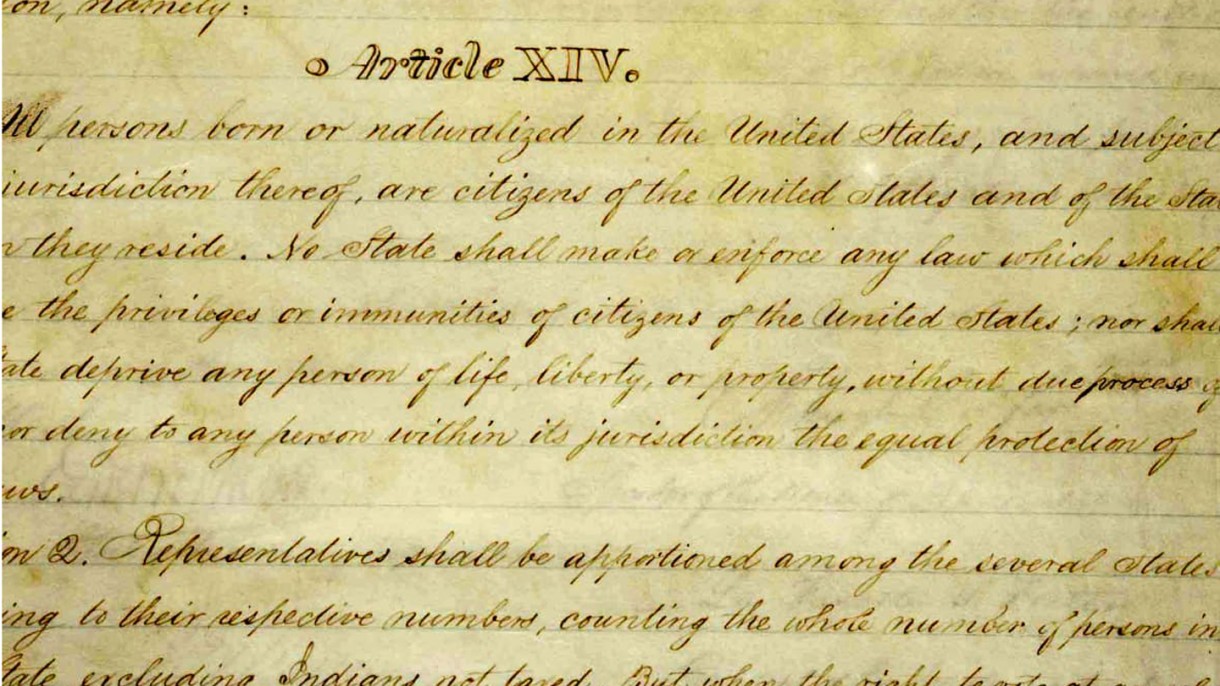
But Republicans in Congress well knew that a law could be repealed by another Congress, and when Democrats took back control, and they would at some point in the future, the Civil Rights Act of 1866 was as good as gone. So Radicals planned to cement those provisions into the Constitution with a new amendment, the Fourteenth, making it virtually impossible to repeal. In addition, as was their aim, the amendment greatly strengthened the powers of Congress at the expense of the states. It gave rights and equal protection of the laws to all citizens in the United States, particularly for blacks.
The Southern states, acting under the Lincoln-Johnson governments, were not happy with the Fourteenth Amendment, being particularly outraged at Section 3 that placed a stigma on their leaders in the late war. Johnson was not happy with it either, mainly because the amendment was proposed by a Congress that was only representing 25 of the 36 states. The Southern delegation was not allowed to participate. So it seemed to Johnson that the process was not a legitimate one. Nor was it, in his mind, a necessary one.
It is also interesting to point out that the final language of the amendment was a compromise between radicals and moderates. The Radicals wanted the amendment to be much harsher than it actually was, everything from the disenfranchisement of more Southern whites, suffrage for blacks, and land redistribution. But the moderates wouldn’t go that far. And it would take moderates to get the amendment over the first hurdle of a two-thirds vote in both houses of Congress.
One of the main architects was Ohio congressman John Bingham, who served on the Joint Committee on Reconstruction. He introduced his own amendment that would “empower Congress to pass all necessary and proper laws to secure to all persons in every State in the Union equal protection in their rights, life, liberty, and property.” He is considered the father of the first section of the amendment. As Justice Hugo Black wrote in 1947, “Congressman Bingham may, without extravagance, be called the Madison of the first section of the Fourteen Amendment.” Bingham has also been called one of America’s “forgotten Second Founders.”
“The Republic,” said Bingham, “is in the hands of its friends, and its only safety is in the hands of its friends. The Party of the Republic proposes only to take security for the future,” and to repudiate a “horrid blasphemy … that this is a Government of white men,” and the solution is “equal and exact justice to all men.” “That has not been done. It has failed to be done in the past. It has failed in respect of white men as well as black men.”
So Bingham proposed a constitutional amendment as a solution to this deficit of freedom. “Many of the States – I might say, in some sense, all of the States of the Union – have flagrantly violated the absolute guarantees of the Constitution of the United States to all its citizens.”
“Go read, if you please, the words of the Constitution itself: ‘The citizens of each State (being ipso facto citizens of the United States) shall be entitled to all the privileges and immunities of citizens (supplying the ellipsis ‘of the United States’) in the several States.’”
“I propose, with the help of this Congress and of the American people, that hereafter there shall not be any disregard of that essential guarantee of your Constitution in any State of the Union. And how? By simply adding an amendment to the Constitution to operate on Congress the power to pass all laws necessary and proper to secure all persons—which includes every citizen of every State—their equal personal rights; and if the of South Carolina will not respect the rights of the citizens of Massachusetts under the Constitution of their common country, I desire to see the Federal judiciary clothed with the power to this question, and assert those rights by solemn judgment, inflicting upon the offenders such penalties as will a decent respect for this guarantee to all the citizens of every State.”
The amendment passed Congress in June 1866 by a vote of 120 to 32, with 32 abstentions, in the House. But the South would have had 61 House seats had they been admitted as members, meaning the amendment would have never garnered a two-thirds vote necessary for passage, coming in at 56 percent if all 61 had voted in the negative. And it must be noted that Republicans had essentially stolen two state delegations – West Virginia and Nevada, both hurriedly admitted to the Union in very bizarre and abnormal ways just before the 1864 election.
The Senate vote was 33 to 11 with 5 abstentions. Again, if the South had been admitted, there would have been 22 Senators who would have all voted no, giving it a tie vote, far short of the two-thirds necessary for passage. And if West Virginia and Nevada had not been represented, the amendment would have failed to achieve a simple majority.
There was also a rather bizarre incident in the Senate to secure the necessary final vote. John P. Stockton of New Jersey, who opposed the Fourteenth Amendment, had been formally seated in the Senate on December 5, 1865, when the Thirty-Ninth Congress convened. Later, when the whips found that the amendment would fall one vote short, a motion was made to unseat Stockton. To expel a member took a two-thirds vote, which they did not have, so they moved to unseat him. But the motion failed 22-21, yet after some overnight pressure on one dissenting member, his vote was changed the following day and the motion passed. So, therefore, Stockton was unconstitutionally expelled from the Senate, or actually “unseated,” thereby giving the Senate the necessary two-thirds vote to pass the amendment. The rule of law meant nothing to Radical Republicans.
The next hurdle was ratification, which would also take some interesting mathematical work. So, with 25 loyal states in the Union, 19 were needed for ratification. If the South was included, there would be 36 states in the Union, thereby needing 27 for ratification. But even though Congress concluded that the Southern states had left the Union were now conquered territory, thereby giving Congress exclusive constitutional authority to govern them, when the amendment was sent to the states for ratification, it was sent to all 36. So were the Southern states now full members of the Union?
The only ex-Confederate state that did ratify it was Tennessee, an act which ended Reconstruction there and put the state back in the Union. Therefore, the Radical plan implemented in the South by Congress did not apply to Tennessee. But there were shenanigans in Tennessee, including violence. In July 1866, Tennessee Governor William Brownlow, a Radical Republican, forced the state legislature to ratify the amendment. After two members of the legislature refused to attend the session to prevent a quorum, they were arrested. They were then counted as present but “not voting,” allowing Brownlow’s government to claim a quorum and approve the amendment.
A few Northern states began to quickly vote to ratify the amendment, beginning with Connecticut, New Hampshire, and New Jersey, which would later rescind its ratification vote.
In Oregon, there was also bizarre behavior. Republicans controlled the state house by only one vote but it was alleged that two were illegally elected. However, they were temporarily seated until the vote was taken. Later in the session, the seats were awarded to Democrats because of the illegalities in the election. Oregon later rescinded its vote also.
In the South, though still not in the Union, the ten remaining former Confederate states refused to ratify it, as did a couple of Border States. The votes were overwhelmingly against the amendment, with several states voting unanimously in the both houses of the legislature. In all, there were only a handful of votes in the South in favor of ratification.
California also voted to reject the amendment, as did the border states of Kentucky, Delaware, and Maryland. So, it didn’t look as though the amendment would gain the necessary three-fourths of the states for ratification and was perhaps heading for failure. Things would get a little worse in March, when Nebraska was due to be admitted to the Union, making the number of states in the Union 37, meaning it would need 28 for ratification.
Though this might seem to be a near-insurmountable obstacle for most, Radical Republicans would not be denied their amendment. Soon after their overwhelming victory in the 1866 midterm elections, Radical Republicans passed the Reconstruction Acts of 1867, which was to “provide for the more efficient government of the rebel States.” And that more efficient government was military occupation and rule by a military governor.
But also in the law was a complicated procedure for the states to get back into the Union. First, the state convention, elected by qualified voters, had to draw up a constitution, which provided for black suffrage. The constitution then had to be submitted to the voters, and if approved, elections for state officers would be held. Then … IF Congress approved the state constitution, and IF the new state legislature ratified the Fourteenth Amendment, and IF the Fourteenth Amendment was ratified by three-fourths of the states necessary to become part of the Constitution, that state could come back into the Union.
This was a bizarre and illegal procedure – How can a state ratify an amendment to a constitution that they are not operating under?
Johnson unsurprisingly vetoed the act, stating in his veto message that the proposed law effectively served as “a bill of attainder against 9,000,000 people at once,” all of whom were excluded from a hearing through their representatives, on the basis of “an accusation so vague as to be scarcely intelligible and found to be true upon no credible evidence,” meaning that the Southern states had been denied their constitutional rights to representation. But Congress unsurprisingly overrode the veto.
To Forrest McDonald, the Radical Reconstruction policy flew in the face of the Constitution in a variety of ways and ran counter to the Supreme Court in the Milligan case, which had, the previous year, in a 9-0 decision, ended trial of civilian military tribunal when civilian courts were operating. The war was over. There were no more hostilities. But none of that mattered to the Radicals in Congress.
In the words of Senator James Doolittle of Wisconsin: “The people of the South have rejected the constitutional amendment, and therefore we will march upon them and force them to adopt it at the point of a bayonet, and establish military power over them until they do adopt it.”
With this level of coercion, and further threats of land confiscation and redistribution, the South, under military occupation, began to capitulate and ratify the amendment. And America has been ruled by it ever since. Today, the amendment is the most litigated section of the Constitution and is invoked in tens of thousands of federal lawsuits that are filed each year.
For the last several decades the Left has used the Citizenship Clause of the 14th Amendment to argue for “birthright citizenship,” that whoever is born in this country, no matter who they are, is automatically a US citizen. If a nine-month pregnant illegal fence-jumper from Mexico arrives five minutes before giving birth, runs to a hospital in Laredo, Texas and has the child, according to Liberals, that child is a US citizen with the same rights and privileges as someone whose family has been here for centuries. But that was never the intention of those who wrote the amendment.
Senator Jacob Howard of Michigan spoke of the Citizenship Clause when he introduced the amendment in the Seante: “This amendment which I have offered, is simply declaratory of what I regard as the law of the land already, that every person born within the limits of the United States, and subject to their jurisdiction, is by virtue of natural law and national law a citizen of the United States. This will not, of course, include persons born in the United States who are foreigners, aliens, who belong to the families of ambassadors or foreign ministers accredited to the Government of the United States, but will include every other class of persons.”
What law of the land? The Civil Rights Act of 1866, which states: “Be it enacted . . . That all persons born in the United States and not subject to any foreign power, excluding Indians not taxed, are hereby declared to be citizens of the United States; and such citizens, of every race and color, without regard to any previous condition of slavery or involuntary servitude, except as a punishment for crime whereof the party shall have been duly convicted, shall have the same right, in every State and Territory in the United States ….”
This law was aimed at newly freed slaves in the South and not immigrants, or in the vernacular of the time: Aliens. It was to ensure that the Freedmen were given their full rights and those rights were not trampled by any state governments. Radical Republicans understood that the law could be repealed at any time by another Congress with a simple majority vote, so to help guard against that, Congress placed similar language in the 14th Amendment, making it almost impossible to repeal. That was its intended purpose. But now that Democrats are losing voters, and must import new ones to win elections, it is being used in ways never intended and Trump is the only President with the guts to call that out and attempt to stop it.
And now we wait for nine unelected Justices of the United States Supreme Court to tell us what the clause really means and if the invasion of our country will continue unabated.
SOURCES
Jeffrey Boutwell, Boutwell: Radical Republican and Champion of Democracy (New York: W. W. Norton & Company, 2025).
Gerald N. Magliocca, American Founding Son: John Bingham and the Invention of the Fourteenth Amendment (New York: New York University Press, 2013).
Philip Leigh, “The True Agenda of the 14th Amendment,” Abbeville Institute Blog, August 4, 2014.
Forrest McDonald, “Was the Fourteenth Amendment Constitutionally Adopted?” Abbeville Institute Blog, April 23, 2014.
The views expressed at AbbevilleInstitute.org are not necessarily those of the Abbeville Institute.