

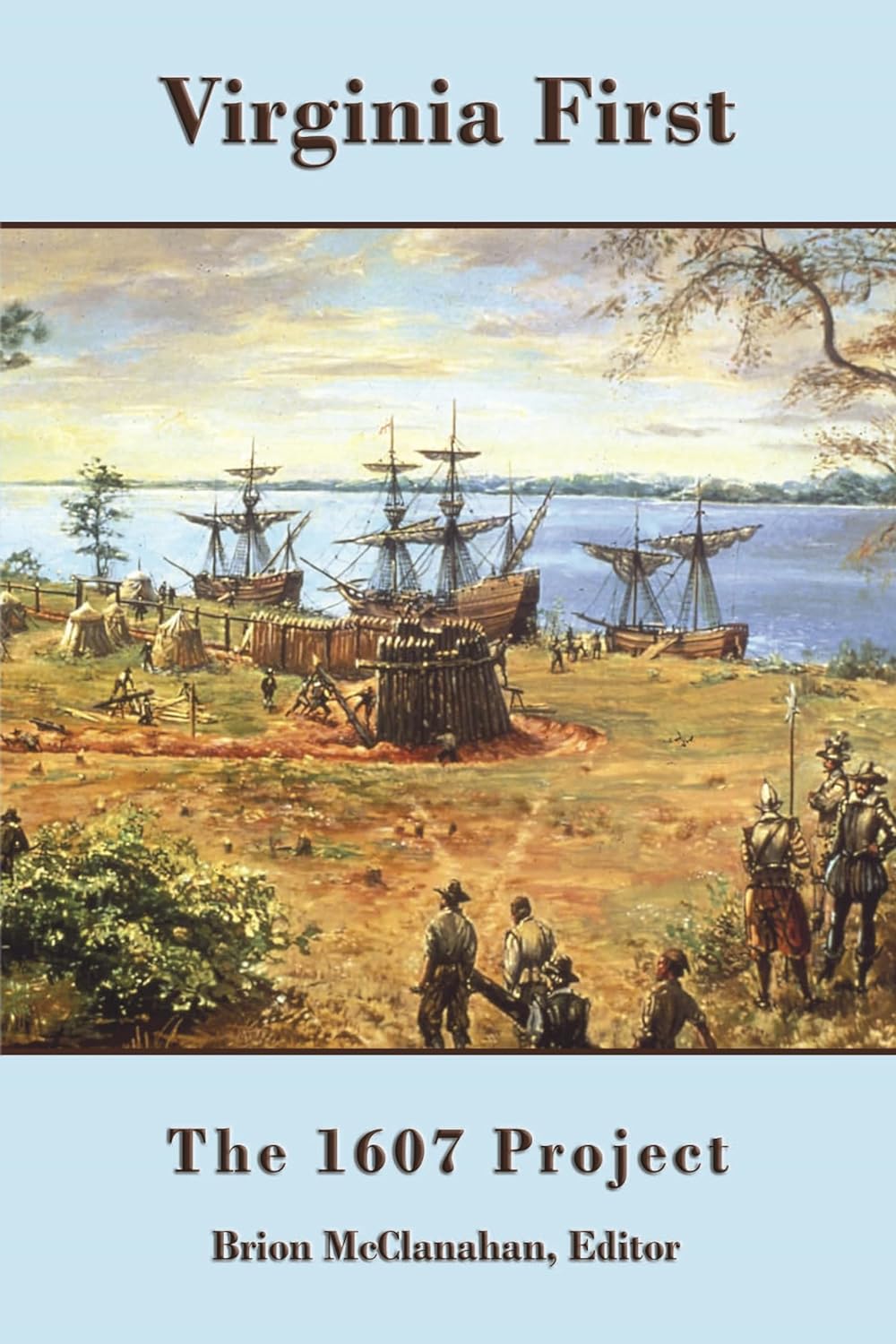
Editor’s Note: This review was originally published at the Independent Institute. We would like to thank Dr. Coclanis for his thorough and critical review of Virginia First: The 1607 Project
The overhyped and tendentiously argued “1619 Project” (hereinafter 1619) was rolled out in vainglorious fashion by The New York Times in August 2019 (nytimes.com). Since the release of the first version or installment of the project in The New York Times Magazine, 1619 has metastasized not merely into a cottage industry but into a bulk producer of glitzy agitprop, including a full-length anthology, a children’s book, a podcast, a docuseries, a curated collection of teaching resources—indeed, an entire curriculum replete with lesson plans. All ostensibly for purposes of elevating the role of racial slavery and postslavery racial oppression in American history, but, as the key principal in the project later admitted, mainly for the purpose of foisting racial reparations on an American public largely opposed to redistributionist transfers of that kind (see Mike Gonzalez, 2023, “At Least Nikole Hannah-Jones Is Honest About the 1619 Project’s Goals,” Commentary, February 28, 2023, The Heritage Foundation, heritage.org; Nikole Hannah-Jones, 2020, “What Is Owed,” New York Times Magazine, June 30, 2020, nytimes.com).
In light of those considerations, it was a pleasant surprise to this reviewer to read Virginia First: The 1607 Project, sponsored by the Abbeville Institute and edited by historian Brion McClanahan. To be sure, Virginia First was not intended solely or even primarily as a critique of 1619, but as much or more as a case for the normativity or even priority of Virginia and by implication the South more generally in shaping American history and culture. Indeed, one can make a reasonable case that Virginia First is aimed as much at New England–centric views of American history as it is at the slavery / black exploitation themes stressed in 1619. Whatever the primary intent, Virginia First represents a thoughtful scholarly intervention into both the 1619 kerfuffle and the longer-lived and ultimately more interesting, more important, and broader debate about the place of both Virginia and the South in American life.
Virginia First grew out of a conference of the same name hosted by the Abbeville Institute in February 2024. This institute, headquartered in McClellanville, South Carolina, was founded in 2002. Its self-described purpose is “to preserve the rich history, culture, and traditions of the American South,” because “the Southern tradition offers a valuable counterweight to modern and post-modern American thought, culture, economics, and politics” (abbevilleinstitute.org).
Such beliefs have placed the Institute in the crosshairs of the Southern Poverty Law Center, which views it as a borderline extremist “hate” group, a characterization that itself seems extreme and hateful. Rather, the Institute is better viewed as a society serving a small community of serious conservative scholars keenly interested in the American South. If it privileges the history, culture, and traditions of white southerners, so be it. There are other groups out there whose interests focus on different groups in the region.
Although the title of the conference and the volume it spawned play off the 1619 conceit, the issues treated and questions raised in Virginia First for the most part challenge The New York Times’s project only obliquely. More to the point, the authors included in Virginia First are far more concerned with laying out the fundaments of early Virginia society and culture and mounting a positive case for their importance to the shaping of both the South and the American nation as a whole. Ironically, that effort leads several of the authors to agree with certain claims made by principals in the 1619 Project, with these strange bedfellows both seeing the importance of early Virginia in the American creation story; both viewing the American colonies as closely associated with race-based slavery; and both believing that, in interpreting the Declaration of Independence, scholars over the years have taken the phrase “all men are created equal” too literally, and in so doing, have anachronistically cast an individualistic Lincolnian spin on a phrase that meant something quite different in 1776.
Such instances of agreement notwithstanding, none of the authors appearing in Virginia First buys into the tenor or tone of 1619, much less its dour and dyspeptic implications. For example, although Virginia First contributor John Devanny agrees with Nikole Hannah-Jones et al. that the year 1619 constitutes a memorable milestone in American history, it was not because of the arrival by ship of “20. and odd Negroes” at Port Comfort, Virginia, but because that was the year that “Virginia established the western world’s first freely elected assembly ‘of a self-governing people’” (p. 96). To be sure, there are earlier claimants to this development, but the Virginia legislature was certainly the earliest case involving Westerners in the New World. In any case, the main point is that to Devanny and the authors of Virginia First, other events mattered more for both colonial Virginia and for America as a whole than the landing of “20. and odd Negroes” on American shores, pace Hannah-Jones.
What mattered more? For starters, the creation in seventeenth-century Virginia of a political order based on legislative supremacy; on “Universal free male suffrage and direct representation” (p. 102); and on the adoption and expansion of the “traditions and customs of the English political order”—trial by jury, protection against unlawful seizure of property, and other “liberties, franchises, and immunities” available to Englishmen (p. 102). Equally important, that political order was based on political particularism and local democratic majoritarianism, which matured over time into a strong belief in state rather than central power, a commitment to a truly federal system with dispersed power centers, and ergo a long-standing indisposition toward, if not outright resistance to, consolidationist thinking and centralized authority—that is to say, a preference for a conservative conceptualization of the American polity. That preference was rooted in seventeenth century Virginia but spread throughout the South and at times informed, or at least significantly influenced, the thinking of residents in other parts of the United States as well.
That conservative view of things is laid out in one way or another in a number of essays included in Virginia First, most explicitly in those by Devanny, Clyde Wilson, Barry Shain, Donald Livingston, and William J. Watkins Jr. America, then, wasn’t built, as Hannah-Jones claims, on “an ideal and a lie,” for to the authors of Virginia First, equality in early America referred not to abstract individuals in a Lincolnian sense but to the equality of particular political communities—divided in 1776 into “thirteen colonies”—representing the majoritarian democratic interests of the people living in each (pp. 107–8). Equality, conceived in this way, was based on history and the “lamp of experience” rather than on the far distant implications of words from Thomas Jefferson’s pen.
As suggested earlier, Virginia First, taken in its entirety, is intended as a challenge to New England–centric views of American history as much as to 1619. Throughout the volume, individual authors take pains to point out that, despite what many historians have told us over time, the culture, ideas, values, and behaviors associated with seventeenth-century Virginia were more influential in America’s later development than were the ideas and behavioral patterns associated with New England. Indeed, in the view of the Virginia First crew, New England was more an outlier than anything else.
According to Virginia Firsters, the roots of the characteristic values and behaviors we like to associate with America—an appreciation for family, tradition, custom, and customary rights; antipathy toward restraints or hindrances on people’s freedom(s); an appreciation for valor; the privileging of experience over ideas and useful knowledge over abstractions; a suspicion of centralized power; and above all else, a belief in self-government and majoritarian democracy at the state level—can be found in early Virginia, not in early New England, which placed higher priorities on ideas and abstractions, on moral perfectionism, and on the use of state power, often centralized, in coercive ways.
Moreover, we are told that early Virginia did not merely shape the American character in profound ways but was the fount or hearth of some of America’s greatest achievements, nowhere more so than in music. Although many writers have traditionally focused on early New England in narrating the history of American music, in his essay in Virginia First, Tom Daniel makes a case that is not merely plausible but convincing that, except for classical music, all important forms of American music can trace their roots to the South. And beyond music? Few would gainsay the fact that southerners, Virginians in particular, played outsize roles in perhaps our greatest achievements of all: the founding of the United States and the creation of the laws and institutions—the operating system, as it were—that has guided the country for well-nigh 250 years.
The challenge to New England–centric views throughout Virginia First is spirited and often persuasive, but not quite as original—or even necessary—as it is made out to be. Since the 1970s scholars associated with the so-called Chesapeake School—Russell Menard, Lorena Walsh, and Lois Green Carr, among others—along with other scholars such as Jack P. Greene (Pursuits of Happiness: The Social Development of Early Modern British Colonies and the Formation of American Culture [University of North Carolina Press, 1988]) have made the case that the emphasis on New England in early American scholarship has often been misplaced, arguing that the Chesapeake colonies were more representative of early America in their development patterns and cultural characteristics than was New England. By now, many if not most scholars have incorporated at least parts of this interpretation into their narratives regarding colonial British America, considerably reducing the once hegemonic role played by New England in the early American story. But a little reinforcement never hurts.
Regarding individual chapters in Virginia First and the volume as a whole, a bit more needs to be said. Self-published by the Abbeville Institute Press, Virginia First is marked by what construction engineers refer to as “value engineering,” which is to say, the provision of the basics in no-frills fashion at the lowest possible cost. The table of contents, for example, includes the titles of the individual chapters but not the authors’ names. In fact, no information about the authors is provided anywhere in the volume. Virginia First is not indexed. And while most of the essays contain footnotes, some do not. Such decisions about protocols and practices, while perhaps necessary, are unfortunate, detracting from the reader’s experience and engagement with what is overall a very interesting and important set of essays.
The volume comprises twelve discrete chapters as well as a brief introduction by editor Brion McClanahan. The table-setting first chapter in the volume—“Virginia First” by Lyon G. Tyler—originally appeared in 1921 as a booklet published by the Colonial Dames of America in the State of Virginia. The subsequent eleven chapters in Virginia First elaborate upon, extend, or otherwise play off themes and people treated in Tyler’s essay. Thus, we get chapters on the evolution of early Virginia society and culture; the ideas regarding governing systems, political configurations, constitutions, and the law that came to be associated with Virginia; how best to explain the magisterial Thomas Jefferson; and Virginia’s roles in and contributions to American music and literature, Christianity, and U.S. military history. A number of writers well-known in conservative circles are included in Virginia First, including two with whom people acquainted with the Independent Institute are certainly familiar: William J. Watkins Jr. and Joseph R. Stromberg, the former writing on the Virginia legal tradition and the latter laying out a “Virginia centric” reading of American history. All in all, a most stimulating collection that won’t convince everyone but will compel all readers—ideological friends and foes alike—to think long and hard about the ideas and arguments advanced.
The views expressed at AbbevilleInstitute.org are not necessarily those of The Abbeville Institute.





“Since the release of the first version or installment of the project in The New York Times Magazine, 1619 has metastasized not merely into a cottage industry but into a bulk producer of glitzy agitprop, including a full-length anthology, a children’s book, a podcast, a docuseries, a curated collection of teaching resources—indeed, an entire curriculum…”
And what looks like will be a huge memorial at Fort Monroe. Completion of it appears close. I’d say mid to late October. Maybe early November.