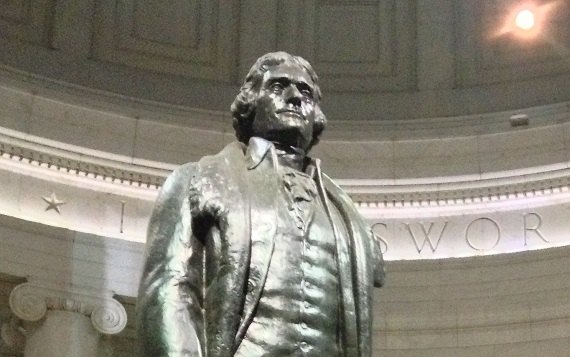

Thomas Jefferson in his 1821 never-finished autobiography, writes of the motivation for and the history behind his only book Notes on Virginia:
Before I had left America, that is to say in the year 1781. I had received a letter from M. de Marbois, of the French legation in Philadelphia, informing me he had been instructed by his government to obtain such statistical accounts of the different states of our Union, as might be useful for their information; and addressing to me a number of queries relative to the state of Virginia. I had always made it a practice whenever an opportunity occurred of obtaining any information of our country, which might be of use to me in any station public or private, to commit it to writing. These memoranda were on loose papers, bundled up without order, and difficult of recurrence when I had occasion for a particular one. I thought this a good occasion to embody their substance, which I did in the order of Mr. Marbois’ queries, so as to answer his wish and to arrange them for my own use.
François Barbé-Marbois (1745–1837) had been made Secretary of the French Legation to the United States in 1779. One of his first significant tasks was to distribute a series of 22 queries to governors or representatives of each of the 13 states for information concerning the culture and resources of each state. The questionnaire for Virginia was initially given to Joseph Jones, Secretary to the Virginian Delegation to Congress. Jones passed on the questionnaire to Jefferson so that it could be answered by an abler statesman.
Jefferson rearranged the queries, answered them by reference to his abundant notes on the young country, Virginia especially, and added an additional query on climate, which for Jefferson could only have been seen as an enormous oversight on Marbois’ part. The booklet formed, as he said, was chiefly for his own use—viz., a motivation for putting into some order his scraps of memoranda, so that they could function for him as a sort of reference book for the new nation.
Marbois’ enquiries, mostly relating to the culture of each state, were the following:
- The Charters of your State
- The present Constitution
- An exact description of its limits and boundaries
- The Memoirs published in its name, in the time of its being a Colony and the pamphlets relating to its interior or exterior affairs present or ancient
- The History of the State
- A notice of the Counties Cities Townships Villages Rivers Rivulets and how far they are navagible. Cascades Caverns Mountains Productions Trees Plants Fruits and other natural Riches
- The number of its Inhabitants
- The different Religions received in that State
- The Colleges and public establishments. The Roads Buildings &c.
- The Administration of Justice and a description of the Laws.
- The particular Customs and manners that may happen to be received in that State.
- The present State of Manufactures Commerce interior and exterior Trade.
- A notice of the best Sea Ports of the State and how big are the vessels they can receive.
- A notice of the commercial productions particular to that State and of those objects which the Inhabitants are obliged to get from Europe and from other parts of the World.
- The weight measures and the currency of the hard money. Some details relating to the exchange with Europe.
- The public income and expences.
- The measures taken with regard of the Estates and Possessions of the Rebels commonly called Tories.
- The condition of the Regular Troops and the Militia and their pay.
- The marine and Navigation.
- A notice of the Mines and other subterranean riches.
- Some Samples of these Mines and of the extraordinary Stones. In short a notice of all what can increase the progress of human Knowledge.
- A description of the Indians established in the State before the European Settlements and of those who are still remaining. An indication of the Indian Monuments discovered in that State.
One can imagine that the queries, listed as they were helter-skelter, were to Jefferson, who was intolerant of disorder, an enormous perplexity—the cause perhaps of one of his infamous headaches. He had to put them into some order before essaying to answer them or answers would not be possible. One cannot help but imagine Jefferson playing for days with the arrangement of the queries, and rewriting them, to give order to them and for the sake of accommodating his copious memoranda, which themselves doubtless had to have been in some sort of order prior to inclusion in his book. Some of Marbois’ queries, number 6 for instance, were confused, as they contained material with social (counties, cities, townships villages, and productions) and natural elements (cascades, cavern, mountain, trees, plants, and fruits). Consequently, they had to be rewritten.
Jefferson’s answers, given for some reason also as “queries,” are as follows. The parenthetical number relate to the queries of Marbois.
I. Boundaries of Virginia (3)
II. Rivers (6)
III. Sea-Ports (13)
IV. Mountains (6)
V. Cascades (21)
VI. Productions Mineral, Vegetable and Animal (6 & 20)
VII. Climate (21)
VIII. Population (7)
IX. Military Force (18)
X. Marine Force (19)
XI. Aborigines (22)
XII. Counties and Towns (6)
XIII. Constitution (1 and 2)
XIV. Laws (10)
XV. College, Buildings, and Roads (9)
XVI. Proceedings as to Tories (17)
XVII. Religion (8)
XVIII. Manners (11)
XIX. Manufactures (14)
XX. Subjects of Commerce (12 & 14)
XXI. Weights, Measures, and Money (15)
XXII. Public Revenue and Expences (16)
XXIII. Histories, Memorial, and State Papers (4 & 5)
The first thing worth noting is the Marbois asks 22 questions and Jefferson offers 23 answers. The reason is that Jefferson wishes not merely to answer the questions, but also to do so in a “logical” manner. Whereas Marbois is asking 22 questions concerning the culture of each of the states, and several of the questions demand some account of the nature of Virginia—of its rivers, mountains, and native biota (6 and 19); sea-ports (13); and its minerals (21)—Jefferson answers by offering a neat division of nature (I–VII) and culture (VIII–XXIII) and begins with the former as a precursor or preface to the latter, and he sneaks in along the way numerous comments, extra-Virginia.
In imposing an order to Marbois’ questions, Jefferson as it were had to break up one of Marbois’ questions and condense others. For instance, Marbois’ sixth question Jefferson answers in Queries II, IV, VI, and XII. Meanwhile, Jefferson answers questions 6 and 20 in Query VI, questions 1 and 2 in Query XIII, and questions 4 and 5 in Query XXIII. Jefferson also introduces one factor of extraordinary etiological significance, climate, which Marbois, for some reason, overpasses.
Why does Jefferson not merely answer the questions in the manner in which they were asked, and leave off at that?
The answer is twofold.
First, Jefferson, as I have shown in Thomas Jefferson: Psychobiography of an American Lion, was an inordinately organized person—obsessively, perhaps even pathologically so—and thus he was incapable of beginning a task without making Jefferson-sense of that task—in a word, without personalizing that task. For instance, when he recommends a course of study for a young lawyer in a letter to Bernard Moore (30 Aug. 1814), he lists the subjects that need to be studied—and Jefferson believes that a suitable lawyer ought to be suitably schooled in all subjects of practicable significance, and so the course was extraordinarily lengthy—and offers a comprehensive list of books on each subject, and then demands that they be studied in a particular order to ensure that no subject is to be undertaken unless one is fully readied for it. Jefferson views the human mind like husbandman views a plot of arable land. For a husbandman to reap a bountiful crop, the earth and climate must be studied, and the former, in a series of steps, each of which attends on the prior step, must be adequately readied before seeding. The mind, for Jefferson, must be similarly readied for praxis of law by through study of the right sorts of subjects, at the right time (and here time of day too is relevant), and in the right order.
Second, Jefferson’s reordering was for the sake of unifying the queries and giving coherence to the project. At some point, the project turned into a book that was to be published and distributed to select scholars. It is likely that he always had in mind publication and limited distribution of his manuscript among scholars, scholarly friends, and students at William and Mary College, so the manuscript had to be maximally user-friendly.
Why did Jefferson’s reworked structure begin with nature and end with culture, instead of begin with culture and end with nature? Why did he not leave each question essentially as a cultural question, as Marbois had asked them, and introduce nature only insofar as natural explanation factored into one of Marbois’ questions?
The thesis of this book comes into play. Notes on Virginia is neither a mere omnium gatherum—a somewhat ragtag collection of anecdotes with philosophical and critical reflections added—nor is it to be deconstructed—read with cautious scrutiny to disclose the latent thesis, threaded perhaps insidiously through the 23 queries.
I maintain that Jefferson crafted Notes on Virginia as comprehensive guidebook for Virginia, and to a lesser extent, its neighboring states, crafted for discerning (critical) readers. The guidebook, beginning with the nature of Virginia (phusis) and then its culture (nomos), was to be as comprehensive as possible to be utilized by the next generation of scholars for the sake of expediting moral progress—i.e., human happiness—through social betterment. Hence, he was amenable to the manuscript, upon completion, being sent to the students of William and Mary. The early naturalistic queries, Queries I through VII, were to be read and assimilated for the sake of reflection on the later cultural queries, Queries VIII through XXII, and improving Virginia’s social conditions with an eye to maximal liberty for the sake of human thriving—liberty not in itself, but for the sake of human thriving or human happiness, that is, what I call Jefferson’s liberal eudaimonism. Critical passages—such as Jefferson’s bout with Buffon and his sparring session with Raynal (Query VI) or his query on the Virginian constitution (Query XIII)—were to be read by referencing the early naturalistic chapters in order to validate or invalidate European criticism of the New World, insofar as the early naturalistic sections offered data suited to that task. The discerning reader was also to evaluate critically Jefferson’s own comments on the culture of early Virginia and neighboring states.
If my thesis is correct, then Notes on Virginia is not merely a snapshot of Virginia at the time of its composition, but also dialectical manuscript—a work-book of sorts. It asks questions such as these: How can the manufacture and commerce of Virginia be ameliorated given the natural assets and liabilities of the state? Given the population of Virginia, what improvements can be made to its constitution? What needs to be done for Virginians and Americans to eradicate slavery? Is the nascent country to be predominantly or almost exclusively agrarian?
The views expressed at AbbevilleInstitute.org are not necessarily those of the Abbeville Institute.