

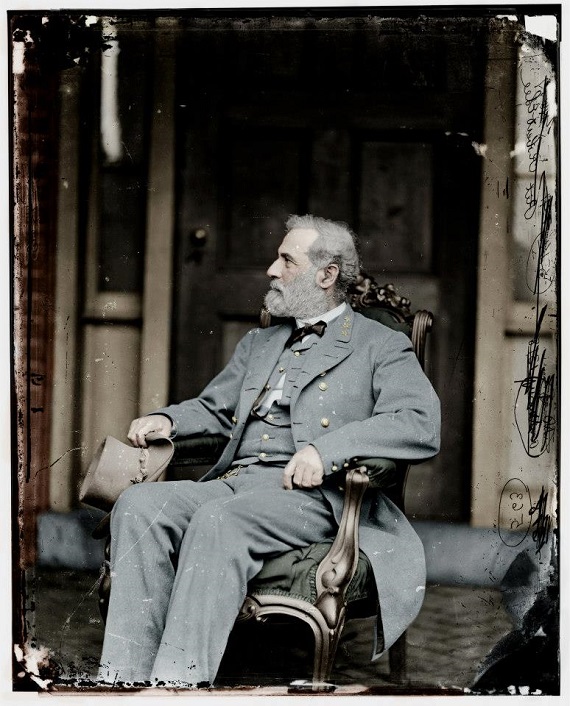
Notwithstanding currently popular interpretations, there is no convincing evidence that Robert E. Lee ever whipped slaves. The argument that he ordered the flogging of three runaways in 1859 took on a new life after Elizabeth Brown Pryor published Reading the Man: A Portrait of Robert E. Lee Through His Private Letters in 2007. Contrary to her implications, she provides no new evidence regarding accusations made by runaway slave Wesley Norris, which were soon publicized in 1859 by two anonymous letters to The New York Tribune and later in an 1866 article obtained “from the lips of Wesley Norris” in The National-Anti Slavery Standard.
Lee owned no slaves at the time but after his father-in-law died in 1857, he became executor of the estate that included two hundred slaves at three Virginia locations: Arlington House, Romancoke and White House Plantation. Although the will stipulated that the slaves were to be freed, it also gave Lee up to five years to release them, partly to comply with Virginia law that required they not be let loose into vagrancy. The properties were also in debt, unprofitable and needed repairs. Finally, the will required that Lee’s daughters be given legacies of $10,000 each, which meant that the properties either become profitable or sold to raise the cash.
Lee decided to work the properties before freeing the slaves. Since there were far more slaves than required at Arlington House, he rented some out. As events transpired, Lee complied with the five-year limit in January 1863 when he freed the slaves.
As might be expected, some slaves had misunderstood that they were to be freed immediately after the master’s death, which they typically based upon conversations with Lee’s father-in-law before he died. In response, Lee pointed critics to the court documents that revealed the five-year limit. Nonetheless, Wesley Norris and two other Arlington slaves set out for Pennsylvania where they hoped to live as presumptive free blacks. All were caught and returned. Norris left with his sister Mary and their cousin, George Parks. When the three were recaptured, Norris claimed that all were whipped.
Notwithstanding Lee denied the incident, author Pryor believed Norris’s story because she said particulars of the narrative “ring true.” Pryor, for example, believes that Norris’ accurate recall of his whereabout at specific times validate the story. But the fact that Norris was recaptured and returned to Arlington on the date that he alleges the whipping occurred is no proof of an actual whipping. Finally, it should be noted that The New York Tribune had long advocated for abolition.
In truth, there’s better evidence that Lee believed slaves should be well treated. The following excerpted letter suggests that he had friendly relations with the Arlington slaves. After the Civil War Lee was required to testify before a Senate committee in February 1866. While in Washington, one of the former Arlington slaves stopped by his hotel while he was out. The visitor was Amanda Parks, the sister of George Parks, who was one of the three Arlington slaves allegedly whipped in 1859. If George had been whipped under Lee’s supervision it seems unlikely that Amanda would want to visit with him. Yet it appears that Lee and Amanda had a friendly relationship. After Lee returned to his Lexington home, he wrote Amanda as follows:
LEXINGTON, Virginia, March 9, 1866.
AMANDA PARKS
I have received your letter of February 27th and regret very much that I did not see you when I was in Washington. I heard on returning to my room, Sunday night, that you had been to see me; and I was sorry to have missed you, for I wished to learn how you were, and how all the people from Arlington were getting on in the world. My interest in them is as great now as it ever was, and I sincerely wish for their happiness and prosperity…
I do not know why you should ask if I am angry with you. I am not aware of your having done anything to give me offense, and I hope you would not say or do anything that was wrong. While you lived at Arlington you behaved very well and were attentive and faithful to your duties. I hope you will always conduct yourself in the same manner.
Wishing you health, happiness, and success in life, I am truly,
R. E. LEE.
If it were true that Lee gave George Parks 39 lashes seven years earlier it seems improbable that Amanda would seek a friendly visit. Yet his letter implies that he felt Amanda’s intentions were friendly. The very fact that he wrote to her also shows respect for her as a human being and reveals the dignity he typically showed toward others by default.
Additionally, while Robert, Jr. was working his own properties the General advised his son to manage the Romancoke slaves with kindness: ”attend to them and give them every aid and comfort in your power and they will be happier.” After lamenting an arson fire at a neighbor’s farm, Lee counseled, “I trust you will so gain the affection of your people that they will not wish to do you harm.” Earlier, as a young man, after he inherited slaves from his mother Lee took one with him on duty to Savannah. It was an elderly personal servant in ill health who the Lee’s thought would do better in a warmer climate. He eventually died while Lee was on duty and is buried along the Savannah River.
The views expressed at AbbevilleInstitute.org are not necessarily the views of the Abbeville Institute.






I am coming to believe that any time anyone uses the words “rings true.” it should be considered an absolutely definitive acknowledgment that the person has no evidence for what he or she is trying to peddle.
You can bet on that!
The concept of whipping, punishment etc was different at that point (even into the 20th century) than what the false interpretation gets today. Various forms of whippings etc were employed on ships, in prisons at home on undisciplined children (to a minor extent) –it was a matter of degree. If it was discipline, that was one thing, if cruelty something else.
I wonder if the NY Tribune ever published the (many times) whipping of slaves in the name of cruelty on those YANKEE slave ships. I doubt it!
This modern presentism by our old “friends” the Yankee liars and Washington DC sycophants and sick-oes is typical of them and the gutter they wallow in.
No more Mr. Nice guy from me. May they all go to hell and rot–and they can take DJT and his Carpetbagging Yankee Floridians et al with him!
The US military officially ended corporal punishment in 1850s…of course, corporal punishment went on for generations…in the US military.
Commie atheist liars will never win…their lies are too easy to dispel.
“May they all go to hell and rot.”
God’s viewpoint:
“Who will have all men to be saved…” 1 Tim 2:4.
The thieves who died on the cross with the Lord at Calvary are interesting to reflect on. At first, both men railed on the Lord. Can we think of what things they might have said to the dying Lord? But one thief did not go to hell and rot. That’s something to think about. He came to his senses about the man in the middle. But, too little, too late? I think it’s more than safe to say that he was a little more than just a “thief.” The Bible tends to be modest and understated about things. That’s not a criticism, it’s to its credit.
It is also more than safe to say that if folks who knew that “thief” knew that the Lord had taken him to “Paradise,” those folks would have exploded in rage, and if they could have, would have choked God Himself. “Are you serious, Lord?! That *! #!!* man deserved to go to the lowest pit of the flames! What are you doing?! Do you know what that man did? Do you know what kind of life he lived?!”
How about the apostle Paul? How many would have liked to have choked God for saving him?
About Paul, Ananias said this: Acts 9:13-14 “…Lord, I have heard by many of this man, how much evil he hath done to thy saints at Jerusalem: And here he hath authority from the chief priests to bind all that call on thy name.”
I am not trying to poke the conscience. Yet, I don’t want to hear anyone say that if one wishes another to hell that the words are are just hyperbole. Folks use hyperbole as a cover.
The writer Derek Hunter on 6/16 said in the title of his column, “There’s a special place in hell for Nancy Pelosi.” How does Hunter know that Pelosi is on her way to hell? But, if she is, would it be ok with Hunter if the Lord saved her before she died? I don’t like Pelosi either, to put it mildly. As unbelievable as it may be though, the Lord wants Pelosi in heaven.
I understand the anger at things. I don’t like what Yankees did. I don’t like the hypocrisy, the injustice, the lies.
But, the greatest evil is man’s ignorance and rejection of God. Not knowing Him or His viewpoint, not knowing what He’s doing.
The future is Him. He’s going to forcibly take back the earth. It’s His.
2 Thessalonians 1:8 “In flaming fire taking vengeance on them that know not God, and that obey not the gospel of our Lord Jesus Christ:”
I do not wish them “to hell.” I am not the Gatekeeper. I don’t believe Stonewall would have wished them there either. But he did say “Give them the bayonet!”
I may pray for them in the spirit but have nothing but contempt for them in the flesh.
You are right. I feel I must love them but I don’t have to like them. And many of them, I don’t like for what they do to others.
I have forgiven all that have done me wrong in my long life, and you must love to forgive.
Forgiveness creates freedom, but it is the love that brings it all together.🤗
It’s funny that the Left hates READING THE MAN, by Elizabeth Brown Pryor as much as Lee and Confederate historians. She doesn’t summarily indict Robert E. Lee as any review of the Wesley Norris event would lead one to believe. She at times betrays admiration and considers Gen. Lee’s family stresses and the trials of an, at times, unrewarding career in the U.S. Army of his day. She seems genuinely fond of the family. Her assessment of Gen. Lee’s Confederate career is a mess.
Ms. Pryor was killed in a collision in Richmond’s West End in 2015 when a man experiencing a psychotic event rammed his car into the back of hers. In the report of her funeral, her sister told of how Ms. Pryor liked nothing better than to spend time off cooking from Mrs. Lee’s recipes. I only mention any of this to say I recommend the book because it contains information available nowhere else, having been assembled from a trove of newly discovered letters. Once I got over the shock of the author’s Norris narrative – about ten years later – I’ve learned to use and occasionally enjoy it.
Do I think Lee whipped slaves? Oh, Hell No. As possible as it is, it is much more improbable. Besides Lee’s disclaimers there is nothing in his well documented life that hints of violence, yet, much that recommends his honesty – from his demerit free four years at West Point, to his shouldering sole blame for defeat at Gettysburg, to his 1866 defiance of a congressional subcommittee, looking to hang Jefferson Davis, in taking responsibility for actions of his Army of Northern Virginia. Any Confederate historian should take and study the Norris charges seriously without fear of disappointment in their conclusion.