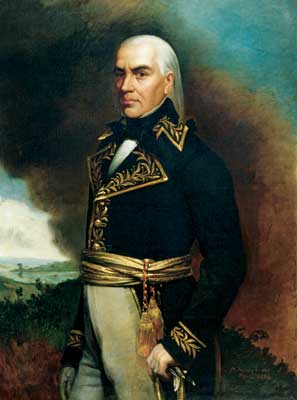
In the tangled web of modern geopolitics, where Venezuela and the United States circle each other with increasing hostility, a forgotten chapter whispers of a time when a Venezuelan patriot walked the American South soil not as an adversary but as an admirer, a student, and ultimately a brother in revolution. His name was Francisco de Miranda, and his story represents a lost bond between two nations now seemingly worlds apart.
In the twilight of the 18th century, this young Venezuelan officer fought to secure American independence, then wandered through the southern colonies with the wide eyes of a revolutionary apprentice, absorbing lessons he would carry back across the Caribbean to ignite his own war for independence from Spain.
Miranda stands alone in the annals of history as the only person to fight in the three great upheavals of his age. He battled in the American Revolution, the French Revolution, and the Spanish American Wars of Independence. His name adorns the Arc de Triomphe in Paris. Venezuelans call him “The Precursor,” the herald who came before the great liberator Simón Bolívar. Yet in the United States, where his journey of discovery began, he remains virtually unknown.
Born in Caracas in 1750, Miranda carried the complex heritage of the colonial world. His father had emigrated from the Canary Islands. Despite the wealth the Mirandas had accumulated in Venezuela, they faced disdain from Venezuela’s old aristocracy, the Mantuanos, who viewed Canarian blood as inferior. This social rejection planted seeds of resentment that would blossom into revolutionary fervor.
Miranda joined the Spanish army and proved himself a capable officer in North Africa and the Caribbean. Then came the opportunity that would reshape his destiny. Spain entered the American Revolutionary War against Britain, and Miranda found himself dispatched to the Siege of Pensacola in 1781. There, in the swampy borderlands of Spanish Florida, soldiers under the Spanish Crown fought alongside their allies to crush British forces threatening the southern flank of the American colonies. The victory secured the Revolution’s success from an unexpected quarter, and Miranda earned a promotion to Lieutenant Colonel for his valor.
That said, Miranda’s triumphs on the battlefield aroused suspicion from the Spanish crown. Spanish authorities, alarmed by his collection of banned Enlightenment texts and whispers of smuggling, accused him of treason. In 1783, Miranda fled northward to the very nation he had helped liberate, seeking refuge in the United States.
He did not arrive in cosmopolitan Philadelphia or bustling Boston. Instead, on June 10, 1783, Miranda’s ship delivered him to New Bern, North Carolina, plunging him directly into the raw, unpolished world of the American South. For a Venezuelan aristocrat accustomed to rigid colonial hierarchies, what he discovered there proved revolutionary in ways that transcended politics.
His diary, The New Democracy in America, chronicles observations that read like field notes from an anthropologist studying an alien civilization. The first shock came at a public barbecue celebrating war’s end. Miranda watched in astonishment as “the very first magistrates and people of note ate and drank with the common folk, passing the plate around, and drinking out of the same glass.”
In Spanish America, such casual mingling between classes would have been inconceivable, a violation of its rigid social order, when juxtaposed to colonial America. Yet here stood proof for Miranda that a republic could function without rigid separation of ranks, that democracy might be more than mere theory.
When Miranda ventured to Charleston, South Carolina, he discovered a society more closely mirroring the aristocracy he knew yet tempered by republican values. The city’s elite welcomed him warmly. Miranda spent about two months in Charleston (July 29 – early November 1783), where he became “well acquainted with prominent citizens,” and during “visits to the courts of justice he imagined that he saw in operation ‘the admirable system’ of the English Constitution.” These experiences would later inform his own plans for Venezuelan independence, his constitutional drafts bearing traces of insights gained during his visit to the fledgling republic.
Yet his immersion in Southern honor culture nearly proved fatal. A misunderstanding over Miranda’s conduct during the 1782 Bahama campaign led William Brailsford, an American who had been imprisoned at New Providence, to challenge Miranda to a duel, threatening to cut short the Venezuelan’s revolutionary career decades before its fruition. Edward Rutledge, then-mayor of Charleston, made a formal call on Miranda to deliver the challenge. After Miranda explained that he had a high opinion of Brailsford and was not responsible for his imprisonment—declaring that “so far from intentionally reflecting on America, he had always respected and possessed a Friendship for her”—Brailsford opted to not follow through with the duel. Rutledge’s intervention prevented bloodshed, saving Miranda from dying on South Carolina soil for a cause far removed from the liberation struggles that would define his legacy.
The soldier in Miranda never rested. He treated his Southern tour as reconnaissance, a masterclass in revolutionary warfare. He meticulously examined Fort Moultrie and Charleston’s fortifications. He toured battlefields, interviewed veterans, and absorbed tactical lessons he would later apply in Venezuelan jungles. The American South became his military academy, its successful revolution his textbook.
Miranda eventually departed the South for the northern states, then crossed to Europe where his adventures would grow ever more extraordinary. He charmed Catherine the Great of Russia, became a general in the French Revolutionary Army and fought at Valmy, and spent decades seeking support for South American liberation from any power willing to listen.
In 1806, Miranda launched an invasion of Venezuela, raising for the first time the flag he had designed for his homeland. The expedition failed, but he returned in 1810 after a delegation led by a young officer named Simón Bolívar traveled to London and persuaded him to come back to declare Venezuela’s First Republic. When that republic collapsed in 1812, Miranda was captured and, in one of history’s cruel ironies, handed over to Spanish authorities by Bolívar himself. He died in prison in Cádiz, Spain, in 1816, far from the American South that had so captivated him three decades earlier.
His legacy endures in ways both obvious and obscure. Venezuela honors him as a founding father. France inscribed his name among the revolutionary heroes on the Arc de Triomphe. Yet in the United States, particularly in the South where he spent months absorbing republican culture and democratic spirit, his story remains largely forgotten.
This amnesia carries contemporary consequences. When American policymakers and Venezuelan leaders clash over ideology and influence, they operate without awareness of a shared heritage of independence. The Venezuelans who fought at Pensacola to secure American independence, the Southern hospitality extended to an adventurer fleeing Spanish persecution, the mutual admiration between republican visionaries separated by language and geography, all these connections have dissolved into historical mist.
In an era when Venezuela and the United States regard each other primarily as adversaries, Miranda’s ghost wanders the forgotten pathways of their shared past. This serves as a reminder that history contains possibilities the present has abandoned, connections the contemporary world has severed, and bonds that might yet be recovered if only we remember to look.
The views expressed at AbbevilleInstitute.org are not necessarily those of the Abbeville Institute.




I admire Jose Nino’s writing style, even envy it. Lost in the historical mist along with Francisco Miranda’s contribution to the foundation of the United States, is the concept of a real gentleman.