

Originally published at Reckonin.com
My synopsis of the history of the Southern people will henceforward be speculative. We may not have sufficient perspective now on the more recent past. There may be important undercurrents that are not noticed yet.
I have called the half century after World War I an era of good feelings because, despite “Civil Rights” and other conflicts, it was a period when Southerners seemed to feel more comfortable as “Americans” and the rest of the country to accept them as such.
Southerners were considered to be Americans, although with a bit of difference. The difference seemed to be accepted more favourably than previously. The South was often thought of as a seat of good times. Consider the popularity of two South Carolina dances – the “Charleston” in the 1920s and the “Shag” later on. Will Rogers, son of a Confederate officer, was one of the most popular of Americans and pioneered humourous radio commentary.
Or consider such popular songs as “Nothin’ Could be Finah Than to Be in Carolina” or “Is It True What They Say about Dixie?.” And from the 1920s on, with radio, Southern music swept the civilised world. It was called “country and western” because that was more commercially viable than “Southern.”
“Gone with the Wind,” book and film, achieved international popularity.
And during this era every thing important in American music came out of the South. And the greatest internationally recognised American literature was by Southerners.
In the 1920s the South had some prosperity. Still it was said that the Great Depression of the 1930s was hardly noticed in the South because conditions were what had long been considered normal. And Franklin D. Roosevelt declared the South to be the No. 1 economic problem of the country. Genuine advance against endemic poverty did not really begin until after World War II and the South remains relatively the poorest region of America.
During the troubled 1930s, Southern Agrarians in I’ll Take My Stand and Who Owns America? offered a humane Jeffersonian alternative to the existing reign of state capitalism and the offered remedy of socialism. Of course, their program had no chance in materialistic America, but it has remained an inspiration to many. And Big Business and progressivism combined in a coalition that became the ruling Deep State, combining state capitalism and socialism. As the Agrarians pointed out, they were simply two sides of a coin.
Southerners embraced World War II and never showed the fascist tendencies of some other regions. Audie Murphy of Texas was the most decorated soldier and his fellow Texan Admiral Nimitz commanded the U.S. fleets in the Pacific. William Darby of Arkansas created the Army Rangers. Virginian George Patton was a spearhead of American forces in Europe and his fellow Virginian “Chesty” Puller was a Marine star. That is to mention only a few patriotic Southern contributions to the American cause. It was said that Japs hollered “To Hell with Roy Acuff!” before a charge and that Brits called the American air arm “the Royal Texas Air Force.”
It does not seem that we got much credit or recognition for our service in that and later wars. In the postwar period the South was returned to its usual role as the red-headed stepchild and became the target of the Communist and other extreme left groups in Hollywood, the media, and among “intellectuals,” and Deep North politicians. Such people have always understood that Southerners are the only major obstacle to their agenda for America.
Southern Democratic leadership in Congress – Richard Russell, Fritz Hollings, Sam Ervin, William Fulbright, Herman Talmadge – exercised considerable conservative influence on a country that moved leftward after World War II. Much more so than the Republican Party which never in its entire existence has conserved anything except corporate profits. The disappearance of the old-fashioned Southern Democrats has left the country with little check on leftward legislation.
George Wallace of Alabama won some Northern Democratic presidential primaries, forcing the Republicans reluctantly and insincerely to embrace the “social Issues” he had raised. He won 13% as an independent candidate in the national election of 1968, depriving both Nixon and Humphrey of a majority.
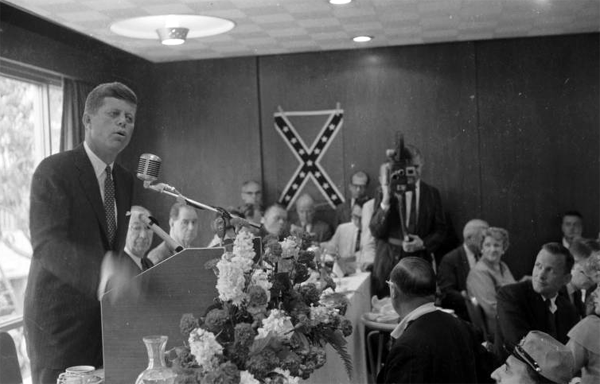
Despite Civil Rights conflict, the Civil War Centennial observance in the 1960s was mostly an exhibit of good feelings. The war was treated usually as an American experience to be shared. President Eisenhower had a portrait of R.E. Lee in the Oval Office, The entrance of the Truman Presidential Library was adorned with an equestrian painting of Lee and Stonewall Jackson. John F. Kennedy was photographed making a speech in front of a Confederate flag.
The Diaspora. This is one of the most important matters in the history of the Southern people. Beginning with World I and up until fairly recent times several million black and white Southern people moved to the North and West, seeking a living. This is the opposite of recent times when affluent Northerners moved South to escape cold, taxes and crime. For a poignant view of Southern experience in the diaspora see Harriette Arnow, The Dollmaker.
The Southern diaspora had some effect on the North where the more conservative areas have Southern settlement. The fate of black Southerners who moved North was on the whole unfortunate. The first generation of African American immigrants from the South worked hard, founded churches, and moved into the middle class. But dysfunctional ghettoes grew in the big cities among the Northern-born black people. Of course, the Yankee politicians and savants blamed the conditions the North had created on slavery and segregation in the South, despite the fact that the conditions are worse the further they are in distance and time from the South.
When there were deadly race riots in Chicago and Detroit during World War II, the media blamed it on “Southern hillbillies,” people who had come there to work. Study indicates that the riots were between white ethnics and northern-born blacks – not a hillbilly in sight. Phony virtue signaling in regard to the race question has always been the Northern position.
Of course, central to Southern history is the 1954 Supreme Court decision banning legal segregation and the Civil Rights events that followed. Southern white people were reluctant to give up the status quo they were familiar with and feared that enforced integration would lead to societal deterioration.
But in the end a greatly significant happening in American history has been the quiet Southern acceptance of an integrated society. We will never be given credit, but generally speaking the South is the least segregated and most racially harmonious region of America. Before the 1970s it was never even admitted that race was a national and not just a Southern question. Nobody could claim that after the riots in Northern cities. Now there is a net migration of black Americans from the North back to South and they avow that they feel more comfortable in the South.
In 1965 there were two events that promised perils for Southerners and indeed all Americans. The Civil Rights Act resulted in unprecedented federal interference and control in private society. The Immigration Act opened the way for an ongoing campaign to substitute Third Worlders for the American population. Both bills passed Congress with most Republicans voting for them and flattering themselves on their egalitarian and progressive virtue. All but a handful of the negative votes came from the South.
The Civil Rights bill passed because it was assumed it was only to be applied to the South. It greatly expanded the power of Deep State bureaucrats and federal judges to further subvert the Constitution with exercise of irresponsible power.
The next half century from 1970 would become a period of threat and trial for the Southern people.
The views expressed at AbbevilleInstitute.org are not necessarily those of the Abbeville Institute.






Clyde Wilson’s article is an excellent portrayal of the period since WWII. And this portrayal from the twenties to WWII was confirmed by my parents and my grandfather many years ago in Houston where I grew up. Old Pearl Bailey always said the solution to America’s racial problem would come out of the South.
Personally, I think the Era of Good Feelings lasted through ’80’s. Notwithstanding my father hosting re-enactors at the site of a skirmish on the farm during the 1960’s Centennial, and knowledge of kinship to a number of veterans, I received very little education of the event. I remember purchasing a Confederate flag at the Smithsonian gift shop during a class trip in 1973, knowing only it was a Southern thing. As a young adult in the 1980’s, desperate only to make living, I remember very little racial animosity and activism.
I recall the beginning as around the mid-’90’s, realized their intentions when a few people in Richmond, Va. were successful in placing a statue of a tennis player on Monument Avenue, and saw the desecrations of an RE Lee mural prominently displayed by the James River.
I learned at that time through the late, lamented Southern Partisan Magazine that the New Age of Hate began in 1991 when the NAACP, faced with lagging membership and needing a Cause, resolved in convention to target the Confederate flag.