

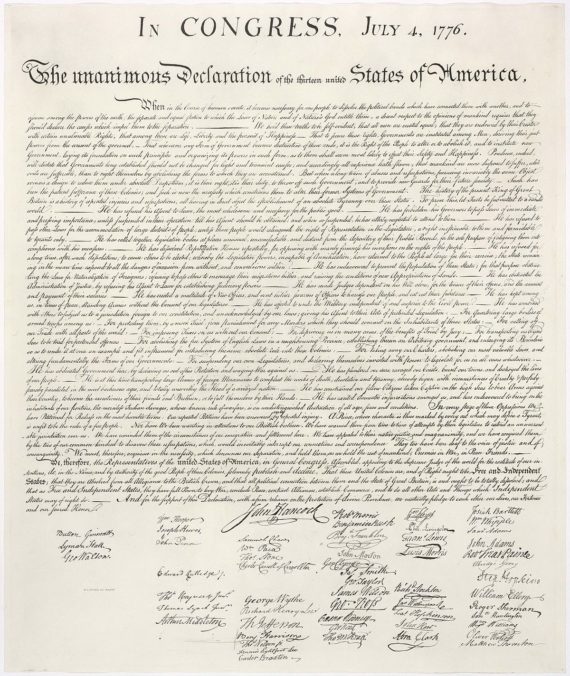
Contents and Preface to my forthcoming book:
I shall be speaking on this “timely” book at the Abbeville conference in March. Hope to see you there!
If you would like to order an autographed copy of this book, which will not be out before the conference, you can contact me at [email protected]
The thesis of this book, Thomas Jefferson’s Declaration of Independence, is that Jefferson’s document is both timely and timeless. As theses go, that is rather white bread. It is certainly at least implicit in many writings on the Declaration of Independence: e.g., Dumas Malone’s The Story of the Declaration of Independence (1954) and David Armitage’s The Declaration of Independence: A Global History (2007). Yet given that so much ink continues to be spent on two key denunciatory theses—that Jefferson did not really write the Declaration and that the actual worth of the document pales when compared to its perceived worth—my thesis needs explicit expression, especially at this kairotic time.
Why is the Declaration timely and timeless?
The Declaration was motivated to express a particular need in its day in the Congress—to explain to the world at the time why the Colonies were at war with and separating from their mother country, England. Yet the warrant for that separation, through the capable and dexterous quill of Thomas Jefferson, was given, by appeal to nature, in terms of certain timeless truths, of which at bedrock lay the expression of human equality, or so, I argue. The genius of Thomas Jefferson—who I maintain was author and not just drafter of the Declaration—lay in the manner that he artfully sketched core principles of a liberal political philosophy in his document that could morally justify political revolutions. That justification was governmental contravention of humans’ natural equality, when governmental figures, placing themselves above natural law, were treating unequally the citizens they were meant to serve.
I expect too that this book will prove to be timely and timeless. It cannot help but be timely, because it comes out just prior to July 4, 2026, which chances to be the 250th anniversary of the Declaration of Independence and the 200th anniversary of the death of Thomas Jefferson, its author. It too will be (hopefully) timeless inasmuch as I anticipate that some, perhaps many, of the key claims that I make throughout the book will pass the critical test of time.
Why is there the need for another book on the Declaration of Independence?
To answer that question, I return to the final sentence of my opening paragraph.
Key book-length writings on the Declaration or on Jefferson’s political thinking that includes large discussion of his Declaration by other scholars—e.g., Carl Becker, Gary Wills, Pauline Maier, Danielle Allen, and Leonard Levy—have left me either wanting more (Becker and Wills) or with a foul aftertaste (Levy, Wills, Maier, and Allen). And so, I crafted this book as a critical corrective. Its success will be determined by my analytic capacity to recognize historical mistakes and abuses of historiography as well as by my “corrections,” some of which in time might themselves need correcting.
What do I find wanting or defective in other important works?
Becker’s book, The Declaration of Independence, published first in 1922, is comprehensive. He covers the natural-rights philosophy behind the document, the history and theory of English government, the writing of the Declaration and its successes and failures as a literary document, and the Declaration itself as a philosophical work. He does not question Jefferson’s authorship of the finished product, as do more current scholars, but he does question Jefferson’s “felicity of expression.” That is worth addressing and I do address it.
The major flaw of Becker’s work is that it is dated. Much has been said about the Declaration after Becker’s book. Another flaw, and it is one that I discuss in chapter 5, is Becker’s own “felicity of expression.” His style of writing is roundabout and metaphor-heavy to the point of wearisomeness, and his metaphors are often mixed. Consequently, it is frequently difficult to penetrate through the haze of his metaphors to grasp exactly what he is trying to say. He was, of course, in his day, at the head of the Progressivist historical movement, which challenged the notion of any non-relativist sense of historical truth and which made “everyman his own historian”[1] and every “historian” as good as any other.
In 1963, Leonard Levy’s Jefferson and Civil Liberties came out. Acknowledging the philosophical content of the Declaration, Levy objects to the superficiality of that content. Jefferson merely offered stale, timeworn maxims for a “libertarianism” that he never then or later fleshed out, though he ought to have done so. Jefferson was preoccupied with the noble utterances of a youth who had experienced too little of life to be philosophizing, not with the realities of instantiating liberty and equality (terms he never defined) in a republic of and by the people. He was “a philosopher of freedom without a philosophy of freedom,”[2] and an armchair philosopher who ought to have kept his musings out of the Declaration. I aim to show that Jefferson was not so philosophically naïve.
In 1978, Gary Wills published his Inventing America: Jefferson’s Declaration of Independence.[3] He aims to correct the notion that we hold and cherish today: Jefferson somehow invented America through writing the Declaration. Consequently, both he and the Declaration—Congress’ Declaration taken as Jefferson’s—have become sanctified. Jefferson, it seems to Wills, had a vision of America before America was birthed. The real Jefferson, the document that Jefferson submitted to the Congress shows, was a vague moralist. Yet his vagueness, still manifest in the document that comes down to us today, has lent itself a tendency to interpret the Declaration as a work of heavy profundity. That thesis, not so radically different, from Levy’s, I challenge.
There is then Pauline Maier’s book, American Scripture: Making the Declaration of Independence (1997), in which she takes herself to advance the points that Becker wanted to advance, but was prohibited from advancing, because of the conservative time in which he lived.[4] She begins with astonishment that the Declaration of Independence is today treated as a religious relic and that Thomas Jefferson is seen by many as another Moses. There is nothing of originality, she asserts, in the document. Declarations of independence were common when Jefferson took up his quill to create his draft. She argues too that Thomas Jefferson was not the author, but merely the drafter, of the Declaration. The other four members of his committee made important additions to his “draft,” and the copy that was submitted to the Continental Congress was heavily edited, so much so that Maier claims some members made more substantive contributions than did Jefferson. Maier’s overall thesis, I aim to show, is false.
Danielle Allen, in Our Declaration: A Reading of the Declaration of Independence in Defense of Equality (2014), iterates Maier’s thesis that Jefferson was merely the author of the first draft of the Declaration with a singular twist: Anyone who had any part, however unnoticeable, in the creation of the Declaration of Independence must be considered as an author, for the document passed through numerous hands, was inspired by numerous thousands of persons over centuries, and is essentially a democratic proclamation. It not only spoke for all Americans at the time, but it also speaks to all people today. She also puts forth the view that “equality” is the key to understanding the Declaration. While “equality” is the key to understanding the Declaration, Allen leaves that as an unexplained posit. She merely believes that there cannot be liberty without equality, and that, I show later, is nowise obvious. The main flaw of her book is its tendentiousness, as the term “a reading” indicates. It can be interpreted chiefly as a document on equality. I go further and show that “equality” is key to grasping the document—a much more singular claim.
There are other important books, of which I make little use: e.g., Allen Jayne’s Jefferson’s Declaration of Independence: Origins, Philosophy and Theology. His is an admirable look at the philosophy and theology behind Jefferson’s Declaration and prominent philosophers—Bolingbroke, Locke, Reid, Bacon, and Kames—who influenced Jefferson. I have done the same in my many books on Jefferson—my focus is almost always on the philosophical mind of Jefferson—and there is much in Jayne’s book that is agreeable. There are also Malone’s and Armitage’s books, which I have already mentioned to which I occasionally refer throughout.
There are then numerous other books of which I make use, as I see fit, by prominent Early American scholars. There are also many other books I have ignored. Exhaustion is not my aim; relevance is. There is merely too much “stuff” on the Declaration for anyone to aim at exhaustion, even if exhaustion were a worthwhile aim.
There are eight chapters in this book.
The first two, covering Jefferson’s study and practice of law and his Summary View of the Rights of British America, are prefatory. Study and practice of law and the reception of his Summary View put Jefferson in position to be on the committee to write the Declaration, and ultimately, led to him being the sole writer of the first draft.
Chapter 3 is a critical analysis of the Declaration of Independence. What was the purpose of the document? What exactly is the argument behind the claim for justified revolution and separation? Is it a logically coherent argument? Is the document eloquently crafted?
Chapters 4 and 5 concern authorship of the Declaration. Was Jefferson really the author of the document or were others vitally involved, and if so, are they to be understood as authors? In chapter 4, I look at people in Jefferson’s day and in our day, who object to the originality of the Declaration—some of whom arguing that Jefferson was merely the document’s drafter. In chapter 5, I critically assess the merit of those criticisms.
The last three chapters address what I take to be the axial concept of the Declaration: equality. Just what did Jefferson mean by human equality and how, and to what extent, does it justify natural rights? I ask and answer those three questions in chapter 6. The final two chapters, in effect, look at the scope of “men” in the sentence, “All men are created equal.” Were Native Americans and Blacks in included (chapter 7)? Were women included (chapter 8)? Study of Jefferson’s corpus of writings offers answers to those questions.
I close with an epilog that sums the arguments on behalf of my thesis: that the Declaration is both a timely and timeless document.
I add three procedural points before ending this prologue.
First, I adopt the terms “First Draft” to the draft that Jefferson composed prior to comments from the Committee of Five, and “Fair Copy” to the draft that he submitted to the Continental Congress, after cosmetic edits by other members of his committee. “Declaration of Independence” I use only for the finished copy.
Second, I offer no citations for letters from or among Founding Fathers. All letters are easily available to all scholars on Founders Online.
Finally, I often, unapologetically, include lengthy quotes. This is chiefly a philosophical book, or a work on Analytic History if one prefers, and so it is of utmost importance that vagueness and equivocation be eschewed and that clarity and precision be achieved. Paraphrase, without due circumspection, can readily lend itself to a biased reading of a text. So too can drawing out a quote from the context of a paragraph. There too are, in Jeffersonian scholarship, too many theses driven by authorial biases which could be readily controverted were they not written under the cloak of artsy, inventive paraphrase.
I hope readers will enjoy reading this book as much as I have enjoyed writing it.
Contents
Prologue
I: Jefferson’s Years as Barrister
II: Jefferson’s Summary View
III: Declaration of Independence
IV: Jefferson Comes under Attack
V: In Defense of Thomas Jefferson
VI: Are All Men Really Created Equal?
VII: Jefferson on Natives & Blacks
VIII: Jefferson on Women
Epilogue
Appendix I: The Declaration of Independence
Appendix II: Jefferson’s (First) Draft of the Declaration
Appendix III: Signatories of the Declaration of Independence
Enjoy the video below…..
[1] Carl Becker, “Everyman His Own Historian,” in American Historical Review, Vol. 37, No. 2, 1932: 235.
[2] Leonard Levy, Jefferson and Civil Liberties: The Darker Side (Cambridge: Harvard University Press, 1963), 172–73.
[3] Gary Wills, Inventing America: Jefferson’s Declaration of Independence (New York: Doubleday, 1978), ix.
[4] Pauline Maier, American Scripture: Making the Declaration of Independence (New York: Alfred A. Knopf, 1997), xvii–xviii.
The views expressed at AbbevilleInstitute.org are not necessarily those of the Abbeville Institute.



I LIKE THE FONT THE FOUNDERS USED FOR united.
Interesting that you caught that, and it is not insignificant. If you go to the conference, bring up that point….
I suspect that it was not only not insignificant but deliberately SIGNIFICANT by the signers.
Hence, my comment.
“invented america” 13 surrender letters from a king?
” She begins with astonishment that the Declaration of Independence is today treated as a religious relic and that Thomas Jefferson is seen by many as another Moses. There is nothing of originality….” what a twat…astonishment. its treated by fox news as religious, and maybe assholes with trucks who plaster only three words from the document on their back window and dont adhere the first ‘two words’ of the remaining 14 paragraphs of it on their vehicles. did TJ or anyone at of the era require it have some new form of ‘originality’?
Scott, hope to see you in Bama….
Dr Holochak. Is there anything, anywhere at all where Jefferson points to his tutelage by Dr. Thomas Walker.
I get “created equal”. Pretty sure I get it to near perfection, since it’s my blood.
Great luck in Alabama. I won’t miss another. Thanks in abundance to Abbeville
I shall talk much about “created equal.” I devote much of my book to that. It is not at all obvious in meaning….
Not that I have seen. It would be a good topic of research. We know of his interest in Walker’s wife–his sole indiscretion.