

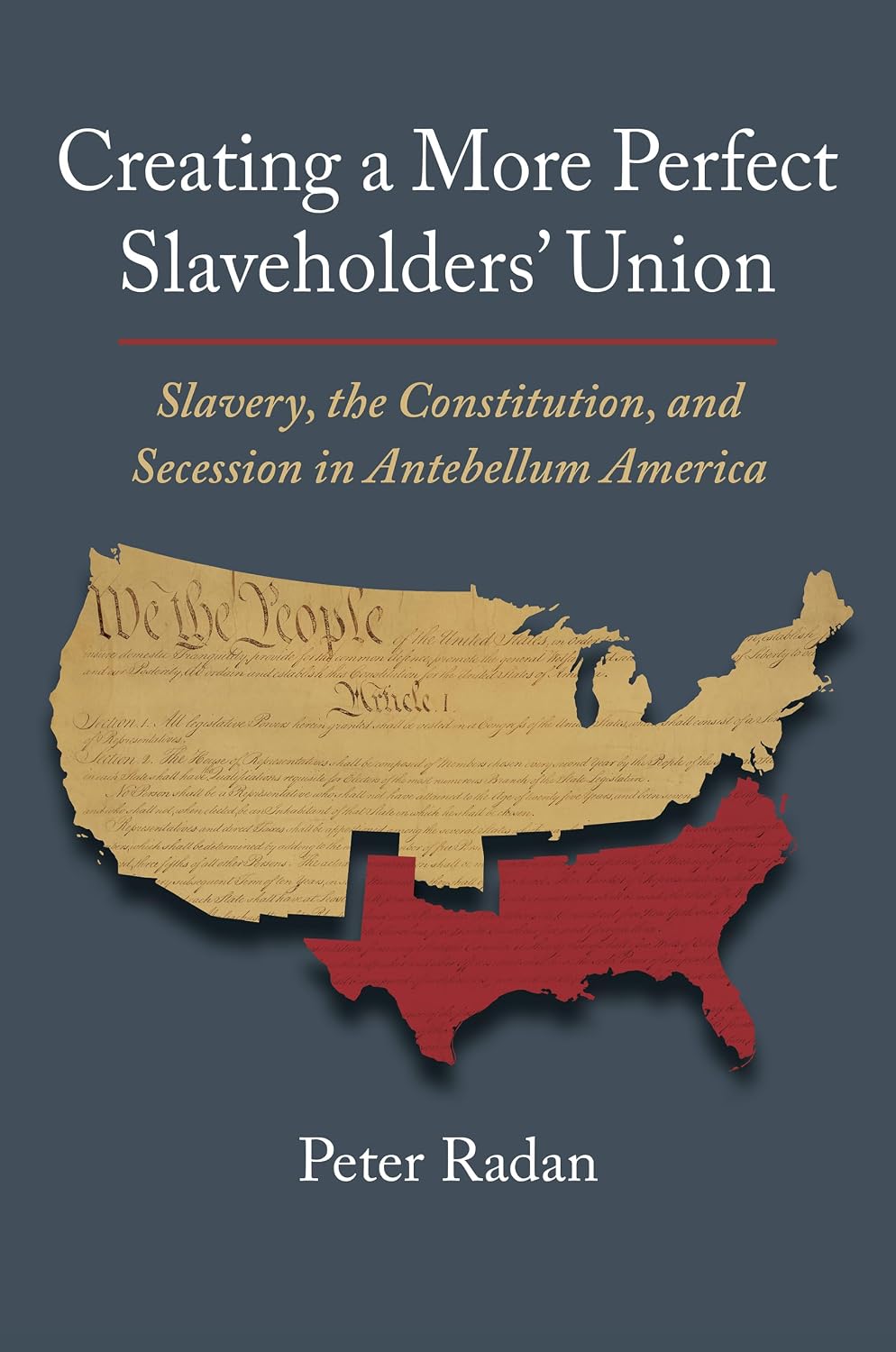
A review of Creating a More Perfect Slaveholders’ Union: Slavery, the Constitution, and Secession in Antebellum America (University of Kansas Press, 2023) by Peter Radan
As with all creditable works of scholarship, Peter Radan begins with a question, why was a war required to end slavery in the United States when it was ended by legal means elsewhere? The answer Radan offers is surprising. In his view, the slave states of the South enjoyed significant constitutional protections for their “peculiar institution,” without which the ratification of the Constitution was impossible. Indeed, Radan goes so far as to declare that the renunciation of the institution of slavery on the part of the slave states after the Civil War as a condition of readmission into the union implied a legal right to secede. He finds, too, the pardon of Jefferson Davis suspicious, as it saved the Republican party from the potential embarrassment of a Davis acquittal from the charge of high treason. Radan is no worshipper of the Constitution as Holy Writ. He recognizes the document’s turgidness and ambiguity, citing George Washington, James Wilson, James Madison, and Chief Justice John Marshall and Associate Justice Joseph Story in support of his assessment. Refreshingly, Radan also cautions the reader to handle with care such outside commentaries as the Federalist Papers, recognizing their primary function as propaganda (meant in its non-pejorative sense) to sway the New York Convention to ratify the Constitution. Unlike many in academia, Radan is not afraid to challenge the consensus.
The heart of Radan’s argument is both clear and simple. The protection of the interests of slaveholders was the central feature of the Constitution. Thus, any attempts on the part of the federal government or the states to violate these protections was, to use a lawyer term, actionable. Radan argues that unilateral secession was a legal remedy. How Radan arrives at this thesis is a result of deft textual and legal analysis.
Radan begins his case with an attack upon the nationalist conception of the Union as perpetual union of one American people. Unlike the Articles of Confederation, the Constitution contains no clause regarding perpetuity and suggests that the phrase “more perfect union” does not imply an argument against secession. In theory, secession might limit the scope of the union, but it certainly would not destroy it. Thus, the conditional ratifications of Virginia, New York, and Rhode Island provided no hinderance to those states’ admission to the union.
Neither does the Supremacy Clause pose an obstacle to unilateral secession in Radan’s view. Secession was not an amending or repeal of federal law, but a withdrawal from the Compact. Oddly, Radan does not cite Luther Martin’s justification of the Supremacy Clause. Martin had introduced the clause to counter a proposition granting a veto of state laws to the federal government. Martin described his intent in this way, “Since in the form I introduced the clause, notwithstanding treaties and the laws of the general government were intended to be superior to the laws of our state government, where they should be opposed to each other, yet that they were not proposed nor meant to be superior to our constitution or bill of rights.” (Luther Martin, Letter, Baltimore Maryland Gazette, March 19, 1788) The intention, at least as Martin had it, was to draw clear boundaries around the scope of federal legislative powers. For Radan, it may be a moot point as he views the Supremacy Clause (and the Guarantee Clause) as binding only on those states in the union. Nor is the Presidential Oath of Office a place of refuge for the nationalists as it requires the President to preserve the Constitution, not the federal regime.
Radan is at his best when he savagely attacks the view that the American people predated the Constitution. He rightly points out that there were several Declarations of Independence in 1776, that the writing and ratification of the Constitution entailed a secession from the perpetual union of the Articles of Confederation, and that it was the people of the separate sovereign states who ratified the Constitution through their delegates in state conventions.
The evidence for the compact theory of the Constitution is, in Radan’s view, compelling. He points out that voter eligibility was left to the states to decide; the Senate had equal state representation with senators chosen by the state legislatures in nearly all instances. Moreover, treaties required the advice and consent of the Senate for ratification. In addition, citizenship was state based; there existed provisions in law and the constitution for treason against the states, and the states played the central role in the ratification of any amendments to the Constitution. For Radan then, John C. Calhoun’s theory of the union as a relationship between principals, the states, and their agent, the federal government was the correct theory of the Constitution. Supporting this theory is the historical fact that the Virginians, Marylanders, Pennsylvanians et al. did not primarily identify themselves as Americans. Quoting Jennifer Ratner Rosenhagen, “America did not have a Volk nurtured by a common Kultur . . . it was nothing other than a contractual arrangement.” In other words, Abraham Lincoln was a poor historian; his assertion that there existed “a single sovereign American people” since 1776 was simply wrong, but nevertheless his view helped to create a powerful “mythical national past,” in the words of historian Mark Neely.
For Radan, the keystone of the Constitution, the compact that formed the federation of sovereign states, was slavery. Without the provisions protecting the institution of slavery the Constitution would not have been ratified. Radan argues that the primary distinction between the states after the War for Independence was the institution of slavery. He accepts Ira Berlin’s observation that the North was a society with slaves, while the South was a slave society due to the crucial role the institution played in the economic production of the Southern states. Radan also turns to Madison to support his dualistic view of early American societies. Madison declared that the chief distinction between the states represented at the Philadelphia Convention was not between the large and small states, but between the slaveholding and non-slaveholding states. To use interposition, personal liberty laws, or nullification to deny slaveholders the right to retrieve their slaves from the free states and to exclude slavery from the territories by Congressional fiat were significant breaches of the Constitution.
The remaining question is whether unilateral secession was constitutional. Here Radan is less certain. He is too good a legal scholar to assert that Texas v. White (1869) is the last word; Supreme Court decisions have been overturned or ignored in the past. The great flaw in Chief Justice Samuel Chases’s majority opinion in the case is his near verbatim repetition of Lincoln’s deeply flawed historical argument for a perpetual union. The Fourteenth Amendment presents a different challenge. Assuming the amendment was legally ratified, which is not a safe assumption, at best one might infer a prohibition on unilateral secession from the Citizenship Clause, the Privileges and Immunities Clause, or perhaps section three’s prohibition on persons “engaged in insurrection and rebellion” holding civil or military office. Nothing, however, exists in any of these provisions that can be construed as a direct prohibition of unilateral secession, nor is there any evidence that any of these sections were intended to function as prohibitions of unilateral secession.
Radan, in my view, is on very solid ground in his legal arguments. His grasp of American history, however, leaves much to be desired. In part, as a legal scholar, Radan is dependent primarily upon the work of historians of the War for Independence and the War Between the States for his historical narrative. In part, too, while he makes a dangerous argument for the legality of secession, he is at great pains to distance himself from any support of the cause of the Confederacy and what he views as the raison d’être for the emergence of the Confederacy, the institution of slavery. As the book’s title states, slavery is at the center of Radan’s analysis. He asserts that it is the central feature of the Constitution, followed closely by white supremacy and inequality; as noted, he repeats uncritically Ira Berlin’s assertion that the South was a slave society as opposed to the North as a society with slaves; and he accepts the view that slavery was America’s “original sin” because he views equality as the true but unfulfilled promise of the American Revolution. Granted, in writing a book with a dangerous argument one might believe Radan felt that he must do homage at the altar of American progressivism to get published. The last page of the book, however, suggests strongly that he is a true believer. The hymns of praise bestowed upon the Thirteenth, Fourteenth, and Fifteenth Amendments, Frederick Douglass, and of all people, retired chairman of the Joint Chiefs of Staff, General Mark Milley are less suggestive of scholarly detachment and analysis than of cheerleading for that will o’ the wisp, an egalitarian society. The consequence is a distortion in Radan’s analysis of the history of the Constitution and the society that produced it.
If Radan is critical of Lincoln’s assertion that Americans were a single people before the ratification of the Constitution, he accepts blindly Lincoln’s and others’ assertions that the Declaration of Independence established equality as the fundamental political commitment in the American polity. The assertion is ahistorical. Eighteenth century Americans speculated that equality may have existed in the state of nature, but the formation of society brought with it inequalities of condition and position. The phrase “all men are created equal” was understood by most political leaders in the colonies as referring to their right to form a polity on an equal basis with the other nations of the world. Egalitarian commitments did not emerge in American until the second decade of the nineteenth century, and then primarily in the North. Even there it was primarily used as a rhetorical weapon against the slave states in the Congress; it did not exist as a political or social commitment anywhere in the United States in the antebellum era. It was Northerners who departed from the original meaning of the Declaration of Independence in their attempt to place equality at the document’s interpretive center.
Another example of how the lens of slavery distorts the historical record is found in the issues of the old Northwest territories and the navigation of the Mississippi. Radan states that there is “no clear answer” for the slave states agreeing to the exclusion of slavery from the Northwest Territory. Some further investigation might have cleared the waters for Radan. Virginia had the oldest and possibly strongest legal claims to these territories. Smaller states with no such claims, Maryland, a Southern slave state, and Rhode Island, a Northern state, expressed grave concerns over this issue. Even if Virginia were forced to concede some territory to the claims of Pennsylvania, Connecticut and other states, the House of Representatives may still have become a Virginia fiefdom, or at best, a body overwhelmingly dominated by the larger states. Northern states had the additional concern of being overwhelmed in the House by the population growth of the Southern states. During the early years of the Confederation and federal republic, most believed the South would outpace the Northern states in population. Restricting slavery from the Northwest was an attempt to address these concerns, and in part, was an especially striking act of magnanimity on the part of Virginia toward the Northern states.
Radan also misunderstands the complex role slavery played in the politics of nineteenth century America. The invoking of the Declaration’s equality clause and the anti-slavery rhetoric of many Northern politicians and intelligentsia was conditioned strongly by the anti-black laws present in so many Northern states. Abaham Lincoln is a perfect example of this conditional egalitarian impulse. As a former legal counsel for slaveowners seeking the return of their runaways, he experienced an epiphany of sorts regarding the morality of slavery (though he did favor enforcement of the federal Fugitive slave laws) but admitted in debate with Stephen Douglass that the equality clause in the Declaration did not confer upon black Americans a state of political or social equality with white men. What Radan may think of such prominent proslavery and anti-secession Southerners as Alexander Stephens and Hershcel Johnson would be interesting to know. Until secession happened, they expressed views held by many proslavery men, namely the belief that slavery was better secured in the Union than outside of it. An argument can be made that Lincoln agreed with these men. Lincoln professed no desire to interfere with slavery where it existed, he supported the Corwin amendment which would have extended direct constitutional protection to the institution in perpetuity, and the Lincoln administration had a powerful motive for preserving slavery where it was already established. The revived Whig economic program of high tariffs funding a host of infrastructure programs required slavery to continue if the South was to remain competitive in the international cotton, rice, sugar and tobacco markets. Southern wealth was to be the engine of Northern industrial expansion.
Slavery had a major role to play in all of this, but perhaps not the exact role Radan and others have in mind. Though the issue of slavery in the territories led to violence in Kansas (though a strong case was made by James C. Malin for much of the bloodshed resulting from disputed land titles) and contributed greatly to the political anxieties of the economically stressed grain farmers in the North, the issue was largely mooted, as Illinois Senator Stephen Douglass recognized. Due to heavy Northern migration inflows into Kansas, the territorial constitution was altered to exclude slavery from the territory, and in a brief five years the slave population dwindled to just eight slaves. Border crossers (ruffians?) from Iowa secured Nebraska territory for the free states, and while Utah Territory did have a provision protecting slave property in its constitution, all 29 of them, the Mormons were hardly sympathetic to the Confederacy. The political calculus of the territories in a short time would leave the South as a definitive minority in the Union and subject to the whims and interests of a sectional political party. Whatever else may be said of the South’s politicians after 1850, they could still count. Slavery was a convenient political tool to unite disparate groups in the different sections, and a rhetorical club (e.g. Slave Power and Black Republican) with which to beat one’s political opponents over the head, literally and figuratively.
While Radan focuses intently upon slavery, using it as an interpretive filter for his analysis, his argument has an interesting subtext. If the states are sovereign and are the principals in the Compact, it stands to reason that the different states may have had somewhat different reasons for pursuing the path of secession. No doubt, anxiety over the future of slavery played a role, but so did the tariff and infrastructure spending issues, the enthusiastic support in some quarters of the North for John Brown’s Harper’s Ferry raid, and the resistance of the governors of Iowa and Ohio toward extraditing the participants and conspirators involved in the raid. The events surrounding Brown’s attempt to ignite a widespread slave rebellion, and the support of many prominent Northerners for Brown pushed many moderate Unionist Southerners into the secessionist camp. More importantly, slavery and the issues surrounding it cannot be abstracted and isolated from the other issues of the day. To do so, as so many historians do and as Radan has generally done, is to engage in the destruction of important context and to undermine our understanding of the past.
Contextual considerations may be a bit beyond the scope of Radan’s legal argument, but even on Radan’s chosen ground there are issues and omissions. As Radan acknowledges, the Southern case for secession hinged on the inability of the Northern states to live up to their legal obligations concerning slaves and slavery, but only in part. The larger guiding principle, however, was John C. Calhoun’s view that the benefits and the burdens of the Union were to be shared equally among the sovereign states making up the Union. Calhoun did not apply this constitutional principle exclusively to the issues surrounding slavery. In his remarks in the Senate on the Deposit Bill in 1838, Calhoun equated the protective tariff and the American System with abolition of slavery as “oppressive measures,” and suggested that Southern commitment to the Union was more often questioned when opposing the tariff regime and American System than the abolitionists. For Calhoun, the issue was larger than slavery; it hinged on the failure of the North to commit itself to the general welfare promised by the Constitution, replacing it with a commitment to exploit one section of the Union for the welfare of the other. It is also important to note that Southern suspicions of Lincoln were confirmed by Lincoln’s actions from the Spring of 1861 to the end of the war. Military occupation and suspension of habeas corpus in Maryland, the calling up of militia to militarily conquer the seceded states, and the shutting down of over a hundred newspapers in the North opposed to the war were all actions which were not authorized specifically or exclusively to the executive branch. Lincoln’s defenders have often referred to these actions as “extra constitutional,” but this euphemism is itself revealing.
Radan’s work is useful for the honest and sophisticated legal argument it lays out in favor of the states’ right to unilateral secession. Yet its singular focus on slavery as the filter through all other issues and events must be understood betrays both a simplistic understanding of a complex period in American history and the predominance of the author’s progressive ideological commitments in shaping his analysis.
The views expressed at AbbevilleInstitute.org are not necessarily those of the Abbeville Institute.




Society with Slaves, vs a Slave Society
I’m good, quite good with Slave Society.
Madison was correct, big difference. Fundemental. Especially if anyone, anyone at all sees the humanity in a Slave Society extraordinary humanity at that.
It’s me all over.
Excellent review and analysis. Thank you.
The bald if inconceivable truth to many today, is that most Americans in the first half the 19th Century, were ambivalent towards slavery, while many who opposed slavery, did so not for reasons of equality but for reasons equating to abject racism. This latter group, who included Abe Lincoln, felt that slavery connected whites and blacks in ways that they believed would bode ill for society. Lincoln, for example, expressly deplored the potential of racial intermarriage and “mixed breed bastards” (his words) and worried about blacks having equal status as whites. Lincoln said that so long as the two races coexisted, he preferred that the “white race should have the superior position”. And so he worked fervently to the end, for a feasible way to remove blacks from the country for resettlement on other continents. Even the insistence of Northerners to keep the Western Territories free of slavery, was not so much for the moral purpose of ending slavery, but to reserve the West “for free, white labor.” (This was their oft used slogan.) Said an early leading “Free Soil” proponent, Congressman Wilmot (Pa.):
“I make no war upon the South nor upon slavery in the South. I have no squeamish sensitiveness upon the subject of slavery, nor morbid sympathy for the slave. I plead the cause of the rights of white freemen. I would preserve for free white labor a fair country, a rich inheritance, where the sons of toil, of my own race and own color, can live without the disgrace which association with negro slavery brings upon free labor.“
Much more could be pulled from the true history, in this vein, than is probably appropriate for mere “comments” … And also I’m aware that subscribers to Abbeville Institute already know all about Northern perfidy, irony and hypocrisy during the period in question and its continuance in the diabolical coverup, ever since.
But I hope I’ve recounted enough to add a few more rounds down range in support of Dr. Devanny’s decisive rout of the specious “equality” (faux) argument , that is so often used to justify the massive atrocity launched upon the Confederate States specifically, and “government by consent” generally.
Deo vindice.
The Ironclad Oath.
This oath changed the united States (Republic of Sovereign States) into a US nation controlled by a federal government. There is no doubt about this statement. When the first idiot lieutenant at West Point swore to die for the Constitution in July 1862, he INVALIDATED EVERY PREVIOUS OATH TAKEN BY ANY NORTHERN MILITARY OFFICER.
The American Civil War was lost by the northern States in July 1862 when that idiot lieutenant swore to die for fedgov…it was lost by the Confederate States in May 1865.
Thank you for an excellent article.