
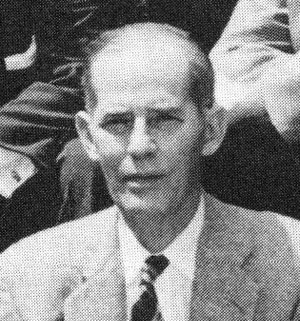
Donald Davidson is remembered as a poet and a polemicist. He was a founding member of the Fugitive poets at Vanderbilt, a contributor to I’ll Take My Stand, and one of the most uncompromising voices of twentieth-century Southern Agrarianism. That reputation is accurate as far as it goes, but it leaves out something that ran through nearly the whole of his working life. In addition to writing about the South in the abstract terms his Agrarian colleagues favored, Davidson kept returning, again and again, to music. He was part of the ballad tradition of the Southern mountains, and the singing culture that carried it. He wrote a folk opera about it. He wrote his only novel about it. He taught it with a guitar in his hand. The scholar and the poet in Davidson were never separate from the man who had grown up around the old songs and could not stop circling back to their significance to Southern culture.
He was born in 1893 in Campbellsville, Tennessee, the son of a schoolteacher and a mother who taught music and elocution. He came to Vanderbilt University in 1909 and, apart from a stint as an army officer in the First World War, never really left it. He earned his bachelor’s and master’s degrees there, joined the English faculty in 1920, and stayed until his retirement in 1964. It was at Vanderbilt in the early 1920s that Davidson fell in with John Crowe Ransom, Allen Tate, and a young Robert Penn Warren in the group of poets and critics who called themselves the Fugitives, publishing their small magazine from 1922 to 1925. The Fugitive years established Davidson as a serious poet in his own right, but the group’s real historical weight came a few years later, when several of its members turned from close reading to cultural argument and became, in 1930, the Twelve Southerners behind I’ll Take My Stand: The South and the Agrarian Tradition.
That book’s argument will be familiar to anyone who has read Robert Lewis Dabney’s 1882 address on the New South, because it is substantially the same argument restated for a new century. The twentieth century Agrarians argued that industrial capitalism, with whatever prosperity it promised, corroded the communal and place-bound life that had sustained the South, and that a people who traded their inherited way of living for Northern commercial models were trading away something they would not get back. Davidson took that argument further and held it longer than most of his Agrarian colleagues, who drifted toward other subjects as the decades passed. He never did. He kept writing essays defending Southern regionalism against what he saw as an encroaching, homogenizing nationalism for the rest of his career, collecting them in volumes like Still Rebels, Still Yankees and The Attack on Leviathan. What distinguishes Davidson from Dabney, and from most of the Agrarians who signed the same manifesto, is that his defense of Southern folkways was not only philosophical. He went looking for the specific cultural material that proved his case, and the material he found and returned to most often was Southern music.
The most direct evidence of that is the guitar. Colleagues and former students who wrote about Davidson late in his life, and after his death, remembered a man who would walk into a classroom on British poetry, pull out a guitar, and sing a ballad before he said a word about meter or rhyme scheme. The same practice carried into family life. His granddaughter, Molly, is my wife’s second cousin, and she remembers him playing the guitar and singing ballads for the family at Endicott, the house in Vermont. “Barbara Allen” comes to mind as one of the songs. He also played the piano for her at his home in Nashville, including a song he had composed for her mother when she was a baby. In addition to the guitar and piano, he kept a dulcimer given to him by a student. Charles Faulkner Bryan, his collaborator on the folk opera Singin’ Billy, helped him get the instrument into working order, and Davidson used the dulcimer in his ballads class at Vanderbilt. For him, the ballad was not a simple text to be scanned and footnoted. It was a thing that lived in the voice and the place, in exactly the sense that the essays in this collection have traced through Sacred Harp singing, front-porch music, and the oral transmission of Appalachian ballads more generally. Davidson had absorbed that understanding early enough, and thoroughly enough, that he could carry it into either the family parlor or a university lecture hall without any self-consciousness either way.
That instinct found its fullest expression in Singin’ Billy, the libretto Davidson wrote for a folk opera built around the life of William Walker, the shape-note compiler known to his contemporaries as Singing Billy. Walker is a familiar figure to anyone who has followed shape note singing as he was the man who published the Southern Harmony in 1835 and was the brother-in-law of B.F. White, the author of the Sacred Harp in 1844 (they were best friends who married sisters). William Walker frequently took the initials A.S.H. after his name (Author of Southern Harmony), telling friends he would rather have those letters after his name than the word President before it. Davidson’s opera is about Walker, the more commercially successful and more mythologized of the two, using the same shape-note world that produced Southern Harmony and The Sacred Harp as his raw material. That a Vanderbilt English professor and Fugitive poet would spend part of his career composing a stage work about a nineteenth-century Southern singing-school master is itself a measure of how seriously Davidson took the tradition. He was dramatizing a history he considered central to what the South actually was.
His only novel took up the same material from the opposite end of the twentieth century. The Big Ballad Jamboree, written in the 1950s and published posthumously in 1996, is set in the summer of 1949 in the mountains of southwestern North Carolina and follows the courtship between Danny MacGregor, a hillbilly singer, and Cissy Timberlake, a folk-music scholar and former singer herself. The novel’s engine is the tension behind living, variable, orally transmitted music when it is approached by people who want to collect it, study it, and fix it on the page or the recording. Davidson had lived through the era of Cecil Sharp’s Appalachian ballad collecting and its aftermath, and he understood from the inside what that collection project had both preserved and cost. Cissy Timberlake is not a villain in the novel, and neither is the commercial music industry that MacGregor’s career must eventually reckon with. Davidson’s interest was in the collision itself, staged with enough affection and enough comic lightness that reviewers at the time called it good-natured rather than bitter. But the underlying question, tradition against commercial prospect, oral practice against the collector’s notebook, is exactly the right question that modern Southern culture should tackle. Donald Davidson had been living inside this question, as a scholar and as an artist, decades before it became a subject anyone like me wrote essays about.
Davidson stood at the point where the tradition became conscious of itself, where a man who had grown up around the ballads went on to study them, teach them, dramatize them on a stage, and build a novel around the very anxiety that studying them produced. He was not a singer, not a folk performer, and not an institution-builder in B.F. White’s patient, self-effacing sense. Davidson was the tradition looking at itself in a mirror, and trying, not always successfully, to keep the reflection honest to the thing it was reflecting.
The physical evidence of that commitment still survives in the family. His granddaughter Molly holds four of his shape-note hymnals. Among them are a copy of William Walker’s Southern Harmony, and Musical Companion, W. H. and M. L. Swan’s The Harp of Columbia, and The Village Harmony: or, New-England Repository of Sacred Musick. One of the volumes still carries a Christmas card inside. She also has his record collection, which includes ballads. The books are worn, as working books tend to be. They are the same kind of objects that appear throughout this collection: the worn Sacred Harp, the family hymnal, the ballad book that stayed in the house long after the singer who used it was gone. Molly remembers him as warm and kind with a very unique, iconic voice. In adulthood she came to see that he had also been the keeper of the Davidson family history and stories, material he passed to her mother, his only child. Among the papers she later found was a six-page letter from his father, dated 1926, on the family’s history, along with other letters showing that Davidson had written relatives for information and that they had written back.
What remains, when the Fugitive years and the Agrarian polemics are all accounted for, is a body of work in which a professional man of letters kept walking back toward the singing tradition of his own region as though it still had something to teach him that his own training could not supply. He wrote an opera about the man who published the Southern Harmony. He wrote a novel about the collision between a mountain singer and the scholars who wanted to study him. He brought a guitar into a lecture hall and sang before he taught. He played the same songs for his family. Whatever else Donald Davidson was, he was also a man who never stopped believing that the ballad, sung rather than merely printed, still had the standing to teach a room full of students (and a room of grandchildren) something a syllabus alone could not.
This is a recording of Donald Davidson reading his 1934 poem “Lee in the Mountains,” likely recorded at Vanderbilt in the early 1960’s.
The views expressed at AbbevilleInstitute.org are not necessarily those of the Abbeville Institute.