

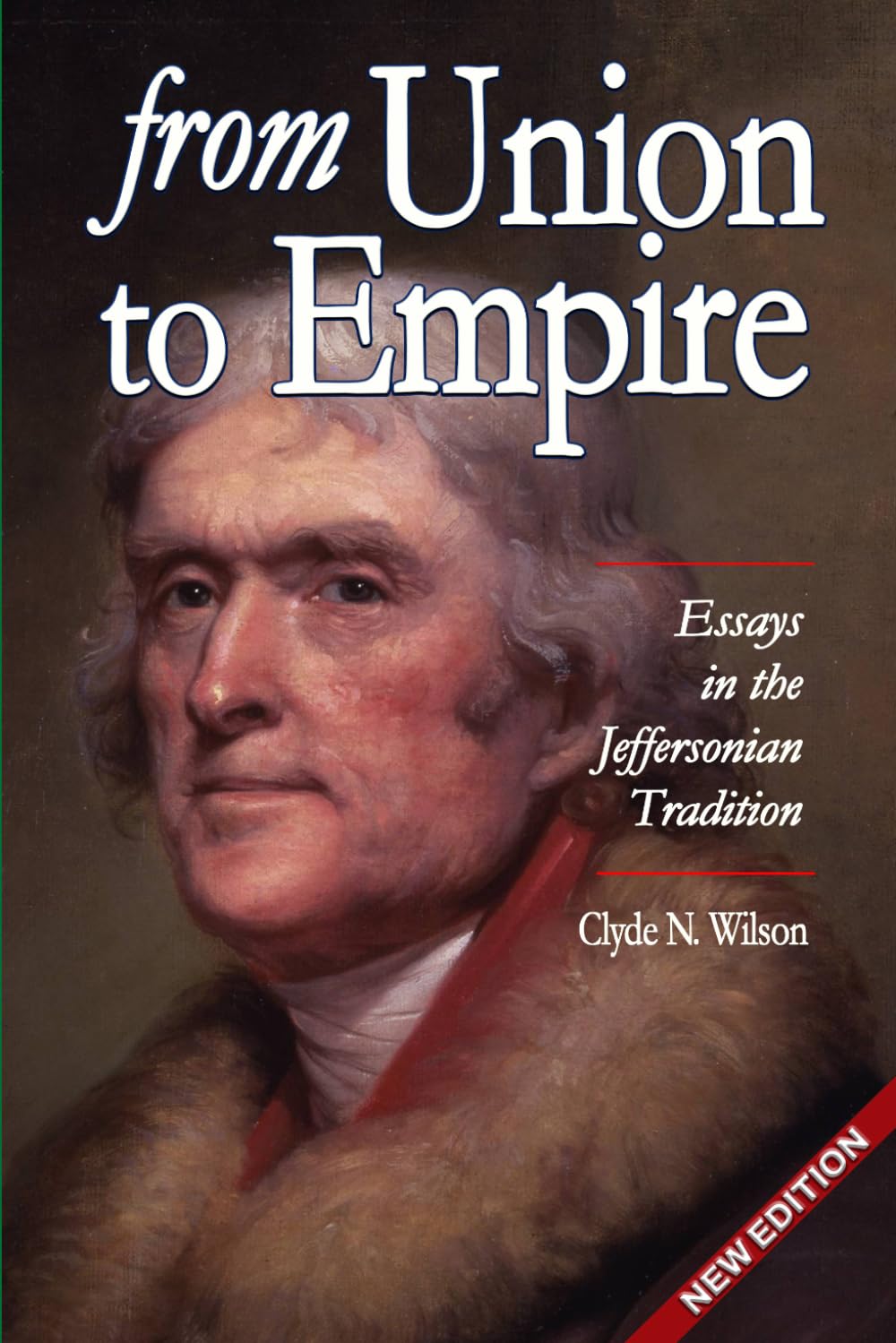
A review of From Union to Empire: Essays in the Jeffersonian Tradition (Shotwell Publishing, 2026) by Clyde Wilson
From Union to Empire, originally published in 2003 by The Foundation for American Education and more recently issued in a new edition by Shotwell Publishing is one of those rare books which does not disappoint the reader who is drawn by the title to pick it up and dive in. It rewards the reader with a better understanding of the vast panoply of events which moved our country from a republican form of government to an empire which today has essentially become an oligarchy. The political movements, events, statesmen and political hacks behind this transition populate the book. It is foremost a work of intellect applied rigorously to the problems which have plagued us since the South was defeated in the Late Unpleasantness and republican government began a precipitous decline. Through essays, short biographies, book reviews and other pieces, Dr. Wilson deftly works tying the disparate pieces of the puzzle into a framework for understanding the flow of American history.
The dedication of the book, “In memory of Russell, Mel and Murray,” speaks volumes to many readers before the Table of Contents is even reached. Russell Kirk, Mel Bradford and Murray Rothbard were men of exceptional character and great learning who championed the principles and values of our Founding Fathers. The work which follows that dedication makes its own contribution to the study of ordered liberty and the “permanent things,” and places Dr. Wilson in that worthy company.
Dr. Wilson ranges far and wide over the landscape of Southern history and culture, and covers the ground with strides unmatched by the lesser denizens of academia. He is well read and draws from a reservoir of knowledge few can match to explain each side of events and the motives behind those seeking to either conserve the limited government of the Founders or those progressives who sought to concentrate power in a strong central government.
We associate the Jeffersonian tradition with republican principles of limited federal government, strong state’s rights, and citizens working to build strong families and communities. This government supports rather than attacks the traditions and heritage of the citizenry. People living close to the land have a local rather than a national or international focus. The farther we move from these ideals, the less liberty and prosperity we enjoy. Culture is rooted in the soil as much as plants.
The reader will understand American history better for having read this book, but more importantly he will grasp the principles and values which held so much promise at the Founding. Dr. Wilson presents facts in such a way as to give a clear view of the pivotal events in American history and what was at stake each time the progressive forces and their centralizing programs thwarted those seeking to conserve republican government. Dr. Wilson shows the end result of the centralizing/progressive reforms is always the same—more government and less liberty.
The failure to conserve the best of the Founding generation’s principles of limited government has attended the fall of our republic and the establishment of a commercial/banking empire. This work analyzes some of the prominent men and events which shaped this fall.
Though the material is scholarly and detailed, it is a surprisingly easy read. Page after page produces passages which are so well written that you want to mark them for future reference.
It also reads like today’s headlines. The beast in Washington D.C. has only grown more corrupt and immoral in the intervening years since these essays were first penned.
Each of the “chapters” in the book is, in fact, a section containing a series of essays or reviews. “Agrarian Conservatism” is the focus of Chapter 1 and the first essay, ‘The Jeffersonian Conservative Tradition’ sets the stage for the rest of the book. It is an excellent introduction, giving a brief history of American political thought, describing political and social movements and defining some key terms. Our history always seems to come down to Thomas Jefferson and Alexander Hamilton, two influential political adversaries of the Founding generation. The conflict between those favoring a more decentralized government (Jefferson’s “country party”) with the states retaining the bulk of the power and those desiring an energetic, strong central government (Hamilton’s “court party”) was not a settled question in the early republic. The final triumph of the Hamiltonians with their energetic (and corrupt) central government took decades. That triumph and how it has played out in history is well described in the essays in this volume.
The next essay, “Citizens or Subjects,” delves into the question of whether we are best described as a republic or an empire. Dr. Wilson states that a strong military and overseas commitments do not necessarily make for an empire. “An empire is differentiated from a republic by the nature of its domestic society and by the purposes which inform its official and public activities.” Unfortunately, our domestic policies tend to smell more of the foul air of empire than the fresh air of liberty.
This chapter also contains several book reviews. A common sport in recent decades seems to be a contest for who can write the best anti-Jefferson biography without appearing to be too partisan and critical. There are reviews of such books, but also a wonderful review of Dumas Malone’s The Sage of Monticello, Volume Six of Jefferson and His Time.
Chapter 2, “The Jeffersonians,” highlights several prominent statesmen of the Founding era, John Taylor, Goerge Mason, Nathaniel Macon and St. George Tucker among them. A couple of essays in this chapter take a look at populism and how it has manifested itself in our political history and discourse.
One very enlightening review included in Chapter 2 is of a speech given by William Faulkner to the Delta Council, an organization of farmers, in Cleveland, Mississippi in 1952. He chose to speak about the Declaration of Independence. His observation was that life, liberty and the pursuit of happiness had “devolved into little more than a shorthand for material security.” Faulkner pointed out that the Founders understood these rights well because many had been without them at some point. It was the effort to pursue happiness, the work ethic, which was vital. A virtuous people strove for “republican ethics and personal honor.” You can see the warnings of the Nashville Agrarians against materialism in what Faulkner was saying.
Chapter 3, “The Lost Constitution,” tackles some of the problems that plague us today as we look at a Constitution which bears little resemblance to the document that was ratified over 200 years ago. “What the Founders Didn’t Count On” is a brief survey of how the Constitution has been changed and abused to fit the needs of a commercial empire. When lawyers and judges became the interpreters of the document it did not take long for the rights of citizens to suffer abuse. This essay was written on the 200th anniversary of the ratification of the Constitution, so there have been several decades of further degradation.
“The Achievement of M. E. Bradford,” a review of Bradford’s A Better Guide Than Reason: Studies in the American Revolution, is a highlight of this chapter. Dr. Bradford looks back at the English Whig influence on our Revolution, which was a reaction to changes in the British government which threatened the customs and rights the colonists viewed as their inheritance. He next looks at the Lincolnian revolution against the principles of the Founding Fathers and his “derailment of American tradition.” Bradford concludes with a look at the populist tradition and how it often gives support to those who see government as the problem. Dr. Wilson concludes his review with high praise for the author, saying the Jeffersonian Agrarians of the South had found a worthy successor in Bradford.
There are other good pieces in this chapter. One tackles the problem of maintaining liberty when we really have no effective free press. Our media are an elite which serve at the pleasure of the ruling class. Though we have not lost all freedom with regards to the press, most of our news and opinion is controlled by a few companies, and there is little chance for effective alternatives.
The ultimate question for republican principles of government in any given period of American history is ‘Who was trying to conserve the republic of the Founders?’ When we look from our perspective, we see a government that little resembles the republic of the Founding Fathers. How did this develop?
Chapter 4, “Empire,” takes aim at the growth of the American empire. The first essay, “Global Democracy and American Tradition,” traces the sprouting of the seed of empire into what we see today—commercial and military ties around the globe that take us farther from our republican roots and closer to entangling alliances. Starting with the subsections on ‘Preserving Domestic Happiness: The Founders Vision,’ then into ‘Non-Interventionist Realism: The Nineteenth Century,’ this essay explores American engagement with the rest of the globe, and continues with ‘The Rise of Internationalism’ and ‘Project World Democracy.’ We also see more dead Americans and more national debt along this road. Unfortunately, the nature of empires does not bode well for a positive change in our future. We seem doomed to the messianic crusade of our elites to spread democracy and American culture, and of course American products, to the far reaches of the planet.
Another essay in Chapter 4, ‘Global Democracy and Conservatism,’ takes a closer look at the effects of globalization on American identity. The cautious foreign relations of our Founding Fathers has gradually been replaced with a different view of American exceptionalism. No longer content to be a special people blessed with self-government, Americans in the last century have sought to export democracy for the universal good of mankind. We see the view of conservatism as the protection of Western Civilization lose prominence to the messianic view of spreading American democracy and culture.
In “The Future of American Nationalism,” Dr. Wilson tells a story about Confederate Gen. Richard Taylor that illustrates the shallowness of those who dare to place themselves in the position of an elite destined to rule over inferiors. Taylor, son of President Zachary Taylor and grandson of a colonel of a Virginia regiment in the Revolution, went to Union Gen. Canby in the final days of the War Between the States to surrender the Confederate soldiers under his command. Invited to stay for breakfast, Taylor tells the story of his meeting with a German staff officer recently arrived in America to fight in the Union army:
This person, with the strong accent and idioms of the Fatherland, comforted me by assurances that we of the South would speedily recognize our ignorance and errors, especially about slavery and the rights of the States, and rejoice in the results of the war.
Taylor recounts briefly his family’s struggles to help colonize America and found the United States, and laments that they had been too busy to teach him the duties of American citizenship. But the German officer “smiled blandly, and assured me of his willingness to instruct me.” We see in this foretaste of nationalism that our “betters” are full of schemes and hot air but short on the virtues and traditions that built our republic.
Also in Chapter 4, ‘The Consent of the Governed’ takes a look at our representative government, rooted in the English tradition of Magna Carta through the Glorious Revolution up to the Declaration’s “these United Colonies are, and of Right ought to be Free and Independent States.” We learn that Jefferson’s belief in equality came not from French books but “from his belief in the self-governing equality of Americans’ primitive Anglo-Saxon ancestors before they succumbed to Norman centralism. “All men are created equal” meant that a Briton on this side of the water is just as damn good as a Briton on the other side, a second son is just as good as a first-born, and that no man is entitled, as Jefferson said on another occasion, by birth “to ride booted and spurred over his fellows.”
Another essay in Chapter 4, “The American President: From Cincinnatus to Caesar,” takes a look at the American presidency’s descent from public servant to imperial leader walking across the world stage. Dr. Wilson takes issue with the current tendency among historians to champion those who were
presidential Lone Rangers—Abraham Lincoln, Woodrow Wilson, Theodore and Franklin Roosevelt, John Kennedy and Ronald Reagan—[who] gallop in to save us from dark forces that threaten divinely ordained progress toward the universal triumph of ‘American democracy.’ (The dark forces are often discovered to be ourselves. The American people must be saved by presidential heroes from their ignorant prejudices against such things as foreign wars, affirmative action, and unlimited immigration.).
A quote from John C. Calhoun tells us all we need to know about politicians-presidential and otherwise:
When it comes to be once understood that politics is a game; that those who are engaged in it but act a part; that they make this or that profession, not from honest conviction or intent to fulfill it, but as the means of deluding the people, and through that delusion to acquire power; when such professions are to be entirely forgotten, the people will lose all confidence in public men. All will be regarded as mere jugglers—the honest and patriotic as well as the cunning and the profligate—and the people will become indifferent and passive to the grossest abuses of power, on the ground that those whom they may elevate, under whatever pledges, instead of reforming, will but imitate the example of those whom they have expelled.
Chapter 5, “Imperial Irritations,” looks at a variety of issues that have plagued the American empire. Immigration, and how its nature has changed over the centuries, is the subject of three book reviews (among them ‘As a City Upon a Hill’). Immigration continues to be a major issue today, as do some of the other issues found in this chapter. Drugs, government overreach, voting laws, abortion, perceived police brutality, ineffectiveness in our Congress (and the inability to reform it) are found in the news just as prominently as a few decades past.
A short but enlightening comparison of ‘Two Prisoners’ shows how shallow American culture is by looking at the favorable treatment received by a skilled politician and privilege seeker, Nelson Mandela, compared with an eloquent artist and prophet, Aleksandr Solzhenitsyn, who was widely ignored by those in power. This comparison exposes how our elite media craft stories to put their spin on how we are to view events and persons.
Chapter 6, “Cons and Neocons,” does an admirable job pointing out differences between traditional conservatism and neoconservatism with its pursuit of global democracy. “Moments in the Sun” is a book review of The Neoconservative Mind: Politics, Culture, and the War of Ideology by Gary Dorrien. Dr. Wilson writes there is no better description of the subject of the book (and by inference much of the neoconservative movement) than the publisher’s press release which reads in part:
Once there was a group of liberals and Leftists. They were Democrats, they were radicals, they were freedom riders. But they became disillusioned by the Left. They moved toward the Right, they opposed the anti-war movement, they made socialist arguments for electing Richard Nixon. They claimed to be true American liberals, and they attacked their former friends who continued to identify with the Left…. They went on to campaign for Cold War objectives of “exporting democracy” and to support Ronald Reagan and his crusade for “family values.”
In the same chapter, ‘Contemporary Liberalism’ is a fascinating short essay which tackles the difference between socialism and liberalism: both of them heretical to our Western political tradition.
This chapter is highlighted by tributes to or book reviews of conservative heroes: Pat Buchanan, Murray Rothbard, Russell Kirk, Richard Weaver, James Burnham and Sam Francis. In a review of Russell Kirk’s America’s British Culture Dr. Wilson writes:
The occasion is always grave when it is necessary to defend obvious truths. The obvious truth, for instance, that what we know as America was and is British in culture. It is a truth that our forefathers seldom remarked upon for the same simple reason that a fish does not notice the water he swims in. The powers that be have banished the obvious truth and have proclaimed as an operative principle an obvious untruth: multiculturalism. Multiculturalism is, as Dr. Kirk argues beyond dispute, not many cultures but no culture, or, in fact, an anti-culture. For a true culture is, of course, an inheritance, an achievement, a tradition, grown not made. Not a decree of the state but a seamless web of the everyday and the eternal, the high and the low.
This chapter also includes a series of short pieces entitled: ‘Clinton, Bush, et al.’ The first paragraph is very insightful:
The Reagan Revolution is dwindling down in its later days into something that in the final analysis differs in only a few details from its predecessors. In fact, Reagan may have established that no Administration, no matter what its will or the size of its majority, can survive the push of the media and the pull of the bureaucracy.
Chapter 7, “History and Historians,” offers Dr. Wilson a chance to look at the study of history today. Some historians are doing good work, and others are doing the work of “court historians,” pandering to the power elite that give them their positions and tenure.
Two books by John Lukacs are reviewed in this chapter: ‘Tocqueville Redivivus’ is a review of Outgrowing Democracy: A History of the United States in the Twentieth Century. Lukacs sets out to interpret the nature and status of American democracy as it evolved over the past century. Dr. Wilson has high praise for Lukac’s work:
Were some power, either republican or princely, to entrust me with a classroom of promising youth who were to be educated to become the best possible historians of the future—well, I would find the works of John Lukacs indispensable. Why? Simply because I can discover in our time no better example of creative historical thinking and practice.
High praise indeed. There is further praise for Lukacs in a review of the 1985 edition of Historical Consciousness, or The Remembered Past. Dr. Wilson again weighs in on the state of historical research and writing:
It does not do to be too pessimistic. So far as history is concerned, there are hopeful signs that the creativity of the Western mind has not atrophied but is rather seeking new channels. Lukacs has been early, though not alone, in pointing to and describing the re-assertion of historical vision that is taking place within literature. There are other examples, of which the works of Solzhenitsyn are perhaps the most conspicuous and persuasive. But this development is taking place outside of and even largely unknown to the academic historical enterprise.
A review of Forrest and Ellen Shapiro McDonald’s Requiem: Variations on Eighteenth-Century Themes has an excellent quote reflecting on the 1987 bicentennial celebration of the Constitution:
The respectful realism of these essays provides a good antidote to the mindless sentimentality of sunshine patriots and the compulsive hectoring of self-appointed re-Founders under whom we have suffered during the Constitution’s bicentennial celebration.
The last essay is a masterful historical exposition of “Federalism in America” and concludes with the wisest and saddest words of the bicentennial: “Political scientists and historians are in agreement that federalism is the greatest contribution of the Founding Fathers to the science of government. It is also the only feature of the Constitution that has been successfully exported, that can be employed to protect liberty elsewhere in the world. Yet what we invented, and others imitated, no longer exists on its native shores.”
Chapter 8, “Restoring the Republic,” is a stand-alone essay that concludes Dr. Wilson’s book. It is a fitting end, tying together many themes from earlier chapters. The world of the Founding Fathers is far removed from our world. The common man no longer has much in common with many neighbors. We can cite poor education, a failing culture and corruption in our leadership. The truth is we have strayed and may no longer have what is needed to right the ship. There needs to be a revival in our culture, a return to respect for the sacred and integrity and honesty in our governance.
It is sad to see in these pages problems exposed and solutions offered decades ago, with the miserable results of those problems metastasizing even as proposed prescriptions have never been implemented, or even debated. All too often it seems our “two party” system has been reduced to a uniparty system, with our only choice the lesser of two evils. Our Founders would have recognized that for what it is—evil. Jefferson said that if man could not govern himself, how could he govern others? Early in the republic we had some statesmen to guide the country and give some hope of better government. Today we lack men of principle, nor do we have the traditions to conserve and guide us back to republican government.
Kudos to Shotwell Publishing for bringing back this classic collection. Though originally published over 20 years ago, with essays spanning many years, this book is as relevant and informative today as when it was first produced. Some chapters will have you thinking: this sounds just like yesterday’s headlines. Others will have you realizing: I know how this turns out because of the folly of our ruling class.
This is the book you want for reference, for instruction and for inspiration. This is the book you want your neighbors to read (as well as our public servants). This is the book which can point the way to a return to liberty and a true union of federal republics. We require a return to virtue in the public space because it was not conserved. The progressive genie was allowed full rein. We must put the genie back in the bottle.
The views expressed at AbbevilleInstitute.org are not necessarily those of the Abbeville Institute.





From Union to Empire along with its “kissin cousin” Defending Dixie are two books every Southerner should have on their bookstand.
Also, they should be there for every Yankee who can read.
Great book by Clyde Wilson.
“All men are created equal” meant that a Briton on this side of the water is just as damn good as a Briton on the other side, a second son is just as good as a first-born, and that no man is entitled, as Jefferson said on another occasion, by birth “to ride booted and spurred over his fellows.”
It is easy to forget what a very hierarchical world existed in 1776. A laborer or even a yeoman was not the equal of a duke or an earl in a court of law, much less in his influence on or in government (on the order of 10% of Britons could vote–much, much lower percentage if you include the apartheided Irish as Britons).
It is my view that Jefferson meant to express “all citizens are equal before the law.” For it is moronic to assert that 2 human beings are created “equal” in any other sense. But his more poetic phrase proved incredibly powerful in destroying a large degree of hierarchy in the world that had existed for ages.