Drive the 90 minutes between Houston and Austin and the land begins to whisper in another language. A road sign reads Praha. Another reads Moravia, then Dubina, then Hostyn. The cotton gins have gone quiet and the dance halls sag at the corners, but the names hold. They belong to people who crossed an ocean, buried half their company along the way, and built a version of home on the blackland prairie so complete that Texans eat its pastry, dance its rhythm, and pray inside its churches without knowing whose memory they walk through.
The first Czechs settled Texas alone, long before anyone organized a crossing. The writer Carl Postl, who published as Charles Sealsfield, may have wandered the Texas and Louisiana borderland as early as 1823. Frederick Lemský arrived in 1836 and played the fife in the Texan band at San Jacinto. A Catholic priest named Bohumír Menzl reached New Braunfels in 1840. Anthony M. Dignowity, born in the Bohemian mining city of Kutná Hora on January 16, 1810, arrived in San Antonio with a group of Arkansas volunteers during the Mexican War, became a successful doctor and businessman, and made himself one of the most outspoken abolitionists in a slaveholding state—narrowly escaping hanging in the San Antonio plaza in 1861. The hill where he lived still bears his name.
What turned a trickle into a migration was a letter. In December 1849, an Evangelical pastor named Josef Arnošt Bergmann left the Czech lands to minister to German Protestants in Texas, reaching Galveston in 1850 and settling at Cat Spring in Austin County. Soon after leading Easter services there, he wrote home praising the country he had found. That letter ran in the newspaper Moravské Noviny, and the Texas Almanac confirms it as “the catalyst of opportunity” that earned Bergmann his enduring designation as the “father” of Czech immigration to Texas. Families crowded onto small holdings read about abundant land, and craftsmen frustrated by the failed uprisings of 1848 read about a second chance.
They eventually made their way to the Lone Star State. In late August 1851, 16 families from northeastern Bohemia left Hamburg on a 17-week voyage to the Texas coast. The crossing was brutal: Austin PBS reports that of the roughly 74 people in that first party, only about half survived the trip. Those who lived took a steamship to Houston, loaded their children and belongings into oxcarts, and walked 60 miles inland to Cat Spring, where one disappointed arrival described the settlement as “not much more than a prairie and a heavy forest that was full of wildcats.”
Others followed the same footpaths, village by village, in what scholars call chain migration, so that old country neighbors became neighbors again. Most came not from Bohemia but from eastern Moravia, where farmers held an average of five to ten acres and faced political and religious oppression and Austrian conscription besides. That Moravian majority still echoes in the Texas Czech dialect — Moravian variants rather than the Bohemian dialects spoken by most Czech-Americans. Immigration stalled when a Union blockade closed Texas ports during the Civil War, surged again through the 1870s and 1880s, and pushed a third wave after 1900 toward Brazoria and Fort Bend. World War I closed the era.
The numbers accumulated quietly. About 700 Czechs lived in Texas when the Civil War began. The Handbook of Texas, in an entry by scholar Clinton Machann, counts 9,204 foreign-born Czechs by 1900 and 15,074 by 1910, then a decline to 7,700 by 1940, even as the number of Texans who spoke Czech at home during childhood climbed to 62,680. The count was always slippery, because Washington used no Czech designation until 1920 and earlier arrivals vanished into the Austrian column. Machann records 168,023 Texans of at least partial Czech descent in the 1990 census and 187,729 claiming Czech ancestry in 2000, while the Texas Almanac puts the 1990 figure at 282,562 and notes that the organization Texans of Czech Ancestry argues the real total approaches a million.
They spread across roughly 250 communities, thickest in Lavaca and Fayette counties, thinning northeast through Williamson, Bell, and McLennan, with a separate cluster on the Coastal Prairie in Wharton, Fort Bend, and Victoria. Fayetteville drew so many families that the Almanac calls it the cradle of Czech immigration in Texas. Because Fayetteville, Cat Spring, and Ross Prairie had begun as German centers, sources generally hand the designation of first Czech settlement to Dubina or to Hostyn, whose settlers arrived on the same ship in 1856.
The prospect of land ownership was the whole point of this endeavor. Many arrived owning nothing and worked as tenant farmers for German settlers who had preceded them by decades, saving until they could buy. Machann identifies two traits at the center of Czech life in Texas—the tightly bound family and the attitude toward land—and describes farming as a way of life rather than a way of making money. Families raised cotton or corn for cash and made nearly everything else themselves. Settlements organized cooperative beef clubs so every member household received fresh meat weekly through spring and summer.
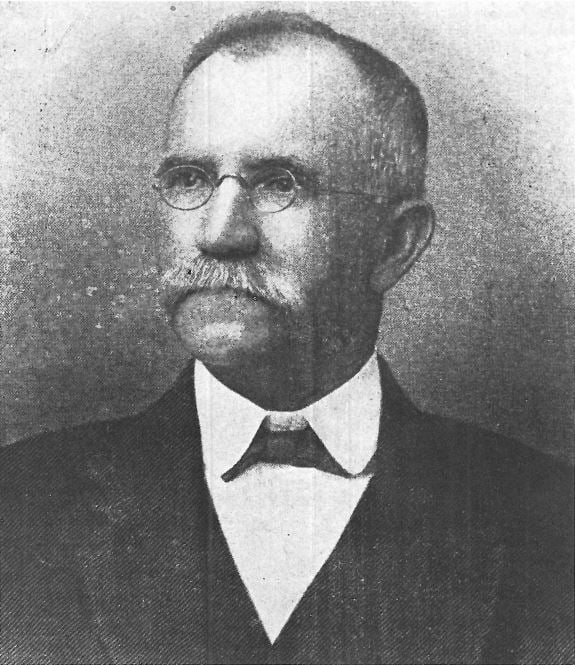
That appetite produced the most consequential Czech Texan of his century. Augustin Haidušek was born on September 19, 1845, in the Moravian village of Mišši, and came to Texas in 1856 when his family settled in the East Navidad area of Fayette County, which he himself would later rename Dubina. He enlisted in the Confederate Army and continued his education during his service by reading and rereading an English-language Bible.
After the war he studied law at the La Grange firm of Jarmon and Cross, and by the end of 1870 had passed his state bar examination, becoming one of the first Czech Americans to practice law in the United States. He won the mayoralty of La Grange in 1875, entered the legislature in 1880 representing Lee and Fayette counties for two terms, and became county judge of Fayette County in 1884, re-elected in 1886 and 1888. As ex officio superintendent of public schools, he vigorously enforced the state law requiring English as the principal medium of classroom instruction and drew criticism from both local Czech Americans and national Czech newspaper editors.
At least partly to argue his assimilationist views publicly, he founded the Czech-language newspaper Svoboda at La Grange in 1885 and edited it until the 1920s. In 1896 he became president of the First National Bank of La Grange, and in 1905 Governor Samuel W. T. Lanham appointed him to the Texas A&M College Board of Regents. Supporting William P. Hobby against James E. Ferguson in 1916 cost Svoboda about 2,000 subscribers—more than half its total.
Faith traveled with them and outlasted them. Somewhere between 70 and 90 percent arrived Catholic, and their first church went up at Ross Prairie in 1859. Fayetteville Czechs petitioned the Bishop of Galveston for a priest from Moravia, and Father Josef Chromčík arrived on Christmas Eve of 1872, then spent 37 years riding a seven-county circuit on horseback to say Mass, baptize, and bury. Their descendants raised the Painted Churches, plain outside and staggering within, among them St. Mary’s Church of the Assumption at Praha in 1895, St. Mary Catholic Church at High Hill in 1906, and Sts. Cyril and Methodius Catholic Church at Dubina in 1912. A Protestant minority carried the older flame of Jan Hus, gathering the first Brethren congregation at Wesley in 1864 and organizing as the Unity of the Brethren in 1903 under Rev. Adolf Chlumský, who saw the church as continuing a Czech reformation the Austrians had crushed three centuries earlier.
They defended the language just as fiercely. Bergmann taught in Czech and German at Cat Spring by 1855. Josef Mašík opened a school at Wesley in 1859 and may have been the first formal Czech teacher in the country. The Catholic school built at Bluff, later Hostyn, in 1868 with Terezie Kubálová as the first teacher may have been the first of its kind in America. Praha taught in both Czech and English by 1870. 33 Czech-language papers circulated in the state, and two—Našinec at Granger and Hospodář at West—still printed entirely in Czech as of the early 1990s.
Then there were the clubs, and the old joke that “wherever you find two Czechs you’ll find three clubs.” The SPJST formed in 1897 to provide life insurance and ended up building a civilization of dance floors. The Catholic orders KJT and KJZT followed in 1888 and 1897. Those halls carried the music outward. The Baca Band of Fayetteville—musical pioneers who celebrated the World War I victory with a blowout dance at SPJST Lodge No. 1—became among the most celebrated names in the region. The polkas and waltzes and accordions traveled far enough that the Texas Almanac traces their crossover into the norteño sound, into conjunto, and forward into Tejano. Fayette County still holds 30 vintage dance halls, more than any other county in Texas, says Steve Dean, co-founder of Texas Dancehall Preservation Inc. “The people of Fayette County dance differently. They still do the traditional steps.”
The inheritance is hiding in plain sight. It is the kolache in a suburban doughnut case and the klobásník beside it. It is Westfest in West, Texas, held every Labor Day weekend in the town the Texas Legislature has designated the Czech Heritage Capital of the State; the National Polka Festival at Ennis, founded in 1967 and drawing tens of thousands every Memorial Day weekend; Czhilispiel in Flatonia, where Czech heritage and Texas chili have achieved an improbable peace; and the Texas Czech Heritage and Cultural Center whose first phase opened in La Grange in 2004, with a library and archives, museum, auditorium, historic structures, and gardens built to keep the record.
Mostly it is the map itself, a scatter of Old World names placed by people who lost half their number getting here and never once considered turning back. Follow those signs off the interstate some Sunday, and the road stops being a road. It becomes a way of remembering an often-forgotten facet of Texas history.
The views expressed at AbbevilleInstitute.org are not necessarily those of the Abbeville Institute.