
I came to Sacred Steel late, and I came to it by accident. I’d been going back through my list of American musical traditions that are actually Southern, checking for anything I’d left out, and Sacred Steel was one of the names that turned up as a gap. I didn’t know the tradition at all going in, so I did what I always do when a new genre crosses my path: I sat down and listened to as much of it as I could find. Aubrey Ghent. The Campbell Brothers. Robert Randolph. Willie Eason and the older Jewell Dominion players who started the whole thing. I expected to hear something like the pedal steel of a Nashville session player, dressed up for church. What I heard instead stopped me a few songs in, because I knew that sound from somewhere else entirely. I was hearing Duane Allman. I was hearing Skynyrd’s three-guitar wall. I kept waiting for the resemblance to fade as I got deeper into the catalog, and it never did.
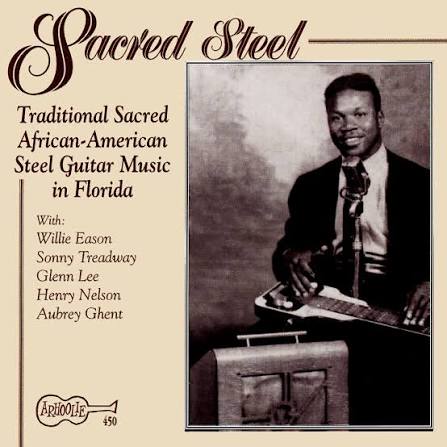
Sacred Steel is not a novelty tradition and it is not a footnote, and its roots are Southern from the ground up. The denomination behind it, the Church of the Living God, was founded in 1903 by Mary Magdalena Lewis Tate. After her death in 1930 the church split into three branches, and two of them, the Keith Dominion and the Jewell Dominion, carried the tradition forward. The steel guitar itself entered the worship service in Florida in the late 1930s, brought in by brothers Troman and Willie Eason, who introduced it to the Keith Dominion’s South Florida congregations as a working substitute for an organ most of those small churches had no money to buy. Willie Eason is the man every serious history of the tradition credits as its true architect, and he did that work inside Florida churches, not anywhere else. Aubrey Ghent, Sonny Treadway, Calvin Cooke, and the Lee Boys, the players who carried the tradition through the rest of the twentieth century, are Florida and Deep South figures almost without exception, and the tradition’s living center of gravity is still Florida today. What Eason and the players who followed him built is the part that matters musically. The steel guitar in these churches did not stay in the background providing harmonic color the way a church organ would. It became the lead voice of the service, carrying the melody of the hymns, answering the preacher, driving the shouting sections of the service the way a lead vocalist would in any other tradition. Willie Eason, and later Ghent, Treadway, and the Campbell Brothers, built a vocabulary around that role: wide, vocal-like bends that push a note sharp of where a fretted instrument could ever put it, sustained tones held and shaken with the bar, a phrasing style that mimics a human shout because it is standing in for one. The steel guitar in Sacred Steel doesn’t accompany the service. It preaches.
Southern Rock grew up in a completely different corner of Southern life, but the players in it were drawing water from the same well. Duane Allman’s slide playing on songs like “Statesboro Blues” and “Layla” is built on the same premise the Sacred Steel players were working from independently: that a stringed instrument can bend past its fixed frets and produce something closer to a human voice than a guitar has any business sounding like. Dickey Betts’ twin-guitar harmonies with Duane, and later the three-guitar interplay that Lynyrd Skynyrd built their sound around with Allen Collins, Gary Rossington, and Ed King, work from the same instinct toward sustain and call-and-response phrasing between instruments that the Sacred Steel tradition uses between steel guitar and congregation. “Free Bird” and “Whipping Post” both build toward long instrumental sections that function less like a composed guitar solo and more like a sustained testimony, one phrase answering the last and building toward release rather than resolution. That structure isn’t an accident of the blues-rock genre. It’s the same shape a Sacred Steel steel guitar takes across the course of a shout section, whether or not either tradition ever heard the other.
The two traditions share their root system without one growing directly out of the other. Sacred Steel’s ancestry runs through Delta and Piedmont blues filtered through Holiness-Pentecostal worship, arriving at the steel guitar because a poor congregation needed an instrument that could do the work of an organ on no budget. Southern Rock’s ancestry runs through the same blues tradition filtered through electric guitar innovation and the British blues revival that reintroduced American musicians to their own regional inheritance. Duane Allman got to slide guitar through Robert Johnson and Elmore James records, not through a House of God service in Ocala, Florida. The resemblance between the two traditions is a case of parallel invention from a shared inheritance, not lineage. Both trace back to the same blues shout and the same gospel testimony. They just arrived at the electric guitar’s possibilities from two different directions, one through the sanctuary and one through the roadhouse.
There’s a temptation, looking at this resemblance from the outside, to sort it along racial lines: Sacred Steel as Black gospel guitar, Southern Rock as white rock guitar, two separate inheritances that happen to rhyme. That’s the same mistake a stranger makes standing in front of a plate of black-eyed peas and cornbread and calling it soul food instead of what it actually is, which is Southern food, eaten by Southerners of every background because it belongs to the region rather than to one half of it. The steel-guitar vocabulary running through both traditions works the same way. It isn’t Black music borrowed by white musicians, and it isn’t white music that happened to echo something Black musicians got to first. It’s Southern music, produced independently by Southerners working from the same blues-and-gospel inheritance in a Pentecostal sanctuary in Ocala and a recording studio in Macon at more or less the same historical moment. Splitting it by race explains nothing that the shared regional inheritance doesn’t already explain better.
Where the two traditions still pull apart is in what the music is for. A Sacred Steel performance happens inside a worship service, and its purpose is corporate. The steel player is answering the preacher and the congregation, building toward a shout that belongs to the whole congregation rather than to any single performer, and the tradition has no interest in a guitar solo as a showcase for one man’s technique. Southern Rock, whatever its debts to gospel and blues, is a concert and recording music built for a stage and an audience that came to watch. The long instrumental passages in “Mountain Jam” or “Free Bird” are still, at bottom, performances by named virtuosos for a paying crowd, and the audience’s role is to watch and respond rather than to participate the way a Sacred Steel congregation does. That’s a real structural difference, and it explains why the two traditions never fully merged even where their vocabulary lines up almost note for note.
The clearest bridge between them arrived decades after both traditions were fully formed, in the person of Robert Randolph. Randolph came up inside the House of God tradition in New Jersey, learned pedal steel the way every Sacred Steel player learns it, in service, and then took that vocabulary out of the church and onto the same stages Southern Rock and jam-band audiences already occupied. Robert Randolph and the Family Band toured and recorded alongside Dave Matthews Band, Eric Clapton, and Derek Trucks, whose own connection to the Allman Brothers Band runs directly through blood and instrument alike. That circuit of collaboration is the one place where Sacred Steel and Southern Rock stopped merely resembling each other and actually met, because a player raised entirely inside the church tradition proved that its vocabulary translated onto a secular stage without needing to be changed at all. Randolph didn’t invent a new style to make that crossover work. He just kept playing the same way he’d always played, and the resemblance the two traditions had carried independently for decades turned out to be strong enough to carry the music straight across the line between sanctuary and stage.
The Campbell Brothers make the same point in a more concrete way. Chuck Campbell plays pedal steel and his brother Darick plays lap steel, the two of them anchoring the house band of a House of God congregation in Rush, New York, and between them they cover the full range of the instrument’s role in the tradition, from Darick’s older, more vocal-toned lap steel style to Chuck’s pedal steel work built for sustain and harmonic reach. When the brothers started taking bookings outside the church, including performances and sessions alongside rock musicians associated with the Allman Brothers Band, House of God leadership reproached them for it and barred them from performing at church services for a time. That reaction is itself the clearest evidence of how completely the two vocabularies overlap. A denomination does not discipline its musicians for playing a foreign style on a secular stage. It disciplines them for taking a style built for the sanctuary and proving, in front of an audience that had never set foot in a House of God church, that it belonged just as naturally on a stage built for the Allman Brothers. The recording that shows this most clearly is the Campbell Brothers, featuring vocalist Katie Jackson, performing “Pass Me Not, Oh Gentle Savior,” recorded for Arhoolie in 1997.
What Randolph’s crossover finally makes plain is something I should have suspected the first night I sat down with Aubrey Ghent and Willie Eason. I went looking for a gap in a list of Southern genres and found a tradition that had been playing the same music as the Allman Brothers Band all along, in a sanctuary I hadn’t thought to listen in. That isn’t a coincidence to be explained away, and it isn’t evidence that one tradition borrowed from the other. It’s evidence of how few raw ingredients Southern music actually runs on, and how far a shout and a bent string can travel once a musician commits to making an instrument talk. Sacred Steel and Southern Rock never merged because they never needed to. They had already arrived at the same place from different directions, which is the surer sign of a shared inheritance than any direct line of influence could be.
The views expressed at AbbevilleInstitute.org are not necessarily those of the Abbeville Institute.