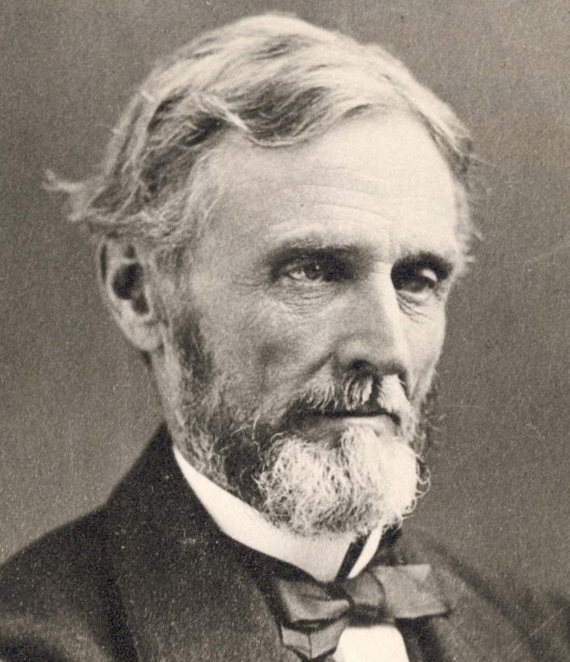
Some months ago, I was busy defending Jefferson Davis on X, which we all know is filled with the most knowledgeable historians the country has to offer, when one extremist proceeded to tell me that Davis raped and lynched blacks. When asked for evidence of such rubbish, I was truly shocked and astounded that he could provide none.
Sarcasm aside, such is the attitude of the Woke Left: hurl made-up, childish accusations at American heroes with absolutely no evidence to support any of it. It’s a comic book version of history. But that is the mind of the American Leftist: They don’t believe in the world that is, only a world in which they have conjured up in their own infinitesimal brains.
As with all prominent Confederates, though, Davis is continually tarred with the brush of racism, slavery, and white supremacy. It’s the “go-to tactic” of mindless morons that makes any meaningful dialogue next to impossible. How is it possible to have a debate with those who begin any exchange with, “You are just mad that slavery was abolished.” Or some such nonsense. It’s a waste of valuable time and the only real recourse is the “block” button.
But facts are facts and, at least in this case, not “stubborn things,” to turn a phrase from John Adams. Davis’s attitude toward black people was not the stuff of Hollywood drivel but of kindness, paternity, and in line with Christian character. And one of the best examples is his Senate confrontation with John Dix of New York in 1848.
Now, imagine if you will, that we conducted a “man on the street” style interview with several average Americans and presented them with this scenario: In the mid-19th century, a Senator from the North and a Senator from the South engaged in a debate over blacks in the United States. One Senator said they were inferior and would eventually go extinct, while the other Senator defended them as members of the human family worthy of kindness and protection. Well, it’s not hard to imagine that 100 percent of those asked would likely conclude that the Southern Senator spoke harshly of blacks, while the Northern Senator defended them. And 100 percent of them would be wrong.
New York Senator John Dix, a Democrat who later served as a general in the War (Fort Dix, New Jersey was named in his honor), remarked on the Senate floor, during a debate over the expansion of slavery in the territories, that “free blacks would continue to be an inferior cast and simply die out.” His point was clear: When slavery was abolished, freed blacks wouldn’t be a problem for long, if left to their own devices. They simply wouldn’t make it on their own. They were incapable. Dix didn’t seem to be bothered by this one bit. Many Northerners, even abolitionists, often held this same, very dim view of black people. And some, like Dix, thought so little of them as a race of people that they also predicted their disappearance over time. Ralph Waldo Emerson famously said that blacks would eventually “go the way of the Dodo” – that is, extinction.
But the one Southern Senator who was very troubled by such a callous attitude was none other than Jefferson Davis of Mississippi, who rose to his feet to respond to Dix: “With surprise and horror I heard this announcement of a policy which seeks, through poverty and degradation, the extinction of a race of human beings domesticated among us. We, sir, stand in such a relation to that people as creates a feeling of kindness and protection. We have attachments which have grown with us from childhood – to the old servant who nursed us in infancy, to the man who was the companion of our childhood, and the not less tender regard for those who have been reared under our protection. To hear their extinction treated as a matter of public policy or of speculative philosophy arouses our sympathy and our indignation.”
Unbeknownst to the “scholars” on X, most Southerners, including Jefferson Davis, believed in what has been called “the high road to emancipation.” This simply means that Southerners believed that slavery was the best position for Africans at that particular time, which was the main point of Calhoun’s now-infamous “Positive Good” Senate speech, but in the future, they could be freed and enjoy productive lives while remaining in the country, as many, like William Johnson of Natchez, had proven. “The Barber of Natchez,” as he was called, who was emancipated in 1820, owned a barbershop and several other businesses as a free black man. So, slavery then, was seen as a transition between their lives in Africa and becoming productive citizens in a self-governing republic.
Many Southerners, including Davis, did not believe blacks could make it on their own at that time in their American journey. Nor did many other Americans, including Dix and Emerson. This seemed to be proven in a little-known experiment carried out by the federal government in 1863, when 453 freed slaves were taken to an island off the coast of Haiti for colonization. In less than 6 months, roughly a quarter of them had died. The government sent naval vessels to rescue the remaining survivors. Many Southerners feared for the future of the slave population if freedom came in one fell swoop. And, as Jim Downs has concluded in his book Sick From Freedom, at least a quarter of the black population became ill or died as a result of emancipation during the war. It’s a casualty count often not included in the war’s devastating death toll.
But Davis had other ideas. In a 1940 interview, which is available at online at the Library of Congress, a former slave named George Johnson, who belonged to Jefferson Davis, spoke about life at Davis Bend. He described Jefferson Davis as not a cruel master but kind and benevolent. Anytime Davis was walking around the plantation and met a slave, “first thing master Jeff look up there and see him, he tip his hat to him. And everyone give him the same thing back. Give him honor.”
Johnson described a day on one of the Davis plantations, when Davis was headed back to Brierfield, he wanted to make sure the slaves were properly fed and not overworked. “When they get through laying the crops, let them be,” Johnson said of Davis’s words to the foreman. “Wouldn’t even let them cut cord wood. But don’t disturb them. I want them undisturbed. See, anything happen to any of my Negroes, we to see Mr. Davis.”
According the Johnson, Jefferson Davis even organized a band for the slaves, a fourteen-member band among his servants. Davis “organized that band for his Negroes, in Davis Bend, on Brierfield Plantation. And, he hired a man in Vicksburg named Charles Morgan, teach them boys music. And he taught those boys music. They got so they could play and he escorted them from landing up home in a wagon and master Jeff be in his hack, and the band would play for them going and coming. And after they got so they could play he bought them a uniform, and named that band the Davis Bend Band. Escorted everywhere he went.” And he allowed them to have dances on the plantation.
These are just a few of the incredible stories leftist scholars refuse to tell. Therefore, given Davis’s true feelings on the issue, let us ponder a series of questions about Davis and his relationship with black people during his lifetime.
If Jefferson Davis was such a racist and bigoted toward blacks, why did he have a black overseer?
This was very uncommon in the Old South, or anywhere else for that matter. But James Pemberton served as the overseer for Brierfield until he died in 1852. This means that Jefferson Davis turned over his entire operation, all of his business affairs, to a black man. This was especially true when Davis was away serving in Congress. And, as his overseer, Davis treated Pemberton exactly like he did any white man he conducted business with. It was customary for business to be transacted in the front parlor of the plantation home. The discussion would usually involve brandy and cigars. Davis always invited Pemberton into the parlor and treated him the same way. And, in a side note, he never referred to him as Jim but James, and would quickly correct anyone who did not also call him by his proper name. Davis also never used the word “slaves” but “servants.”
If Jefferson Davis really saw blacks as inferior to whites, why would he fight for a patent for Benjamin Montgomery for his paddle wheel invention?
Benjamin Montgomery was put in charge of the general store for the plantations on Davis Bend by his owner, Joseph Davis, Jefferson Davis’s older brother. He was later put in charge of all the purchasing and shipping operations of the plantation. That in and of itself was remarkable, to give that kind of responsibility to a slave. Montgomery, like Pemberton, was also educated and very literate, a very rare thing in the Old South. This was part of the Davis plan of making slaves ready for freedom in the future. Jefferson Davis fought to get Benjamin’s patent approved, but the patent office refused to do it because of his status as a slave.
If Jefferson Davis was so evil, why did he and his older brother Joseph have a court system on their respective plantations and allow the slaves themselves to determine the guilt or innocence of law-breakers and mete out punishment?
Slaves on both Davis plantations were in charge of the plantation justice system, serving as jurors who could determine guilt or innocence and specify punishment. Davis, as the judge, could reduce the punishment if he thought it was too harsh but he could not make it harsher. Slaves did, in fact commit crimes against other slaves, and oftentimes the slave juries meted out harsh punishment, such as whippings. This was yet another way in which the Davis brothers were educating their servants on the workings of the American justice system, an incredibly rare feature of the Southern plantation system.
According to George Johnson, physical punishment was very rare on the Davis plantations and the work load was what he called “reasonable.” In one story, Johnson told of a young slave boy working a row of cotton but who was not keeping up with the rest of the crew. The slave driver wanted to whip him for his slow progress. But the boy ran to Davis, who sent him to the big house to eat breakfast and work in the garden and flower beds away from the fields. Davis then fired the slave driver.
If Jefferson Davis was such a heartless and cruel man, why did he and his wife take in a black child during the war?
Varina Davis witnessed a five-year-old boy being beaten by a black woman and put a stop to it. They then took him in to live with them in the Confederate White House. They lost him later when Davis was captured by federal forces in May 1865. Yet, since this goes against their carefully crafted narrative, historians continue to say this story is a myth.
If Jefferson Davis was heartless toward blacks, why did he send a female servant to New Orleans for special medical treatment?
The Davis’s, like most plantation owners, were always concerned about the welfare of their slaves, who had the best medical and dental care, and at least on one occasion, being sent to New Orleans for specialized treatment. Such an endeavor was expensive and not the actions of someone who didn’t care about his servants.
If Jefferson Davis was such a cruel master, why did he make sure his elderly slaves were well cared for?
During the war, an elderly black couple lived at Brierfield. And, despite the lies from faux-historians, elderly slaves did not work on plantations. In this case, Davis wanted to ensure that they had enough blankets and furniture for the upcoming winter, writing to his staff back home to enquire about his elderly former servants. But, when the benevolent Yankee troops later raided Brierfield, they stole every bit of it from “Old Bob” and his wife, accusing them of having swiped it all themselves.
If Jefferson Davis was such a unkind owner, why did many of his former servants attend his funeral in New Orleans in 1889?
Many of them came to pay their respects when they heard that their old master had passed away. And many of them had tears in their eyes as his casket passed by them. One former servant of Davis, James H. Jones, missed the funeral procession in New Orleans. In a letter to the mayor of New Orleans, he expressed his regret:
“As the old body servant of the late Jefferson Davis, my great desire was to be the driver of the remains of my old master to their last resting place. Returning too late to join the State Delegation from this city, I am deprived of the opportunity of showing my lasting appreciation of my best friend.”
As these little-known facts reveal, Jefferson Davis was a man who considered his servants to be his own family and he treated them as such. He was not the heartless, cruel proto-typical slaveowner that pervades the mind, the imagination, and the writings of leftist fanatics and faux-historians.
The views expressed at AbbevilleInstitute.org are not necessarily those of the Abbeville Institute.