There were five wars for independence in the history of North America (i.e., Anglo America). The first was the American Revolutionary War, or War for American Independence (1775-1783). In that war, the United States of America won their independence from Great Britain. The second was the War of 1812 (1812-1815), also known as the Second War for Independence, because the United States would have lost their independence if they had lost that war. The third was the Texas War for Independence or Texas Revolution (1835-1836), in which the Republic of Texas won its independence from Mexico. The fourth was the Mexican War or War with Mexico (1846-1848), in which the independence and annexation of Texas as a state in the United States was secured and the independence of what is now the Southwestern United States was won from Mexico. The fifth and last was the War Between the States, also known as the War for Southern Independence or War for Confederate Independence (1861-1865). This was the unsuccessful attempt of the Confederate States of America to obtain independence, for which they fought for four years during that war before suffering defeat.
The first and third are clearly recognized as wars for independence and the second and fifth are recognized as such by some. However, the fourth is generally misunderstood and not usually recognized as a war for independence. It should be called the War for Southwestern Independence. It has been mischaracterized and denounced more than any other war in the history of the United States excepting, maybe, the War Between the States. A typical example of this mischaracterization was made by Robert E. Quirk in his book An Affair of Honor: Woodrow Wilson and the Occupation of Vera Cruz (Lexington: University of Kentucky Press, 1962). He stated, “Even American historians agree that the war of 1846 was an aggressive act against Mexico – Americans desired Mexican territory and took it.” Patrick J. Buchann answered this allegation in his book A Republic, Not an Empire by saying that “the charge is but another big lie in the Blame America First series.”
This charge that this territory was wrongfully taken from Mexico by the United States has also been used to justify both the invasion of the United States by Mexican illegal aliens and mass immigration from Mexico. Mexican writer Elena Poniatowska said that the United States is “a country that needs to speak Spanish because it has 33.5 million Hispanics who are imposing their culture.” At a Congress of the Spanish Language in Madrid, Spain in 2001, former Mexican President Vicente Fox said that Mexican immigrants who continue to speak Spanish in the United States are doing their patriotic duty. Another speaker at the same conference was Carlos Fuentes, perhaps the leading literary figure in Mexico at that time. Allan Wall, a U.S. teacher living in Mexico at the time, reported of Fuentes’ speech, “He said that there is a silent reconquista, a reconquest of the United States. He didn’t even limit it to the Southwest, as many do; he just said ‘of the United States.’”
However, an examination of the facts reveals otherwise. In his excellent book Blood over Texas, Sanford H. Montaigne, correctly pointed out that people of that opinion never look south of the Rio Grande.
The so-called period of expansion began with the Louisiana Purchase of 1803 under the administration of President Thomas Jefferson. The Lewis and Clark Expedition went all the way to the Pacific Ocean because the United States had an interest in the entire area. There were border disputes between Canada and the United States well into the Nineteenth Century.
The Treaty of Paris in 1783, which ended the Revolutionary War, left ambiguous descriptions of some of these boundaries. Areas of northern Maine were settled by both Canadians and Americans. British troops occupied eastern Maine during the War of 1812 with plans to permanently annex it to Canada as New Ireland, but the attempt was abandoned at the end of the war. There were efforts by some Americans for the United States to take all of Canada in that war because of the British involvement in stirring up Indian hostilities against the United States. Troops from both countries were involved in a confrontation in northern Maine called the Aroostook War in 1838 and 1839, though there was no fighting involved. One general involved on the U.S. side was Major General Winfield Scott. The disputes over the boundaries of Maine, New Hampshire, Michigan, and Minnesota were not settled until the Webster-Ashburton Treaty of 1842.
After the War of 1812, there were disputes between Great Britain and the United States over the Oregon Country. The territory was jointly occupied by both British and U.S. troops in this dispute starting in 1818. Both some British and Canadians on one side and some Americans on the other wanted the entire territory. The 54 degrees 40 minutes north latitude parallel was its northern boundary. President James K. Polk had campaigned advocating that the United States acquire all of Oregon and Texas. The slogan of those Americans who wanted the United States to annex the entire Oregon Territory was “54 40 or Fight!” A settlement was reached in 1846 under Polk where the territory was divided between Canada and the United States along the 49th parallel.
The immediate occasion for the Mexican War was the annexation of the Republic of Texas by the United States, which had taken place in the last days of the administration of Polk’s predecessor, President John Tyler. Texas was originally a Spanish colony, but was largely unsettled because of Comanche domination of the area. The area of Comanche domination was called Comanchaeria. It dominated most of Texas with the exception of the very eastern portion. The Spanish did little more than establish missions there, each of which had a church and military presence. Moses Austin of Missouri received a land grant from the Spanish Crown in 1820 to establish a settlement of Americans in the eastern portion of Texas to serve as a buffer against the Comanches. He died before the settlement was established and the work was carried on by his son Stephen F. Austin. In 1825, Mexico received independence from Spain and Austin had to renegotiate his grant with the Mexican authorities. Texas was mostly settled by Americans, the vast majority of whom were from Southern states. Very few Mexicans would settle there. At the time Texas won its independence from Mexico in 1836, the non-Indian population of Texas consisted of 90% Americans and 10% Mexicans.
The Republic of Texas had never intended to maintain independence indefinitely. It had intended to become a state in the United States. It tried several times to become a U.S. state, but it did not succeed in doing so until 1845. The abolitionists fought Texas statehood because it would have added another slave state to the Union. William Lloyd Garrison, editor of the abolitionist newspaper The Liberator wrote:
“Texas is the rendezvous of absconding villainy, desperate adventure, and lawless ruffianism – the ark of safety to swindlers, gamblers, robbers, and rogues of every size and degree. Its distinguishing characteristic is unmitigated depravity. Nothing homogeneous is found among its population, except a disposition to extend and perpetuate the most frightful form of servitude the world has ever known, and to add crime to crime.”
Representative and former President John Quincy Adams of Massachusetts declared, “We hesitate not to say that annexation…WOULD BE IDENTICAL WITH DISSOLUTION. It would be a violation of our national compact…so deep and fundamental…as, in our opinion, not only inevitably to result in a dissolution of the Union, but fully to justify it.” Thus, New England talked of secession once again, as it had done in the War of 1812 and when Missouri statehood was discussed. It is interesting that Adams had sought the purchase of Texas in 1825.
Mexico had repudiated recognition of Texas independence almost immediately after agreeing to it at San Jacinto and had repeatedly attacked Texas since the end of the Texas War for Independence. Texas had successfully repelled them each time. Great Britain and France had tried to convince Texas that they supported them as an independent republic because they wanted the Republic of Texas to serve as a buffer against U.S. expansion, just as the British had previously armed Indians on our frontier to do the same. The British saw that their goods could enter Texas free of U.S. tariffs and viewed Texas as a source of cotton to them. As the possibility of U.S. annexation of Texas loomed in 1845, Great Britain and France convinced Mexico to finally recognize the Republic of Texas if it would remain independent and not join the United States. Given this choice between these two alternatives, Texas chose U.S. statehood, which it had sought for so long.
Mexico had stated beforehand that it would consider United States annexation of Texas as an act of war. When U.S. annexation came, Mexico immediately began mobilizing for war by organizing an army under General Mariano Paredes. The Mexican minister of war declared that it would face only “some miserable colonists, a few hundred adventurers, and a handful of speculators from New Orleans to New York.” The United States responded by sending an army under Major General Zachary Taylor, “Old Rough and Ready,” and his Army of Occupation to Texas. His son, Richard Taylor, became a Confederate general in the War Between the States. As a U.S. state, Texas was entitled to U.S. protection from foreign invasion and Indian incursion. At the same time, Polk had sent John Slidell to Mexico City to try to negotiate an agreement in order to prevent war, but the Mexicans refused to receive or even meet with him. Slidell was later to become famous during the War Between the States in the Trent Affair. That Polk desired a peaceful settlement was also evidenced by his acceptance of a plea from former Mexican President and General San Antonio Lopez de Santa Anna to return to Mexico from Cuba, where he had been banished, to negotiate a peaceful settlement. However, once back in Mexico, Santa Anna went back on his word and rallied Mexico against the Americans.
There was a dispute over the southern boundary of Texas. The Rio Grande River had been the southern boundary of the old Spanish province of Texas. Under the Mexican Federal Constitution of 1824, the Nueces River had been the boundary between the states of Coahuila and Texas on the north side and Tamaulipas on the south side. However, Santa Anna nullified that constitution when he made himself supreme dictator.
The Treaty of Velasco, signed at San Jacinto in 1836, established the independence of the Republic of Texas with the Rio Grande River as its southern boundary. This treaty was signed by both Santa Anna as President and General-in-Chief of Mexico and by General Vicente Filisola, who succeeded Santa Anna as General-in-Chief. Mexico later repudiated the treaty and refused to recognize the independence of Texas, considering it a renegade Mexican state. Mexico also claimed the Nueces River to be the southern boundary of Texas.
When he first arrived in Texas, General Taylor established his Army of Observation at the north bank of the Nueces River. However, this army was later ordered to the north bank of the Rio Grande River. There, it built a fort called Fort Texas. At this time, negotiations over Oregon were still ongoing and the possibility of war there was still imminent. Both British and U.S. troops were stationed there and this brought both sides to the negotiation table. Polk felt that if Taylor’s army were stationed in the disputed territory between the Nueces and Rio Grande Rivers, this would bring Mexico to the negotiation table. However, Mexico wanted no part of that. The war started when a reconnoitering party of 63 U.S. dragoons under Captain Seth Thornton were attacked and overwhelmed by a much larger Mexican force under General Anastasio Torrejon. He had been instructed in a letter from Mexican President Mariano Paredes to take the initiative in hostilities. Thornton’s second in command was Captain William J. Hardee, a future Confederate general. Torrejon’s commanding General, Mariano Arista, notified Taylor that he “considered hostilities commenced and should prosecute them.” After the war, Arista declared, “I had the pleasure of being the first to begin the war.” When war came, Polk declared:
“The cup of forbearance has been exhausted even before the recent information came from the frontier….But now, after reiterated menaces, Mexico has passed the boundary of the United States, has invaded our territory and shed American blood upon the American soil. She has proclaimed that hostilities have commenced, and that the two nations are now at war.
“A war exists, and notwithstanding all our efforts to avoid it, exists by the act of Mexico herself, we are called upon by every consideration of duty and patriotism to vindicate with decision the honor, the rights, and the interests of our country.”
He was, of course, correct. Congressman Edward D. Baker of Illinois resigned his seat in Congress to join up with the Illinois volunteers. He would later be killed in the Battle of Balls Bluff in the War Between the States. Baker’s seat in the House of Representatives was then taken by Abraham Lincoln, this being his only term in Congress. Lincoln introduced a resolution blaming the United States for the war by claiming the Nueces River to be the boundary between Texas and Mexico, thus taking the side of Mexico. Buchanan correctly stated:
“The Mexican War was not begun by U.S. soldiers on Mexican soil, but by Mexican soldiers on disputed land that Santa Anna had signed away to the Texans. Mexicans had fired the first shots and inflicted the first casualties. Assuming that Polk’s desire for negotiations meant that he would shrink from war, Mexico underestimated him and the fighting spirit of the U.S. army.”
The Whig Party was opposed to the war and a group called the Conscience Whigs charged that the war was being waged by a supposed “Slave Power Conspiracy” in order to open up new territories and states to slavery. This is an often repeated charge, but there is no factual evidence for it. Senator John C. Calhoun of South Carolina was alleged to be one of the foremost spokesmen for the so-called “Slave Power Conspiracy” at that time and he was opposed to the war on the grounds both of the unsuitability of those territories for slavery fearing that they would add to the number of free states and also because he was against the United States acquiring territories populated by non-white peoples. Congressman Robert Toombs of Georgia, the future Confederate Secretary of State and General, also opposed the war.
After the opening attack, the main force of Torrejon’s army crossed the Rio Grande. Fort Texas was bombarded by Mexican artillery from Matamoros, which was across the Rio Grande from it. Major Jacob Brown, the commander of Fort Texas, was mortally wounded. The fort was later renamed Fort Brown for him, and the later city which sprung up on the site was named Brownsville. Lieutenant Braxton Bragg was also manning artillery in Fort Texas.
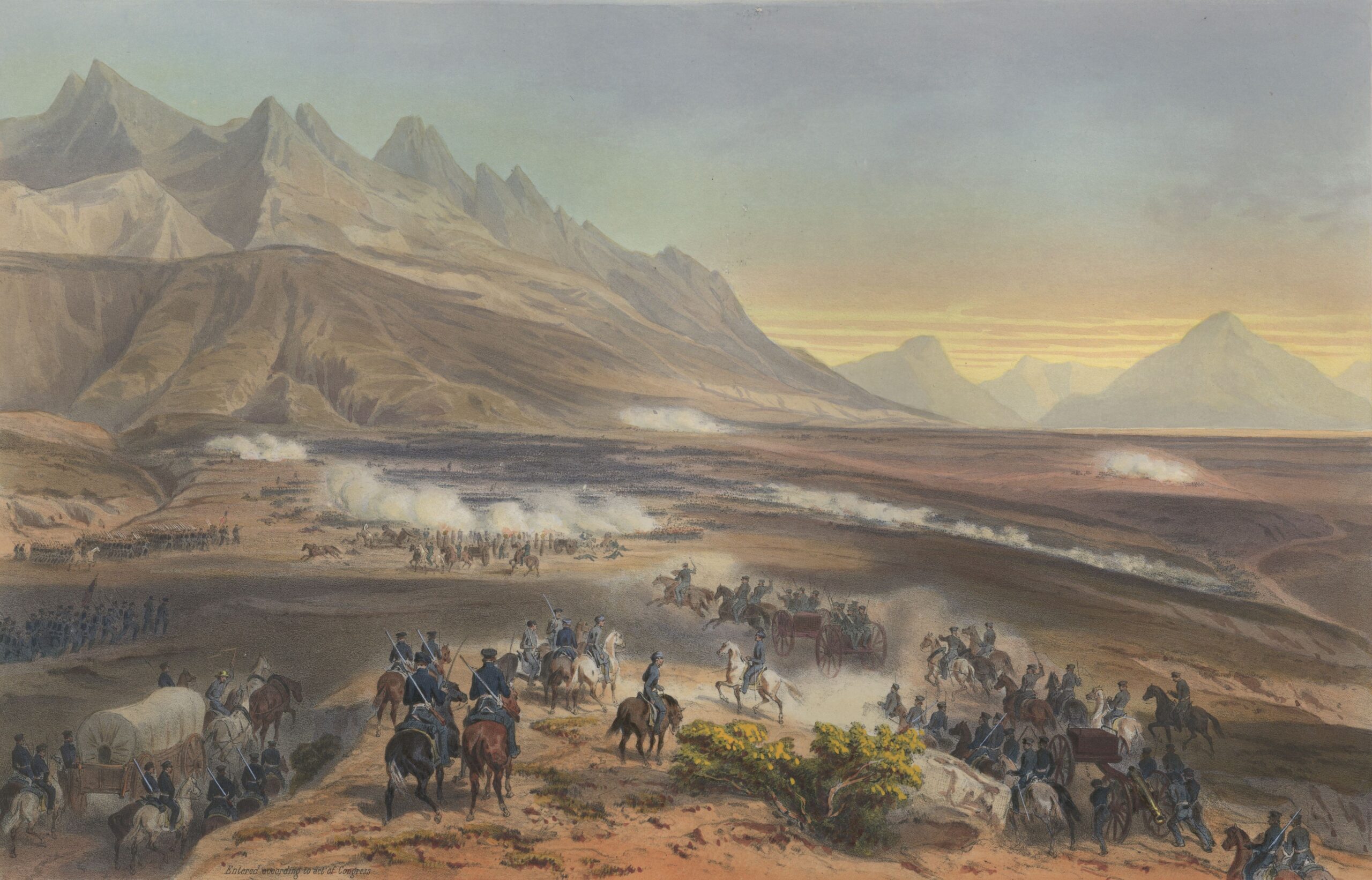
The first U.S. volunteers began arriving at this time as well. Taylor and Arista first encountered each other at the Battle of Palo Alto on May 8, 1846. Lieutenant Lloyd Tilghman was one of the first Americans to spot the Mexicans. He was the future Confederate general who was to surrender Fort Henry to Ulysses S. Grant, who was then also on the field at Palo Alto as a Lieutenant in the 4th US Infantry. Taylor was kept very well informed of the terrain from the beginning by the capable work of a topographical engineer from Pennsylvania, Lieutenant George Gordon Meade, the future victor of Gettysburg. The Mexican artillery opened the battle, but U.S. infantry fire was so devastating that there was no need for the bayonet. On the Mexican left flank, about 1,000 Mexican lancers were thrown against Taylor’s right. The 1st and 3rd U.S. Infantry formed squares and fired at the Mexicans, repelling the charge. U.S. artillery fired before the Mexican artillery could respond. Despite the holes the U.S. artillery made in the Mexican lines, however, those lines stood firm until dark. After dark, the Mexicans withdrew. The Americans lost nine killed and 44 wounded. The Mexicans lost about 250 in all. Captain Ephriam Kirby Smith wrote back to his wife “that there were no volunteers with us.” He was the older brother of future Confederate General Edmund Kirby Smith.
The next day, Taylor pursued Arista as the latter withdrew to the south and met him at the Battle of Resaca de la Palma. Whereas the battlefield of Palo Alto had been an open plane, this one was an area of dense and thickety chapparal which was broken up by resacas, or dried up river beds. These resacas formed either sunken lagoons or dry depressions. In his pursuit of the Mexicans, Taylor sent Captains George A. McCall and Charles F. Smith, both of whom were to become future Union major generals in the War Between the States, forward with infantry detachments. Arista’s forces were deployed in a defensive position in the Resaca de Guerrero, which was protected by a dense growth of thorny brush. U.S. artillery opened fire as U.S. troops advanced through the brush. The fighting was hand to hand and the Mexicans were defeated and withdrew across the Rio Grande into Mexico, drawing fire from Fort Texas along the way. This ended the Mexican incursion into Texas. Taylor lost 262 killed, 355 wounded, and 185 missing. The Mexicans lost almost six times more.
It was after these two battles that the United States reciprocated with a declaration of war. Calls were made for volunteer troops and most all states responded. New England was the region where the war was most strongly opposed and the 1st Massachusetts Regiment was the only volunteer regiment raised from all of New England during the war. New England even talked of secession over the war once again. Buchanan writes, “Henry David Thoreau protested in Massachusetts by refusing to pay his state poll tax. After he spent one night in the lockup, Thoureau’s aunt came and paid the tax. He retreated to his cabin on Walden Pond to write Civil Disobedience.” There was considerable sentiment against the war. The Whig Party and the Abolitionists were both opposed to it, as were some Democrats. This gave the Mexicans encouragement, thinking that this would cause the Americans to give up the war effort. Lieutenant Meade wrote home that Mexico “expects a pronunciamento [proclamation] on the part of the Whigs and Northern Democrats, forcing the Government to withdraw the troops and propose more lenient terms. In this idea…she is…fortified…by the speeches in Congress of some of the Whigs, and the tone of many newspapers of the Whig press….Do not think this idea is absurd; it is true.”
There were four campaigns in this war. There were two campaigns in Mexico under Zachary Taylor and Winfield Scott respectively. Both of these two generals were Virginians. The other two campaigns were in New Mexico and California. As these latter two are pertinent to establishing the war’s character as a war for independence, they will be covered by the author in detail. There was an important caravan trade which went from Independence, Missouri through Santa Fe, New Mexico and to Mexico City. New Mexico and California were largely ungoverned by Mexico. Justin Harvey Smith, in his book The War with Mexico, stated:
“In March, 1845, the war department of Mexico admitted publicly that that the northern sections of the country [referring to New Mexico and California] were ‘abandoned and more than abandoned’ by the general government. Sensible Mexicans held that the connection of the province with their miserable system involved injury instead of benefit. The people received no protection against the ravages of the Indians. The national troops were a constant menace to the citizens….The duties and extortions levied upon the caravan merchants increased the price of their goods; and of late the central government had been trying to deprive the provincial authorities of money and the people of comforts by stopping that business entirely.
“The citizens appeared weary of oppression. They would not pay the taxes. It was found necessary in 1845 to excuse them from one of the most profitable but most annoying of imposts. Indifference toward the general government – a natural return for its neglect and its vexations – prevailed, and the continual changes in that government aggravated the lack of patriotism. Indeed, there was more than indifference. A move to follow the example of Texas had been made in 1837, and the idea of joining the United States, which had existed in that year, became so strong by the early months of 1846 that representatives of the province [of New Mexico] in the [Mexican] national Congress openly avowed it.”
Smith’s book is the most well researched work on that war ever written. The author read every document he could find about it not only in the archives of both the United States and Mexico, but also of many European countries as well. No other book written on the subject since has matched his research and use of sources. While Smith’s conclusions have been criticized by his detractors, his facts have never been.
Fort Leavenworth was then the westernmost outpost in the United States. An Army of the West was organized there under the command of Colonel Stephen W. Kearny, who was a veteran of the War of 1812. New Mexico was largely uninhabited with the exception of Las Vegas, Santa Fe, which was the capitol, and Albuquerque. Their march was a long and difficult one, 900 miles across the desert, and food and water were lacking.
Upon reaching Santa Fe, they christened it “Mud Town.” It consisted of adobe hovels and the palace was a one-story adobe building with a dirt floor. Kearny announced that the United States was claiming New Mexico and that it welcomed its people as friends.
He was accepted enthusiastically. There was some opposition in Taos which attempted to form a force to oppose him, but the attempt fell apart before any action was taken. In addition, he was then joined by the 2nd Missouri Regiment under Colonel Sterling Price, who was to become a Confederate general. As Kearney had more troops than necessary at that point, he sent some to support Brigadier General John E. Wool, a future Union general, in Chihuahua, Mexico and joined others which went to California.
The former missions which were established by the Spanish in California now lay in ruins. Upper California was populated by 10,000 whites and 15,000 Indians. The whites lived in a strip 450 miles long along the coast from San Francisco to San Diego, and the white population consisted of Americans and Europeans. There were also a few Mexicans. There were no local governments, police, or newspapers, and all Mexican rule was strictly military. The situation was chaotic and the people hated Mexican rule. Recognizing this situation, Mexico had offered California to Great Britain, but the British declined the offer and told Mexico to hold on to it. It was after hearing this that the United States took interest in acquiring Mexico.
California was ripe for the taking at this point, either by the United States or by some European power. Polk had issued the Polk Doctrine, which was an extension of the Monroe Doctrine. Like the former, it warned against any European incursions in the Western Hemisphere. When John Slidell had been sent to Mexico City to try to negotiate, his instructions were to try to get the Mexicans to agree to accept U.S. annexation of Texas and to accept the Rio Grande as its boundary. However, he was also instructed, if things went well enough, to also try to negotiate for the U.S. purchase of California and New Mexico.
Consequently, in the spring of 1845, before the war began, Navy Secretary George Bancroft had instructed Commodore John D. Sloat, commander of US Naval forces in the Pacific, “to avoid any act which could be constrained as aggression” but that “if he should ascertain beyond a doubt that the Mexican government has declared war against us” he should “at once…blockade San Francisco, and occupy or blockade such other ports” as his force would permit. In the meantime, Brevet Captain John C. Fremont of the U.S. Topographical Engineers accompanied by 62 men left his post on the Missouri River for the Oregon Country.
Fremont was given the name “Pathfinder of the West,” but he actually charted paths which had already been blazed by others. He was better called by Alan Nevins “Fremont the Pathmarker.” In December, he arrived at Fort Sutter, which was at the site where Sacramento, California is today. It was commanded by Captain Johann August Sutter, a Swiss adventurer. After obtaining supplies there, he moved south to the San Joaquin Valley, where he did some exploring and fighting with the Indians there. He then obtained permission from General Jose Castro, commandant general of the Mexican military forces in the province in Monterey, to stay there for the winter. By early March, Fremont had stretched his permission and moved his men to the Salinas Valley, only 25 miles from Monterey. Upon learning of this, Castro ordered them to withdraw from the province. Fremont then built defenses on Hawk Hill and raised the U.S. flag there, declaring that he would fight if attacked or perish. However, he withdrew that night and returned to Sutter’s Fort. In May, Captain Archibald Gillespie delivered orders to Fremont which are a matter of controversy, but in all probability were the same as those delivered to Commodore Sloat, to help in the conquest of California in case of war with Mexico. By that time, the war had begun in Texas, although word of this had not yet been received in California. With a change of government in Mexico City, there was an attempt to call a convention in Santa Barbara to declare independence for California and to seek the protection of a foreign power. It did not occur because Castro refused to let those from the northern part of California attend. In May, Sloat heard of the fighting in Texas, but was not certain that it indicated that war had actually been declared. When he heard in June that the U.S. Navy was blockading the Gulf coast of Mexico, he proceeded to blockade San Francisco and other ports. Fremont, who had not yet received word that hostilities had begun, then seized 170 horses from Castro, which was taken by the latter as horse stealing. He then had his men seize the garrison at Sonoma. The prisoners were taken to Fort Sutter, among which was Mariano Vellejo, the founder of the post. Robert Selph Henry says in The Story of the Mexican War, “There, fortified by Vallejo’s excellent California brandy, they raised a new flag, designed and executed by William Todd, a nephew of the Mary Todd who married a frontier lawyer named Abraham Lincoln.”
The state flag of California today is patterned after this flag. As Fremont’s action was unauthorized, Sloat refused to give Fremont’s efforts any support. Fremont, still not having received any word at this point that war had actually been declared, proceeded with his conquest of California under the Bear Flag. Henry says further:
“So far as it went, this enterprise consisted of a skirmish at San Rafael, the capture and execution of two or three prisoners by each side, Fremont’s exploit of crossing San Francisco Bay just inside the Golden Gate (so named by Fremont himself on that occasion) and spiking the ancient cannon of the abandoned Mexican post at the Presidio, and a big Fourth of July celebration at Sonoma, followed by a meeting of the settlers at which Fremont ‘was selected to take the chief direction of affairs’ for the newly proclaimed Republic.”
It was at this same time that Commodore Sloat’s ships arrived at Monterey and San Francisco. The cities were occupied by the Navy and the U.S. flag was hoisted over them. Sloat also then learned of Fremont’s exploits, but as his orders were to occupy the port cities, he gave no support to those activities in the interior as he had received no orders to do so. When Sloat notified the authorities that he sought their cooperation, Castro replied with an angry complaint of “a band of adventurers, headed by Mr. J.C. Fremont,” and his actions in “forcibly taking possession of the post of Sonoma, hoisting an unknown flag, making prisoners…committing assassinations and every kind of injury” associating these actions with the United States. In the meantime, more U.S. ships arrived. Upon learning of the U.S. seizure of port cities, Fremont marched his command to Monterey and put it and himself at the disposal of the U.S. Naval commander. It was then formed as the California Battalion of Mounted Riflemen with Fremont in command and Gillespie second in command. The USS Congress, which was later to be sunk by the CSS Virginia at the Battle of Hampton Roads, arrived at Santa Barbara under the command of Captain Robert F. Stockton and the U.S. flag was raised there. Upon learning that the Mexicans had fortified Los Angeles, Stockton joined a force of his sailors with Fremont’s men to march on the city, but the Mexican resistance disbanded before they arrived. With this, the United States was in possession of all significant areas of Upper California, which was then declared annexed to the United States. Newspapers and postal facilities were then established there for the first time. Elections were declared and local governments were established. The majority of the populace was pleased.
The populace was not unanimous, however. Among Mexican sympathizers in Los Angeles, San Diego, and Santa Barbara, there was an uprising against U.S. rule. As this was happening, Kearny’s force journeying from New Mexico had made its way to California. Fremont had sent Christopher H. “Kit” Carson to guide Kearny to California. Carson had shown many of the paths to Fremont which he had mapped. Carson had news to take to Washington of the occupation of California. Kearney had the news sent by another courier and Carson led Kearny and his men west. In the War Between the States, Carson was to command the 1st New Mexico Volunteer Infantry, which helped to repel the invasion of New Mexico by Confederate General Henry H. Sibley at the Battle of Valverde in 1862. The journey to California was slow and severe because of lack of water in the desert, but they arrived near the coast in December and fought the Mexican sympathizers in the Battle of San Pasqual north of San Diego on December 6 and 7. The fighting was hand to hand and they suffered very heavy casualties, including the wounding of Kearny. After he and his men had been taken into San Diego, where they were refreshed, Kearny attacked the Mexican sympathizers again at the Battle of Rio San Gabriel on January 8. The Americans won this battle and, from there, they marched into Los Angeles once again taking it for the United States. Fremont was not heard from during this time. This ended all fighting in California.
Fremont was court-martialed and found guilty of mutiny and insubordination. He was pardoned by Polk, but resigned from the army. In 1856, Fremont was the first Presidential candidate of the Republican Party. When the War Between the States came in 1861, Lincoln appointed him major general in the Union army. Later that year in St. Louis, Missouri, Fremont issued a military proclamation declaring martial law and confiscation of property of those taking up arms for the Confederacy. This included declaring their slaves freed. Lincoln asked Fremont to revoke the emancipation clause. When Fremont refused to do so, Lincoln did so himself. This time, though, Fremont did not get court-martialed.
Mexico itself was so unstable that one president after another was forced from office. Other Mexican states had also attempted independence, attempts which were put down with bloody reprisals. Guatemala separated from Mexico at this time and Yucatan did several times, though the latter rejoined Mexico. Some foreign powers also tried to take Mexico because it was so unstable. France tried to do so in the Pastry War of 1838, in which France seized Vera Cruz for a time and Santa Anna lost a leg. Mexican citizens went to Scott when the U.S. army was in Mexico and asked him to be their President because Mexico had never been as well governed before as it was under U.S. occupation.
Scott’s campaign resulted in the capture of Mexico City, the national capitol. That ended all major campaigning in Mexico, but guerilla activities continued unabated. Sometimes, they caused the National Road, along which was the line of communication for Scott’s army between Mexico City and Vera Cruz on the Gulf of Mexico, now the Gulf of America, to be cut. The major work at this point was to negotiate a peace. This, Santa Anna refused to do. Finally, on October 7, a new provisional government came to power and Santa Anna was deposed. The new Minister of Relations, Pena y Pena, was willing to meet with the Americans to discuss negotiations.
Nicholas P. Trist was from Charlottesville, Virginia. He was married to Virginia Jefferson Randolph, Thomas Jefferson’s granddaughter. He was West Point educated, worked for Jefferson personally, and personally studied law under Jefferson. Upon Jefferson’s death, at which he was present, he worked for the State Department. He worked as a clerk there for most of his career but was the U.S. consul to Cuba for a time. There, he learned Spanish and could speak it fluently without an accent. Trist, who was then the chief clerk of the State Department, which was second in rank to the Secretary of State, was selected by Secretary of State James Buchanan to negotiate a peace treaty with Mexico and sent to Scott’s headquarters at Vera Cruz. At the time negotiations were to begin, though, he received word that he had been relieved of his post. Polk and Buchanan felt that the Mexican authorities were seeking to gain time and not to make peace and that, under those circumstances, the presence of a commissioner in Mexico would do no good and might do harm. They said that future proposals would go through Scott, and that Trist was to return to Washington. Trist would have been unable to return at this time because the National Road was not open. Scott saw Trist’s abilities and the rapport he had with the Mexicans as a negotiator because of his Spanish skills and instructed him to proceed with negotiations anyway.
On February 2, 1848, the Treaty of Guadalupe Hidalgo was signed. Under it, Mexico agreed to recognize the annexation of Texas and accept the Rio Grande as its border and to sell New Mexico and Upper California to the United States for $15 million. The United States agreed to assume $3.25 million dollars in debts owed by Mexico to U.S. citizens, which the United States had been arguing with Mexico to pay for a long time. The Mexican government had always been in bad shape financially. In fact, for a time during the war, the Mexican government taxed the Catholic church, though this did not last long because of the reaction against it. That government was in better financial shape after receiving the $15 million from the United States than it had ever been.
Trist had the treaty sent to Secretary of State Buchanan by a journalist. It arrived in seventeen days. When Buchanan received it, he took it to Polk at the White House. Polk was furious with Trist as being insubordinate by negotiating the treaty when he did not have the authority to do so, but when he read the treaty he was very pleased with it. Buchanan suggested to Polk that he hold a cabinet meeting to discuss it. Most of the cabinet members were pleased with it, but a few were not, particularly Buchanan because he favored the United States taking over all of Mexico. Polk decided to sleep on it. The next day, he had it sent to the Senate for ratification. There was hot debate over it in the Senate committee, which ended up sending it to the floor with no recommendation. It was even more hotly debated on the floor. Among those opposed, there were some who wanted the United States to annex all of Mexico and others who wanted the U.S. to annex none of it. After several votes, the treaty was narrowly ratified by the Senate. It was then sent back to Mexico, which also ratified it. This ended the war and the United States army returned home. Trist’s last job at the end of his life was that of postmaster of Alexandria, Virginia and he is buried there in Ivy Hill Cemetery.
In the opinion of the writer, James K. Polk was one of the great presidents of the United States. The territory he acquired for the U.S. by the Oregon Cessation of 1846 and the Mexican Cessation of 1848 was so great that it can only be compared with that of Jefferson’s Louisiana Purchase. Polk did not run for a second term because he accomplished everything he wanted to do in one administration. At the same time the peace treaty was finalized, gold was discovered in California. If California was still under Mexico at that time, there would have undoubtedly been an international scramble by European powers to gain control of it and, to enforce the Monroe Doctrine, the United States would have had to involve itself in a war to stop them. Polk also opposed those who wanted the United States to annex all of Mexico. He was concerned, as Buchanan has pointed out, with extending liberty and freedom to American peoples, not imposing U.S. rule on alien peoples.
The writer was in Mexico once in his life in 1989. He spent part of a day in Tijuana. That city is just across the border from San Diego, California. After he crossed the border back into San Diego, the houses there seemed like mansions compared to the ones in Tijuana. He saw some houses in Tijuana which no longer had any roofs over them at all and were still occupied. He had a lunch which cost 4,000 Mexican pesos. He purchased it with less than $2 in U.S. currency. He could clearly see that California is much better off now after gaining its independence from Mexico. It also gave him a greater appreciation when he then visited the San Pasqual Battlefield State Park in Escondido, California. Fortunately, the battlefield is well preserved. Unfortunately, however, they showed a film at the Visitor Center there entitled Mr. Polk’s War which sounded like a New England interpretation and blamed the United States for the war. California seems to have forgotten its own history. It is not the only place that has.
The U.S. states today which were formerly part of Mexico and whose independence was gained in the War with Mexico were California, Nevada, and Utah, and parts New Mexico, Arizona, Wyoming and Colorado. This area is far better off now after having gained independence from Mexico that it would be if it were still under it. The Mexican War was indeed the War for Southwestern Independence.
Sources:
Robert Selph Henry, The Story of the Mexican War. Indianapolis: Bobbs-Merrill Company, 1950; reprinted, New York: Da Capo Press, 1989.
Justin Harvey Smith, The War with Mexico, 2 vols. New York: Macmillan, 1919.
Sanford H. Montaigne, Blood over Texas. New Rochelle, NY: Arlington House Publishers, 1976.
David L. Hoggan, The Myth of the ‘New History’: The Techniques and Tactics of the New Mythologists of American History. Nutley, NJ: Craig Press, 1965, Chapter III, “The Mexican War,” pp. 72-93.
Patrick J. Buchanan, A Republic, Not an Empire: Reclaiming America’s Destiny. Washington: Regnery Publishing, Inc., 1999, Chapter 8, “’Jimmy Polk’s War,’” pp. 105-125.
Robert MacNeil and William Cran, Do You Spean American? A Companion to the PBS Television Series. New York: Nan A. Talese, 2005, Chapter Five, “Hispanic Immigration: Reconquest or Assimilation?”, pp. 89-114.
There are several editions of Justin Harvey Smith’s book The War with Mexico available, but the buyer should beware that some of them only reprint one of the two volumes and not both of them.
Henry’s book The Story of the Mexican War was the first in a trilogy. The other two books in this series were The Story of the Confederacy (Revised Edition, Indianapolis: Bobbs-Merrill Company, 1936; reprinted, New York: Da Capo Press, 1989) and The Story of Reconstruction (Indianapolis: Bobbs-Merrill Company, 1938; reprinted, New York: Konecky and Konecky, 1999). All three of these are excellent one volume histories of these three periods of history. He also wrote a biography of Nathan Bedford Forrest entitled First with the Most Forrest (Indianapolis: Bobbs-Merrill Company, 1944; reprinted, New York: Alpine Fine Arts Collection, 1993) and edited As They Saw Forrest: Some Recollections and Comments of Contemporaries (Jackson, TN: McCowat-Mercer Press, 1956; reprinted, Wilmington, NC: Broadfoot Publishing Company, 1991). Henry also wrote books on railroad history.
The views expressed at AbbevilleInstitute.org are not necessarily those of the Abbeville Institute.