

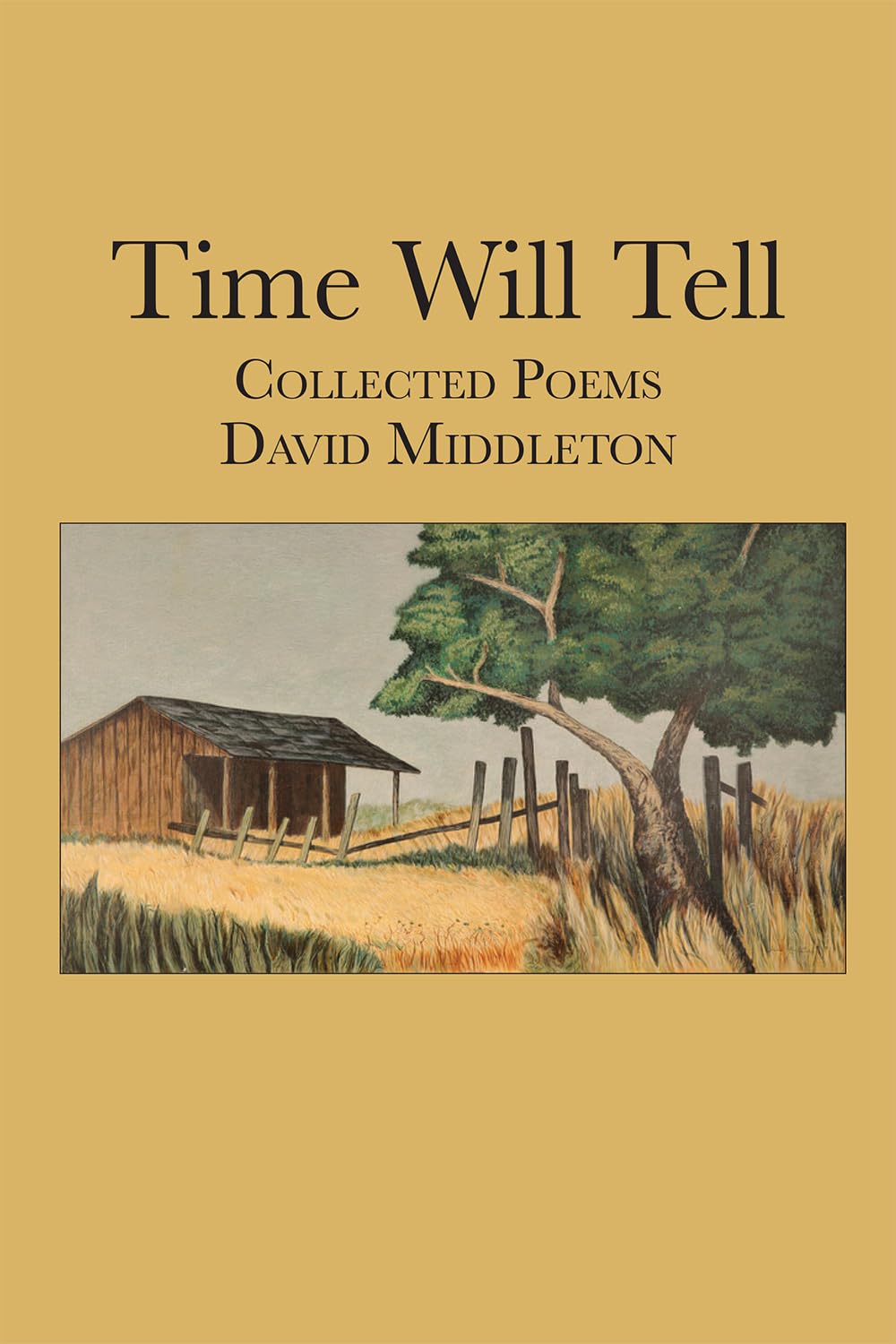
A review of Time Will Tell: Collected Poems (The University Press of SHSU, 2025) by David Middleton
The deaths of Fred Chappell in 2024 and of Wendell Berry this past summer have left a gaping hole not only in Southern letters but in American prosody as a whole. Their poems, seemingly confined to the hills and hollers and valleys of southwestern North Carolina and northwestern Kentucky, actually encompassed greater parts of the world and of imagination and were rendered with a skill, wit, and intelligence not often found in contemporary verse. Their concerns were not confessional, not scandalous, or scabrous. Their work pointed out, and continues to do so, in vivid fashion how the regional embodies and reflects the whole, as all great, enduring literature does. Their passing leaves us bereft of champions of the local, gifted craftsmen, men of letters. “Is all lost?” we ask ourselves, those of us who care. “Is there anyone we can turn to in these hours of loss?” Yes. There is.
For more than ten years, it has been my pleasure to read and study and be delighted by the work of David Middleton, one of America’s two or three finest living poets. I have also enjoyed a personal relationship with the poet and brought him to Union, South Carolina, to speak at the University of South Carolina Union’s annual Upcountry Literary Festival, where he displayed all the mannerliness and grace that characterize his poetry. His collected poems, Time Will Tell, appeared late last year in handsome paperback and cloth editions from Texas Review Press, and had it arrived in a normal world of letters, it would have gotten all the acclaim and literary prizes accorded to lesser works of verse.
Middleton, a retired professor of English at Nicholls State University, was born in Shreveport, Louisiana, but adopted Thibodaux, Louisiana, as his home when he moved to the southern part of the state to attend graduate school at Louisiana State University. Nicholls State is located in Thibodaux and was Middleton’s academic home for thirty-three years. He has six collections of poetry to his credit thus far, and it is from these previous books – The Burning Fields (1991), Beyond the Chandeleurs (1999), The Habitual Peacefulness of Grunchy (2005), The Fiddler of Driskill Hill (2013), The Dwelling Place (2022), and Outside the Gates of Eden (2023) – that work is drawn for Time Will Tell. Middleton is a formalist. That means he has no compunction about utilizing traditional poetic forms or employing rhyme in his poems. This is in a time when traditional forms, including regular rhyme schemes, are considered blasé among contemporary literati, for whom the use of such forms is a sign of artistic weakness, at best, nostalgic, at worst, reactionary. Middleton, however, has ignored such predictable judgments and gone his own way, accompanied by a handful of other tradition-guided craftsmen whose work will live beyond the detritus of most modern-day poets whose poems are often so esoteric, so often grotesquely personal that they hold little appeal for the general reader. “The personal rots,” wrote Yeats in reaction to the abandonment of form in modern poetry. “The solid thing is packed in ice and salt,” meaning traditional form and rhyme scheme. An even greater literary curmudgeon, Robert Frost, observed that “writing poetry without rhyme is like playing tennis without a net.”
In Standing by Words, the late Wendell Berry has an essay entitled “The Specialization of Poetry” in which he confronts the phenomenon of abandoning traditional form by some of America’s leading poets of the time in an effort to “turn inward,” that is, to make the Self, the Personal, the chief focus of the work. This specialization requires ignorance of the poet’s community as well, the place from which he or she sprang and presumably dwells, at least in his or her imagination and memory. David Middleton has practiced none of this “specialization.” His work not only adheres to traditional forms but depends, for the bulk of his subject matter, upon that rural swath of northwestern Louisiana in which he was born and brought up. His regionalism, however, does not limit the range of his interests. This adopted son of Thibodaux, this lifelong Southerner is comfortable as well with more cosmopolitan concerns, as are most other Southern poets of note (Berry, Chappell, George Garrett, et al.), and one finds in Time Will Tell poems about The Odyssey (much a controversial topic these days), Wallace Stevens, Thoreau, and John Martin Finlay, the latter Middleton’s close friend and poet who passed from AIDS at the young age of fifty.
Indeed, the entirety of one of his collections, The Habitual Peacefulness of Grunchy: Poems After Pictures of Jean-François Millet, is concerned with and inspired by the work of the nineteenth century French pastoral painter and one of the fathers of that era’s realist movement in painting, whose appeal to fellow regionalist Middleton should be obvious. Millet’s Barbizon and Middleton’s rural Louisiana share much in common, including the prominence of the land and the closeness of the community. “Two Men Turning Over the Soil” is a fine, poignant example of the former, this inspired by a Millet painting from 1866:
They work upon the untilled hillside soil
Rocky and uneven, all splotched with tufts
Of green and yellow grasses stark in March,
Shovels cutting and dumping lumps of earth
While midway in the distance plains seem set
For planting furrows streaked bright pink and blue,
Small piles of fired weeds making pure white smoke,
Some great estate long settled in its ways.
The father frowns and stares at bared turned ground
Beside his son who uproots turf observed
By eyes more full of wonder than despair
From those few springtime years he’s labored there.
These are the priests whose common, solemn mass
Will raise up grape and grain from canvas-clays
Blocked out by Millet’s crayons and pastels,
His stippled sweat saltwatering the rocks.
For Middleton, the eternal, not the ephemeral, is the important thing, that which is planted by skillful, loving hands which yields up for years to come, whether that thing be “grape and grain” or a poem sent out into the world to remind man of his necessary proximity to the land and his responsibility to upkeep it and use it wisely.
Of course, the bulk of his poems draw from his native Louisiana, the land, the people, the customs, the memories. Among these are “Louisiana Passage: The Whippoorwill,” “Toward North Louisiana,” “The Old Bank in Saline,” and “Blue Herons,” all taken from Beyond the Chandeleurs. From the same book comes my own favorite of these autobiographical poems, “The Sunday School Lesson,” which limns a moment from the poet’s boyhood and gives a good example of the natural, unsanctimonious piety in which he and his people live. At Sunday school in north Louisiana, a group of thirteen-year-old boys, bored and “constrained by polished shoes, / Bow ties, oiled hair, orders against all noise, / And one eternal hour of Good News” are eventually entranced by their teacher’s account of his night on the lake in which a storm whips up and he swears to have seen “Christ by lightning drawing near,” an anecdote provoked by his reading to the boys from the Gospel of Matthew: “when affrighted, / Disciples cried to Jesus as He came, / Walking across night’s foam upon the water, / To grasp weakening Peter who looked down, / Distracted by the winds that made him totter, / Now mastered by the fear that he would drown.” The speaker, now a grown man and in remembrance, concludes:
It took me over thirty years to know
How soul’s redeemed by wonder, lost in awe
Before those depths through which I, too, must go…
Middleton’s deep, unabashed faith informs his social concerns. He is not a “social warrior” by any means, obsessed with the trendy crisis of the day. He knows the permanent things are at stake. “Permanent things” – the phrase first coined by T.S. Eliot then appropriated effectively by such conservative writers as Russell Kirk – are those time-tested verities and values which separate human beings from animals. Man is a spiritual creature, not a mere predator feasting on the sensate, these writers remind us, bound in a compact with other such beings and guided by certain rules of behavior. Manners, for instance, are a protector of this compact. They are, as George Garrett once wrote, “a recognition that our fellow human creatures, all of them, are made in the image of God.” Southerners perhaps know this best, they being dwellers in one of the last places on earth where manners are practiced, at least in some semblance, at least for now, before the South is completely homogenized with the rest of the country.
Outside the Gates of Eden, Middleton’s last standalone collection, from 2023, deals in several poem with this erosion of manners, as a sign of overall decline in man’s spiritual nature. In “Toll Free,” a poem worthy of the recently-deceased Wendell Berry in its denunciation of the mindless, soulless machine, the speaker is subject to the dehumanization of technology that sets him on a spiraling “journey” just to get his bad cable TV reception righted. In “Goodbye, Dear,” he finds that people can no longer muster up appropriate manners in simply sending out email to one another:
How seldom now do you begin with Dear,
Both warm and formal (civil) but a mere
First name – “David:” – like a Sir or Madam
Summons to a wayward child of Adam.
No salutation as in Saint Paul’s Letters,
Your curt tone saying one should know his betters
As if you bid a servant or a beast,
And you in all these emails not the least
Aware of such abruptness being rude –
Public, private address grown crass and crude –
And so, in closing, I reply (hit Send)
Goodbye: And let this conversation end.
To the everyday reader, these complaints may seem like mere carping, mere caviling and prissy pickiness, but Middleton and his speaker know that it is the small details of human behavior and interaction that give most accurate diagnosis of the moral/spiritual health of any given society. When a place gives up the basic niceties of human interaction and the careful use of language, it basically announces its own demise.
So, too, when it accepts detritus as amusement, as “entertainment.” Here is “Test Patterns” from the same collection, which clearly contrasts what used to pass as family fare, however simple or maudlin, to what now inundates everywhere, at every turn, all hours of the day:
Leave It to Beaver, The Andy Griffith Show
Where fathers talked to sons of right and wrong
Or Gunsmoke where Matt shot an outlaw down,
Then said to Chester, “he was just no good.”
to
…infomercials, soft porn, cable news –
No national anthem, sign off, sleep and peace.
In my review for The Alabama Literary Review a year or so ago, I called Middleton’s Outside the Gates of Eden “the finest book of American poems this decade.” I might have to revise such a judgment. Forgive the pun: time will tell, but David Middleton’s collected poems, a true treasure trove, a beacon in the literary and social darkness, might just take the title.
The views expressed at AbbevilleInstitute.org are not necessarily those of the Abbeville Institute.






Thank you for introducing us to David Middleton!
My pleasure! He’s a joy to read.