When my paternal grandmother passed away; her departure left me reflecting on her legacy and impact on my cultural understanding of who I am. Grandma was what many call a “Heritage American”. Every branch of her family had resided in the country before many of the Founders were born and were representative of colonial Virginia and the Middle Atlantic. However, most forebearers had resided in the southern lowlands of Ohio since the 1790s. Her direct ancestors founded the county from which her parents hailed and were among the first families of the neighboring three counties when Indians and wild buffalo still roamed this part of the land.
Grandma, herself, was born at the height of the Depression in a rural hamlet called Buford and grew up in the village of Lynchburg, named for the town in Virginia from whence the original settlers came. Like many of her generation, and before, Grandma was situated in a particular place. She never thought any larger than her county. She rarely concerned herself with statewide issues and was not that political to begin with. However, Grandma was a “nominal” Democrat for most of her years, being a member of that party but never really in step with whatever its current iteration was. The best way I can put it is she would’ve gotten along famously with William Jennings Bryan. She was a rare breed that had faded long ago, representing that remnant of 19th century Western Democrats (think Stephen Douglas, Clement Vallandigham, etc.) who fused Jeffersonian and Jacksonian principles. They believed in an agrarian society, populist economics, and a defense of local autonomy and identity. In many ways, Grandma’s kind had strong southern inclinations, while being situated outside the South.
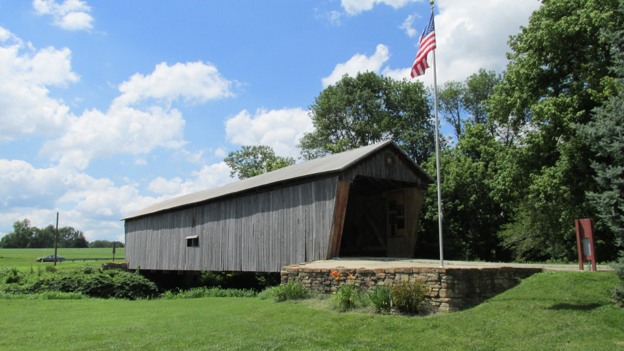
At heart, Grandma was a provincialist, and proud of it. I remember how elated she was that her tiny village houses the only covered bridge in the state that spans two counties. Perhaps seemingly insignificant to the average passerby, but to grandma that was a cherished part of her locale. She had a lot of localized wisdom that was always exhibited in particular beliefs, mannerisms, and speech. Some common vernacular Grandma used was, “down home”, “over town”, “our folk”, “never heard tell of”, “hain’t”, “at’all” (for at all), “feesh” (for fish), “poosh” and “boosh” (for push and bush), “warsh”, and referred to bell peppers as “mangoes” among various other novelties. She enjoyed the county fair, home-grown products, local hand-made goods, and concerned herself with the farmers and the people who lived around her. She valued the little things, on a scale that most moderns cannot comprehend.
Grandma would know when things were seasonally available to eat and I always knew that summer was in full swing when she’d make fried tomatoes and serve it cottage cheese doused in black pepper. Or when summer was transitioning to autumn as the pawpaw fruit littered the ground, ready to be made into cream pies or jelly. And no matter what time of year it was, fresh country noodles were always served over a heap of mashed potatoes covered in a thick chicken gravy (a delicacy in southern Ohio). She knew when things ought to be planted, when the local farmers would be hanging the tobacco or shelling the corn, and would accurately be able to predict the type of winter we were in for based on the coloring pattern of Wooly Bear Caterpillars. It would take me a generation to tell of all the things grandma knew. I learned just about everything I know regarding rural life and its traditions from my grandma. The stories she would tell of her childhood and the “old days” of true rurality (no highways, air conditioning, television, indoor plumbing, etc.) always fascinated me and instilled in me an appreciation for the folkways of our ancestors and their distinct manner of living.
Now, I understand that to most people, including the U.S. Census Bureau, Ohio is not considered the South, and that talking about a non-southern state on a blog that is intended for southern things may seem a bit odd, but… “hold your horses”. The historic culture of the lower Ohio River Valley is considerably influenced by the cultures of the Upper South and Appalachia. However, that ain’t my point. I am trying to say that provincialism and localism are deeply Southern concepts. And, after all, the Southern tradition is the American tradition. So, if it exists outside of Dixie’s determined boundaries, well that’s a good thing and provides hope for us all.
However, being provincial has fallen on hard times. Provincialism is thought to be a dirty word nowadays; describing something backwards, narrow-minded, and against progress. The modern world condemns anything associated with it and they have worked tirelessly to eradicate any aspect of provincialism in our culture through multiple homogeneity schemes. While they have been largely successful, they have not completely banished it from the American mind. I can assure you it is still alive, to some extent, here in Highland County; and I’m sure it exists in pocketed rural counties and small towns across America.
Provincialism is something that we ought to re-embrace and cherish. Properly understood, it is not merely an attachment to a particular place but a way of cultivating rootedness in an increasingly transient world. To be provincial is to recognize that home is more than a dot on google maps. It is a collection of familiar landscapes, inherited customs, family stories, local institutions, and relationships that give shape and continuity to one’s life. It provides a sense of belonging that cannot easily be replaced by the mobility and anonymity of modern life. The Christian understanding of home has always been more substantial than mere geography. Home is where generations meet, where children learn the stories of their grandparents, where family names acquire meaning, where churches and cemeteries preserve the memory of those who came before, and where ordinary customs become vessels of continuity. To cherish one’s home is not to retreat from the wider world, but to recognize that love begins with the particular. Cherishing these things does not require believing that one’s own place or traditions are perfect; rather, it means recognizing that human beings flourish when they have something concrete to love, preserve, and hand down. We are called to love our neighbors, but we cannot love an abstraction; we love actual people in actual communities. Provincialism encourages gratitude for the ordinary things that surround us and reminds us that a meaningful life is often built not through constant novelty, but through fidelity to people and places that have become our own. Richard Weaver said, “…provincialism is your belief in yourself, in your neighborhood, in your reality. It is patriotism without belligerence.”
This attachment also creates a deeper appreciation for inherited ways of being. Traditions are, in a sense, accumulated memory. They embody the experiences, judgments, sacrifices, and habits of generations who lived before us. When we take them seriously, we become recipients rather than merely consumers of culture; conscious that we have inherited something that we are responsible for preserving, refining, and transmitting. Home becomes a place of stewardship, where memory is preserved and traditions are practiced rather than merely remembered.
Provincialism at its best teaches us to see the familiar with fresh gratitude, understanding that the customs and ways of life we inherit are not disposable simply because they are old. They can be sources of wisdom, identity, beauty, and belonging, giving us both roots from which to draw strength and something worthy of passing on to those who come after us. It teaches us to see the familiar landscape not as ordinary or insignificant, but as a place entrusted to us and worthy of gratitude. Every generation receives a cultural inheritance that it did not create for itself, and the old ways can contain the accumulated experience of countless people who lived before us, helping make our own existence possible. To remember them is to recognize that we are not self-created individuals standing alone in history; we are heirs. And being an heir carries a responsibility.
This is one of the deepest gifts of provincialism. It teaches us to find meaning not merely in what we can acquire or experience, but in what we can love, tend, preserve, and ultimately pass on. Home becomes more than a place where we happen to live, it becomes a portion of God’s creation for which we have been entrusted with stewardship, a community whose memory we help preserve, and a heritage for which we can give thanks. I think often of grandma and miss her dearly, and I am so thankful I inherited a fraction of her provincialism to continue cherishing and recultivating the older ways. M.E. Bradford put it best when he said, “I think we’ll do better by remembering who we are.”
The views expressed at AbbevilleInstitute.org are not necessarily those of the Abbeville Institute.




The people of southernmost Ohio and Indiana, years ago, still had “very strong Southern inclinations.” In the words of an old country song, “Cincinnati, Ohio” is “where the river winds ‘cross the Mason and the Dixon line.” A long while back I worked with a lady from Southern Indiana who had a drawl you could cut with a knife. This was a wonderful essay.
A great bit of the southern part of Ohio was settled by folks from our beloved Southland, and from the stock of those men, women, and children, black and white, who lived, worked, and struggled for life together, not as “master” and “slave”, but as co-dependents for survival and, yes, existence.
The historically reimagined versions of Mr. Lincoln’s war for tariffs tell a different story, but as a visitor, and from a neutral point of view, the difference in the people and society in Cincinnati and Cleveland is shocking to an old Southern boy.
…..localism are deeply Southern concepts…heh, the north was selling south in earnest. and abe himslef said? Peoria Speech (1854) If slavery did not now exist among them, they would not introduce it. If it did now exist amongst us, we should not instantly give it up. This I believe of the masses North and South.” Little Compton, Rhode Island Race & Ethnicity
• White: 96%
• Two or More Races: 3% and Rhode Island had one of the wealthiest men on the continent….in teh international slave trade? De Wolfe?