On the evening of March 2, 1699—Fat Monday, the night before Mardi Gras—two brothers from the French colony of New France steered a small boat into the muddy mouth of the Mississippi River, hunting for a waterway that earlier expeditions had failed to find and hold. Pierre Le Moyne d’Iberville and his younger brother Jean-Baptiste Le Moyne de Bienville were sailing under orders from King Louis XIV of France to establish a French outpost on a stretch of Gulf Coast that Spain and England both coveted for themselves. They rowed upriver through the night and the next morning, camped for the night at a large bend near the river’s mouth on Tuesday, March 3, 1699, Fat Tuesday itself.
In tribute to the festive holiday being celebrated that day back in France, Iberville named the spot Pointe du Mardi Gras (Mardi Gras Point) and the adjoining channel Bayou du Mardi Gras. These remain, as historian Arthur Hardy has noted, the oldest place names of non-Native American origin in the entire Mississippi River valley. His journal entry, however, betrays no party at all, only the bare record of a tired man making camp: “I came to sleep on a turn that the river makes on the west, 2 leagues from the mouth on a point to the right of the river.”
The first reference to Mardi Gras in the Americas was not a celebration. It was a French-Canadian soldier and explorer, camped in a Louisiana swamp roughly 60 miles south of where New Orleans would later be built, homesick enough to name his campsite after a holiday he was missing. The first actual Mardi Gras celebration in North America would not take place until 1703—four years later, near present-day Mobile, Alabama. Plaquemines Parish officials erected a commemorative marker at the site in 1971, and the Rex organization added a large plaque for the 1999 tricentennial, though the plaque has since been damaged and now lies flat on a platform next to Fort Jackson, a 90-minute drive down Louisiana Highway 23. It memorializes a feast that never happened.
What the Le Moyne brothers carried into the wilderness was far older than themselves. The word Carnival descends from the medieval Latin carnelevare, meaning to remove meat—a plain description of what Catholic households did with their meat, eggs, milk, lard, and cheese before the 40 days of Lent emptied the larder. Think of it as the original use-it-or-lose-it policy: everything perishable had to go before Ash Wednesday. Mardi Gras, French for Fat Tuesday, names the last day of that indulgence. And because Easter moves around the calendar (it falls on the first Sunday after the first full moon following the spring equinox), the entire Mardi Gras season drifts with it. In 2026, it landed on February 17.
Historians have long traced Carnival back to a pagan past the Church never fully buried. Many point to ancient Roman festivals like Lupercalia— a fertility rite involving animal sacrifice, naked priests, and ritual whipping— and Saturnalia, a week of feasting, gift-giving, and social inversion in which masters served their slaves. Church leaders, rather than trying to stamp out these wildly popular celebrations, chose to absorb them into the Christian calendar instead. Historians treat that lineage as a plausible family story rather than a proven pedigree. What the record does show is a medieval Europe thick with masking and inversion, from the Feast of Fools in France, where clergy mocked their own rituals in a brief licensed chaos, to the masquerade balls of Venice, with Spain and the German states adding their own variations.
Through it all paraded the Boeuf Gras—the fatted ox that symbolized the final meat before the fast, an emblem the House of Bourbon popularized and French colonists eventually shipped across the Atlantic to New Orleans. In England the same Tuesday became Shrove Tuesday, from the old verb to shrive, meaning to hear confession and grant absolution. A Pancake Bell rang from church towers to call the faithful to be shriven, then sent them home to burn off the butter and eggs in a pan, which is why the English still eat pancakes on the day Louisiana eats king cake.
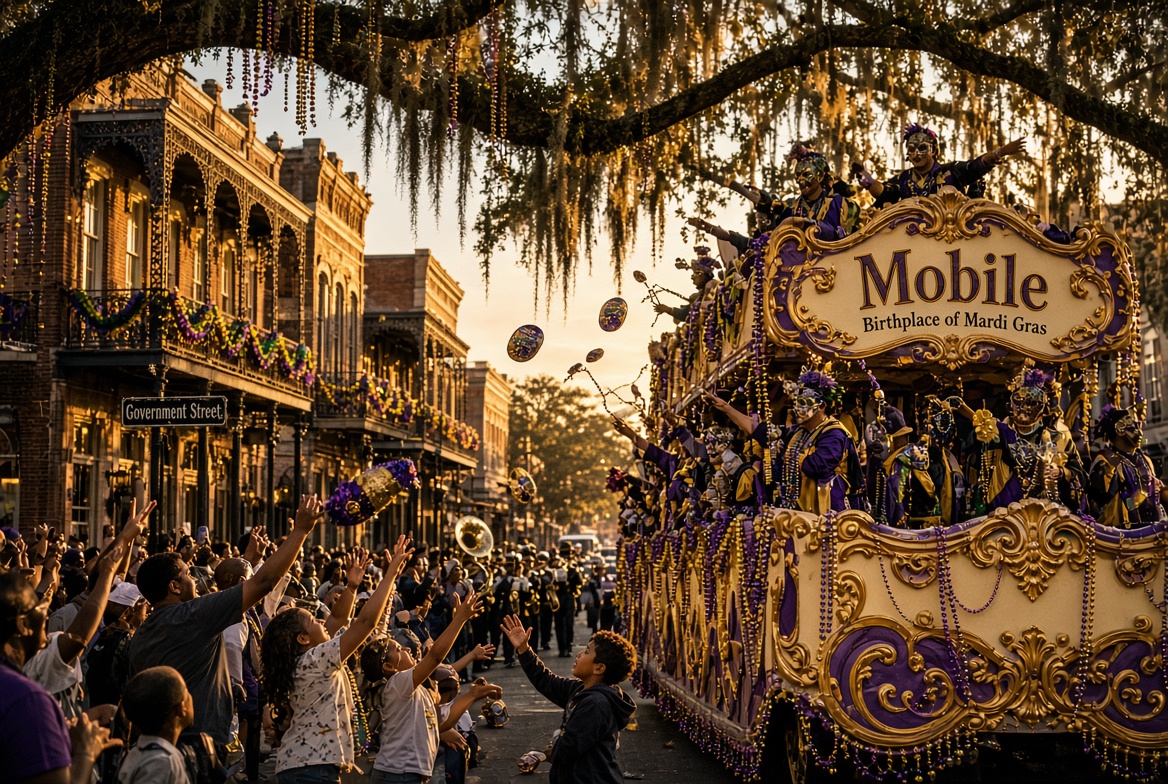
The first genuine celebration on this continent happened in an unexpected locale. Bienville founded Fort Louis de la Mobile in 1702, and Mobile served as the capital of French Louisiana long before New Orleans existed. In 1703, the settlers and soldiers there held what most historians credit as America’s first organized Mardi Gras. University of Alabama archivist Donnelly Lancaster Walton put it plainly: “Apparently as early as 1703, the French held a type of Mardi Gras celebration in Mobile. New Orleans wasn’t founded until 1718. Therefore, strictly speaking, Mobile had the earliest celebration of the two cities.”
The institutional infrastructure came next. Around 1704, the colonist Nicholas Langlois organized the Masque de la Mobile, a mystic society historians regard as the ancestor of every krewe (social clubs that host parades during Carnival) alive today. It evolved into the Société du Boeuf Gras by 1711, when 16 men pushed a papier-mâché bull’s head through the streets on a cart, staging the first known Mardi Gras parade in North America. That tradition rolled every year until the Civil War halted it.
Mobile’s most consequential accident arrived on New Year’s Eve in 1831, when a cotton broker named Michael Krafft gathered friends, grabbed rakes, cowbells, and farming implements from a hardware store, and staggered through downtown making an unholy racket. The Cowbellion de Rakin Society that grew from that spree became the first formally organized masked parading society in the United States, eventually rolling themed floats by 1840. As Mobile Carnival Museum historians have argued, the two defining ingredients of American Carnival, a themed parade and a ball hosted by a secret organized society, were both invented in Mobile. The Strikers Independent Society, founded in 1841 by cotton warehouse workers who were excluded from the Cowbellions’ elite ranks, survives as the oldest American mystic society still in existence.
New Orleans inherited these traditions. In 1856, six young Mobile natives formed the Mistick Krewe of Comus, modeling it on the mystic societies they had left behind and staging the first torchlit procession through New Orleans streets in 1857. New Orleans had held elegant balls since the 1730s, refined by Louisiana Governor the Marquis de Vaudreuil in the 1740s, but it had no parading machinery of its own until Mobile handed one over.
The Civil War silenced the festivities, and Joseph Stillwell Cain restarted them. Tradition holds that in 1866 Cain dressed as a fictional Chickasaw chief called Chief Slacabamorinico—the Chickasaw reportedly chosen because they had never been defeated by the United States, a taunt aimed straight at Union occupiers—and led a parade through Mobile. He helped move Mobile’s celebration from New Year’s Eve to Fat Tuesday and helped found the Order of Myths.
The season now opens on Twelfth Night, January 6, and ends at midnight on Fat Tuesday, when Ash Wednesday claims what is left. Because krewes fund the parades themselves, New Orleanians call it the Greatest Free Show on Earth. The Twelfth Night Revelers recorded the first “throws” in 1870, Rex expanded the practice, and aluminum doubloons arrived in 1960. Rex, inaugurated in 1872 to honor a visiting Russian grand duke, fixed the official Carnival colors: purple for justice, green for faith, and gold for power.
The scale of festivities is now staggering. A Tulane study by economics professor Toni Weiss, commissioned by the Mayor’s Mardi Gras Advisory Council and New Orleans and Company, valued the 2023 season at $891,202,780—roughly 3.07 percent of the city’s GDP—while the Downtown Development District counted about 1.8 million visitors. Rio, Trinidad, and Venice grew from the same medieval root rather than from Bourbon Street.
Rio, Trinidad, and Venice grew from the same medieval root rather than from Bourbon Street. But the krewes, the masks, and the throws came out of a French fort on Mobile Bay, and the whole American story began with a homesick captain naming a bend in a river on a Tuesday when nobody celebrated anything at all.
The views expressed at AbbevilleInstitute.org are not necessarily those of the Abbeville Institute.