
Why doesn’t the South get credit for American music? The question answers itself, almost. If you trace American music to its roots — blues, jazz, country, bluegrass, gospel, rock and roll, soul — you end up in the same place every time: the American South. The Mississippi Delta. New Orleans. Appalachia. Memphis. Nashville. Tobacco Road. The church pews of Georgia. The low country of South Carolina. The mines of Kentucky. The corrals of Texas. The fields of Alabama. The swamps of Louisiana. This is not a regional boast; it is irrefutable music history. And yet the South receives remarkably little cultural credit for what may be its greatest gift to human civilization. Understanding why requires confronting some uncomfortable truths about power, about money, about race, about Northern condescension, and about Southerners themselves.
The Victors Write the History
The Civil War’s consequences extended well beyond politics and economics. The North gave itself permission to shape and narrate the culture. For generations following Reconstruction, the institutions that decided what was celebrated and what was remembered were overwhelmingly Northern. The universities, the publishing houses, the major newspapers, and eventually the recording industry in its formative decades were all located in the large cities of the Northeast corridor and the Midwest. These institutions told the story of American culture from where they sat. The South, politically marginalized and economically prostrate, lacked the institutional machinery to tell its own story in the terms that modern credentialing requires.
Southern music was also labeled as “folk,” “primitive,” or “regional.” The elite culture of the North often treated Southern forms as raw material rather than high art. A conservatory composer from Boston was “serious.” A genius fiddler from Appalachia was “local color.” That bias has lasted for generations and is still going strong. American culture often reduces the South to politics, poverty, accents, or old conflicts, and that makes it harder for outsiders to acknowledge the region as a primary engine of cultural sophistication.
This is not a tinfoil hat conspiracy theory. This is the ordinary operation of power. It is inevitable. Cultural credit flows to those who control the apparatus of documentation and distribution. The South had the music. The North had the megaphone.
The Music Traveled; the Birth Certificate Stayed Behind
The North took possession of Southern intellectual cultural property, slapped their names on it, and never thought twice about it. A farmer in Alabama, a church pianist in Georgia, a fiddler in Louisiana, or a guitarist in Mississippi could create something revolutionary, but record labels, magazines, radio networks, and later TV were elsewhere. That means the story of Southern music was told by outsiders.
When blues moved to Chicago, when jazz found its audience in New York, when record producers brought in tape machines, and when the great migration carried Black Southern musicians northward, the Northern cities that embraced, commercialized, and profited from these forms received the cultural credit. Chess Records in Chicago. Motown in Detroit. The Brill Building in New York. These were real institutions doing real work, and their contributions deserve recognition, but something was definitely lost in that transaction. They conveniently forgot the music’s point of origin.
The birth certificate stayed behind, and nobody up North was particularly motivated to go looking for it. Why would they be? The music was already there, already theirs, and already generating revenue and prestige. The Southern origins were just an abstraction and a distant backstory that complicated a simpler, more flattering narrative about urban sophistication rescuing raw talent from the wilderness.
The Racial Accounting
Race made the reckoning complicated in ways that ultimately benefited no one. White Northerners who genuinely loved Black music found themselves in an uncomfortable position: the South was where this music was born, but the South was also the place of slavery and Jim Crow. To grant the South cultural credit felt, for many Northern progressives, like granting it a moral pass — as though acknowledging the genius of the Delta blues required overlooking the conditions under which that genius was forged. Never underestimate a Northerner’s ability for getting hopelessly tangled in hypocritical knots.
This was a false dilemma, but it was a powerfully felt one, and the result was a kind of cultural laundering. The music was claimed by its destinations rather than its origins, and Southern Black culture in particular was quietly written out of the regional ledger while being celebrated in abstraction. The music became “American.” Its birthplace remained unspeakable. Black Southern musicians found their contributions routinely stolen, underpaid, re-recorded, or minimized. Blues, gospel, rhythm & blues, early rock, and soul were foundational, but many originators were denied wealth and recognition. U.S. copyright battles are sadly loaded with too many cases of white Northerners stealing legal credit for music clearly written by Black Southerners, who had no recourse for challenges.
The Complicity of Southerners Themselves
Here is the uncomfortable argument, the one Southerners need to hear from within their own tradition: we have been complicit in this erasure. We did this to ourselves.
For generations, too many white Southerners defined their heritage almost entirely around the Confederacy and its military defense. This was totally understandable as a response to defeat and humiliation. It was also a catastrophic misallocation of cultural capital. When you lead with Fredericksburg instead of the blues, you hand your critics the argument they wanted all along and bury the one they can’t answer. The cultural treasure was sitting right there in front of us the whole time. We had the most original, most influential, and most genuine art form the world had ever seen, and too many Southerners were looking the other way and nursing a different grievance entirely.
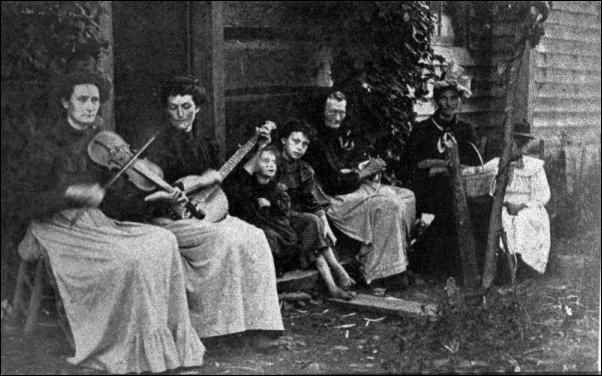
Another facet of this predicament is that Southerners themselves often took Southern music for granted because they grew up and lived around church singing, family picking, dance music, and local virtuosos their whole lives. What the rest of the country realized was miraculous was what Southerners saw as routinely ordinary, taking a careless attitude towards a magical abundance of wealth. The tragedy is that this very ordinariness, which was the sign of a living, breathing, totally integrated musical culture, was precisely what made it invisible to the people who possessed it.
The Abbeville tradition has long argued that the South possesses a distinct civilization worth defending. If that is true — and it is — then the defense should begin with what is genuinely indefensible: not the military record, which can be debated, but the artistic and cultural legacy, which cannot. No serious person disputes where American music comes from. Southerners should be making that argument loudly, constantly, and without apology. We need to be throwing that in their faces every chance we get. “Why does that Daniel guy keep writing all this stuff about Southern music, and why does Abbeville keep publishing it?” Because when it comes to music, the South is undefeated.
The Oral Tradition and Its Costs
There is a final, structural explanation that has nothing to do with malice or politics. The Southern musical tradition was fundamentally oral and participatory. It lived in front porches and juke joints and church services and work songs — in performance, in transmission from hand to hand and voice to voice, in the kind of living cultural practice that resists documentation almost by nature.
Modern cultural credit flows to those who wrote things down, filed copyright, built institutions, and told their own story in print. The Southern tradition was not organized around those imperatives. The music was everywhere, but the paperwork was nowhere. By the time the recording industry arrived to capture what it could, the framework for credit — who owned what, who invented what, who should be remembered for what — was already being written by people who weren’t even there at the creation.
This is not an excuse for inaction, but a simple diagnosis. The oral tradition so common in the South produced extraordinary art. However, it also produced extraordinary vulnerability to appropriation, misattribution, and forgetting.
The Argument That Cannot Be Answered
American music is Southern music. Jazz, blues, country, gospel, bluegrass, rock ‘n roll, soul, R&B, sacred harp, barbershop, funk, Cajun, Tejano — the genealogy runs through the South with a consistency that borders on the monotonous. This is the Southern contribution to world civilization, and it dwarfs in lasting influence almost anything else any other American region has produced.
If you removed Southern influence from American music, what remains would be dramatically smaller, less distinctive, and less globally influential. At best, it would be no better than Europe Lite. That’s not regional and cultural cheerleading. It’s absolutely historically defensible. The blunt truth is that America wants the product without honoring the source. America loves Southern music while mocking Southern people. Therefore, most important thing to remember is that the music IS the argument. It has been waiting to be claimed.
The South has allowed this argument to go unmade for too long, distracted by battles it could not win and grievances it could not resolve. The cultural case is different. It is not a matter of interpretation or perspective. It is a matter of history. Southerners should make it — not defensively, not as a counter to criticism, but proudly, specifically, and with the confidence of people who know exactly what they gave the world. It’s not picking a fight if they can’t even fight back. No brag, just fact.
The views expressed at AbbevilleInstitute.org are not necessarily those of the Abbeville Institute.