
The Battle of Gettysburg, fought from July 1 through 3, 1863, left around 10,000 dead from both sides. These soldiers were initially buried in temporary graves on the battlefield. The Federal Government established the National Cemetery System for the Union dead in 1861 and the Soldiers’ National Cemetery was established in Gettysburg for the Union dead from that battle. That cemetery was made famous when President Abraham Lincoln delivered his Gettysburg Address at its dedication on November 19, 1863.
While the removal of the Union dead to either National Cemeteries by the Federal Government or to local cemeteries by their families began during the War Between the States itself, the removal of the Confederate dead from their temporary graves on battlefields to permanent resting places in cemeteries did not take place in earnest until after the war. Every major battle of the war except Gettysburg was fought south of the Mason-Dixon Line and the Confederate dead were either interned in local cemeteries or Confederate cemeteries which were established nearby for their burial. This was done by private organizations which mostly consisted of Southern women.
However, as Gettysburg was in Pennsylvania and, thus, north of the Mason-Dixon Line, its soil was considered attainted by former Confederates and their wishes were that the remains of the Confederate soldiers buried there should be returned to the South. Major General Fitzhugh Lee, the nephew of General Robert E. Lee, wrote his uncle a letter asking him is opinion on the subject. His uncle, who was the commander of the Army of Northern Virginia at Gettysburg, replied in a letter to his nephew dated December 15, 1868. In it, he stated:
“I have considered the subject of your letter,…and though I have no desire that my views should govern the decision of a question in which others are equally interested, I will give them for your consideration. In the first place, I have no fears that our dead will receive disrespectful treatment at the hands of the Gettysburg association [i.e., the Gettysburg Battlefield Memorial Association]. If they do so, it will then be time, as it will also furnish the occasion, for us to apply for their transfer to our care. I am not in favor of disturbing the ashes of the dead unless for a worthy object, and I know of no fitter resting-place for a soldier than the field on which he has so nobly laid down his life. If our State governments could reflect the wishes of their citizens, and each State could receive its own dead, I think it would be very appropriate to return them to their native soil for final interment, if possible; and I know it would be soothing to the feelings of their friends to have their sacred dead committed to their affectionate keeping.”
While the Confederate graves in Gettysburg received no disrespectful treatment there and the writer agrees with General Lee and is sorry that a Confederate cemetery was not established there, Southern sentiment that the remains of their sons there be returned to their native soil prevailed. Hollywood Cemetery in Richmond, Virginia was the cemetery in which the most were re-interred, receiving the remains of 2,935 Confederate soldiers from the Gettysburg battlefield in 1872. Many of them were unknown. The section of the cemetery in which they are buried is known as Gettysburg Hill. This was the work of the Hollywood Memorial Association, a group of Richmond women who also reinterred the remains of Confederate dead from local battles around Richmond who died in Richmond military hospitals.
Three other cities where smaller numbers of Confederate dead from Gettysburg were buried were Raleigh, North Carolina, Charleston, South Carolina, and Savannah, Georgia, and there were others as well. The Southern ladies’ memorial associations in these various cities turned to Samuel Weaver and his son Dr. Rufus Benjamin Weaver, both natives of Gettysburg, for help in locating and exhuming the graves of the Confederate dead there. Samuel Weaver had supervised the re-interment of the Union dead into the National Cemetery and he and Dr. J.W.C. O’Neal had mapped all the known Confederate gravesites on the Gettysburg battlefield. However, Weaver was killed in a railroad accident before he was able to start the work. Dr. Rufus Weaver, his son, then took up the work. A historical marker honoring him for his work in this matter now stands along Lefever Street in Gettysburg just north of Unity Park. It was erected by the Freeman’s Battery Forrest’s Artillery Camp 1939 of the Sons of Confederate Veterans in Savannah, Tennessee. The marker states:
“In 1871, now a doctor of anatomy, Dr. Rufus Benjamin Weaver took on took on the difficult job of exhuming, collecting, boxing, and shipping, the remains of Confederate soldiers. Whenever a grave was opened, Dr. Weaver was present to insure that all remains possible were recovered. Dr. Weaver was supposed to be paid the agreed price of $3.25 for each body he was able to recover, however the Southern ladies memorial associations were unable to pay more than 50% of what he was actually owed. Despite this fact, Dr. Weaver continued the noble work of repatriating the remains of 3,320 Confederate soldiers to the South.”
It is clear to see that Hollywood Cemetery received the majority of these remains. One of the other cemeteries to receive them was Magnolia Cemetery in Charleston, South Carolina, where the remains of 82 Confederate soldiers from Gettysburg were re-interned in the Cemetery’s Confederate Section in 1871 by the Ladies’ Memorial Association of Charleston for Commemorating the Confederate Dead. Confederate soldiers who fought in local battles such as Battery Wagner, Fort Sumter, and Secessionville, as well as battles in Virginia, are buried there as are the three crews of the H.L. Hunley. A total of about 2,000 to 2,200 Confederate soldiers and sailors are buried there.
The burial of Confederate soldiers from the Gettysburg battlefield in Charleston is also noteworthy because Charleston was to the War Between the States what Boston was to the Revolutionary War. It was the city where the first blow for freedom was struck. Not only did the secession convention of South Carolina which ratified the state’s Ordinance of Secession on December 20, 1860 met there at South Carolina Institute Hall, but the first shots of the war were also fired there. The Union forces repeatedly tried to take it during the war. When they finally did take it early in 1865, a Union song celebrating this was “The Fall of Charleston” written by Eugene T. Johnson. One line in it was “Babylon has fallen.”
An address was delivered on the occasion of the re-internment of the Confederate dead from Gettysburg at Magnolia Cemetery by Dr. John Lafayette Girardeau. He was a Presbyterian minister before and after the war and served during the war as the chaplain of the 23rd South Carolina Infantry Regiment. He also served as a professor of systematic theology at Columbia Theological Seminary in Columbia, South Carolina after the war. Much of his ministry was to black congregations. Girardeau’s black congregants missed his preaching during the war and were anxious to have him back. However, he was unable to do this for two years from 1865 to 1867 because Federal Government authorities turned that work over to a missionary from the Freedmen’s Bureau during that period. There was more mission work by Southern whites to Southern blacks in the Antebellum South than there was in foreign missions during that period. One work on this subject was written by Charles C. Jones in 1842.
Girardeau was of French Huguenot descent. The name Huguenot likely originates from the German word eidgenossen, meaning confederates. They were French Calvinists and many of them fled France because they were persecuted by the Catholics there, often by burning at the stake or some other form of murder. One French Huguenot wrote a book in 1579 under the pseudonym Junius Brutus entitled Vindiciae Contra Tyrannos: Of the Lawful Power of the Prince Over the People and of the People over the Prince. The English translation of the Latin title is “A Defense of Liberty Against Tyrants.” The book recognized that law comes from God and that government is covenantal. It argued that there are covenants between God and the king, God and the people, and the king and the people. The people covenant with God to be His people ruled by His law and they covenant with the king to submit to his authority as God’s minister as long as he rules them by God’s law and respects their God given rights. Consequently, the book argued resistance against kings who violated God’s law. The book was reprinted several times in history, including the Apology of William in Amsterdam in 1581, the overthrow of Charles I in 1648, and the Glorious Revolution of 1689. It was also one of the most widely read books in the British North American colonies before and during the American Revolution.
One place where Huguenots who fled France settled was in South Carolina. Francis Marion, the South Carolina hero of the Revolutionary War known as “the Swamp Fox,” was of Huguenot descent. The Girardeau family was also among the Huguenots who settled in that colony, later to become a state. John L. Girardeau’s address in Charleston in 1871 strongly reflects this heritage. It has been republished by the Society for Biblical and Southern Studies under the title A Heritage of Resisting Tyranny. Thus, the likely origin of the word Huguenot as confederates was appropriate here. In an article in the ConfederateShop.com Newsletter, Rob Hodges, Jr. called it “The Confederate Gettysburg Address.”
Confederate Lieutenant General Richard H. Anderson delivered the opening remarks. He was followed by Girardeau. One of Girardeau’s opening remarks was, “And wilt Thou, Almighty Being, inspire what may be uttered with the spirit of wisdom, justice, and truth.” He spoke with affection upon the remains of these soldiers being returned to their native soil and of fears that “their graves would be designated as those of rebels and traitors” had they remained on the battlefield on which they fell. In answer to the charge that they were, he stated, “In the face of the world we protest, that so far as having been rebels against legitimate authority and traitors to their country, they were lovers of liberty, combatants for constitutional rights, and as exemplars of heroic virtue benefactors of their race.” He then went right into the heart of the matter:
“There are three great elements in the social constitution of man, involving corresponding necessities – The Domestic, the Political, and the Religious. Answering to these fundamental features of our nature there are three Divinely ordained institutes, independent of, but related to, each other – the Family, the State, and the Church. Taken together they constitute the trinity of human relations. Each of them is indispensable to the wellbeing, if not the very preservation, of the race. They are the pillars on which rests the stability of society, as well as the prime motors in its catholic Progress – its organic nisus (effort) towards for the great end for which it was originally obtained. To injure either of them is to strike a blow at the root of human happiness; and so intimate is the bond between them, so nice and delicate their action and re-action upon each other, that to impair one of them is to imperil the integrity of them all. Adverse to each and all of these beneficent ordinations, and consequently antagonistic to the vital interests which they suppose, there is a spirit abroad in the earth, almost universal in its operation, the measures of which are characterized by a subtlety and unity betokening the shaping of one master intelligence – that of the Arch-foe of God and man. Need it be said that this is Radicalism? Conceived in revolt from the sublime and harmonious order in which the different elements operate, it purposes to upturn the very ground-forms of society. Nothing that is sustained by the experience of the past, nothing that that is venerable with age and consecrated by immemorial associations, nothing that descending through the ages has retained, in the midst of change and revolution, the fragrance of our primeval estate, or even of patriarchal dignity and simplicity, nothing just, true and pure, will be allowed to escape the sweep of this deluge.”
He went on to say:
“This ruthless, leveling Spirit wages war against the Family, the State and the Church. Hearth-stones, grave, altars, temples, – all are borne down under its tempestuous irruption. Nothing is safe from it. There is no sanctuary which it will not invade, no just, holy, time-honored sanction which it will not violate. Contemning the ordinances of man, it swaggers, in its Titanic audacity, against the empire of the Eternal. A leader of Parisian Socialism is reported recently to have exclaimed, that if he could reach the Almighty, he would poniard (stab) Him upon His throne! Breach after breach has it already opened through the barriers which limit and restrain it, and in its onward rush, should laws, constitutions and public sentiment fail to impede its course, can only be arrested, aside from immediate Divine intervention, by the iron power of imperial Absolutism. Plunged into the vortex of anarchy by this Genius of Lawlessness, swimming for life in the vast gulf of the miseries induced by it, men will in very despair turn for refuge to Autocratic Despotism. It has been said by a great writer on Government, that there are two cardinal wants of society – protection and liberty; and that of these the first in order is protection. Existence must be pre-supposed by happiness. In accordance with this principle it is but natural to judge that, when men have tried the desolating misrule of anarchy, they will recoil for protection under the sceptre of Despotism. But a selfish desire for safety will not have eradicated the prescriptive habits of democratic license, and the probable resultant of these conflicting forces will be a mechanical union between the imperial and popular element – between Consolidated Despotism and Democratic Absolutism. To this the indications in Europe and on this Continent seem to point. Extremes will meet on a principle shared by both – uncompromising hostility to regulated government and constitutional liberty. Apparently as far apart as the poles, they will be united by a common axis, on which the insane attempt will be made to drive the revolutions of the political world.”
When one reads this today, one is struck by the fact that this same radicalism which was established by the victory of Union arms at Appomattox in 1865 still rules us today. This spirit of radicalism has advanced over the years and is now trying to destroy every institution that Girardeau said it would. The Federal Government has since continuously usurped powers reserved to the states and the people by the 10th Amendment to the U.S. Constitution. The family now in such a state of decline that the majority of children growing up now are not living in households where they are with both their biological parents in a heterosexual monogamous marriage. Despotism is indeed on the rise and the family situation is clearly devolving into anarchy, as are many other things. In regard to Girardeau’s observation about extremes meeting, we are seeing that today with the alliance between radicalism and Islam. He continued:
“We must resist the influence of Radicalism in its Socialistic aspects as we would oppose the progress of a plague. Socialism and Communism are developments of the same Radical spirit. They go hand in hand. When the relations of life are subverted, the rights which spring from them are destroyed. When the altars of the Family are overthrown, it is but a step to tear down the pillars of the State.”
This is still playing out today as well. David Jenkins, a member of the National Political Committee of the Democratic Socialists of America (DSA), has openly stated, “Our goal is Communism.” Comparing the platform of the Communist Party with the stated goals of the DSA bears this out. And Lenin said, “The goal of Socialism is Communism.” Walter D. Kennedy and Al Benson, Jr. have written books about the Marxist support for the Union cause in the war, Lincoln, Marx, and the GOP and Red Republicans and Lincoln’s Marxists. Girardeau stated, “This somewhat extended portraiture of the spirit of Radicalism will not be deemed out of place, when it is remembered that it powerfully contributed to produce the evils under which we are now suffering. It was against its aggressions, in the particular forms in which they were directed upon the South, that these men whose memories we honor today and their compatriots contended unto death.” He commented further:
“It began by assuming the existence of a ‘higher law,’ growing out of what were denominated the instincts of human nature, which it held to be superior, in the sphere of morals, to Divine Revelation, and, in that of politics, to the provisions of the Federal Constitution. With such a theory from which to derive its inspirations, it is not to be wondered at that it regarded neither the Laws of God nor of man which were conceived to lie in the path to the attainment of its ends. Pushing out this baleful dogma to its legitimate results, it boldly invaded the political order, and the fundamental principles of that federative government, which we had inherited from our fathers. Resting not until it had destroyed the attitude of strict neutrality, imparted to the Constitution by the wisdom of its framers, it perverted that instrument into an organ, and the government into an agent of a section, trampled under foot the rights of sovereign States, and utterly refused to the people of the South all claim to think and act for themselves.”
These comments are appropriate to bring to remembrance the cause for which the soldiers who were being remembered here struggled. Girardeau also stated:
“These men also contended for the existence and the purity of their social relations, particularly in the domestic form. They fought for their firesides as well as for their political rights. The same Radical spirit which disregarded the limitations of the Constitution, contemns the Divinely-instituted barriers which fence in the sanctities of the Family relation. Its triumph bodes for us no good. The danger is imminent of the introduction amongst us of novel social theories, born on another soil, and coming in as filthy camp-followers of a conquering host….It becomes us with all our might to resist that corruption of manners which is incompatible with the simplicity of free institutions, and the purity and integrity of moral character.”
In the Antebellum North, such things as abortion and so-called “free-love” began being accepted. These were abhorrent in the South, which was strongly influenced by Reformed Christian doctrine as a result of the Second Great Awakening in the early 19th Century. Another result of this was that the Confederate army was the most Christian army since Cromwell’s army. The facts concerning this revival were chronicled after the war in two books by two former Confederate chaplains, Christ in the Camp by J. William Jones and The Great Revival in the Southern Armies by William W. Bennett. Girardeau’s address includes extended remarks pointing this out.
Despite claims to the contrary, no such revival occurred in the Union army. The Second Great Awakening took an entirely different turn in the North and there apostasy spread, the two foremost forms of which were Unitarianism and Transcendentalism. The radical theology in the North led that section to embrace radical politics as well. The contrary theologies which arose in these two sections resulted in two different worldviews from which two incompatibly different ways of life emerged. It was the clash of these two worldviews which led to the secession of the South. A more detailed narrative of this can be found in A Theological Interpretation of American History by C. Gregg Singer and Sacred Conviction by Joseph Jay.
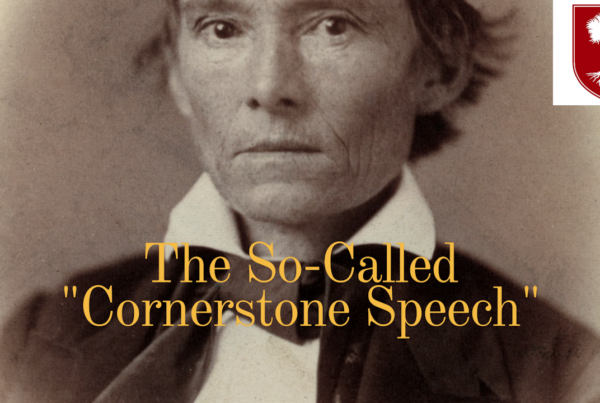
Many among the ill informed have misquoted Alexander H. Stevens’ so called “Cornerstone Speech” as supposed evidence of what the Confederacy really stood for. There are other blogs appearing on the Abbeville Institute website which successfully refute their claim. This writer has been studying the War Between the States and its causes for 58 years. In his opinion, the best quotation he has found which gets to the real differences between the North and the South during the 19th Century is from James Henley Thornwell, a predecessor of Girardeau at Columbia Theological Seminary and author of a proposed preamble to the Confederate Constitution which failed passage. It was in an article in the Southern Literary Messenger in July 1851, and in it, Thornwell wrote:
“These are mighty questions which are shaking thrones to their centers – upheaving the masses like an earthquake, and rocking the solid pillars of this Union. The parties in this conflict are not merely abolitionists and slave-holders – they are atheists, socialists, communists, red republicans, Jacobins on the one side and the friends of order and regulated freedom on the other. In one word, the world is the battleground – Christianity and atheism the combatants, and the progress of humanity is at stake. One party seems to regard society with all its complicated interests, its divisions and subdivisions, as the machinery of man – which as it had been invented and arranged by his ingenuity and skill may be taken to pieces, reconstructed, or repaired as experience shall indicate defects or confusions in the original plan. The other party beholds it as the ordinance of God.”
Girardeau’s address is another example of a statement of the real differences between the sections. Girardeau acknowledged this by stating:
“The relation between our people and the Gospel at once confers invaluable benefits and creates imperishable responsibilities. We cannot impair it without doing ourselves irreparable damage. Our civilization takes its dominant type from Christianity. All its distinctive moral features are derived from it….The stability of a State, and of the institutions which it embraces and which go to make up its organic life, depend on the degree in which the principle of moral obligation obtains, and the rules of virtue are practiced. But, as been observed by a splendid writer on American Democracy, there can be no true morality without religion. It is incumbent on us, therefore, as possessing the only perfect religion which the world has known, to appreciate the responsibilities which flow from such an endowment. Apostasy from Christianity would be suicide.”
This can be seen today. Girardeau also predicted that the loss of civil liberty resulting in the Northern victory in the War Between the States would also lead to the loss of religious liberty and said that the two go together. That, too, is being seen in our day. Girardeau stated:
“To sum up what has been said: Our brethren will not have died in vain if we their survivors adhere to the great principles for which they contended unto death; if we preserve an attitude of protest against those Radical influences which threaten to sweep away every vestige of constitutional rights and guarantees, to pollute the fountains of social life, and ultimately to whelm our civil and religious liberties in one common ruin.”
He also stated:
“If we adopt not this course, what will be the consequences, which must ensue? One of the results will be that the only remaining representatives on this continent of free republican principles – especially in their federative form – will have ceased to exist, and the faintest, the last hope of a return to the noble, the glorious estate inherited from our patriotic ancestors will have gone out in the blackness of darkness. And then it must in all probability follow that the question of the possibility of republican institutions, or of the maintenance of the principle of free representation will have been negatived (negated) forever. The failure of the experiment on this continent instituted under conditions so favorable, under auspices so happy will discourage any similar attempt for the future in any country under heaven.”
The writer can only cite parts of Girardeau’s address, but one can see the parallels between it and Lincoln’s Gettysburg Address, the latter of which breathes the spirit of radicalism which Girardeau denounced. Hodges went to greater length to expound on the parallels between these two addresses in his article, which this writer recommends to his readers. The Society for Biblical and Southern Studies is to be heartily commended for reprinting this address and making it available once more. Girardeau closed his address with these remarks:
“Heroes of Gettysburg: Champions of constitutional rights! Martyrs for regulated liberty! Once again, farewell! Descend to your final sleep with a people’s benedictions upon your names! Rest ye here, Soldiers of a defeated – God grant it may not be a wholly lost – Cause! We may not fire a soldier’s salute over your dust, but the pulses of our hearts beat like muffled drums, and every deep-drawn sigh breathes a low and passionate requiem. Memory will keep her guard of honour over your graves; Love will bedew them with tears; Faith will draw from them her inspiration for future sacrifices; and Hope, kindling her torch at the fires which will glow in your ashes, will, in its light, look forward to a day when a people once more redeemed and enfranchised will confess that your death was not in vain.”
****************************************************
Additional Sources:
A Heritage of Resisting Tyranny: An Address Given by Rev. John L. Girardeau, D.D. at the Re-interment Ceremony in Charleston, South Carolina, Confederate Memorial Day 10 May 1871. Spout Spring, VA: Society for Biblical and Southern Studies, 2009.
Rob Hodges, Jr., “The Confederate Gettysburg Address,” ConfederateShop.com Newsletter, April 17, 2024. https://confederateshop.com/my-two-cents/the-confederate-gettysburg-address/
Henry Alexander White, Southern Presbyterian Leaders, 1683-1911. Edinburgh, UK: Banner of Truth Trust, 2000 (1911).
Morton H. Smith, Studies in Southern Presbyterian Theology. Phillipsburg, NJ: Presbyterian and Reformed Publishing Company, 1987 (1962).
George A. Blackburn, ed., The Life Work of John L. Girardeau, D.D., LL.D., Late Professor in the Presbyterian Theological Seminary, Columbia, S.C. and Sermons by John L. Girardeau, D.D., LL.D., Late Professor in the Theological Seminary, Columbia, S.C. Harrisonburg, VA: Sprinkle Publications, n.d. (1916 and 1907).
Charles C. Jones, The Religious Instruction of the Negroes of the United States and William S. Plumer, Thoughts on the Religious Instruction of the Negroes of This Country. Harrisonburg, VA: Sprinkle Publications, 2009 (1842 and 1848).
Fitzhugh Lee, General Lee, Premier Civil War Classics. Greenwich, CT: Fawcet Publications, Inc., 1961 (1894).
Vaughn & Starbuck, We’re the Boys for Mexico. Cassette tape. Virginia Beach, VA: Vaughn & Starbuck, 1993.
Walter D. Kennedy and Al Benson, Jr., Lincoln, Marx, and the GOP. Columbia, SC: Shotwell Publishing, 2023.
Walter D. Kennedy and Al Benson, Jr., Red Republicans and Lincoln’s Marxists: Marxism in the Civil War. Lincoln, NE: iUniverse, 2007.
J. William Jones, Christ in the Camp: Or, Religion in the Confederate Army. Harrisonburg, VA: Sprinkle Publications, 1986 (1887).
William W. Bennett, A Narrative of the Great Revival which Prevailed in the Southern Armies during the Late Civil War Between the States of the Federal Union. Harrisonburg, VA: Sprinkle Publications, 1976 (1876).
G. Gregg Singer, A Theological Interpretation of American History, Revised Edition. Phillipsburg, NJ: Presbyterian and Reformed Publishing Company, 1981, Chapter 3, “Transcendentalism and the Rise of Modern Democracy.”
John Jay, Sacred Conviction: The South’s Stand for Biblical Authority. Columbia, SC: Shotwell Publishing, 2018.
- Rondel Rumburg, Confederate Flags Matter: The Christian Influence on the Flags. Spout Spring, VA: Society for Biblical and Southern Studies, 2015.
Benjamin M. Palmer, ed., The Collected Writings of James Henley Thornwell, 4 vols. Edinburgh, UK: Banner of Truth Trust, 1974 (1875).
The views expressed at AbbevilleInstitute.org are not necessarily those of the Abbeville Institute.