
Why the US’s Northwest Ordinance of 1787 Was Essentially Jefferson’s Land Ordinance of 1784
A believer in “demographic imperialism,” says Gordon Wood in Empire of Liberty, “Jefferson was the most expansion-minded president in American history.” Jefferson, a resolute optimist, envisaged a nation, mostly agrarian, spread across the continent, and separated neatly into square, self-sufficient states according to a Cartesian, two-dimensional grid. Westerly expansion was a way to test his hypothesis that republican government thrives in a large territory—a hypothesis later articulated in his Second Inaugural Address when president.
Robert Tucker and David Hendrickson state in their Empire of Liberty that Jefferson’s notion of domestic society was “contingent on the fulfillment of expansive [i.e., territorial] goals.”
That point is ingeminated by Lawrence Hatter in a paper titled “The Narcissism of Petty Differences.” “For Jefferson, the incorporation of the western territories into the United States was essential to the revival of the Federal Union.” Regional trade between east and west would “forge ties of mutual interest,” thereby “enriching both sections and strengthening the Union.” It would also prevent misappropriation of the ultramontane lands of North America.
To George Rogers Clark (4 Dec. 1783), Jefferson expresses concern about British interest in land west of the Mississippi.
I find they have subscribed a very large sum of money in England for exploring the country from the Missisipi to California. They pretend it is only to promote knolege. I am afraid they have thoughts of colonising into that quarter.
To John Jay (14 Aug. 1785), Jefferson writes concerning French intentions to colonize the western parts of North America,
If they would desire a colony on the Western side of America, I should not be quite satisfied that they would refuse one which should offer itself on the eastern side.
Jefferson’s view of the need to expand met with firm opposition—especially from Federalists who feared loss of political power in northeastern states. Others worried about opening Pandora’s box. Says John Larson in “Jefferson’s Union and Internal Improvements,” “Many national leaders, including George Washington, believed that rapid and unregulated settlement would abandon the West to chaos.” They proposed what might be dubbed “gradualism”—viz., the slow but steady settlement of western lands with tight governmental controls overseeing the process. Tight governmental control was deemed needed because of distrust of barbaric and adventurous settlers.
Jefferson was no gradualist. Greatly confident that the settlers of the territory would be capable of self-governing, Jefferson thus proposed opportunistic settlement of western lands and self-government insofar as circumstances allowed. Jefferson writes to François de Marbois (14 June 1817), in the vein of a sentiment of Cicero:
My hope of its duration [i.e., the republic] is built much on the enlargement of territory, and the belief that men are disposed to live honestly, if the means of doing so are open to them.
The land south and west of the Great Lakes—roughly comprising Ohio, Michigan, Indiana, Illinois, Wisconsin, and some of Minnesota—was first in possession of France and then Britain, but it was lost by Britain with the Revolutionary War. Thereafter, there was considerable debate, concerning ownership of the land, and several states, including Virginia, which claimed much land to its west, staked claims. The debate was eventually settled by Jefferson, who proposed that all states should relinquish their claims of ownership and that the territory should be divided into new states, shaped in rectangles, insofar as the land would allow.
The result was the An Ordinance Establishing Land Office for the United States, drafted chiefly by Thomas Jefferson in 1784. “This document,” writes Merrill Peterson in “Jefferson, the West, and the Enlightenment Vision,” “ranks in universal importance to all those drawn by Jefferson,” next to the Declaration of Independence. Jefferson writes of the division of the land:
It shall be divided into Hundreds of ten geographical miles square, each mile containing 6086 feet and four tenths of a foot, by lines to be run & marked due North & South, & others crossing these at right angles, the first of which lines, each way, shall be at ten miles distance from one of the corners, of the State within which they shall be. … These Hundreds shall be subdivided into lots of one mile square each, or 850 acres and four tenths of an acre by marked lines running in like manner due North & South and others crossing these at right angles.
Jefferson proposes that surveyors use both a chain on and chop in trees (or other marks) to make the basal subdivisions. Each hundred will be designated by three chops on a tree; each square-mile lot, one chop. They shall begin from the extreme northwest lot of the first Hundred and work easterly. When the first row, to be numbered 1 to 10, is finished, a second, to be numbered 11 to 20, shall begin from the west and beneath the first. To ensure exactitude,
the surveyors shall pay due & constant attention to the variation of the magnetic meridian, & shall run & note all lines by the true meridian, certifying with every plat what was the variation at the time of running the lines thereon noted.
Much of the rest of the ordinance concerns rightful acquisition of land. It ends with the provision of land—acreage determined by rank—to officers and soldiers in the service of the United States.
Prior to the 1784 ordinance, Jefferson, along with Samuel Chase and David Howell, fashioned a committee report concerning the government of the western territory on March 1, 1784. The report, with the exception of certain interlineations, is entirely in Jefferson’s handwriting, and formed the basis for the ordinance of 1784.
In that report, the members of any territory will be allowed to establish a temporary government, until such time as the territory “shall have acquired 20,000 free inhabitants.” At such time, they will call a “Convention of representatives” to establish their own constitution and government. Each temporary or permanent government must abide by the following principles:
1, That they shall forever remain a part of the United States of America.
2, That in their persons, property & territory, they shall be subject to the Government of the United States in Congress assembled and to the articles of confederation in all those cases in which the original states shall be so subject.
3, That they shall be subject to pay a part of the federal debts contracted or to be contracted to be apportioned on them by Congress, according to the same common rule and measure by which apportionments thereof shall be made on the other states.
4, That their respective Governments shall be in republican forms, and shall admit no person to be a citizen, who holds any hereditary title.
5, That after the year 1800 of the Christian æra, there shall be neither slavery nor involuntary servitude in any of the said states, otherwise than in punishment of crimes, whereof the party shall have been duly convicted to have been personally guilty.
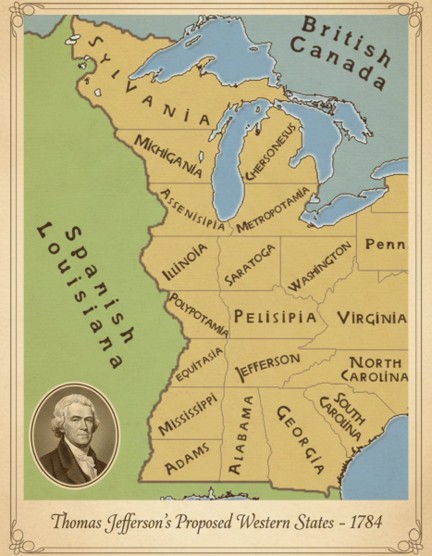
Upon populational growth equivalent to or in excess of the least populous of the 13 original states, a territory will be admitted into the Congress of the United States “on an equal footing with the said original states,” granting consent of nine of the original states. The territories, 10 in all, are to given the names Sylvania, Michigania, Cherronesus, Assenisipia, Metropotamia, Illinoia, Saratoga, Washington, Polypotamia, and Pelisipia—with the exception of “Washington,” a strange méli-mélo of Greek, Latin, and Native American words.
The 1784 committee report morphed into Jefferson’s 1784 ordinance, which would eventually become, with modifications, the Northwest Ordinance, passed on July 13, 1787, and signed into law two years later on August 7.
What do the report and draft ordinance of 1784 show? First, they exemplify Jefferson’s optimism and keen sense of timeliness. He opposed Washington’s gradualism with its concomitant tight governmental controls, and essayed to move forward with a plan for partitioning the northwestern lands, for allowing for the sale of land to settlers, and for ceding to them the right of self-governing. Second, they signify Jefferson’s almost obsessive passion for order. He aimed to tame and improve the land by imposing on it a two-dimensional grid—boundaries set off whenever possible at right angles in a manner alien to the countries of Europe and in a manner that factored in topography—and by allowing settlers to clear it and “improve” it, mostly by farming it. Third, they illustrate Jefferson’s sense of justice. On the one hand, he was clear that any legitimate American had a right to acquire western property, and he had the goal of making acquisition of such land a just procedure. On the other hand, upon admittance to the United States, any new state would have obligations to the nation, equal to all other states. Fourth, they show Jefferson’s disrelish of artificial aristocracy and his relish of equality. Here Jefferson states that hereditary title bars a person from citizenship in the Northwest Territories. Furthermore, there his stipulation that each new territory can be self-determined as long as it republican in essence—i.e., that is a government for and of the people. Last, they are evidence of Jefferson’s lifelong execration of the institution of slavery. Though always an advocate of states’ rights, the stipulation that slavery ought to be abolished in the northwest lands after the year 1800—“That after the year 1800 of the Christian aera, there shall be neither slavery nor involuntary servitude in any of the said states”—is a for-the-nonce concession to southern states, but recognition ultimately, and recognition by a Southerner, that the institution ought to be banned universally. That clause failed to pass by one vote.
Thomas Jefferson’s Report on Government for Western Territory; March 1, 1784
The committee appointed to prepare a plan for the temporary Government of the Western territory have agreed to the following resolutions:
Resolved that the territory ceded or to be ceded by Individual States to the United States whensoever the same shall have been purchased of the Indian Inhabitants & offered for sale by the U.S. shall be formed into distinct States bounded in the following manner as nearly as such cessions will admit, that is to say; Northwardly & Southwardly by parallels of latitude so that each state shall comprehend from South to North two degrees of latitude beginning to count from the completion of thirty-one degrees North of the equator, but any territory Northwardly of the 47’th. degree shall make part of the state—below, and Eastwardly & Westwardly they shall be bounded, those on the Mississippi by that river on one side and the meridian of the lowest point of the rapids of Ohio on the other; and those adjoining on the East by the same meridian on their Western side, and on their eastern by the meridian of the Western cape of the mouth of the Great Kanhaway. And the territory eastward of this last meridian between the Ohio, Lake Erie & Pennsylvania shall be one state.
That the settlers within the territory so to be purchased & offered for sale shall, either on their own petition, or on the order of Congress, receive authority from them, with appointments of time and place for their free males of full age to meet together for the purpose of establishing a temporary government, to adopt the constitution & laws of any one of these states, so that such laws nevertheless shall be subject to alteration by their ordinary legislature, and to erect, subject to a like alteration counties or townships for the election of members for their legislature.
That such temporary government shall only continue in force in any state until it shall have acquired 20,000 free inhabitants, when, giving due proof thereof to Congress, they shall receive from them authority with appointments of time and place to call a Convention of representatives to establish a permanent Constitution & Government for themselves.
Provided that both the temporary & permanent Governments be established on these principles as their basis. 1, That they shall forever remain a part of the United States of America. 2, That in their persons, property & territory, they shall be subject to the Government of the United States in Congress assembled and to the articles of confederation in all those cases in which the original states shall be so subject. 3, That they shall be subject to pay a part of the federal debts contracted or to be contracted to be apportioned on them by Congress, according to the same common rule and measure by which apportionments thereof shall be made on the other states. 4, That their respective Governments shall be in republican forms, and shall admit no person to be a citizen, who holds any hereditary title. 5, That after the year 1800 of the Christian aera, there shall be neither slavery nor involuntary servitude in any of the said states, otherwise than in punishment of crimes, whereof the party shall have been duly convicted to have been personally guilty.
That whenever any of the sd states shall have, of free inhabitants as many as shall then be in any one the least numerous of the thirteen original states, such state shall be admitted by it’s delegates into the Congress of the United States, on an equal footing with the said original states: After which the assent of two thirds of the United States in Congress assembled shall be requisite in all those cases, wherein by the Confederation the assent of nine States is now required. Provided the consent of nine states to such admission may be obtained according to the eleventh of the Articles of Confederation. Until such admission by their delegates into Congress, any of the said states, after the establishment of their temporary Government, shall have authority to keep a sitting Member in Congress, with a right of debating, but not of voting.
That the territory Northward of the 45’th. degree, that is to say of the completion of 45 degrees from the Equator & extending to the Lake of the Woods, shall be called SYLVANIA:
That of the territory under the 45’th.& 44’th. degrees that which lies Westward of Lake Michigan shall be called MICHIGANIA, and that which is Eastward thereof within the peninsula formed by the lakes & waters of Michigan, Huron, St. Clair and Erie, shall be called CHERRONESUS, and shall include any part of the peninsula which may extend above the 45th degree.
Of the territory under the 43’d & 42’d degrees, that to the Westward thro’ which the Assenisipi or Rock river runs shall be called ASSENISIPIA, and that to the Eastward in which are the fountains of the Muskingum, the two Miamis of Ohio, the Wabash, the Illinois, the Miami of the lake and Sandusky rivers, shall be called METROPOTAMIA.
Of the territory which lies under the 41’st. & 40’th. degrees the Western, thro which the river Illinois runs, shall be called ILLINOIA; that next adjoining to the Eastward SARATOGA, and that between this last & Pennsylvania & extending from the Ohio to Lake Erie shall be called WASHINGTON.
Of the territory which lies under the 39’th.& 38’th. degrees to which shall be added so much of the point of land within the fork of the Ohio & Missisipi as lies under the 37th. degree, that to the Westward within & adjacent to which are the confluences of the rivers Wabash, Shawanee, Tanisse, Ohio, Illinois, Missisipi & Missouri, shall be called POLYPOTAMIA, and that to the Eastward farther up the Ohio otherwise called the PELISIPI shall be called PELISIPIA.
That the preceding articles shall be formed into a charter of Compact, shall be duly executed by the President of the U.S. in Congress assembled under his hand and the seal of the United States, shall be promulgated, and shall stand as fundamental constitutions between the thirteen original States, & those now newly described unalterable but by the joint consent of the U.S. in Congress assembled and of the particular state within which such alteration is proposed to be made.
Enjoy the video, below!
The views expressed at AbbevilleInstitute.org are not necessarily those of the Abbeville Institute.