
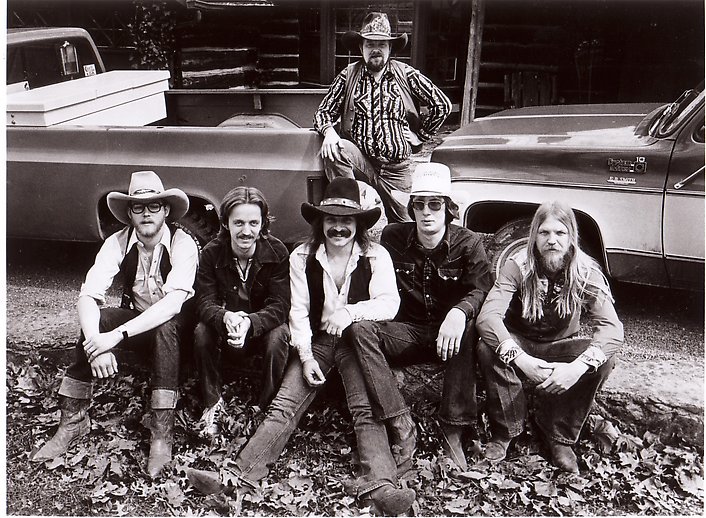
A Christmas record by a Southern rock band presents an interesting challenge. The songs are already familiar and usually easy enough to recognize, and a band with a distinctive sound can make even “Jingle Bells” or “Santa Claus Is Coming to Town” sound like its own. The more revealing question, however, is what happens when the musicians put the familiar repertoire aside and write their own Christmas songs? What does a Southern rock band choose to sing about when it is no longer borrowing somebody else’s melody, lyric, or holiday sentiment? What does Christmas sound like when it comes through the musical vocabulary of the South?
The albums considered here by the Charlie Daniels Band, Lynyrd Skynyrd, the Marshall Tucker Band, and .38 Special approach that question from different directions. All four bands released Christmas albums containing traditional standards mixed with original songs, and it’s their original songs that are the most revealing parts of the collection., Not only are these new compositions, but they give us a glimpse of how these bands understand the season through their own musical, religious, and regional identities. Taken together, the songs offer something more interesting than four variations on the usual Christmas album. They offer several different interpretations of a Southern Christmas.
Charlie Daniels deserves more attention than a single album can provide, because he recorded three distinct Christmas albums over the course of nearly two decades: Christmas Time Down South (1990), Merry Christmas to All (2002), and Joy to the World: A Bluegrass Christmas (2009). There is also a fourth title, Hallelujah, It’s Christmas Time Again (2012), but that release is a compilation drawn from the 2002 and 2009 albums rather than a separate collection of new material. It is worth acknowledging because it appears in Daniels’s Christmas discography, but it does not contribute a new body of original songs to this survey. The three earlier albums provide a much more interesting opportunity to follow the development, reuse, and reinterpretation of Charlie Daniels’s Christmas compositions.
Christmas Time Down South, released in 1990, begins with a premise that Daniels understood better than most musicians: Christmas is not experienced in the abstract. It takes place somewhere, among particular people, in familiar surroundings, with memories and traditions that belong to a place. The title track announces that geographical sensibility immediately. Daniels does not have to explain what makes Christmas in the South distinctive. We don’t have the snowfall, the icicles, or the eggnog of the Northeast, and the title itself establishes that setting. The music that follows is his familiar country-rock vocabulary rather than attempting to imitate the orchestral grandeur of a conventional holiday production.
The album consists of all-original Christmas material with the exception of the last song – “The Christmas Song (Chestnuts Roasting on an Open Fire)” by Mel Tormé and Robert Wells. It’s the original material that gives the Southern identity to the project. “Christmas Time Down South,” “Carolina I Hear You Calling,” “My Christmas Love Song to You,” “Mississippi Christmas Eve,” “Little Folks,” “Cowboy’s Christmas Gift,” and “Carolina (I Remember You)” approach the season from different angles. Some are rooted in place and memory; others are concerned with family, affection, and the ordinary pleasures of Christmas. “Jesus Is the Light of the World” brings a more explicitly religious dimension, while “Hallelujah,” written by Bruce Ray Brown, adds another original composition to the collection. To my knowledge, no other artists have ever covered any of the original songs on this album.
“Carolina I Hear You Calling” and “Carolina (I Remember You)” are especially revealing because they connect the Christmas album to Daniels’s broader musical identity. Carolina is not simply a convenient place to locate a holiday song. It is part of the emotional geography of the music. The South is not a decorative backdrop for the holiday; it is the place from which the music and its memories originate. “Mississippi Christmas Eve” offers a similar sense of regional specificity, while “My Christmas Love Song to You” takes a more personal direction. “Cowboy’s Christmas Gift” draws upon the storytelling tradition that Daniels had long cultivated. Christmas, in this collection, is not limited to a single mood or subject. It can be religious observance, family occasion, romantic season, or a time for remembering where one belongs.
The album’s title track would become particularly important in Daniels’s later Christmas work. When he returned to it in 2009, he did not simply reissue the original recording, but placed the composition in a bluegrass setting and invited Aaron Tippin to sing the lead vocal. The change is significant. The earlier recording belongs to the familiar country-rock world of the Charlie Daniels Band, while the later version draws upon acoustic bluegrass instrumentation and a different vocal personality. The song’s regional identity remains intact, but its musical clothing changes. It is a useful reminder that a good composition need not be tied permanently to one genre or style.
Daniels returned to another of the 1990 album’s original songs, “Mississippi Christmas Eve,” for Joy to the World: A Bluegrass Christmas. The later version retains Daniels’s composition but places it among banjo, mandolin, fiddle, acoustic guitar, and the other instruments associated with the bluegrass ensemble assembled for the project. The result is not a new song but a new interpretation. The earlier recording and the later one approach the same Christmas setting through different branches of Southern country music. One sounds like the Charlie Daniels Band; the other sounds like a bluegrass gathering at Twin Pines Studio. The difference is not merely a matter of instrumentation. It demonstrates how comfortably Daniels’s writing could move between related musical traditions without losing its regional character.
“Hallelujah” makes the comparison more interesting still. Written by Bruce Ray Brown, it appeared on the 1990 album and returned in the 2009 bluegrass collection. Its presence on both records also reminds us that Daniels’s Christmas repertoire was not exclusively his own songwriting. He was willing to include a composition from another musician when it fit the musical and spiritual character of the project. The later recording places the song in the same bluegrass environment as the other returning compositions, giving it a different instrumental setting while preserving its original identity. Bruce Ray Brown was the guitarist and harmonica player for the CDB, and he wrote several of their songs in the 90’s.
The second Daniels Christmas album, Merry Christmas to All, appeared in 2002. Unlike the 1990 collection, it leans more heavily on familiar Christmas standards, including “I’ll Be Home for Christmas,” “Have Yourself a Merry Little Christmas,” “The Christmas Song,” “Blue Christmas,” “Rudolph the Red-Nosed Reindeer,” and “White Christmas.” However, two original compositions deserve particular attention: “God Bless the Mother” and “It’s Bad to Have the Blues (At Christmas Time).” Daniels also revisits “Jesus Is the Light of the World,” which first appeared on Christmas Time Down South.
“God Bless the Mother” is a particularly interesting title because it shifts attention away from the usual Christmas subjects. The holiday is often described through children, gifts, decorated trees, and family gatherings, but mothers occupy a central place in the traditions that make those gatherings possible. Daniels gives that familiar figure a song of her own. Christmas music has always made room for direct expressions of gratitude and affection, and Daniels was never a songwriter who needed to disguise a simple idea beneath elaborate language.
“It’s Bad to Have the Blues (At Christmas Time)” is a different matter altogether. The title introduces a little humor, but the subject has a more serious side. Christmas is commonly presented as a season of universal happiness, yet the holidays can make loneliness, disappointment, and absence more noticeable. Daniels approaches that contradiction through the blues, a musical tradition that has always understood how sorrow and good humor can occupy the same room. The title is almost a joke, but the sentiment behind it is familiar to anyone who has experienced a Christmas that did not quite match the picture on the greeting card. It is one of the more appealing ideas in the Daniels Christmas catalog because it recognizes that the season does not require everybody to be cheerful on command.
“Jesus Is the Light of the World” provides the opportunity to compare the 2002 recording with the original version from 1990. The composition remains the same, but its return on the later album places it in a collection with a somewhat different balance of secular standards and religious material. It also demonstrates that Daniels regarded some of his Christmas compositions as worth revisiting rather than treating them as disposable seasonal novelties. The song had become part of his own Christmas repertoire, and its appearance on a second album gave it a longer life.
The third album, Joy to the World: A Bluegrass Christmas, appeared in 2009 and represents a more deliberate change in musical direction. Daniels assembled an impressive group of guests, including Aaron Tippin, Kathy Mattea, Dan Tyminski, Jewel, members of the Cox Family, and the Grascals. The project was built around bluegrass, and the arrangements make extensive use of the acoustic instruments and vocal traditions associated with that music. It is a different musical environment from the country-rock setting of the 1990 album, even though several of the compositions are the same.
The album’s most significant original material consists of the returning songs “Christmas Time Down South,” “Mississippi Christmas Eve,” and “Hallelujah.” Rather than introducing a new set of Christmas songs, Daniels chose to revisit compositions that had already become part of his seasonal repertoire. This gives Joy to the World a quality of reflection. The songs have not been abandoned or replaced; they have been given another musical life. The participation of other singers and instrumentalists also makes the project feel less like a solo exercise and more like a gathering of musicians who share an affection for the music.
The album includes one other original Daniels contribution worth mentioning, although it is not a song in the ordinary sense. “A Carolina Christmas Carol” is a lengthy spoken Christmas narrative, running more than sixteen minutes. It belongs to Daniels’s storytelling tradition rather than to the collection of original songs examined here. The album also includes his reading of the Christmas story from the Book of Luke. Both pieces are important to the character of the record, but neither should be confused with an original musical composition. They demonstrate that Daniels’s interest in Christmas extended beyond writing and performing songs. He was also interested in the stories and religious traditions that give the season its meaning.
There is something fitting about Daniels returning to his earlier compositions in this way. His music had always been comfortable moving between country, rock, bluegrass, gospel, and traditional fiddle music. The 2009 album makes those connections especially clear. The original songs do not lose their identity when placed in a bluegrass arrangement. Instead, the change of setting reveals how much of their character was already rooted in the broader Southern country tradition. Daniels did not have to write new songs to make a different kind of Christmas album. He had songs worth revisiting, and he had the musicians to help him hear them again.
Lynyrd Skynyrd takes a more “muscular” approach on Christmas Time Again, released in 2000. The album is particularly interesting because it is not simply a collection of Skynyrd performances. It includes contributions from two of the band’s Southern rock associates: Charlie Daniels performs “Santa Claus Is Coming to Town,” and .38 Special contributes “Hallelujah, It’s Christmas.” The result is something of a small Southern rock reunion, with the familiar holiday repertoire providing common ground for musicians whose identities were established long before they recorded Christmas music.
The band’s own compositions are where the album becomes most revealing. “Christmas Time Again,” written by members of the band, is the most direct statement of the album’s purpose. It does not attempt to make Christmas sound like something foreign to the group. Instead, it places the season inside the familiar Skynyrd musical vocabulary. The guitars, vocal delivery, and general rhythmic character remain recognizably those of a Southern rock band. There is no need to disguise the group’s identity in order to accommodate the holiday.
“Mama’s Song” takes a more personal turn. Its title alone suggests the importance of family memory, a subject that has always had a natural place in country and Southern popular music. “Skynyrd Family” makes that sense of kinship even more explicit. The title is particularly appropriate for a band whose history has been shaped by loss, continuity, and the survival of a musical identity across generations of musicians. “Classical Christmas,” an instrumental composition, offers a different kind of contribution, allowing the band to approach the season without relying on a lyric or a familiar Christmas narrative. These songs give Christmas Time Again a personality beyond its selection of holiday standards.
There is also something fitting about the participation of Daniels and .38 Special. Southern rock was never a collection of completely isolated bands, each operating within its own musical territory. Its history is full of shared stages, friendships, overlapping personnel, and musical influences. Their appearances on this album reinforce that sense of community. The record may be credited to Lynyrd Skynyrd, but its holiday gathering is a little larger than the band’s name suggests.
The Marshall Tucker Band’s Carolina Christmas, released in 2005, is a more reflective affair. The album brings together musicians from different periods of the band’s history, along with members of the extended musical family. That sense of continuity is important to the record. The Marshall Tucker Band has experienced enough personnel changes and personal losses to understand that a band’s history is not always a straight line. Therefore, its Christmas album consequently has a quality of reunion about it, as though the season has provided an occasion for old friends and family members to gather again.
The original songs are particularly revealing. “Christmas in Carolina,” written by Chris Hicks, establishes the album’s regional perspective. Like Daniels’s title track, it understands that Christmas belongs to a place, but the Marshall Tucker version has its own Carolina identity. “Snowfall in Georgia” extends the geographical reach beyond the band’s home state, finding holiday imagery in a part of the South where snow is sufficiently unusual to make the occasion memorable. The title has a certain charm because it does not depend upon the familiar northern Christmas landscape. A snowfall in Georgia is an event worth remembering precisely because it is not an ordinary occurrence.
“My Christmas in Custody,” written by drummer Barry Borden, takes a decidedly different approach. Its premise introduces a comic and somewhat mischievous note into an album otherwise concerned with home, memory, and family. Not every Christmas song needs to be sentimental, and the presence of humor is entirely appropriate to a band whose music has never been limited to solemn subjects. “Leave the Christmas Lights On,” written by George McCorkle, Mike Geiger, and Phillis Austin, returns to a more familiar emotional territory. The image of Christmas lights left burning suggests home, welcome, and the hope of return. It is a modest idea, but a good Christmas song does not necessarily need a complicated one.
The album’s strongest quality, and most emotional aspect to a longtime fan such as myself, is its sense of family. The participation of past and present musicians, together with members of Doug Gray’s family, gives the recording a warmth that is not merely a matter of arrangement or production. The familiar songs provide the framework, but the original compositions give the album its local character. Carolina Christmas is not trying to create a new Southern Christmas tradition. It is documenting one that already exists, with all the affection, humor, and occasional awkwardness that accompany a family gathering.
Of all the albums, .38 Special’s A Wild-Eyed Christmas Night, released in 2001, makes the most direct effort to preserve the band’s established rock identity while adapting it to the holiday season. The title is a good indication of the approach, and the cover art is a little creepy. This is not a quiet fireside collection, nor does the band make much effort to conceal its arena-rock background. The album is lighthearted, energetic, and generally comfortable with the idea that Christmas music can have a little more volume than the neighbors might prefer.
Its original songs are a mixture of personal reflection and good-natured holiday enthusiasm. “Hallelujah, It’s Christmas!” was written by Don Barnes and Danny Chauncey, while “It’s Christmas and I Miss You,” written by Barnes and Jim Peterik, takes a more sentimental direction. The latter is built around one of the season’s familiar emotional realities: Christmas has a way of reminding people who is absent as well as who is present. The holiday can be joyful and still leave room for loneliness. That is a useful subject for a Christmas song, and the combination of Barnes and Peterik gives it a melodic approach that is well suited to the band’s polished rock sound.
The title track, written by Jim Peterik, is the album’s most obvious attempt at a rowdy Christmas celebration. Peterik was not a member of .38 Special, but his songwriting had a long association with the melodic rock tradition, and his contribution fits comfortably into the band’s musical world. “That Old Rockin’ Chair,” written by Danny Chauncey and Donnie Van Zant, offers another perspective. Its title suggests the familiar comforts of home and the older traditions that become especially important during the holidays. Together, these songs give the album more personality than a collection consisting entirely of familiar standards would have provided.
There is an interesting distinction between .38 Special and the other bands here. Daniels and the Marshall Tucker Band lean heavily on geographical identity, while Skynyrd draws upon the idea of family and musical fellowship. .38 Special approaches Christmas through the conventions of popular rock: strong melodies, direct emotional statements, and an uncomplicated sense of fun. The band’s Christmas music does not require a change of personality. It simply gives that personality a seasonal subject.
Taken together, these albums demonstrate that Southern Christmas music is not a single style. It can be country-rock storytelling, blues-influenced Southern rock, a family reunion, or a polished arena-rock celebration. The original songs are what make the comparison worthwhile. Familiar standards tell us how these bands interpret music that already belongs to the Christmas tradition. Their own compositions tell us what they have to add to it.
There are recurring themes across the records: home, family, memory, regional identity, faith, absence, and the pleasure of being together. Those themes are not exclusive to the South, of course, but the musical language through which these bands express them is unmistakably shaped by their Southern backgrounds. The South appears as a place inhabited by people who have their own memories, musical traditions, and ways of observing the season.
That is ultimately what makes these albums more interesting than their seasonal packaging might suggest. None of the bands has to abandon its musical identity to make a Christmas record. Daniels remains Daniels, Skynyrd remains Skynyrd, Marshall Tucker remains Marshall Tucker, and .38 Special remains .38 Special. Their original songs show that Christmas music does not have to sound alike to belong to the same tradition. Sometimes the most convincing way to celebrate the season is simply to sound like yourself.
The views expressed at AbbevilleInstitute.org are not necessarily those of the Abbeville Institute.