

It all started on my sister Robin’s front porch in Goochland one evening last summer. Cousin Jody and Miss Donna had come up to see one of their grandsons, who is at the University of Virginia. I had been invited over for supper that evening for a visit, and we were reminiscing about the “cousin’s house parties” that we all used to have many and many years ago. Jody and my sister decided that we ought to have a family reunion, to get everybody together again, the “old folks” (now that was us) and the young ones, to tell the old stories again and to pass them on. Jody suggested we see about having it at “The Sanctuary,” which is Eddy and Cousin Susannah’s hunting camp in the Low Country. Robin and Susannah got together and organized it, and we gathered on the last week of October.
Jody said they would be staying at a hotel in Orangeburg, so my brother Cris and Miss Jill got a place there, too. I called and got a better deal next door, made even better by making it “no refund for cancellation.” I was subsequently invited by both Eddy and Jody to stay at The Sanctuary and go out on a deer stand in the morning, but with my arrangement with the hotel, and with some of my “senior citizen issues,” I graciously declined. But Robin and I drove down together on Friday, and she stayed with Susannah and Eddy to help in setting things up for the next day.
That evening those of us from out of town were invited to Nancy’s and Cousin Jim’s house out on his farm for a bowl of chili. We got there in the late afternoon and pulled through two brick-pillared gate posts and parked in the front yard. The house is single story, with a wide covered veranda across the front. It reminded me of the picture of Isak Dinesen’s house on her coffee plantation in Kenya, which she wrote about in Out of Africa. Nancy and Jim greeted us, and Nancy apologized for not keeping a pristine house, but we were immediately disabused of that notion when, crossing from the front sitting room to the dining room, we were met with a dining table and its formal place settings for eight or ten. The furnishings and the wall adornments bespoke gentility and civilization.
In the kitchen, Jim had on a pot of chili simmering. In the passageway was a cooler of ice with libations, and chairs all about. At Jim’s invitation, I had taken a beer out onto the patio, and he and I were sitting at the table when his cell phone rang. It was his son Deaver, who had been on the combine all day harvesting peanuts, and he was calling to ask Jim to come pick him up. Jim and I got into the truck and started off. Along the way, we came to a rise in the land. Jim said that this was the Orangeburg Escarpment which, millions of years ago, used to be an escarpment of limestone cliffs that ran from Georgia, through South Carolina, and up into North Carolina, and it used to mark the coastline. Now, all that is left is a rise in the land dividing the coastal plain of the Low Country. Cousin Jim farms over a thousand acres of cotton and peanuts on land (some of it leased) that straddles the Orangeburg Escarpment.
When we got to the field, Deaver was parking the combine by a grove of trees. He is a handsome, smiling young man who not only farms, but has a degree in Literature and teaches as a college professor. He had been running the combine all day, and gave Jim a report on the crop and his opinion of the prospects. Peanuts are a row crop, and when they are ready for harvest, the rows are plowed up to turn the peanuts (which, of course, grow underground) into the air to dry. After drying for a number of days, they are harvested with the combine, and then taken to a dryer for market. Jim said he probably would take these to Cameron, about ten miles the other side of Orangeburg.
Peanuts became a big crop to help replace cotton when the boll weevil wrought its destruction across the South. George Washington Carver became famous with his scientific work with the peanuts, and therefore helping to make them a profitable staple crop. The Carolina peanuts are different than the Virginia peanuts. In Virginia, the “nuts,” or “seeds,” are larger, with two in the pod. They are good deep fried and crunchy, with salt. I forgot to ask what kind Jim raised. I have always thought that they were “runners” in Carolina, but they may be “Valencias.” They usually have three or four nuts in the pod, and they are smaller, but they make good boiled peanuts, which are a Carolina delicacy.
Back at the house, we regaled ourselves on good chili and good company, with a good crowd before we departed for our respective domiciles. The next morning, I found within walking distance a Cracker Barrel, which had returned from its brief foray into “wokeness,” and had restored its racially insensitive old logo, so I went in and had a breakfast of sausage, grits, and eggs. Later, I called my sister and got the GPS coordinates for The Sanctuary – or, rather, thereabouts, for it is not listed on the map, which is a good thing. But an orange tarp wrapped around a post told me where to turn off down a dirt track through the pines. Driving along, I noticed several open deer lanes cut through the pines and planted in grass, making for a good stand at the end.
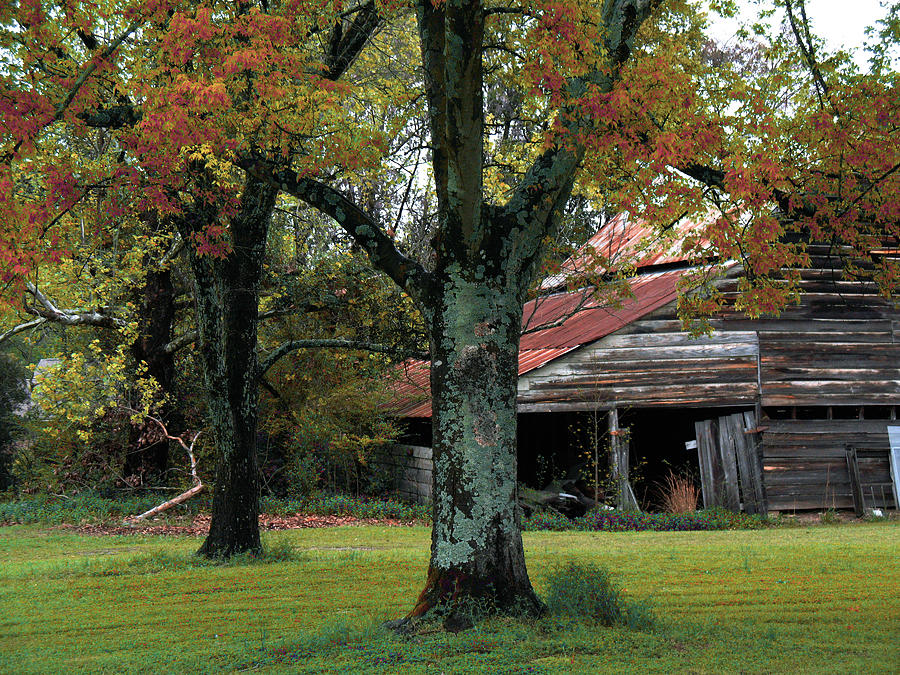
Upon arrival, I saw the compound with cars parked around in the trees. The Sanctuary is a hunting camp of the most excellent sort. The first building is a log barn, not chinked, which houses an assortment of all kinds of ”stuff.” (I did not go in and take an inventory, but I could see through the un-chinked logs that it housed many important things.) The other side of this structure was a fire pit, which was sort of the focal point of the buildings surrounding it. The fire pit was constructed by squared off logs notched and interlocked in about a ten foot square about two feet high, and filled with stone, in the middle of which was the fire pit itself. This was a wide and shallow cast iron, saucer-like “kettle.” Eddy said it had been used to render down sugar cane for making syrup. It now served as a fire pit, and there was a big rack of seasoned firewood split and stacked nearby that kept the fire going.
Besides the log barn, there was a semi-open air kitchen/galley with sink and stove and metal tables for processing deer meat. Today it was being used for barbeque, cole slaw, buns, sauces, pastries, plates, cups, saucers, and other fixin’s for our repast. Outside was a cooler or two with iced down beer and other drinks.
Next around from the galley was an open air shed, under which was a long table and benches. After our visiting and eating, this would be where we gathered to sort through our genealogies, remember our kinfolks, and tell the old stories.
Beyond these building and the fire pit, was the bunkhouse itself. It was a single story house built up off the ground, with a porch all across the front. Inside, it was mostly open with bunk beds everywhere, and a kitchen and a bathroom in the back. All around were mounts of large antlered bucks, skulls with antlers, and bare antlers adorning the walls. Eddy told me that now the deer have overpopulated to the point where a “wasting disease” has shown up among them. I don’t know how you are supposed to tell if one has it, but you are not supposed to eat the meat.
But we had good barbeque, and on that day, many more people showed up who were from closer around. Altogether, we had kin from Richmond, Charlotte, Spartanburg, Columbia, and Charleston, not to mention our cousins from the farms around Orangeburg. And we had three generations, from old fogeys like me, to little babies, and good lookin’ cousins in between! After dinner, we all gathered around the big table, with benches and chairs under the shed. Robin had made a genealogical chart to help sort out the kinfolks going way back, and Jody had family pictures on his computer that he projected onto a screen. He was good at pointing out who was who among our ancestors, and then we had pictures of family reunions past where we all picked out who was who in them, and told funny stories about the cousins’ house parties that we all remembered. Then we all gathered at the house on the porch and in front of the porch for a group picture that the young ones one of these days can show to their children and tell them about the barbeque we all had at The Sanctuary “back in the day.”
That evening, Jody, Donna, Robin, and I went over to Eddy’s and Susannah’s house for a little sip of bourbon before calling it a night. We sat on the patio in the cool of the evening. From there, across the brown fields, we could see the house in which Jim and Jody and Susannah grew up. It was built by their father, Uncle Tom. Before it came into new hands and was remodeled, it had been a large white house with columns in the front, and it was approached from the highway down a long lane of magnolias. We affectionately called it “Uncle Tom’s Cabin.” But he had a large and successful farm, named “Magnolia Lane,” and I used to love to visit my cousins there.
Jim said the new cotton pickers have put many people out of work. Jody said he remembered the old days, when cotton picking time came around. Children would get out of school and go into the fields with their parents. At dinner time, the dinner bell would ring, and Uncle Tom would bring dinner out to the hands. At day’s end, Jody said they would come out there with some sort of a beam set of scales to weigh the cotton each had picked. (Uncle Tom would pat the bottom of each sack, because sometimes there would be a couple of bricks that had gotten in there somehow.) Uncle Tom would then pay each picker in cash at the end of the day.
At the end of our day, I went back to the hotel. Before turning in, I had supper with Jody and Donna, and Cris and Jill at the Ruby Tuesday restaurant nearby. The next morning, I went back to the Cracker Barrel and had bacon and French toast (which I highly recommend!) After checking out of my lodgings, I headed back to Susannah’s to pick up Robin for the trip back to Virginia. On the way out of town, I stopped at a Piggly Wiggly, where I heard I could find some liver puddin’. Uncle Tom raised hogs, and they made it out on the farm. We also had it in Cameron, when I was visiting my grandparents. The way I always remembered it, it was in a large casing, but here at the store it looked as if it had been made into a loaf and then sliced up, with each slice put into a vacuum sealed package. Anyway, I bought a bunch, gave a couple of packs to Susannah and a couple to my sister. Later, when I got home, I tried it on my grits for breakfast, and it turned out pretty good – but not quite like I remember it. Maybe that was because of the home cooking back then…
On the way home, we passed back through Orangeburg, and, since we would not be too far out of the way if we went by Cameron, that’s what we did. Coming from Orangeburg on the long strait road, you can see the grain elevator at Cameron from miles away. It used to be an open road, but now trees have grown up around it making it feel closed in. Just before town, we turned off to go by the cemetery, surrounded by fields of cotton in the boll. The family plot is enclosed by a concrete curbing, and it is under an old magnolia tree dripping with long streamers of moss, and it encompasses the damp fecundity of the Cameron that I remembered as a boy. Dr. Traywick rests there beside Miss Janie and an infant that they had lost. Another infant of one of their granddaughters rests there as well. And beside Miss Janie is Grandma Pearl, who, as a little girl, had to refugee with the family out of the Greenbriar Valley of West Virginia back to Virginia during The War.
We next went over to the Colored cemetery nearby to visit Emma Keitt. When she was a little girl, she was playing on the roof of her porch and fell off, breaking her legs. They were not set and they healed in such a way that she was crippled for life. Granddaddy, who was a doctor, did what he could do for her, and took her on to help Miss Janie. She had quarters attached to the back of the garage, and we boys would torment her by shooting firecrackers under her house. But whenever I came to visit as a little boy, she always had a gift for me – often either a pair of socks, or a bar of soap. I look back on it with tenderness. She was kin to the poet Emanuel Keitt (spelled a bit differently) and would sometimes quote lines from one of his poems:
Sowing seed of kindness,
Sowing seed of love,
In dis moral winyard
Fo’ de God above.
Don’t wait ‘till de undertaker overtake me
With no place else on earth to go,
But send my flowers by de dollars worth,
And leave them at my do’…
We found his stone, placed there by my father:
“In Loving Memory of Emanuel Keitt”
At the edge of town is the water tank. It was a dreaded mission that called us when we were boys. There neither was nor is there now any safety cage around the ladder, and just before you reach the platform around the tank itself, the ladder hangs out a bit past the vertical. Then, from the catwalk, another ladder goes up to the spire on the top of the tank. This ladder is on wheels at the bottom and a swivel at the top, so it can be moved all the way around the tank to allow some brave soul to paint it, I suppose. We finally got up enough gumption to make it, and I remember touching the tip of the spire with my finger. Now they have a chain link fence around the tank to keep little boys off of it.
My father told me that when they were building the tank, one of the men got heat stroke and was hung up in the ladder. Uncle Joe, my father’s brother, went up there and got him down. During the Second World War, he was a surgeon with the 20th Engineer Regiment, and was killed by German artillery in the Hurtgen Forest while carrying a stretcher. He was buried at Arlington Cemetery with a Silver Star, a Bronze Star, and two Purple Hearts.
As soon as you pass the water tank, you are on Front Street, which is “uptown.” A row of stores was on one side and the railroad runs parallel to it on the other. “Back in the day” the tracks separated the White part of town from the Colored. Maybe it still does. I don’t know. There are no signs. Maybe that’s just the way people want it. And why not?
The stores are all closed up, and the Station Depot has been moved and made into a museum or something. I think there is a town Hall and a police station, but Furstner’s store and Felkel’s Superette are all boarded up, and Moorer’s filling station, where we used to get firecrackers, is gone. But there is a peanut dryer and a cotton gin. My father used to travel, and one day he was in New York or someplace, and wanted to call down to Cameron for something. Back then, you know, you didn’t have cell phones and all that, and to make a long distance call, you had to dial (remember “dialing”?) – you had to dial “0” and get the operator and tell her you wanted to make a long distance call. Anyway, Dad called the operator from New York and said he was calling Cameron, South Carolina for Mr. C. D. Bull. The operator said “You want him at de house or at de gin?” Well, so I think instead of calling C. D. Bull, he ended up talking to the operator about old times there down home in Cameron.
I used to love to go to Cameron. My father traveled, as I said, and he would come home at the end of the week and then we’d get in the car and drive to South Carolina. I’d sleep on the way down. One time I rolled off the backseat into the pies that my mother had made and had put on the floorboard. Those were the days before seatbelts, of course. When I was a bit older, my mother sometimes would pack me some clothes and make me some sandwiches and put me on the train to Cameron. The conductor would look after me. Cameron was a flag stop, and when we’d get there, the train would stop and I would walk up the street to Doc and Miss Janie’s house. That would be parental abuse these days, I suppose, now that little boys are dressed like gladiators to go ride their bikes, and they are not allowed to stump their toe or skin their knee or eat a peck of dirt or shoot out street lights with their bb gun.
Driving the block or two to the end of Front Street, we turned back and then drove up to the house. The old house has changed and has been remodeled, the two big magnolia trees in the corners of the front yard are no longer there, the garage and Emma’s quarters are gone, the pecan trees in the back where the cacophony of starlings used to swirl and squawk are gone, Doc’s office across the street has been converted into a cottage, and the old white frame Methodist Church next door has a new brick façade. I remember one Sunday my Cousin Jim (not this Cousin Jim, but my other Cousin Jim) and I decided to skip church. We slipped out of the house and climbed to the very tip top of the magnolia tree in the corner of the yard nearest the church. After a while we saw the people gathering, the ladies going in and the men standing around outside. Pretty soon we could hear everybody calling us: “ooo Jimbo, ooo Bozie, time to go to church!” Man, we really had them fooled! Finally they gave up and started walking across the yard. I can see them now: Momma and Aunt Bruce and Aunt Mary Hope and Miss Janie and my girl cousins and my little sister, all like flowers in their summer dresses, (my younger brother was not around yet), and Daddy and Uncle Bert and Uncle Riley and Grandaddy with his cane, all walking across the yard to the church, while “Miss Mawgret” started in on the organ.
We had done it! We were really something! We punched each other, up in the top of the magnolia tree.
Back then, of course, there was no air conditioning, and even the summer mornings were hot and humid. In the rack for the hymnals on the back of the pews, there were always some of those cardboard funeral parlor fans, sort of squarish in shape overall, but well rounded on the corners and a sort of dip or swoop halfway down, and with a flat handle stapled to it like an oversized tongue depressor. There was always a picture of a church or Jesus on it, and courtesy of the funeral parlor. I well remember Miss Janie sitting in the pew fanning herself with one of those funeral parlor fans and quietly saying, “whooie, whooie” – especially when Dr. Inabinet got going in the middle of his sermon, holding the open Bible aloft and striding back and forth in front of the congregation.
I think he was doing that on that Sunday morning in the magnolia tree, for the windows were open, and we could hear him. Jim looked at me with his eyes sort of bugged out and said, “He HOLLERS at ya!”
We never skipped church again.
Old times there are not forgotten.





Mighty fine.
“Old times there are not forgotten.”
Look away, look away, look away Dixie Land.
YOO VEE AAA?! He’s not turning into a leftist I hope. Sounds like UVA will not succeed in turning him into a leftist, but one cannot be too careful these days. FYI, all of Albemarle County is a cesspool of leftism in case you did not know.
“Albemarle County is a cesspool of leftism” . Man, ain’t that the truth.
No, I don’t think so. He is not majoring in “Transgender Studies in Zimbabwe,” or “Political Correctness in the Lives of Tattooed Lesbians”. He wants to become a doctor. Besides, his brother is an Infantry officer in the Marine Corps, his father was a Marine, and his grandfather ( my cousin Jody) was voted ” Most Likely To Secede” – and he did!
Glas to hear that, H.V.
Best regards.