
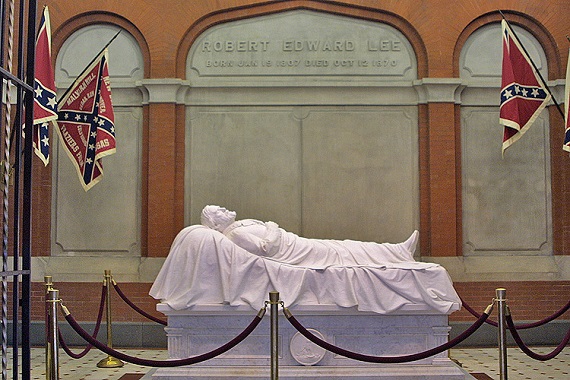
On this day (Oct. 12) marks the anniversary of the death of General Robert E. Lee CSA, Commander of the Army of Northern Virginia. He graduated from West Point without a single demerit. He fought with high distinction & courage in The Mexican-American War.
He served his nation as West Point Superintendent. Many of his cadets would go on to fight in the War Between the States. Lee’s former commanding officer in the Mexican conflict, General Winfield Scott, the commander-in-Chief of the U.S. Army in 1860, said ‘Lee is the finest soldier in the Army.’
President Lincoln offered then Colonel Lee the command of the entire Union Army newly organised to crush Southern secession. Lee’s home state of Virginia first voted against secession from the Union but then decided to vote for secession following Lincoln’s order to send 100,000 troops into the South. Remember that the peacetime U.S. Army counted a mere 15,000 soldiers. By 1865 the Union had more than 3 million men under arms.
Lee opposed secession. He also saw slavery as an evil. The Lee family freed their 66 slaves in 1862, the year before Lincoln’s 1863 Emancipation Proclamation, which did not affect the slave-holding states remaining in the Union.
All night long Lee paced in his home “Arlington”. Lee thought secession was unnecessary. As a serious professional soldier of great substance, intellect & wisdom, Robert E. Lee thought the South’s chances of independence were small. Perhaps if the Confederacy fought well & skillfully, they had at most two years to gain independence. But if they were unable to maximise these precious first two years before the Union could mobilise together its vastly superior strength, Lee foresaw a horrible war of attrition ending in Southern defeat.
And yet, Robert E. Lee being a guileless man, chose to decline Lincoln’s offer of the command of the Union Army. He said despite his opposition to secessation, he could not bear arms against his own family and his native state of Virginia. Save only in defence of his people and state, he would hence unsheathe his sword no more.
After the War General Lee was offered lucrative positions & sinecures from admirers throughout the United States and Great Britain. He turned down all these offers. A man of great modesty & humility, the old General accepted the presidency of the small Washington College, named after its early benefactor & the 1st President of the young United States. For Lee had strong personal ties to George Washington through Mrs Lee, whose father was the grandson of Martha Washington. The Lees’ Arlington home is practically a shrine to George Washington. Many of the General’s personal belongings are still located at Arlington House. Moreover, Robert E. Lee’s father Lighthorse Harry Lee, was a Revolutionary war hero who served under Washington & became his closest protégé beside a young French nobleman, the Marquis de Lafayette. General Washington looked upon these two officers as his sons.
So General Lee using his experiences as West Point Superintendent and then as the Chief of the South’s most successful army, turned them to excellent use as college president. Lee had students who were veterans of the Lost War. Lee felt an obligation to teach his students how to win the peace, succeeding in the greater world as useful citizens of a reunited country. General Lee’s personal example and actions pointed the way to reconciliation even in a time of living in the aftermath of great devastation and deep losses. These bitter issues were not to be borne by the Southern people, but General Lee showed them the way, because he bore those bitter losses and War’s desolation on his own already burdened shoulders.
Today, his former college, now Washington & Lee University, has renamed the hallowed chapel where Robert Lee & his family are buried. The school has also closed General Lee’s tomb to the public. Just as throughout the South, every effort has and is been made to destroy the Southern heritage and its noble Confederate pass. When I was young, I visited the Lee Chapel several times. It is a very special place for all Southerners who retain a faithful heart for Lee & how he represented the very best in the Southern spirit.
Rest well My General!
The views expressed at AbbevilleInstitute.org are not necessarily those of the Abbeville Institute.





The Ironclad Oath of 1862 required yankee officers to swear allegiance to the Constitution…the previous oath from 1830 until 1862 had no such requirement.
General Lee and every other officer engaged in the struggle for independence NEVER swore to uphold a mandatory union, only to fight to defend the sovereign States in whatever form the States found themselves.
The Ironclad Oath and the Corwin Amendment are the two smoking guns of the War for Southern Independence…the yankees wish they could remove these from history books as they have removed them from public discourse.
Lee is resting in a peace far beyond the reach of carping critics who wouldn’t have been fit to shine his boots.
Indeed.
Much has been made of RE Lee’s night of pacing the upstairs floors of Arlington over his decision to resign from the US army. It’s not an apocryphal tale having been reported in a letter from his wife to another. Certainly fraught with pathos, it at times reads like a Shakespearean Tragedy.
Just as the road to Appomattox was a maneuver, defeated, and not a retreat, the result of Lee’s late night anguish, April 19, 1861 was more wearing a path to acceptance than a decision. RE Lee was never going to raise a hand against Virginia. If conditions of acceptance to West Point included prospects of coercion Lee would have ended as a lawyer or small farmer – hard to imagine, a politician. His fealty to his state and her people, oddly, may have been born of his father’s dissipation and exile as he came to be raised by an extended family of Lee and Carter cousins, from Tidewater to Alexandria. In any event, RE Lee certainly struggled with the certain loss of his family’s estate and life-long home but his decision to remain as a Virginian was preordained from an early age.
I am proud that my ancestors were attached to the Army of Northern Virginia under Lee.
A man with less integrity would have taken control of the Union Army and misused it to defeat the North. But men like Lee did not have ulterior motives and lived by a strict moral code.
Many thanks for this, Alphonse. I was reminded yesterday listening to national news that the culture is so besotted by its cartoon image of the South, they haven’t a clue about the actual, honorable, charming people whose families are from here and have contributed to these places for generations. I am thinking right now of my favorite uncle, an understated, accomplished doctor who served his city in so many ways and made one quip to me not long before he died about the statue toppling. It was the only impolite thing I ever heard him say.
ashamed of my southern relatives who speak so loudly against America and everything she stands for!!!