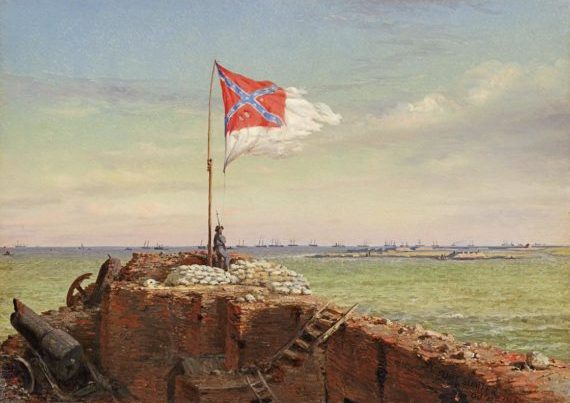

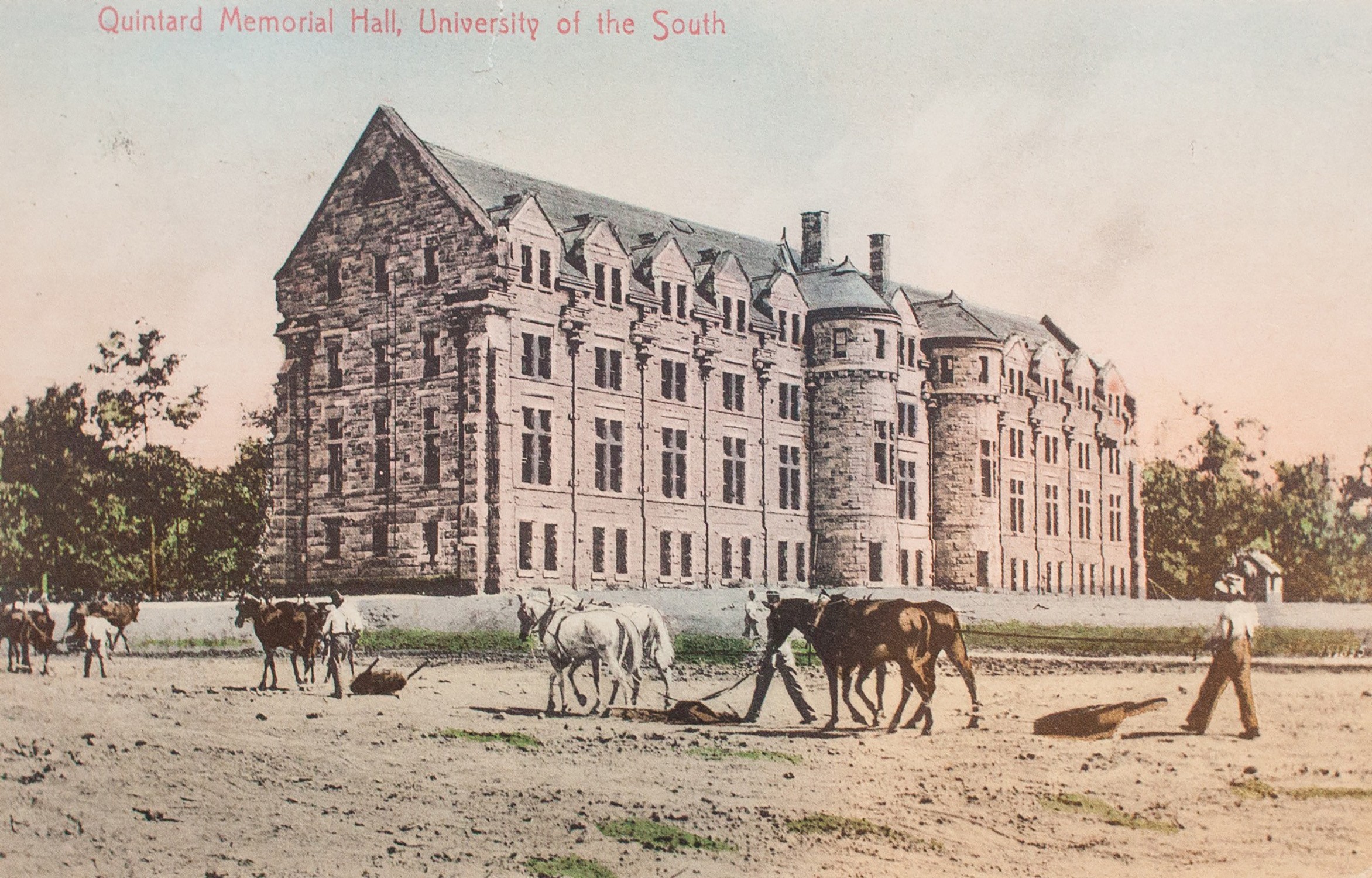
The University of the South appears poised to remove many, if not all, Confederate names and images from its campus and memory because they may smack of Southern treason/secession and slavery. Such removal is a poorly conceived idea. First, secession (i.e., “independence”) is probably the one, true and great gift that America has offered Mankind. Second, slavery is an American, if not a universal, curse; it is not just some Southern thing. Third, this University is The University of the South, founded primarily by and for Southerners; however, it seems ready, because of Southern secession and slavery, to create and then destroy as scapegoats various Southerners for various perceived “crimes”. Beware: scapegoating is rarely wise and often dangerous. (Study Rene Girard).[1]
Alexis de Tocqueville (1805-1859), who is the greatest purveyor of, and commentator on, America, stated in his masterful treatise, Democracy in America, that if “the Union attempted to enforce by arms the allegiance of the confederate states [which composed this Union], it would be in very much the same position as that of England in the [1776] War of Independence. Moreover, a government, even if it is strong, cannot easily escape from the consequences of a principle once admitted as the foundation of the public right which ought to rule it. This confederation was formed by the free will of the states; these, by uniting, did not lose their nationality or become fused in one single nation. If today one of those same states wished to withdraw its name from the contract, it would be hard to prove it could not do so. In resisting it, the federal government would have no obvious . right. Jd., Vol. Part 11, Ch. 10 (1848), Anchor Press/ Doubleday, Garden City, NY (19th ed., 1975).
Lord Acton of England, the great 19th Century chronicler, historian and champion of liberty (1834-1902), articulated the primary, if not the eternal, principle of all political thought with his maxim: “Power tends to corrupt; absolute power corrupts absolutely”. In his January 18, 1866 essay entitled “The Civil War in America; Its Place in History” (the “War in America”), Acton applied this maxim when he wrote that “history is filled with resistance provoked by the abuse of power. But whereas in the old world the people produce the remedy, in America they produce the cause of the disease. There is no appeal from the people to itself. After having been taught for years that its will ought to be law, it can not learn the lesson of selfdenial and renounce the exercise of the power it has enjoyed. Therefore, it has been laid down by political writers as a universal rule that a degenerate republicanism terminates in the total loss of freedom. Many have prophesized that this would be the end of the American Republic”.
Acton continued in “War in America” with the following: “[A] confederacy possesses one resource against such a catastrophe which is denied to a single state. Centralization finds a natural barrier in the several state governments. ‘This balance’, says Hamilton, ‘between the national and state government is of the uttermost importance; it forms a double security for the people’ .”
In line with such thoughts, Acton wrote Gen. Robert E. Lee in February of 1866 and said that “I saw in State Rights the only availing check upon the absolutism of the sovereign will and secession filled me with hope, not as the destruction but as the redemption of Democracy… Therefore, I deemed that you were fighting the battles of liberty, our progress, and our civilization; and I mourn for the stake which was lost at Richmond more deeply than I rejoiced over that which was saved at Waterloo.”
As for slavery, Lord Acton, in “War in America”, noted that it was not “the cause of secession, but the reason of its failure. . . [But] if, then, slavery is to be the criterion which shall determine the significance of the civil war, our verdict ought, I think, to be that by one part of the nation it was wickedly defended, and by the other as wickedly removed.”
Only power can check power. Since 1865, however the power of State Rights has unquestionably decreased, as Acton mournfully lamented. Such decrease should not, however, be a cause of celebration because, with such decrease, the powers of centralized government have increased overwhelmingly, if not fully, and, in turn, absolute power and corruption have increased proportionately.
With the attempt by the University of the South to remove from its campus all vestiges of the Confederate States of America, it is (a) denouncing, among other things, secession/independence, which is the fundamental principal of the United States, and State Rights, which is, according to Acton, Hamilton and other towering political thinkers, one of the two great pillars upon which our Republic was constructed, and (b) enhancing and applauding the constant rise of unchecked power, if not absolute power, of a centralized government. Under the destructive banner of “cancel culture”, a badly misled portion of our society marches on, as if in a trance, through our institutions in order to undermine all remembrances of a confederacy, whether in its original form as the States united in America in 1776 or the Confederate States of America of 1861-65. As this University now appears ready to jump rashly into the ranks of “wokeness” by destroying America’s confederated past and by ravaging America’s history, it, along with other dazed institutions, seem bent upon highstepping towards an authoritarian future and shoving its faculty, its staff, its alums, and, most importantly, its students, both current and future, down a dark path into the arms of a government controlled by centralized power and, in turn, absolute power (which, of course, corrupts absolutely). Such a government, as Lord Acton forewarned us, would be a “catastrophe” and would leave us with “the total loss of freedom”.
Renown Marxist historian, Eugene Genovese (1930-2012), in his book, The Southern Tradition: The Achievement and Limitations of an American Conservatism, Harvard University Press Cambridge, MA (1994), recognized the immense and beneficial aspects rising from the Civil Rights Movement of the 1960’s; however, he also expressed deep concern about the “neglect of, or contempt for, the history of Southern whites, without which some of the more distinct and noble features of American national life must remain incomprehensible”. He said that the “northern victory in 1865 silenced a discretely southern tradition of American history and national identity, and it promoted a contemptuous dismissal of all things southern as nasty, racist, immoral and intellectually inferior”. In sum, Genovese exclaimed that “we are witnessing” nothing less than “a cultural and political atrocity, an unceasingly successful campaign by the media and an academic elite [Sewanee?] to strip young white southerners, and arguably black southerners as well, of their heritage and, therefore, their identity.”
Because our university is the University of the South, it should… no, it must… recognize and honor Southerners of distinction and importance, whether they served in the C.S.A. military or government of the 1860′ s or in the Civil Rights Movement of the 1960’s. But as we wish to celebrate those Southerners critical to the 1960’s Movement, there is no corresponding need to cancel those Southerners who served in such military or government during the 1860’s. There is, or should be, a place at The University of the South to exhibit and recognize more Southerners, not less, who greatly influenced the South throughout the decades. If, instead, the University decides to cancel its history, it is cancelling its future and crippling its students, faculty and alumni, who acknowledge, if not honor, that history.
In the words of the Martin Luther King, Jr. (1929-1968), who was, beyond doubt, the most influential Southerner, if not American, of the post-World War Il era: “I have a dream that one day on the red hills of Georgia, the sons of former slaves and the sons of former slave owners will be able to sit down together at the table of brotherhood”. Thank God Almighty that his dream has become reality; however, it will be hard, if not impossible, to keep this reality alive if institutions, like our University, disfigure, dishonor, and cancel, if not out-right obliterate, the memory, honor and dignity of the fathers of many of those sons now sitting at the table. Be very careful; don’t push these sons away from the table. They will push back. Such is the nature of Man. (Again, study Girard.) In the words of the English historian, politician and poet, Thomas Babington Macaulay (1800-1859):
To every man upon this earth
Death cometh soon or late.
And how can man die better
Than facing fearful odds,
For the ashes of his fathers,
And the temples of his gods.
Stop the destruction of the American/Southern history! Do not destroy the memory of confederacies and the high ideals held by American confederacies (including the 1776 and 1861 Confederacies) with their constant checking against both absolute power and the loss of freedom. As another famed Englishman exclaimed centuries ago: “I beseech you, in the bowels of Christ, think it possible you may be mistaken”
****************************************************************
[1] *”Over the years, [Rene Girard] has developed a… theory according to [which] human beings imitate each other and this eventually gives rise to rivalries and violent conflicts. Such conflict is partially solved by a scapegoat mechanism, but, ultimately, Christianity is the… antidote to violence”, Internet Encyclopedia of Philosophy: a Peer-Review Academic Resource, Rene Girard (1923-2015)
“Each person must ask what his relationship is to the scapegoat. I am not aware of my own, and I am persuaded that the same holds true for my readers. We only have legitimate enmities, and yet the entire universe swarms with scapegoats.”
“The protective system of scapegoats is finally destroyed by the Crucifixion narratives as they reveal Jesus’ s innocence and, little by little, that of all analogous victims.”
“More than ever, I am convinced that history has meaning and that its meaning is terrifying.”
Rene Girard
The views expressed at AbbevilleInstitute.org are not necessarily those of the Abbeville Institute.