
October is a time when folks put a skeleton on the porch and call it a personality. Plastic gravestones, jack-o-lanterns, spider webs, fog machines, and a playlist that treats death like a party favor. However, the Southern mountains don’t need October for that, because they’ve already got the murder ballads. There are songs about a girl who walked into the woods and never walked out, songs about a river that kept the body until the neighbors came looking, and songs about a man who picked up a stick a mile from town and unfortunately used it.
Pretty Polly. Omie Wise. The Knoxville Girl.
If you grew up anywhere near an old-time porch, a Baptist fellowship hall, or a cousin who still owned a banjo on purpose, you’ve probably heard at least one of these songs. Chances are, you may have even heard it before you were old enough to know what you were hearing, and that’s the part that makes people nervous. Why would anybody sing a murder song to a child? What are those hillbillies thinking? Why would a community take a real-life murder and turn it into something you could hum while you shucked corn and shelled lady peas?
Of course, the easy answer is that mountain people are either just grim or backward. That’s all there is to it. Or maybe they’re secretly in love with bloody violence and just waiting for somebody from a coastal magazine to notice. No, that answer is too neat and clean, and it’s also lazy.
The Appalachian murder ballad is not a Halloween costume or an October genre. It is the way a Southern community processed violence before it had a newspaper that would print the names, a court that would finish the job, or a true-crime podcast that would package the grief and sell it back. The South did not invent the murder ballad, but the South kept the form alive after the rest of the English-speaking world had mostly moved on to other ways of telling the story.
Before we get to Polly, Omie, and the girl from Knoxville, we need to know what we’re talking about, here. A murder ballad is not just a sad song with a dead body in it. It’s a story that travels by mouth, built specifically to be remembered, and pointed towards a specific killing. Most of these started in Britain as what are called broadsides, which are cheap, printed sheets sold in the street, and displaying lyrics, but no music. Somebody died, somebody was hanged, or somebody left town one step ahead of the sheriff. A printer would take that plot, rhyme it, often “to the tune of” a melody people already knew, and a ballad-seller sang it out loud enough in the open market to make you want to buy the paper. It’s like headline news with verses and a refrain.
Francis James Child was a Harvard scholar who spent the nineteenth century collecting the older narrative ballads of Britain, and he caught some of this family of songs — “Edward,” “Lord Randall,” “The Twa Sisters.” But the songs Appalachia actually sang on the porch or at the kitchen table came later, after undergoing a mountain-influenced transformation. Those songs crossed the Atlantic in the heads of people who did not pack a library. There were Scotch-Irish families, English indentures, and other folks who paid for the crossing with years of labor in Pennsylvania and then walked south along the valleys until the land got steep enough to keep them. They brought the plots with them, but they did not always bring the extra verses, and that is what’s most important. The Appalachian versions are reductions. The ship falls out of the story, the ghost falls out, the trial falls out, and the moral falls out. What remains is the tragic walk, the deep, rushing water, the stick, the grave, and a name you can remember long after the song is finished. Appalachian murder ballads always feel leaner and colder than the British original, because the mountains edited. Let’s start with the song people probably already know – “Pretty Polly.”
The power of “Pretty Polly” is not that it sits neatly in a sad little minor key. It hovers, refuses to resolve, and will not let you get comfortable. It is actually not in a traditional minor key, but in the dorian mode, which is a minor key with a raised sixth. It’s that raised sixth that gives the song its unsettled and unresolved mood.
“Pretty Polly” is the shortened Appalachian version of an English broadside called “The Gosport Tragedy,” also known as “The Cruel Ship’s Carpenter.” The earliest printed copies of that original song show up in the early eighteenth century, and the plot is way longer than anybody would want to sing on a front porch. A ship’s carpenter promises marriage, gets the girl pregnant, murders her, and then ships out. However, her ghost appears in the hold of the vessel holding a ghost baby in her arms. He didn’t just kill one – he killed both. The killer confesses and dies at sea.
A scholar named David C. Fowler attempted in 1978 to pin the story to a real ship called the HMS Bedford, where a carpenter named John Billson died aboard that ship in 1726, and a crewman named Charles Stewart met the ghost. Whether Fowler found the exact crime or an unusually convenient set of names is a fight for footnotes. For our purposes, the point is much simpler. England may have printed a long supernatural news ballad, but Appalachia only kept the girl, the walk, and the hole in the ground. The man does not lose his temper in the woods and commit a crime of passion. He was there the night before already digging her grave. He was a man who packed a shovel instead of a picnic.
Besides Dock Boggs, there was also B.F. Shelton, Roscoe Holcomb, and the Stanley Brothers who later gave it that high, lonesome finish people now treat as the official mountain accent of doom. Woody Guthrie borrowed the tune for “Pastures of Plenty,” and Bob Dylan leaned on the shape of it when he wrote “Ballad of Hollis Brown.”
The melody always worked because the story got reduced. There was no ship, no courtroom, and no ghost with a ghost baby to make the moral official. It was just a girl who trusted a walk, and a man who had already decided how the walk would end. If you’re looking for Halloween, that is plenty. But if you’re looking for the culture, notice what the edit and reduction did. It moved the horror out of the afterlife and into the decision to commit murder. The man is not punished by a ghost, but is revealed by a grave.
If Pretty Polly was an import that learned to talk with a Southern accent, then Omie Wise was homemade and homegrown, because Naomi Wise was a real person. She was an orphan, born around 1789, and bound out to the household of William and Mary Adams in Randolph County, North Carolina — New Salem, just north of what is now Randleman. In the spring of 1807 (some later tellings say 1808, and the actual headstone itself is part of the argument) teenaged Naomi Wise went missing. A search party followed horse tracks to the Deep River and found her body in the water with marks on the throat. Those are the kind of details a community does not forget even when it can’t get a jury to agree on them.
Jonathan Lewis, a young clerk connected to a better family than Naomi’s, was charged with the murder, and the grand jury billed him in late March of 1807. He went to a jail to await trial, but he escaped. He was eventually caught years later and brought back, tried in 1812, and acquitted of the killing. Although he was found guilty of the jailbreak, the court could not, or would not, make the murder stick. Some later North Carolina historians aren’t even convinced the murder trial ever actually happened.
Frank C. Brown, who spent decades collecting North Carolina song, said that judged by how far she traveled, “Poor Naomi” was probably the state’s most significant contribution to American folksong. That is a scholar’s way of saying they might not have been able to close the case, but they could still sing the verdict. Braxton Craven — later president of Trinity College, which would grow into Duke — published a sentimental version of the story in the 1850s under the title “Naomi Wise, or the Wrongs of a Beautiful Girl.” Craven’s Omie is the girl the ballad wants: trusting, wronged, and almost too gentle for the cruel world that killed her.
Later researchers, working from an older local poem discovered by the folklorist Eleanor Long-Wilgus, found a less convenient Naomi. In that version, she was older, already a mother, and already poorly talked about. However, a more complicated victim is not a less murdered one. The ballad wasn’t guilty of lying because it made her innocent, since the ballad did what ballads do. The ballad simply gave us a girl, a false promise, the Spring, a river, and a name we can’t forget.
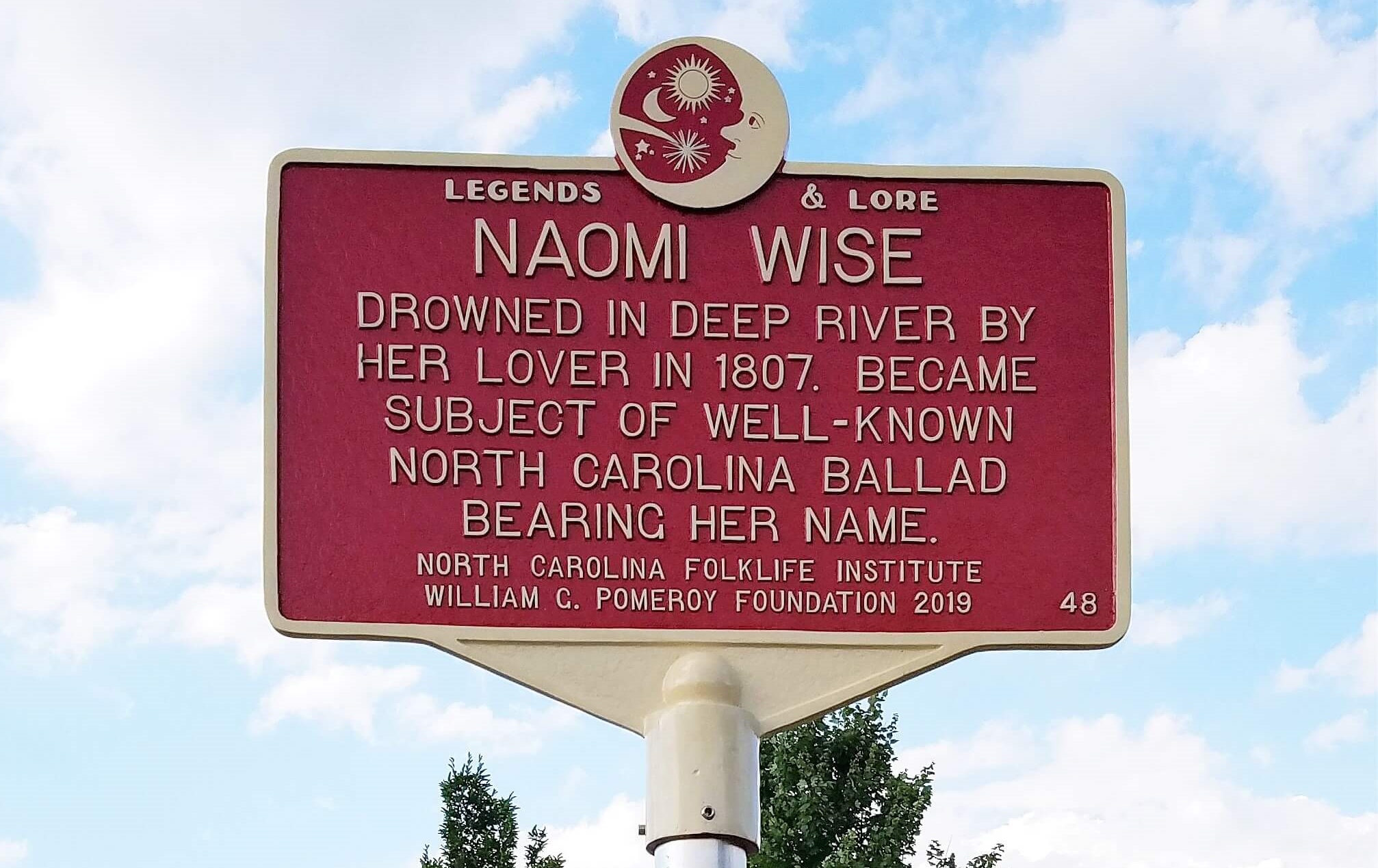
G. B. Grayson recorded “Ommie Wise” in 1927, the same year Shelton and Boggs were putting Polly on shellac. Doc Watson sang her later with that calm of his that makes the words hit so much harder, because he is not performing shock, but simply reporting the facts. You can still stand near Deep River and find the actual marker. Naomi Wise. Drowned by her lover. Subject of a well-known North Carolina ballad.
If “Pretty Polly” is the imported story stripped to the grave, and “Omie Wise” is the local story the courthouse refused to finish, then the “Knoxville Girl” is the traveling plot that can sadly be found lurking in just about any town. A man is courting a girl, and then changes his mind. He takes her out for a walk about a mile outside of town, and then picks up a stick and starts beating her. She falls on her knees and begs, but he keeps on beating until the job is done, and the ground is covered in her blood. He throws her into the river, and goes home to stare at the ceiling while his mother reads his face. By morning, the whole town knows. That last part is the tell, because the song is only partially about the killing. It is also about a place that finds out about the killing.
The Knoxville Girl did not begin in Knoxville. The oldest solid ancestor is an English broadside from the 1680s called “The Bloody Miller,” or “Hanged I Shall Be.” In 1683, at Hogstow Mill about twelve miles south of Shrewsbury, a mill apprentice named Francis Cooper killed a young woman named Anne Nichols. Writer and politician Samuel Pepys, who collected ballads the way some people now collect vinyl, kept a copy. But then, the local parish register adds a detail the later songs often drop – three weeks after Anne Nichols was buried, a boy was baptized. His name was Ichabod, and the parents listed were Francis Cooper, homicide, and Anne. If you’re a little rusty on your First Samuel, Ichabod means “the glory has departed.” So even the baby’s name was a verdict.
From that English mill, the story travelled a great distance. It became “The Berkshire Tragedy,” a long London broadside with an Oxford lass in it. Then, it became “The Wexford Girl” in Irish tradition. Once it arrived in America, it became the “Oxford Girl,” the “Lexington Girl,” the “Export Girl,” and finally the “Knoxville Girl.” Basically, once “Wexford” got into the title, any town that didn’t have an “X” sounded wrong. Wexford. Oxford. Lexington. Knoxville.
The city of Knoxville itself only took that name in 1791, more than a hundred years after the real murder. Therefore, the song didn’t need a particular murder on historic Gay Street. It just needed a place any Southern singer could say without breaking the tune. Arthur Tanner was the first to put it on record in the 1920s. The Blue Sky Boys cut it in 1937. Finally, the Louvin Brothers recorded it in 1956, and for a lot of people that became THE version — close harmony so pretty you could miss that you are listening to a murder confession. That is the whole Appalachian murder ballad tradition in one gesture. If beauty carries the bad news, the bad news will more likely be remembered.
So why the children? What would possess somebody to sing songs like these to children? Modern media is age-gated. We have a children’s aisle and an adult aisle in life, and American culture likes to fantasize that those aisles were always there. But that’s not accurate. A mountain household in 1880 did not have a “children’s aisle.” It had a room, a fire, a table, a workday that ran until the light quit, and a stock of songs that had more than one job to do. A murder ballad in a room like that was not some kind of inappropriate slasher film. Instead, it was much closer to a proverb that served as a warning to the children.
Do not follow him into the woods. Do not believe the springhouse meeting is a wedding. Do not take the evening walk a mile from town with a man whose voice got quiet. The warning was not subtle and it was not supposed to be. Subtlety is a luxury of people who have more civilized ways for keeping their daughters alive. The Appalachian murder ballad reduced the English death songs to only contain the things a girl needed to know to grow up safely in the hills.
There is another job being administered by Appalachian murder ballads, and it is less comfortable to admit. The songs are interesting and entertaining. They have a plot and great character development. They have a twist you can see coming a mile away and still cannot stop. Human beings have been gathering around violent stories for as long as we have had language, and we are kidding ourselves if we pretend the only honest response is to cover the children’s ears. The only concern is to make sure the culture can tell the bloody story in a way that keeps the victim’s name alive. “Pretty Polly” keeps Polly. “Omie Wise” keeps Naomi. The “Knoxville Girl,” cruelly, often does not keep the name Anne, and that is the reason Omie Wise feels different. The song insists that she is always a local girl from Randolph County.
People sometimes hear all of this and decide the South must have been uniquely obsessed with killing women. Yeah, let me slam the brakes down on that one. England printed these plots by the yard, Ireland sang them, and Scotland had its own inventory of blood. What the Southern mountains did was refuse to throw the songs away when print news, then radio news, then television news arrived later to do the same work. The rest of the country may have gotten the police blotter, but the Appalachians got the tune and kept it. Appalachia made these stories more concentrated than the originals, with less afterlife and more decision. The Southern mountains and the murder ballad will not give you the satisfaction of a closed case if the closed case would let you stop thinking about that tragic walk.
All of this finally brings us back to the plastic gravestones of October. Halloween is a licensed hour for playfully looking at death without having to keep it or deal with it. You put the bones out, then you take the bones in. The murder ballad does not work on that calendar, because it is not seasonal. Southern communities had to decide which names were going to survive the people who knew them, and music is an excellent storage medium. It is portable, it is copyable by children, and you can’t burn it. It will outlast a jail that cannot hold a defendant and a jury that will not convict one.
That is why these ballads feel wrong in a streaming playlist titled “Spooky Folk Songs.” The playlist just wants atmosphere, but the murder ballad wants to set the record straight. Atmosphere is what you use when nobody knew the girl, but a murder ballad is what you use when somebody did.
I am not going to tell you these songs are wholesome, because they are definitely not. They present the murders of innocent women in beautiful melodies, and any honest listener has to struggle with that. Discomfort is not an argument for pretending the songs were only entertainment for people who liked a lot of blood. The Appalachian murder ballads were how a place thought in public about trust, about class, about what happens when a promise of marriage is a trap, and about a river that will hold evidence until a neighbor is brave enough to look. This is one of the harder rooms in the house of Southern culture, but we do not honor the room by boarding it up and hiding the children. We honor it by admitting what the room was for.
So, when somebody cues up “Pretty Polly” because the banjo sounds like a haunted house, I want you to hear several things at once. Hear the woods, and hear the grave that was already finished before the invitation for a walk was even offered. Hear the Deep River, and a search party reading hoofprints in the mud. Hear a mile outside Knoxville, or Wexford, or Oxford, or whatever town with the “X” in the name. And then notice that the song can do the work a courthouse will not do. A community that has to live with a killing will either talk about it, sing about it, or pretend it did not happen — and pretending is how the next tragic walk starts all over again.
Pretty Polly. Naomi Wise. The Knoxville Girl.
Somebody suffered and died. Say her name, keep the tune, but whatever you do, don’t take that walk. The Southern mountains figured that out a long time before anybody ever put a skeleton on the porch.