

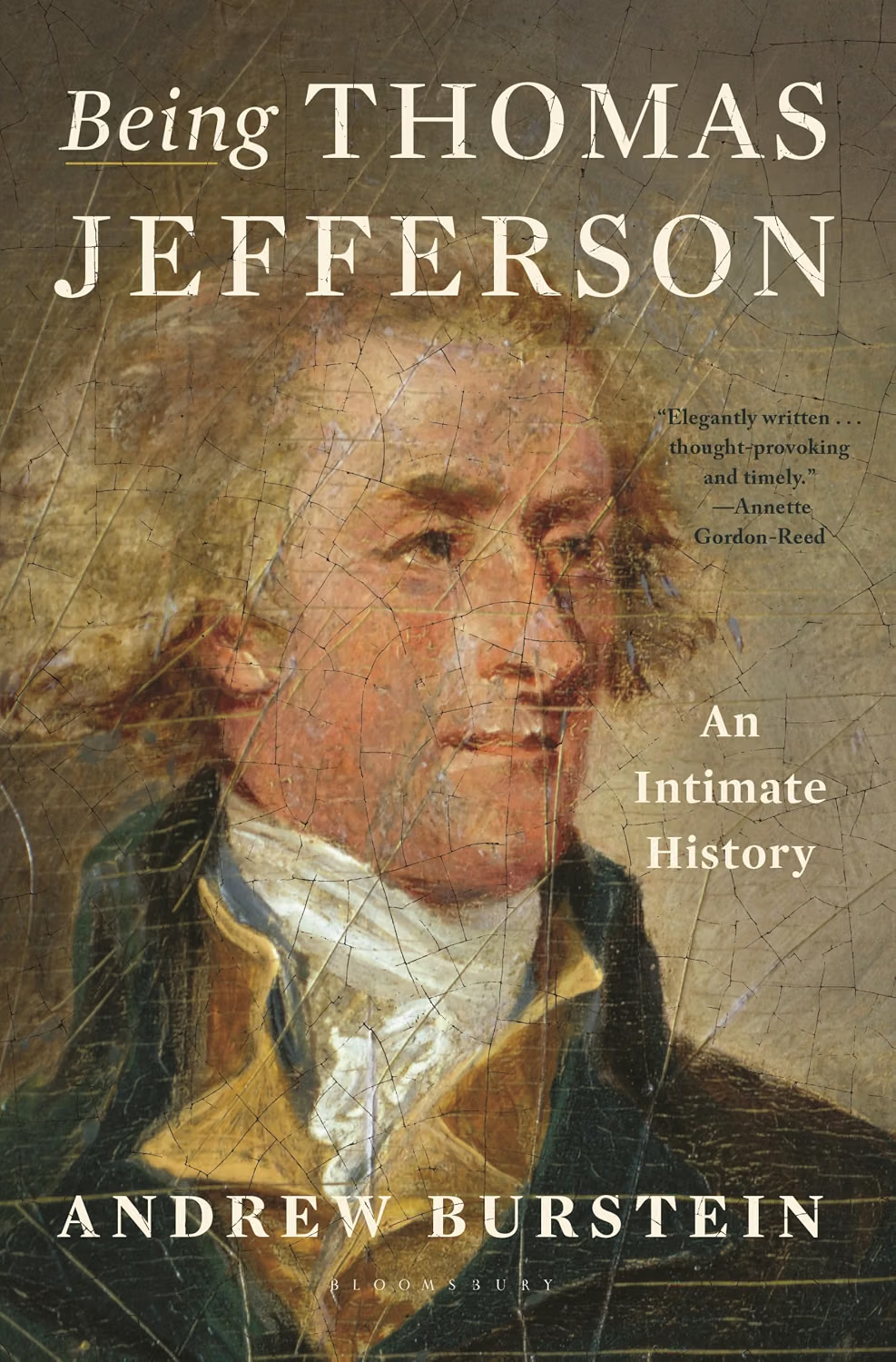
A review of Being Thomas Jefferson: An Intimate History (Bloomsbury Publishing, 2026) by Andrew Burstein
“It is a truism that every attempt at history writing and biography is an improvisation, including this one.” ~Andrew Burstein
“Improvising” is equivalent to “winging it.” I cannot agree that all history is improvisation. I cannot even concede that improvisation ought to be acceptable in any part of a historical project. Improvisation ought never to be allowed in history. Historians often must resort to speculation—viz., assertion that is grounded, but not firmly so—but that speculation ought to be reasonable, not arbitrary. Moreover, whenever a historian resorts to speculation, he ought to alert readers that he is doing so.
I do concede, however, that “this one”—Burstein’s Being Thomas Jefferson—is improvisation. In what follows, I explain why that is the case. Pame!
Why Another Book on Jefferson?
What happens when someone without any training in psychology or psychoanalysis undertakes a psychobiography of Jefferson? You get Andrew Burstein’s newest book on Jefferson: Being Thomas Jefferson.
This book is about the extraordinary drama that punctuated the life of a famous man [Thomas Jefferson] who had an unusual need to control his environment.
Jefferson dreamt large and achieved much, but he paid a ponderous price. This introduction primes us for expectation of a book on Jefferson’s pathology, his psychopathology, but that essentially never comes. The reasons are two: Jefferson, though somewhat neurotic as is any person of extraordinary achievement, was not psychotic; and Burstein has not the training to write such a book. Yet he does.
Why?
I have spent a sizable chunk of my career with Jefferson and have at length arrived in a place where I feel I can tackle the largest questions that have hamstrung a slew of professional historians. Being Thomas Jefferson emphasizes the drive for public celebrity [sic] that the subject scrupulously hid. As a study of inner life, the book, central drama is the negotiation going on in his mind as he wavers between involvement and retreat, between conviction and irresolution.
The shock value of the last sentence of the quote is zero, for it is applicable to any person on the planet, but the sockdolager is the claim that Jefferson seems to have had an extraordinary drive for “public celebrity” that other scholars have failed to see. (Is not “public celebrity” redundant, for does not celebrity entail publicity? Does “private celebrity” make any sense?)
Burstein ingeminates that pages later.
Something no Jefferson scholar, myself included, has previously reckoned with until now is this beguiling writer’s pursuit, not just of happiness, but of celebrity.
Is that so?
Jon Meecham in his book on Jefferson developed a thesis on Jefferson’s love of and pursuit of power. Is not acquisition of power some sense of public celebrity?
Henry Wiencek book Master of the Mountain was about power and thus notoriety.
Nonetheless, Jefferson love of “public celebrity” is not at all obvious to one reading Jefferson’s writings. It is obvious to Burstein, however, who has now “arrived in a place” to make it clear to us.
This is a second book by Burstein on the inner life of Thomas Jefferson. How does this book differ from his first?
I am scrutinizing a many-sided individual whose emotional makeup was shaped by a wide range of influences, the sum of which carries both negative and positive weight.
Yow, a claim of uncommon banality (silliness intended)! That is, however, just one illustration of the profound psychological insights this wanna-be psychoanalyst gives.
Something Building
Burstein depicts the life of Jefferson as tragedy gone wrong. Jefferson had certain successes in his life—Burstein is wholly unconcerned with full discussion of any of them and Jefferson actually had numerous successes—but whatever he did was tainted by his own drives for exercise of power and public celebrity, or so says Burstein. In his retirement, Jefferson merely concerned himself with his public image after his death. All of his post-retirement deeds, even the University of Virginia, were about enhancing his celebrity. Burstein painstakingly tries to develop that argument by selective engagement with data, by ignoring incommodious evidence, and by citing Fawn Brodie, Peter Onuf, and Gordon-Reed.
Burstein, if we follow Aristotle, has given us a tragedy—sort of. For Aristotle, tragedy involves anagnorisis (some sort of recognition after a crisis) and peripeteia (a turning point). With the success of those two elements, readers feel catharsis, which for Aristotle a sense of identity with the main character. Burstein’s Jefferson develops a political philosophy at odds with reality, persists in pushing that philosophy, and never comes to recognize that he lives in cloud-cuckoo-land: no recognition, no turning point, and thus no catharsis. Burstein’s tragedy is that Jefferson could not even live out a true tragedy! Yet that is what it is like when someone concerns himself only about himself.
The book has four parts and 13 chapters. Part I, “Personal Growth,” is about Jefferson from birth to the creation of Monticello. Part II, “Passionate Years,” covers Jefferson’s time in the Second Continental Congress to his time in France where he falls for and seduces Sally Hemings and meets abolitionists like Condorcet. Part III, “Political Hazards,” cover his years of service to the US government. It shows a politician who sticks to political principles, despite them being at odds with reality. Chapters 11 and 12 cover his two terms as president and depict Jefferson as a man of mellifluous verbiage (“cleverness as semantic nonsense”) and “with words [that] cleverly disguised a rigid belief system at the core of his unspoken ambition.”
As a reader goes from chapter to chapter, he senses a build-up of Burstein-created tension. It becomes obvious that this is a man—I resist the temptation to use “scholar”—who, like his mentor and hero, Pete Onuf, really hates Thomas Jefferson. Moreover, he wants anyone who reads through his book—that, I promise, is an arduous task—to hate Jefferson as much as he does.
Promising to disclose the inner Jefferson like his hero Onuf tries to do in The Mind of Thomas Jefferson, a discerning reader will find himself having entered the intellectually craven mind of Andrew Burstein.
Intellectual cravenness is evident by Burstein, who makes numerous substantive claims without backing them or without backing them sufficiently.
Jefferson was stubborn and reactive, unwilling to reconsider a prejudice when good [sic] contradictory evidence was presented to him.
One might, here, expect several clear examples. None are forthcoming. Furthermore, just what makes contradictory evidence “good”?
Again,
Jefferson was extraordinarily adept at communicating emotion on the page.
He had, adds Burstein, a keen perception for the expectations of a correspondent and wrote accordingly (Onuf’s thesis, n’est-ce pas?). Burstein adds:
No matter what prompted a letter, he considered the exercise pointless if he did not at the same time convey an unmitigated spirit of elevated humanity—his true calling card.
That is a lovely sentiment, but I admit that I do know grasp what “an unmitigated spirit of elevated humanity” means. Scrutiny of Jefferson’s writings, however, indicates a habit for passionlessness, concision (at a time when prolixity was the norm), and clarity of expression. Jefferson sometimes conveyed emotion, but infrequently.
Jefferson wrote cryptically, adds Bursteins, as “still, his words require considerable decoding” (Onuf again!). He might begin a letter with serious matters, transition to gossip (example please!), and then sandwich the serious and the frivolous with history or literature. Did not just about everyone else of his day do the same in letters? Was it not typical for a correspondent, if intimate, to write about several things, each calling for a reply, in letters?
Burstein condemns Jefferson for being “resistant to change.” He notes that Jefferson was pliable in his early years, but he quickly morphed into a lapis durus, at least when it came to political issues. Jefferson quickly clung to a political vision of things that he was most reluctant to dismiss. He had a
reluctance to confront the incongruities [examples please?] that exist in his political philosophy. He forged the head with blatant, unfounded optimism, fantasizing [sic] a country in which both poverty and impoverished minds were already on the way to disappearing. He prophesied an America that could not be.
Jefferson over time clung stubbornly to his view of republican government, because it was a political vision that he developed over time in keeping with Enlightenment progressivism. That included at base government of and for the people: the vox populi. That his vision of America, judged by what we have today, did not materialize is not proof, or even evidence, that his vision of America “could not be.”
Burstein also cites Jefferson’s son-in-law Jack [the cool way of referring to any John] Eppes’ sexual affair with Betsy Hemings, granddaughter of Sally Hemings’ mother. That story has never been substantiated.
Jack Eppes turns out to have taken after the president in his personal, not just his political, choices. … It is highly unlikely that President Jefferson was kept in the dark about a relationship with which he would surely have empathized.
If Jefferson was not kept in the dark by Eppes, there is no reason for Burstein to use “would” which is subjunctive: viz., “he would have empathized had he….”
Burstein goes on to give us merely another dry and redundant biography of Jefferson. He takes us through the contours of his life, gives us numerous anecdotes along the way, many of which are given, it seems, to fill a quota of pages, required of any biographer. As is the case in his prior book, he very often castigates Jefferson for owning and not freeing his slaves (yawn!), for asserting that Blacks are less intelligent than Whites, for not treating his children by Hemings as well as he treated his white daughters (explained fully by there being no relationship with Hemings), for living large though his debt was heavy, and so on.
Wandering is the norm, and one wonders what is the worth of a thesis—Jefferson’s love of cekebrity—if the book is not constrained by that thesis and there is scant elaboration of it.
Platitudes
Then there are in the book the sort of platitudes, dry and uninformative, that one expects of disciples of Onuf.
Jefferson’s most cherished world was a private world of his own design, where he loved and where he bore the losses of the ones he loved.
Is that not true of all, or nearly all, persons?
Again, there is this highly informative sentiment.
it may mean something or it may mean nothing that the Monticello cemetery, laid out by her son, places her [Jefferson’s mother’s] grave at some distance from where Jefferson’s wife, children, and brother-in-law Carr are buried.
Cutisms
There are numerous “cutisms” that Burstein inserts to give his book that Gordon-Reed feel. On construction of Monticello, Burstein says cutesily,
If he built it, they would come.
On writing letters, Burstein says uninformatively:
The way a letter ends is often telling.
Psychologisms
And so, we get throughout a large number of psychological insights, “Bursteinian psychologisms” as it were, about Jefferson from a person without training in psychology. None are fully justified. Burstein is typically not fond of providing illustrations of his armchair psychological generalizations.
It should already be clear that Jefferson was what pop psychology these days recognizes as a common personality type: the control freak. (Evidence please!)
The nodus is that Burstein remains throughout his book at the practiced level and only at the practiced level of pop psychology.
Again:
To preserve a rational order (as he saw it), Jefferson found it necessary to hold fast to irrational methods of observation and analysis.
Just what are those “irrational methods”? Burstein does not say. Yet have shown in several writings—my critique on Notes on Virginia for illustration—that Jefferson was conversant with and practiced in the methods of scientific inductivism, outlined by Bacon and practiced by Galileo, Harvey, and Newton, inter alii. We find his inductivism in numerous letters and throughout Notes on Virginia. In addition to profound ignorance of psychology, Burstein here shows profound ignorance of the history of science and scientific methods.
Again:
Jefferson’s world was bound to collapse, but like so many other elite Virginians with First Family surnames, Jefferson was mired in his tracks. … The psychological terms for this kind of deficient outlook is “cognitive dissonance,” an inability to manage the prospects or accommodate the uncomfortable tensions associated with the feared collapse of one’s own long-nourished society.
Almost, Herr Freud. Cognitive dissonance occurs when held beliefs are inconsistent or contradictory. According to C-D theory, persons are moved to eradicate the dissonance by 1) behavioral changes, 2) rejection of one of the troublesome beliefs, or 3) rationalization of the tension to remove the dissonance. To Burstein, Jefferson merely lived with the dissonance, which C-D theory disallows.
One must concede that Burstein exhibits large courage in this book. He tackles a psychological biography of Jefferson when he has no training or education in psychology. He does in several places give kudos to, even criticism of, Fawn Brodie—another biographer, without training in psychoanalysis, who attempted a psychobiography of Jefferson.
Yet Burstein might consider lack of psychoanalytic understanding an asset, just as his hero, Onuf, considered expertise in Jeffersonian biography a drawback when he held his “free for all” conference, “Jeffersonian Legacies” at UVa in October 1992! Of his hero, he writes in his acknowledgements at the rear of his book:
Thomas Jefferson, Foundation Professor of History, Peter Onuf, is a giant of a thinker with an infectious enthusiasm for historical analysis and a stage presence [that] words cannot do justice to [sic]. I hold the distinction of being the first of as many grateful PhD students. Aside from Peter’s memorable books and incisive articles on Jeffersonian America, he embodies the highest ethic [emphasis mine!] of intellectual engagement.
(Here I felt nauseas! Had I read this before taking up the book, I would not have read the book.)
Clishmaclaver
Burstein also shows considerable courage in tackling issues—and this is the norm in his book—that have nothing to do with his thesis; what might be dubbed Bursteinian clishmaclaver. He divagates often to cover episodes he wishes to cover, even if they prove irrelevant to his thesis. His discussions of Jefferson and Henry, Hamilton, Burr, and Marshall tend to demonize Jefferson and exonerate his “adversaries”—what is the norm in Jeffersonian revisionism.
Deviousness
Burstein is also not above deviousness, even nastiness, to show that Jefferson really was a SOB. He considers a passage in a letter by Jefferson to Francis Eppes (13 July 1787) on how to clear up his debt. Jefferson is in France at this time. I leave this in Burstein’s words and ask readers to note Burstein’s use of ellipsis:
“I am decided against selling my lands. They are the only sure provision for my children, and I have sold too much of them already. I am also unwilling to sell negroes, if the debts can be paid without. … My debts once cleared off, I shall try some plan of making their situation happier, determined to content myself with a small portion of their labour.”
He sounds sincere and compassionate. Until, in the one sentence that follows, he is a cruelly calculating aristocrat. “I think it better for them therefore to be submitted to harder conditions for a while in order that they may afterwards be put into a better situation.” In other words, he would look better if, while he was in Europe, his enslaved labor force was worked to the bone so that after his return, he could seize credit by making a noble gesture toward them. There is only one conclusion to draw from this order of thinking.
In the quoted passage, Burstein leaves out a critical sentiment, which I place in bold-face font.
When I consider the quantity of tobacco to be counted on, the charges to come out of that, it appears evident that the debts can not be paid in this way. I am decided against selling my lands. They are the only sure provision for my children, and I have sold too much of them already. I am also unwilling to sell negroes, if the debts can be paid without. This unwillingness is for their sake, not my own; because my debts once cleared off, I shall try some plan of making their situation happier, determined to content myself with a small portion of their labour. I think it better for them therefore to be submitted to harder conditions for a while in order that they may afterwards be put into a better situation.
In short, Burstein is unwilling to grant that Jefferson might have cared a whit about his slaves. He did. Both his family and his slaves, he notes here, are important considerations. Because he has to worry about his family, Jefferson is unwilling to sell land. He is also unwilling to sell Blacks, if he can find a way of paying off his debt without selling them. Once the debt is paid, Jefferson continues, the current state of productive affairs will diminish, and each slave will have less work to do. And so, Jefferson reasons, if his slaves are willing to work hard, as they have been doing, till his debt is paid, their situation will improve. Once we return the sentiment that Burstein has seen fit to excise, we see plainly that Jefferson is thinking about the wellbeing of his slaves, not of his own wellbeing, as Burstein asserts. This is an instance of nasty, really shitty and intentionally so, scholarship!
Burstein also asserts that Jefferson celebrated the death of daughter Maria (17 Apr. 1804) by having sex with Sally Hemings.
Though one can do no more than speculate, the calendar suggests that during that month [of Maria’s passing], Jefferson took solace of a kind in sharing intimacy with Patty’s [his wife’s] enslaved half[-]sister. Nine months (almost to the day) after his daughter’s death and burial, Sally Hemings—who had been “Maria’s maid” from the time they were both children—gave birth to a son.
What this and the prior passage show is that in his attempt to show that Jefferson was a SOB, Burstein shows himself to be an unqualified SOB!
False Claims
Jefferson privileged his own experience over the best-known treatments of the day, which he found lacking.
Here Burstein is referring to the science of medicine in Jefferson’s day—something again about which Burstein knows little. Jefferson, Burstein asserts, had knowledge superior to established physicians. Jefferson never anywhere says so, though he was often very critical of medical dogmatism, for he was a medical empiricist.
Again,
Jefferson developed his attachment to creative hyperbole early on.
Burstein goes out of his way to find instances of hyperbole in Jefferson’s writings to “prove” that he cared little about reality. That is easily done with any figure who has written thousands of letters.
Again,
At twenty, he was an intense student who aimed to please his professors.
The implication is that Jefferson’s motivation to learn was external, not internal, and that is clearly false.
Burnsteinian Grammar
Sentence modality is often strange. “It should be said that…,” “It is not inconceivable that…,” and improper uses of the subjunctive: “I would suggest that…” and “… a fact that would seem relevant here” (the subjunctive requires an explanation!). Again,
Jefferson vowed that if Rebecca Burwell were [sic] to accept him as a husband, he would establish himself in the colonial capital.
Use of “were” implies that the antecedent is false, which was not Burstein’s intendment. “Were” should be “should.”
Burstein meaninglessly adds adjectives for rhetorical flair: e.g., “perfectly legal,” where “perfectly” adds nothing, for something is legal or it is not. He also at times expresses himself sophomorically: e.g., “that could not possibly be true” instead of “that could not be true.” He also cutesily throws in contractions in places, but not very often. Use them or don’t use them! (Egad, he has gotten me contracting!)
Finally, the number of instances of misplaced participial phrases is too numerous to list. One can merely pick out any particular page—the quote with which I begin this review contains one—and be sure to find one. Participial phrases are supposed to precede directly or follow directly what they modify. For instance:
He tried to project consistency in personal letters and presidential addresses, offering assurances that he was bent on proving, through executive action, an unselfish ‘cherishment’ of the open country.
That should read:
He, offering assurances that he was bent on proving, through executive action, an unselfish ‘cherishment’ of the open country, tried to project consistency in personal letters and presidential addresses.
or
Offering assurances that he was bent on proving, through executive action, an unselfish ‘cherishment’ of the open country, he tried to project consistency in personal letters and presidential addresses.
High Moralisms
Following Onuf’s “highest ethic of intellectual engagement,” Burstein peppers us with certain “high moralisms” throughout his book.
To subject any race to scientific analysis is an act of depersonalization.
Since race has been seriously studied and that roughly began in Jefferson’s day, we have been engaged in such depersonalization. Is it not commonly known today the East Africans are genetically superior to most others when it comes to speed in running short distances? Is it not commonly known today that Japanese and Chinese Asians are superior to most others in intelligence? Moreover, Burstein’s Onufian historiography is essentially depersonalization.
Burstein calumniates Jefferson for the “perverse idea of breeding human property.” Why is the notion perverse? Does he not realize that humans, like other animals (and humans are animals), can successfully be bred for traits? No parents of a handsome daughter wish to see her marry a physically unattractive male.
Final Thoughts
Burstein ends his book in syrupy, incomprehensible Gordon-Reed-esque thoughts on historiography. A cultural historian, he states, is a “referee” of sorts. He has
to make sense of the emotions, persuasions, and conjectures of a strange world, pausing good and long before imposing judgment upon a people whose views were shaped under different conditions than those we face today. All societies are reactive, responding in spasms of momentary fear or puzzlement, and in ways that allow even disreputable beliefs to persist for extended periods. It takes a thoughtful backward glance to deepen the conversation, to see in other than black and white and to replace ideological rigidity with a richer curiosity.
The last sentence, artsy in construction, is void of meaning and mixes confusing metaphors: a glace deepens conversation and replaces “ideological rigidity” with “richer curiosity.” Jefferson’s problem, it seems, is that he gave us ideological rigidity with his republicanism when what was wanted was richer curiosity (richer than what?). Moreover, do not historians, even those who badly practice psychoanalysis, deal with facts as well as “emotions, persuasions, and conjectures”?
After the first couple of chapters, it is easy to see where Burstein is going and what his verdict is going to be. Burstein’s Jefferson is a fraudster. He took Sally Hemings as his concubine—“there is scarcely any doubt now that he had sex with a woman he’d inherited as property” (evidence here?)—and disregarded the children he had with her. Moreover, Jefferson’s outward calm was a dodge, for the inner Jefferson was a mess.
It was a cruel camouflage for the frustration he felt in losing battles; that half-honest [sic; honesty does not admit of degrees!] sense of himself as a “son of nature” ineffectively masked the anger he felt toward those whose bad-mouthing was offensive enough to justify his fighting for future honor.
Again, the inner Jefferson
had fixed ideas about a good many things, manipulating [sic; another misplaced participial phrase!] life’s complexities to satisfy an inner imperative that the world should conform to the vision he embraced.
Then, there is the title, Being Thomas Jefferson. Burstein nowhere explains that choice of title. Has he, through intellectual and moral maturity, come to know Thomas Jefferson as if he were Jefferson? That comes out throughout the book when Burstein picks out one word from something Jefferson wrote—e.g., “sincerity,” “mystery,” “schism,” and “intimacy”—and he proceeds to tell us precisely what that word meant to Jefferson, who constantly used words and prose for manipulative purposes. That, it seems, explains why Burstein had to wait so long to write this book: He has literally become Thomas Jefferson, and it takes time to become Thomas Jefferson. I and all other Jeffersonian scholars can surcease our efforts, now bootless. There is only one scholar fit to write about Thomas Jefferson.
Overall, this is the sort of book that is the norm in Onufian Jeffersonian historiography: Begin with a thesis entailing Jefferson’s racism, his lust for Sally Hemings, and his hypocrisy; offer merely and at best a few illustrations; and, mostly importantly, neglect contradictory evidence. And yet, Burstein says of Jefferson:
Jefferson believed what he wanted to believe. He had the very human tendency of drawing conclusions by selecting evidence that provided an immediate benefit to him or ratified an earlier preconception.
Do not those sentiments perfectly accord with Burstein’s Onufian historiography?
Historians are not referees. They ought to write historical narratives without giving verdicts.
Book reviewers, however, are referees. They are asked to give a verdict on a book they have read, and that they have studied.
My verdict?
Pure codology, written with especial venom! Avoid this book!
Enjoy the video below on why a cop, former captain of police in San Francisco, loves Thomas Jefferson….
The views expressed at AbbevilleInstitute.org are not necessarily those of the Abbeville Institute.






Andrew,
I admire your tenacity and patience to have spent so much time and effort in reviewing this Burnstein tripe.
Having studied Freud in my MSW therapy program I can assure you that Burnstein meets the criteria of an unconscious projectionist. Projection is an unconscious defense mechanism and is a common trait of Marxist. Progressives who desperately need to be noticed because they are internally and chronically empty like his writing. Marxist Conflict Theory is alive and well in Burnstein to tear down the history of Jefferson as a key author of a Republican form of government in order.to hide his own diabolical tyranny against humankind in the form of totalitarianism.
Spot on, Mark. “Tripe” is a good word.
I studied Freud for 30 years, and I have five published books on him. My best is Freud: From Individual to Group Psychology. It moves from Siggy’s interest in the clinic to more generic matters concerning humanity as a whole.
Thanks!