

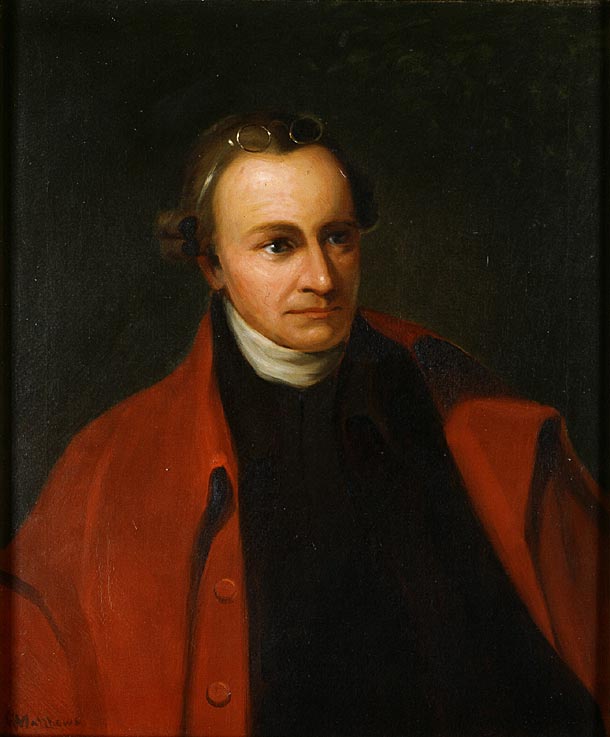
Patrick Henry, otherwise known as Mister Give Me Liberty Or Give Me Death, was a pretty good musician, much like his contemporary, Thomas Jefferson. But Henry did not practice scales. He did not copy violin pieces by hand into notebooks, did not build a personal library of Italian Baroque composers, and did not submit himself to the long discipline of mastering European repertoire. He played the fiddle the way a man plays who learned it because the music was already in the house — because a father brought it from Aberdeen, Scotland and let it loose in the rooms where a boy grew up. He played it at taverns and on porches and, late in life, under a tree by a stream at his Red Hill plantation, with no audience in mind and no aspiration beyond the pleasure of the thing itself. He is, in this body of work, the most complete embodiment of the vernacular Southern musician, and the fact that he played the same instrument, in the same colony, at the same moment in history, as a close friend who approached that instrument in an entirely different spirit, makes him something more than an interesting case. He is the other half of a contrast that defines Southern musical culture from its colonial foundations forward.
His father, John Henry (an ironically musical name), had emigrated from Aberdeen, and he did not leave the Scottish fiddle tradition behind when he crossed the Atlantic. He carried it into a Virginia household and set it loose there. The Scottish fiddle tradition was not a recent invention — it was an ancient, deeply ingrained musical culture that had shaped the social life of the Scottish lowlands and highlands for generations, and it arrived in Hanover County as a living practice to be continued. Patrick Henry, born in 1736, didn’t receive any kind of formal instruction in the continental sense, but he learned through proximity and repetition by being around someone who already knew how to play. That is the oldest form of musical transmission the South has ever known, and it is not a lesser version of the conservatory method. It is a different thing entirely, with a different relationship to the music and a different understanding of what the music is for. The Scottish fiddle tradition that Patrick Henry inherited from his father is the direct ancestor of the Southern fiddle tradition, and Henry sat at that transmission point personally.
The Hanover Tavern years are where that inheritance became fully social. Henry’s family had connections to the tavern through marriage, as it was owned by his father-in-law John Shelton. Henry served as host and entertained guests with his fiddle, and he eventually kept it himself for a period, and the playing he did there had nothing to do with performance in any modern sense of the word. It was participation. It was pure Tavern fun. The fiddle at a colonial Virginia tavern was functional music — music with a purpose that was inseparable from the needs of the room. People danced. The evening organized itself around the music. He played because the room needed playing, because the dancing required a fiddle, because the social fabric of tavern life in Hanover County in the 1750s was woven through with music in exactly the way that all Southern music, before and after, has been woven through with the life happening around it. It was at that tavern, or in those years, that he met Thomas Jefferson. They were both young Virginians, both fiddlers, and the friendship that formed between them was genuine and lasting.
The image deserves to be held before it is analyzed: two men who will become among the most significant figures in American history, both holding fiddles, in a colonial Virginia tavern, playing for dancing. Whatever else that moment is, it is a musical one. And the music they were making together was not the same music, in spirit, that Jefferson was also practicing in private. Jefferson’s relationship to the fiddle was rooted toward the cultivated European model — the Corelli, the Vivaldi, the hours of private discipline, the aspiration to the amateur ideal as the Enlightenment understood it. Henry’s was not. Henry’s fiddle lived at the tavern, at the gathering, in the social event. The same instrument, the same colony, the same friendship, and already two entirely different understandings of what the fiddle was for. Jefferson’s cultivated approach was not superior to Henry’s vernacular one; it was differently intentioned. Henry’s participatory approach was not a lesser version of Jefferson’s discipline; it was a complete and coherent musical philosophy in its own right, one that the entire subsequent history of Southern music vindicates. The blues musician who never read a note learned his music the same way Henry learned his. The page is not the song. The room is the song.
What would it have sounded like? There are no documented sources that contain the titles of anything Patrick Henry actually played, but it’s not unreasonable to speculate. “Soldier’s Joy” is one of the most widely documented fiddle tunes in the Anglo-Scottish tradition, present on both sides of the Atlantic by mid-century, and among the earliest tunes to appear in American manuscript collections. Therefore, it doesn’t take much to imagine this very tune wafting through the Tavern on those lively evenings.
His second marriage, in 1777, brought Dorothea Dandridge into the Henry household, and the Dandridge family was a musically prominent one in Virginia. Dorothea was a cousin of Martha Washington, and a man entirely indifferent to music does not marry repeatedly into musical households. The musical environment Henry sustained across his adult life — the tavern years, the Dandridge connection, the instrument kept at hand through all the decades of political life — reflects a consistent understanding that a household without music is missing something essential. That understanding did not need to be articulated because it had never been in question. It is an older understanding than Jefferson’s, embedded in habit and practice rather than in theory, and it is the understanding that the South carried forward.
The Red Hill image is the one that endures, and it should. Accounts describe Henry in his later years sitting under a tree at his plantation in Charlotte County, fiddle in hand, playing by himself in the open air with no audience and no occasion beyond the afternoon itself. Red Hill still commemorates this. The image is vivid precisely because it is so specific and so unpretentious: not a parlor, not a performance, not a demonstration of cultivated taste for the benefit of visitors. A man and a fiddle under a tree, the stream nearby, the afternoon taking its time the way Virginia piedmont afternoons do in the warmer months. Whatever he was playing — and there is no record of what he played in those moments, which is itself a kind of evidence — he was playing it for the same reason he had always played, because the music was in him and the setting allowed it out. There is a line that runs from that tree backward through the Hanover Tavern and John Henry’s Aberdeen fiddle, and forward through generations of Virginians and Carolinians and Tennesseans and Kentuckians who learned the fiddle the same way, played it in the same places, and understood it to belong to the same social fabric. Henry was not the founder of that tradition; it was already old when his father carried it across the Atlantic. He was its most prominent early American embodiment.
The musical thread did not stop with him. At least one grandchild, Emma Cabell, became an accomplished pianist said to have studied under Paderewski — one of the foremost concert pianists of the late nineteenth and early twentieth centuries. That sits at a considerable distance from a Scottish immigrant’s fiddle in a Hanover County household, but the distance is precisely the point. The thread runs through generations, shifting form, absorbing new influences, moving from fiddle to pianoforte to the concert hall, yet remaining continuous. The musical household Henry inhabited and that his second marriage deepened was not an isolated phenomenon but a generative one, the kind that produces musical children and grandchildren because music has been present so long and so consistently that it becomes part of what the family is rather than something it does.
Jefferson could play with discipline and aspiration. Henry could play with freedom and abandonment. Jefferson’s fiddle lived in the parlor, surrounded by carefully selected European repertoire. Henry’s fiddle lived outside — at the tavern, at the gathering, under the tree. Both men understood that music was not a commodity to be consumed but an activity to be inhabited, and on that foundational point they were agreed. Southern musical culture has always contained both of these possibilities, and Virginia produced them simultaneously, in two men who knew each other well enough to have played together, who held the same instrument in the same colony at the same historical moment. The parlor and the porch are not opposites. Each sustains something the other cannot fully provide — the parlor gives music precision and the aspiration toward a finished form; the porch gives it breath and the understanding that a song is not complete until the room has claimed it. Between the two of them, Jefferson and Henry owned the whole house.
Patrick Henry gave a great many speeches. He left behind a famous phrase about liberty and death that—hopefully—schoolchildren are still required to memorize. What he also left behind, though history has been less careful about preserving it, was a fiddle under a tree and the sound of it carrying across a Virginia afternoon to no one in particular — or rather, to everyone who happened to be nearby, which in the Southern understanding of music is the same thing. Thomas Jefferson owned the parlor. The porch belonged to Patrick Henry.
The views expressed at AbbevilleInstitute.org are not necessarily those of the Abbeville Institute.




Bravo!
Thank you!