

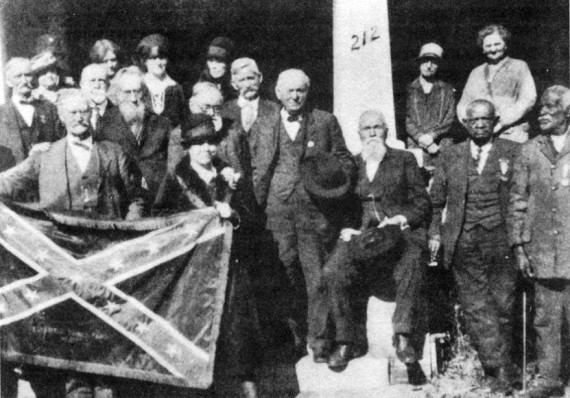
Establishment historians often conflate historical facts with the establishment-friendly inferences which they derive from those facts. They then report their conclusions as merely “the historical facts,” which they solemnly declare to be “based on primary sources”. They insist that nobody can reasonably disagree with them, because they are merely reporting the facts. This article will focus on two examples, the history of black men in Confederate service and the interpretation of Mississippi’s secession declaration.
Black Confederates
In his review of Black Confederates and Afro-Yankees in Civil War Virginia, Professor Clyde Wilson wrote:
“Black Confederates! Remember, you heard it here first. You will be hearing more if you have any interest at all in the Great Unpleasantness of the last century that is the focal point of American history. There are more things in heaven and earth, dear Horatio, than are dreamed of by Ken Burns.”
This mention of black Confederates infuriates establishment historians, who insist that there is no such thing, and that no black men served “as soldiers”. In erasing black Confederates they claim to be merely stating a fact based on primary sources. After all, you wouldn’t want to reject primary sources:
“Marshalling a variety of primary sources, Kevin Levin documents the existence of camp slaves who served in the Confederate army. However, none of these camp slaves ever served as a soldier.”
What they do not reveal is that this notion of the “camp slave” is invented by Kevin Levin as the only correct terminology to be used in relation to any black man in Confederate ranks. Is this confected terminological dispute over what to call black men in Confederate ranks merely a report of “the facts” as “documented in primary sources” as claimed by Mr. Levin?
It is not disputed that there were slaves in Confederate war camps serving in all manner of roles. But nobody at the time referred to the body servants who accompanied Confederate officers as “camp slaves”. An officer would say “my servant” not “my camp slave”, and in most cases referred to him by name. In letters home, speaking of the challenges posed by the constant rain and wet clothing, Robert E. Lee wrote, “Perry is my washerman, and socks and towels suffer.” He never referred to Perry as “the camp slave”. Later, when his wife sent him socks, he wrote, “as I found Perry in desperate need, I bestowed a couple of pairs on him, as a present from you, the others I have put in my trunk and I suppose they will fall to the lot of Meredith” – Meredith being the cook for whose welfare Lee also expressed concern, writing “Meredith will have no one near to supply him but me”. Similarly, black musicians in the Confederate armies, who were paid the same wage as white musicians, were referred to as musicians, not “camp slaves.” For example, Charles Benger was referred to as a musician and fifer, faithful old soldier and devoted old friend. Nobody called him “camp slave”. After the war black Confederates were colloquially referred to as “rebel Negroes” not “the former camp slaves”.
Mr. Levin does not like this historically accurate terminology, as he believes it risks sanitizing slavery. People might overlook the fact that slavery existed. They might see Mr. Benger as a man and a fifer, forgetting that he was merely a “camp slave”. To Mr. Levin, this would amount to a rejection of the facts, because if we see slaves as human, there is a risk that we might forget the fact that slavery is wrong. We might forget how terrible Confederates were if we notice that they were friends with black men. Mr. Levin therefore wants all the slaves in Confederate ranks – or even free black Confederates serving alongside slaves – to only ever be referred to as “camp slaves”. This preference is said to be merely the facts.
The fact that there were slaves in Confederate ranks is not disputed. It is also a fact that some of these men were reported at the time, in Union officers’ reports and in newspapers, to be armed and uniformed. They were informally, and sometimes in the pension records, referred to by their own officers as “soldiers”. These men attended Confederate Veteran reunions after the war, so their existence was neither disputed nor a secret. But Mr. Levin insists that it would be inaccurate and misleading to refer to them as black Confederates. He believes they were not real Confederates, and that they only attended Confederate reunions for nefarious reasons like greed (in hopes of getting money out of it) or false consciousness (still thinking like slaves even though they were free) or mere folly (allowing themselves to be used as tools of white supremacy). He argues that “camp slaves” were inaccurately listed as soldiers on pension forms because, as he sees it, a “camp slave” cannot logically be a “soldier”. In Marxist theory, a slave cannot be a soldier because a slave, unlike a regular conscript who is also coerced into fighting against his will, is too exploited and oppressed to be able to function as a real soldier. Mr. Levin reports all these Marxist opinions as merely “the historical facts” the he derived from “primary sources”.
Whatever else the debate over black Confederates is, it is not a debate about historical facts. It conflates fact and inference. While facts can be objectively ascertained and verified, we need not agree on the significance, relevance, interpretation, or implications of those facts. When people disagree on judgements of relevance, the only way to resolve that disagreement is by logical reasoning. Establishment historians add a further error to reporting their own interpretations as facts – having already failed to distinguish between fact and inference, they claim that any disagreement with their conclusions can only be resolved by bringing in new primary sources. If you want to dispute their narratives, you will have to produce a new primary source that proves their “facts” to be wrong. Yet what is disputed is not the “facts”, but their interpretation of the facts. As Clyde Wilson said,
“The material brought forth in these two recently published works has not been unknown; it has always been self-evident to serious historians who have worked with primary sources. Large numbers of black people identified the South and the Confederacy as their homeland and homefolks, and did not rush into the arms of the emancipators. This really is not surprising to anyone who knows anything about history or human nature, which, of course, does not include Ken Burns.”
Mississippi’s secession declaration
Mississippi’s secession declaration dominates the debates about secession and war because it contains the clearest emphasis on the institution of slavery – which is precisely why it is treated as the most important secession declaration. Any secession declarations that did not mention slavery are deemed to be uninteresting and unimportant – nobody wants to read the Tennessee secession declaration, that is boring! It has to be Mississippi’s, with all those rousing words about slavery. That is not simply reporting the facts. On the contrary, it is a choice exhibiting a judgment of relevance and significance – the relevant documents are those that highlight slavery, while those that make no mention of slavery are not relevant. As Gene Kizer, Jr, argues:
“All 13 states represented in the Confederate government produced a legal document such as an ordinance of secession that withdrew the state from the Union. Tennessee’s was called a Declaration of Independence.
“Most of the ordinances of secession were straight-forward documents referring to a state’s ratification of the Constitution then withdrawing the state from it, as well as proclaiming its sovereignty, etc. Alabama and Arkansas did go a little beyond pure legalese in discussing some issues but nothing like a declaration of causes.
“Only four of the 13 Confederate states issued declarations of causes. Nine did not.
“Those four declarations are the basis for the entire argument against the South because politicized academia and the ignorant news media simply ignore substantial evidence they don’t agree with.”
That argument cannot be answered simply by referring once more to Mississippi’s declaration. That is circular reasoning, which claims that disagreement over slavery as the cause of secession and war can only be resolved by reading Mississippi’s secession declaration which is selected precisely for its emphasis on slavery. Reading Mississippi’s declaration cannot resolve the debate between those who believe the history of the South was “about slavery” and those who view slavery, as Alexander Stephens put it, as the “occasion” or “immediate” cause of secession after a constitutional dispute that had been brewing since the 1840s and even earlier. The disagreement does not merely concern what is stated in Mississippi’s declaration – which can be ascertained by anyone with reading ability. The title states “A Declaration of the Immediate Causes which Induce and Justify the Secession of the State of Mississippi from the Federal Union”. There follows the often-cited statement that
“Our position is thoroughly identified with the institution of slavery … a blow at slavery is a blow at commerce and civilization. That blow has been long aimed at the institution, and was at the point of reaching its consummation. There was no choice left us but submission to the mandates of abolition, or a dissolution of the Union, whose principles had been subverted to work out our ruin.”
At the end, it states the choice to follow the footsteps of their fathers who fought in the American Revolution. This was not mere rhetoric – Jefferson Davis’s own father was a Revolutionary War veteran who served in the Georgia militia, and the same was true of many Confederate officers. Mississippi declared:
“We must either submit to degradation, and to the loss of property worth four billions of money, or we must secede from the Union framed by our fathers, to secure this as well as every other species of property. For far less cause than this, our fathers separated from the Crown of England. Our decision is made. We follow their footsteps. We embrace the alternative of separation; and for the reasons here stated, we resolve to maintain our rights with the full consciousness of the justice of our course, and the undoubting belief of our ability to maintain it.”
The “reasons here stated” are itemized in 16 factors said by Mississippi to prove the case, examples of the hostility they believed had been exhibited against the South. These factors are treated as significant by those who emphasize the constitutional nature of the dispute, including:
It tramples the original equality of the South under foot.
It advocates negro equality, socially and politically, and promotes insurrection and incendiarism in our midst.
It has enlisted its press, its pulpit and its schools against us, until the whole popular mind of the North is excited and inflamed with prejudice.
It seeks not to elevate or to support the slave, but to destroy his present condition without providing a better.
It has invaded a State, and invested with the honors of martyrdom the wretch whose purpose was to apply flames to our dwellings, and the weapons of destruction to our lives.
It has broken every compact into which it has entered for our security.
It knows no relenting or hesitation in its purposes; it stops not in its march of aggression, and leaves us no room to hope for cessation or for pause.
It has recently obtained control of the Government, by the prosecution of its unhallowed schemes, and destroyed the last expectation of living together in friendship and brotherhood.
What political significance is to be attached to these reasons? Are they relevant, or should we focus only on slavery? These questions cannot be answered simply by reading the declaration, as the choice of what to highlight or overlook is a judgement of relevance. Jefferson Davis, for example, described the cause of the South as “Not that of the South only, but the cause of constitutional government, of the supremacy of law, of the natural rights of man.” Establishment historians could, of course, continue to dismiss his view and purely focus on slavery, just as they can choose to call black Southerners “camp slaves” as suggested by Mr. Levin. But a persuasive argument is not the same thing as a mere statement of the historical facts. People are persuaded by arguments based not only on the facts but also on their ideological preferences, value judgements, and judgments concerning the significance to be attached to historical facts. Debates concerning the significance or implications of historical facts cannot be resolved purely by reading the primary sources, as the establishment historians would have us believe. Facts call for interpretation, and for an exercise of judgment based logical reasoning. As Clyde Wilson has said, “History is not a mathematical calculation or scientific experiment but a vast drama of which there is always more to be learned.”






I love it.
Keep on firing Ms. Njoya. If you had been with Pickett and Pettigrew we might have held that hill.
Deo Vindice
It may have been better if Ms. Njoya had command of the 10 or more brigades that were designated for support of Pickett/Pettigrew but not deployed. As Federal General Marsena Patrick said to his captive Confederate officer as Pickett’s survivors retreated, “A few more men Captain and you would have won your independence right here.”
Excellent work by Ms. Wanjiru Njoya. I enjoyed reading her articles. I loved how she put Levin to shame.
Four Billion dollars was the GDP of the United States in 1860, it was also the fair market value of the slaves as a whole. The GDP of the US today is 30 Trillion dollars…this is the amount of money in modern terms invested in the 1860 slave economy. Slave owners who were black, White, and other colors stood to lose this amount of wealth. In 1862, northern politicians purchased the freedom of DC’s slaves for 300 dollars per head. How benevolent of these northern politicians to ensure they and their cronies received at least partial compensation for their property.
Decades ago I read somewhere that a unit of Black Confederates slaughtered a large number of Union soldiers during the Seven Days Battles. I have never been able to find that reference again. Foolishly I did not bookmark it. Has anyone else run across such a notation?
Wasn’t it Andrew Jackson that said slavery would be the South’s pretext for creating a Southern Union or seceding? Note, he said “pretext”
It is amazing how they photoshopped those black fellows into that old picture. Almost as amazing as having 1500 free black men VOLUNTARILY form the Louisiana Confederate Native Guard in New Orleans during the first year of the war. The first black military officers in the New World fighting for the Rebels…along with the Five Civilized Tribes…
Dear Dr. Njoya – love all your work OMG. I recall back in the late 90s, here in metropolitan Chicago, there was a high school just south of the city near the area of northern Illinois celebrated as the French Canadian Corridor. This High School’s nickname was “The Rebels” and their school symbol had always been the Confederate Flag and the students there were exceptionally proud. Then, of course, one day the School succumbed to political correctness and changed the symbol and banned any and all confederate symbols to be worn to school – as very many students did as a matter of course.
The last student, was a young lady who dutifully pulled up to school wearing her Confederate jewelry, earrings, necklaces and such, stood before the entrance and took them off, and handed them to a gentleman who had accompanied her to school that day – a Black Gentleman, who was wearing his ANCESTOR’S Confederate Uniform – the whole thing – and carried with him the Confederate Flag.
May I also consider this to be a primary soucre! 🙂
PS – His African Ancestor – to be clear