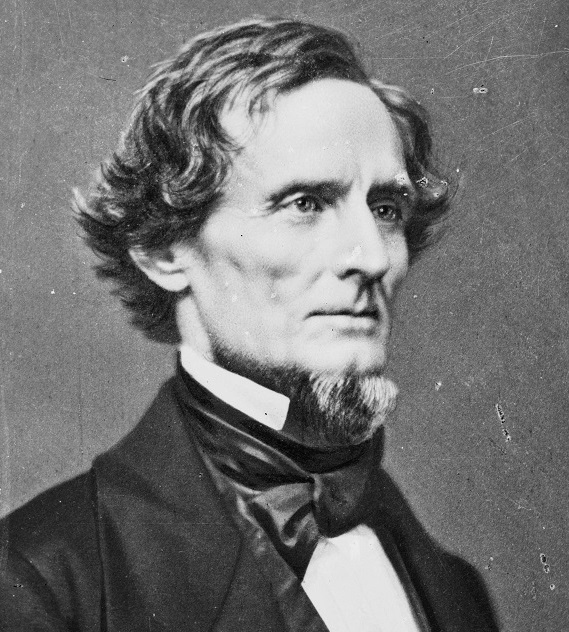
If we could travel back to the summer of 1860, a time when the two political parties were busy lining up acceptable candidates, preparing for national conventions to nominate someone for President, and trying to hold their fragile components together, little did people know the political chaos that was about to unfold throughout the year, and little did they know that by the early months of 1861, there would be two American Presidents instead of one.
And, in our travels, if we could poll the American public in 1860, before any elections were held, on the popularity of Abraham Lincoln and Jefferson Davis, the results would be astounding. Most Americans today would likely conclude that Lincoln would win any survey hands-down. But they would be wrong. Lincoln was still a rather obscure individual in 1860, before he was nominated by the Republican Party to head their ticket. But Davis would have been widely known and more widely respected.
Yet today, it is Lincoln who has won out. His popularity is so vast that one would be hard pressed to find any other American for whom such ink has been devoted, with some 18,000 volumes in print, most of which are not only positive but almost worshipful in tone and substance. Davis, on the other hand, has become a pariah in many circles. Most books about him are negative, denigrating his reputation and casting him in an unfair light.
“Lincoln, in fact, was a very limited man,” writes Clyde Wilson. “He had less national and executive experience than any previous President. He knew how to sway a jury with plausible arguments. He could spout homely wisdom and anecdotes. He was adept at using pseudo-Biblical language to justify his actions. Compare his mind with the experience, achievements, knowledge of war, and broad literacy and historical knowledge of Jefferson Davis.” And it is no comparison at all.
But we live in Lincolnian America, not in a “Davisian” America. “History has not been kind to Jefferson Davis,” wrote James McPherson in the forward to a reprint of Davis’s memoirs, a line he repeated in his book, Embattled Rebel: Jefferson Davis as Commander in Chief. But many historians, including McPherson, have done very little to correct it.
Many Southerners who step up to try to defend President Davis, as perilous as that can be, do so by defending the rightness of the South’s cause, the right of secession, constitutional principles, and the like. And that is certainly worthy of discussion. But my task here is different. I seek to defend Jefferson Davis, first, by pointing out his incredible resume. There was simply no other Southerner in 1861 who could match it, and probably not many Northerners who could either. And second, by the incredible odds he faced as leader of a new Southern republic. The task before him was enormous, seemingly insurmountable, and he knew it. He should be praised for conducting a war that should ended in defeat within six months, yet he carried on the struggle for four long years, and nearly pulled it off the impossible.
In short, Jefferson Davis has received far too much of the blame for the Confederacy’s defeat in the war. Could someone else in the South have led the CSA to victory? Unlikely. Is there any one decision that Davis could have made differently that would have changed the outcome of the war? Again, unlikely. If Davis and Lincoln were to have switched places, would the South have prevailed, as some scholars have suggested? Nonsense.
With Lincoln’s election in November 1860, with less than 40 percent of the popular vote, seven States of the Deep South left the Union. Delegates from those now-independent States met in Montgomery, Alabama and formed the Confederate States of America. One of their first major tasks was to decide who would be the new republic’s first President, a commander-in-chief who might just face war with the North. Lincoln, who would be inaugurated on March 4, 1861, had shown no inclination to compromise. “We can only explain Lincoln’s role by assuming either that he wanted war or he was spectacularly incompetent to deal with a grave and unprecedented situation. Many Northerners believed the latter,” writes Clyde Wilson. Either way, war seemed almost inevitable.
Initially, it seems, the delegates favored Robert Toombs of Georgia as President and Jefferson Davis as general-in-chief of all Confederate forces. It looked to be a done deal and a good pairing of two of the South’s ablest sons. Toombs had been a long-time member of both Houses of Congress and Davis’s military credentials were far beyond that of any other Southerner. Yet the night before the vote, Toombs, while in the hotel dining hall, was found to be in a state of inebriation that concerned many of the delegates. Was this a man the young country needed in a time such as this? The next day the delegates chose Davis as President and Alexander Stephens of Georgia as Vice President. Toombs would serve briefly as the first Secretary of State.
Davis was appealing for a host of reasons. For one thing, he was not a fire-eater nor a radical. In fact, he had opposed secession upon Lincoln’s election. But his overall resume was the closest thing to perfection that anyone could ask for. He was a West Point graduate, briefly served in the US House, had combat experience in Mexico as a colonel, served as Secretary of War under Franklin Pierce where he reformed the US army, and two separate stints in the US Senate, chairing the Senate Military Affairs Committee. No other resume could possibly come close to that of Jefferson Davis. But the presidency was a job he did not want.
On February 10, 1861, pruning rose bushes at his plantation home near Vicksburg, Davis received a telegram that would change his life: He had been elected provisional president of the new Confederate States of America. “Reading that telegram he looked so grieved that I feared some evil had befallen our family. After a few minutes he told me like a man might speak of a sentence of death,” his wife, Varina, later wrote. He would do his duty but it was not what he most desired. “I have no confidence in my ability to meet its requirement. I think I could perform the function of a general. … Upon my weary heart was showered smiles, plaudits, and flowers, but beyond them I saw troubles innumerable. We are without machinery, without means, and threatened by powerful opposition but I do not despond and will not shrink from the task before me.”
And that task was going to be enormous. Consider for a moment what President Jefferson Davis was up against. In 1861, the North possessed 23 states and had a population of 22 million. The North had a four-to-one advantage in potential manpower. The North had a much more diversified and self-sufficient economy, particularly in manufacturing. The North had a monetary exchange. The North had a three-to-one advantage in railroad track mileage, and an even greater advantage in the production of coal and iron. The North had more capital and a much more highly developed financial and commercial network. The North also possessed a navy and naval shipbuilding facilities. The North had a capital, government buildings, and relations with foreign nations.
Davis and the South started with nothing. The Confederacy, after the secession of the Upper South, consisted of 11 states with a population of 9 million, in which 4 million were slaves. The Confederacy had no army nor navy whatsoever. The Confederacy had no national capital, no monetary exchange, no relationship with any foreign nation. The manufacturing capacity of the entire Confederacy equaled just one-fourth of the total output of the State of New York! Jefferson Davis had to build a country from scratch and quickly, with nowhere near the resources enjoyed by Abraham Lincoln. On paper, the conflict should have been over in six months. This was akin to the Super Bowl champions playing a newly-formed high school team. It was supposed to be no contest at all. But Jefferson Davis performed a feat that no one else could scarcely imagine.
As William E. Gladstone, British MP and Chancellor of the Exchequer, noted in 1862, “We know quite well that the people of the Northern States have not yet drunk of the cup – they are still trying to hold it far from their lips – which all the rest of the world see they nevertheless must drink of. We may have our own opinions about slavery; we may be for or against the South; but there is no doubt that Jefferson Davis and other leaders of the South have made an army; they are making, it appears, a navy; and they have made, what is more than either, they have made a nation.”
But war for his new nation was not what Jefferson Davis wanted. “I worked night and day for twelve years to prevent the war, but I could not. The North was mad and blind, would not let us govern ourselves, and so the war came,” he said. “All we ask,” he said on another occasion, “is to be let alone.” But that was not on Lincoln’s mind.
In Jefferson Davis’s first inaugural address, February 18, 1861, he never mentioned slavery. In Lincoln’s first inaugural address, March 4, 1861, he not only mentioned it but advocated for its permanent protection. In Davis’s address, he never threatened violence but sought peaceful separation and independence, hoping for the establishment of free trade with all the world. In Lincoln’s address, he threatened violence over collection of the tariff duties and denied the right of any state to leave the Union.
In the hopes of avoiding the unthinkable, the Confederate Congress passed a resolution, calling on the President to appoint three commissioners to attempt to make peace with the North.
“Resolved by the Confederate States of America in Congress Assembled, That it is the sense of this Congress that a commission of three persons be appointed by the President elect, as early as may be convenient after his inauguration, and sent to the government of the United States of America, for the purpose of negotiating friendly relations between that government and the Confederate States of America, and for the settlement of all questions of disagreement between the two governments upon principles of right, justice, equity, and good faith.”
Adopted on February 15, 1861, President Davis appointed three men – Martin J. Crawford of Georgia, John Forsyth of Alabama, and Andre B. Roman of Louisiana – who traveled to Washington to hopefully meet with Lincoln or Seward. They were authorized to offer full payment for all federal installations inside the Confederacy AND the South’s share of the national debt. The commission was refused. In fact, Lincoln never offered to meet with Davis or anyone to try to find a solution to the crisis. And so the war came.
Despite the tremendous disadvantages, the Confederacy fought valiantly for FOUR LONG BLOODY YEARS against a foe with all the advantages, and nearly triumphed. As Orestes Brownson from Vermont wrote after the War, “Though a child of the North, and not blind to the faults of the South, we have always personally preferred southern to northern society. Its superiority was proved in the civil war, in which the south showed a unanimity, an energy, a hardihood, a spirit of endurance, and a power of sacrifice, that we found not in the North.”
And Davis made tremendous sacrifices of his own. Not only did the family lose a child, Joseph, who tragically fell from the balcony at the Confederate White House in Richmond, their personal possessions were lost as well. “Mr. Davis was greatly misjudged in many ways,” wrote Confederate Postmaster General John H. Reagan. “He was the most devout Christian I ever knew, and the most self-sacrificing man. When his plantation was in danger of being seized and the property destroyed, he was urged by friends to send a force of men to protect it. ‘The President of the Confederacy cannot afford to use public means to preserve private interests, and I cannot employ men to take care of my property.’”
Unlike Lincoln, and his henchmen, Seward and Stanton, who seemed to relish suppressing the rights of the people, President Davis was protective of the civil liberties of his fellow Confederates. As Professor Ludwell H. Johnson wrote in North Against South:
“The Confederate government and people manifested a remarkable solicitude for the preservation of civil liberties and states’ rights even in the midst of a struggle for national survival. So dedicated to constitutional rights were leaders such as Jefferson Davis that the government did not suppress a single newspaper. Nor did the President presume to suspend the writ of habeas corpus by executive decree whatever the crisis, regarding that power as belonging exclusively to Congress. Congress suspended the writ grudgingly and only for limited periods, and the President acted under the suspension with great restraint. In contrast to the North, there was no imprisonment of thousands of civilians by executive warrant. Professor David Donald has argued that such extreme libertarianism killed the Confederacy by preventing the government from enforcing conscriptions and stamping out sedition. ‘The real weakness of the Confederacy was that the Southern people insisted upon retaining their democratic liberties in wartime.’ The Confederacy, he writes, ‘died of democracy.’ However, given the odds, it is doubtful if an authoritarian policy, even if politically possible, could have squeezed from the Southern people enough additional resources to turn the tide of battle.”
Other Northern historians have made note of this as well. “The Confederate government exhibited the greater regard for the liberty of the individual, and the Southern citizen the greater jealousy of the use of arbitrary power. Lincoln from the first assumed the right to suspend the writ [of Habeas Corpus] by Executive decree, a right never claimed by Davis.” This was written by James F. Rhodes, in his book A History of the Civil War, 1861-1865, which won the Pulitzer Prize in 1918. Rhodes also served as the 14th President of the American Historical Association in 1899.
Even a former Union general, and future President, admitted as much before the United States Supreme Court. In the case, Ex parte Milligan, in 1866, whereby the Court held that trying civilians in military tribunals, when the civilian courts were open and operating, was unconstitutional, one of the attorneys made note of the South’s policies. James A. Garfield, who was arguing in favor of Milligan, compared Lincoln’s policy with that in the Confederate States, where nearly all of the war had been fought.
Despite the South’s “rebellion,” said Garfield, “there was still in the minds of those men, during all the struggle, so deep an impression on this great subject, that, even during their rebellion, the courts of the Southern States adjudicated causes, like the one now before you, in favor of the civil law, and against courts-martial established under military authority for the trial of citizens. In Texas, Mississippi, Virginia, and other insurgent States, by the order of the rebel President, the writ of habeas corpus was suspended, martial law was declared, and provost marshals were appointed to administer military authority. But when civilians, arrested by military authority, petitioned for release by writ of habeas corpus, in every case, save one, the writ was granted, and it was decided that there could be no suspension of the writ or declaration of martial law by the executive, or by any other than the supreme legislative authority.”
Even with the issue of prisoners of war, in which so many men had needlessly suffered, the blame was not placed on the South for the problems. “We think that the Confederate authorities, and especially Mr. Davis, ought not to be held responsible for the terrible privations, sufferings and injuries which our men had to endure while they were kept in the Confederate military prisons. The fact is unquestionable, that while the Confederates desired to exchange prisoners, to send our men home and to get back their own, General Grant steadily and strenuously resisted such an exchange,” said Charles A. Dana, who served as Assistant Secretary of War under Lincoln.
Though this has barely scratched the surface in defense of the mountain of attacks levied against President Jefferson Davis, the facts presented are solid and show the real man, not the stuff of faux-historians. Not only was Jefferson Davis, and the South, right in seeking self-government, but heroic in facing overwhelming odds against a superior foe.
As S. A. Steel wrote in his 1914 book, The South Was Right, “The failure of the South does not prove that it was wrong, nor does the triumph of the North prove that it was right; that only proves the North was stronger than the South. Success is no test of truth; if it is, we can justify some of the most hideous tyrannies of the past, from Tamerlane, who built his throne on the skulls of his slaughtered victims, down to the latest despot who rules by right of the sword.”
The views expressed at AbbevilleInstitute.org are not necessarily those of the Abbeville Institute.




“…that only proves the North was stronger than the South.”
Physically, not spiritually.
Nice reading. Thank you.
Thanks for this, Sri!
“Sir”
An excellent presentation, very timely as our civil liberties and individual rights are eroded day by day.
This was a wonderful piece. Thank you.