

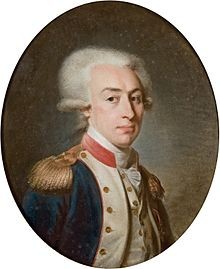
President James Monroe in 1824 invited the Marquis de Lafayette, an enormous French figure in the American and French Revolutions, to visit the United States after decades abroad in France. Lafayette agreed to visit and the visit would last over a year, from August 15, 1824, to September 3, 1825. Jefferson invited the great Frenchman to pay him a visit.
Let me once more have the happiness of talking over with you your first labors here, those I witnessed in your own country, it’s past and present affliction.
Lafayette pledged to visit Jefferson at Monticello and then to dine at the newly built Rotunda of the University of Virginia in celebration of the new institution.
Who was Lafayette?
Marie-Joseph Paul Yves Roch Gilbert du Motier de La Fayette was an American patriot from France who came at his own expense to the Colonies to help them in their war with England. He would become indispensable to Gen. Washington and he led the siege of Yorktown. He befriended Jefferson when the latter was governor and the two became intimate during Jefferson’s 5-year stay in Paris.
Lafayette arrived in Albemarle County late in the morning on November 4, 1824. Refreshing himself at Mrs. Boyd’s Tavern, he set out for Monticello in a landau, drawn by four grey horses. The landau was followed by other carriages, a detachment of cavalry, and uniformed guards.
As the procession approached Monticello, the cavalry lined up on one side of the circular road before the house, while everyday citizens lined up on the other side. Thomas Jefferson, who had been ill, feebly but decidedly approached his distinguished guest. Grandson Thomas Jefferson Randolph gave this account, too rich for paraphrase:
The lawn on the eastern side of the house at Monticello contains not quite an acre. On this spot was the meeting of Jefferson and Lafayette, on the latter’s visit to the United States. The barouche containing Lafayette stopped at the edge of this lawn. His escort—one hundred and twenty mounted men—formed on one side in a semicircle extending from the carriage to the house. A crowd of about two hundred men, who were drawn together by curiosity to witness the meeting of these two venerable men, formed themselves in a semicircle on the opposite side.
As Lafayette descended from the carriage, Jefferson descended the steps of the portico. The scene which followed was touching. Jefferson was feeble and tottering with age—Lafayette permanently lamed and broken in health by his long confinement in the dungeon of Olmutz. As they approached each other, their uncertain gait quickened itself into a shuffling run, and exclaiming, “Ah, Jefferson!” “Ah, Lafayette!” they burst into tears as they fell into each other’s arms. Among the four hundred men witnessing the scene there was not a dry eye—no sound save an occasional suppressed sob. The two old men entered the house as the crowd dispersed in profound silence.
There was at the end of Lafayette’s stay a gala dinner at the newly constructed University of Virginia. In addition to Jefferson and Lafayette, there were at the event presidents James Madison and James Monroe. It was a spectacle-filled way to showcase Jefferson’s new university, what he would call his “Simeon’s song,” while honoring his eminent guest.
Jefferson penned a few laudatory words, read by Vaul W. Southall, about Lafayette.
I joy, my friends, in your joy, inspired by the visit of this our ancient and distinguished leader and benefactor. His deeds in the war of independence you have heard and read. They are known to you, and embalmed in your memories and in the pages of faithful history. His deeds in the peace which followed that war, are perhaps not known to you; but I could attest them. When I was stationed in his country, for the purpose of cementing its friendship with ours and of advancing our mutual interests, this friend of both was my most powerful auxiliary and advocate. He made our cause his own, as in truth it was that of his native country also. His influence and connections there were great. All doors of all departments were open to him at all times; to me only formally and at appointed times. In truth I only held the nail, he drove it. Honor him, then, as your benefactor in peace as well as in war.
Enjoy the accompanying video….
The views expressed at AbbevilleInstitute.org are not necessarily those of the Abbeville Institute.





My ancestor, Major Carter Page, was aide de camp to General Lafayette and proposed a toast at General Lafayette’s reception at Richmond to a particularly brave fellow solider at Yorktown.
Carter Page’s son, my ancestor Dr Mann Page formally welcomed General Lafayette at the Rotunda.
My ancestral first cousin, Judith Page Rives was entertained by General Lafayette at his country estate, which was full of historic portraits of the Viginia landscape. She then, along with her husband Ambassador William Cabell Rives, witnessed the final convulsions of the French wars, and the first session of the Newest government where General Lafayette was seated on the main floor, his hair white. Their host seated with them in the balcony stating to her, that General Lafayette was a Revolution in himself.
Wow, you have some real stories to tell!