
There is a particular kind of song that only appears after history has already banged its gavel and rendered its verdict. While some songs are intended to rally the faithful or stiffen resolve, this is not that kind of song. This song arrives later, once the cannons have cooled, the banners have been folded away, and the surviving population has been left with the less dramatic task of figuring out how to live inside a radically altered world. Songs such as this don’t argue for a cause or justify a loss. They don’t ask whether the rebellion should have happened, and they don’t attempt to persuade anyone that it was noble, foolish, righteous, or doomed. These songs accept defeat as a condition, not as a debate, and they concern themselves instead with memory, absence, and the quiet work of mourning what was taken away.
Both Jacobite Scotland after Culloden and the American South after the Civil War produced music that fits squarely within this category. These songs are often misunderstood precisely because they are calm and not inflammatory. They do not shout, they do not accuse, and they do not dramatize their suffering in ways that modern listeners have been trained to expect from “political” music. Instead, they sound deceptively gentle, even romantic, while carrying meanings that are anything but sentimental. They are not the songs of resistance, but the songs of the aftermath. These are the songs of lament.
To understand songs of lament, the proper starting point is not with the music itself, but with the policies that followed defeat, because the character of the lament is inseparable from the nature of the loss being mourned. In both historical instances involving the Highlanders and Southerners, an entire culture and way of life were on the chopping block.
After the Jacobite defeat at Culloden in 1746, the British government didn’t treat the Highlands as a geographical region merely in need of occupation and pacification. Instead, it identified Highland society itself as the problem that required correction. The solution undertaken by the British was not limited to military suppression but extended into cultural, legal, and economic life. Clan authority was dismantled, traditional weapons were seized, tartan and Highland dress were banned, Gaelic was marginalized, and patterns of movement and landholding were fundamentally altered. The British never sought reconciliation between victor and defeated, but prevention. In this view and policy, rebellion was not a brief political event but a symptom of the disease, and the cure required dismantling the entire social structure that made rebellion possible in the first place.
A similar logic appears in the Union strategy during the later stages of the American Civil War, most visibly in Sherman’s March through Georgia. Here again, the objective extended beyond defeating opposing armies in the field. Civilian infrastructure, agricultural capacity, and economic stability were treated as legitimate targets, not because of any single battle, but because of the belief that the Southern way of life itself sustained resistance. As with the Highlands, the underlying conclusion was that the culture which produced rebellion could not be trusted and allowed to remain intact if future resistance was to be prevented.
The relevance of this parallel between Highlanders and Southerners is not moral but psychological. In both cases, defeat was not followed by a negotiated return to normalcy but by the realization that normalcy itself was permanently altered. Life, as they had always known it, was gone. In both cases, the war was not simply an end to a political project, but the dismantling of an entire social world and inherited culture. The music that followed reflects that understanding.
This is the correct context in which the Scottish folk song “Loch Lomond” must be heard. You know it – “You’ll take the high road, and I’ll take the low road, and I’ll be in Scotland afore ye.” The song’s popular reputation as a gentle love song is not entirely accidental, but it is profoundly incomplete. On the surface, the lyrics appear pastoral, even soothing. The imagery of banks and braes, of parting and return, seems designed to evoke nostalgia. Yet folk songs of this period, particularly in Scotland, rarely announce their true subject matter directly. This is a song about catastrophe. Songs like this rely on shared cultural codes, symbolic language, and assumptions that would have been immediately legible to their original audience, but have drifted away over time. “Loch Lomond” is a tragic Jacobite song of lament.
The central image of the song, the distinction between the “high road” and the “low road,” is the clearest example of this coded language. In Scottish folklore, the high road is the path of the living, governed by time, distance, and uncertainty. The low road is the path of the dead, whose spirits travel directly home without delay. When the speaker declares that one companion will take the high road while he himself takes the low road, he’s not describing alternate travel routes through the countryside. He is stating, calmly and without melodrama, that one of them will live and one of them will be executed.
The line that follows, asserting that the speaker will arrive in Scotland “afore ye,” is not romantic bravado but metaphysical accounting. Death is faster. That is the entire point of the lyric.
Although the symbolism alone is incredibly powerful enough, the most striking aspect about this construction is its emotional orientation. Notice that the speaker is not frightened, angry, or defiant. He doesn’t take a political stance and curse his captors or proclaim the justice of his cause. Instead, he does something incredibly human. He comforts the living by reframing death as a means of return. The burden of grief is placed on the survivor, not on the condemned. This inversion is essential to understanding the song’s function. It’s not an act of resistance, but an act of emotional triage.
The Jacobite tradition produced an entire repertoire of canonical lament. Their body of music functioned collectively as shared mourning rather than historical record. These songs never attempted to narrate events in any systematic way, and they never sought to explain the political mechanics of failure. Instead, they operated as emotional artifacts, preserving what couldn’t be restored. We don’t get to know what they knew as much as we get to feel what they felt. Taken together, these songs reveal a culture that had moved beyond argument and into recognition of their fate. The Highland culture became one that no longer asked what might yet be done, but learned how to live inside what had already been lost.
Another of the clearest examples of this posture appears in “Mo Ghile Mear,” a song that on its surface presents itself as a love lament for a vanished hero. Sung originally in Irish Gaelic, its language of devotion and loss is deliberately personal and intimate, yet its referent is unmistakably political. The absent beloved is Bonnie Prince Charlie himself, already in exile after Culloden, already beyond retrieval. What distinguishes the song is not its symbolism but its emotional restraint. There is no anger toward those who defeated him, no speculation about return, and no appeal to future action. The cause has ended, and the singer is not left to mourn injustice, but its absence. The tone is bereft rather than defiant, which is precisely what marks it as a post-rebellion lament rather than a song of resistance.
A similar transformation is evident in “The Skye Boat Song,” which modern audiences often interpret as a gentle lullaby stripped of any historical urgency. In its original context, however, the song functions as an escape narrative that is already looking backward. The prince is being carried away from Scotland, not toward restoration but toward disappearance. The calmness of the melody represents resignation, and a musical acknowledgment that panic would serve no purpose. Like “Loch Lomond,” the song refuses the dramatics that would imply the possibility of reversal. The escape is not the beginning of a return; it is the end of a chapter.
That sense of finality becomes even more explicit in “Will Ye No Come Back Again,” which frames exile as a question already answered. The song doesn’t formulate a plan or suggest conditions under which return might occur. It simply articulates longing, fully aware that longing will not be satisfied. The interrogative form of the song is hopeful, a way of giving voice to absence rather than attempting to resolve it. In this respect, the song closely resembles Southern postwar laments that express yearning without expectation, acknowledging that desire and probability are no longer aligned.
Other Jacobite laments shift their focus away from individuals entirely and toward landscape itself. “Farewell to the Creeks” was not composed immediately after Culloden, but closer to the Highland Clearances that followed. It mourns rivers, hills, and familiar terrain that can no longer be inhabited freely or safely. The loss being marked is not sovereignty in the abstract, but access, movement, and belonging. The Highlanders lose their sense of “home,” which was the whole point. This emphasis places the song in direct emotional proximity to post–Civil War Southern music that laments displacement rather than defeat, recognizing that the most enduring consequences of war are often geographic and domestic rather than military.
Even songs that began closer to praise than grief gradually migrated into the orbit of lament. “Charlie Is My Darling” illustrates this evolution particularly well. Earlier iterations celebrate the prince’s charisma and promise, but later performances increasingly emphasize what did not come to pass. Over time, encouragement gave way to elegy, not because the song changed its lyrics dramatically, but because history changed the meaning listeners could honestly extract from them. This is how lament traditions evolve: not through revision, but through accumulation of knowledge that makes optimism unsustainable.
What unites these Jacobite songs is not political messaging but emotional posture. They almost never proclaim that the cause was right, that betrayal explains failure, or that revival remains possible. Instead, they speak in the language of absence. “He is gone. The old world is gone. We remember.” This posture mirrors the Southern musical response after the Civil War with striking precision. In both cases, the transition from anthem to lament signals a cultural recognition that history has already moved on, leaving memory as the primary remaining inheritance. These songs do not argue history. They grieve it, and in doing so, they quietly acknowledge that grief itself has become a form of cultural continuity.
While General Sherman achieved his objective by physically marching through Georgia to the sea, the Union achieved the same objective by metaphysically marching throughout Southern culture. The silent part about the word “Reconstruction” is that in order for something to be reconstructed, it must first be torn down and dismantled – not just damaged. Local men were disarmed, civilian firearms were seized, movement was controlled through passes and curfews, traditional labor rhythms were broken by the loss of land, animals, seed, and credit, and public expressions of Southern identity—songs, commemorations, flags, and reunions—were pushed out of civic life and into private memory. Union forces carried out summary executions, extrajudicial killings, and lethal reprisals, often justified as responses to resistance or alleged violations of occupation rules. Civilians accused of aiding Confederate soldiers were shot without formal trial, hanged, or killed while “attempting to escape.” Even former slaves were killed by Union soldiers, most often under the same loose conditions that produced other extrajudicial violence during occupation. And just as Gaelic was marginalized, Northerners ridiculed the Southern accent with cultural contempt.
Therefore, the same musical structure appears in Southern songs of lament, just in a slightly different musical language. Several post–Civil War Southern songs such as “Lorena,” “The Vacant Chair,” “Carry Me Back to Old Virginny,” “When This Cruel War Is Over,” and eventually even 20th century songs, such as “The Night they Drove Old Dixie Down,” and “The Legend of the Rebel Soldier,” carry the same tradition as the Jacobites. These songs do not celebrate sacrifice, nor do they predict restoration. They are concerned instead with absence, irreversibility, and the unsettling recognition that the promised future failed to arrive. Additionally, these songs operate entirely outside the framework of the “Lost Cause” myth as they never argue that the war was noble, misunderstood, or stolen.
“Lorena,” in particular, occupies a remarkably similar emotional space to “Loch Lomond.” Its lyrics describe lost love and irretrievable time, but in the years following the war it was widely understood as mourning something larger than a romantic relationship. Like “Loch Lomond,” it is slow, restrained, and devastating precisely because it refuses to dramatize its pain. There is no rage in the song, no demand for explanation, only the recognition that what has been lost cannot be recovered by wishing.
“The Vacant Chair” is a painful song that makes this logic explicit by relocating the loss from battlefield to home. The empty chair is not symbolic nor a metaphor for political defeat, but a stark reminder of domestic permanence. No argument is offered. The chair will never be filled again, and the family must learn to live with that fact.
A particularly instructive Southern example appears in “Carry Me Back to Old Virginny,” a song whose later political associations have often obscured its original emotional function. When stripped of retrospective symbolism and examined in its postwar cultural context, the song aligns closely with the lament tradition rather than with celebration or advocacy. It does not articulate a belief in victory, restoration, or even meaningful return. Instead, it dwells in longing directed toward a place that has already receded into memory, a homeland that exists more vividly as an internal geography than as a viable destination. The request to be “carried back” is not a logistical plan but an emotional orientation, signaling a recognition that physical return, even if possible, would fail to restore what was lost.
“Carry Me Back to Old Virginny” was written in 1878 by James A. Bland, who was African American but not himself a former slave. That distinction matters historically, because the song was still written from inside the cultural aftermath of slavery and war, not from a position of abstraction. What Bland’s authorship does is add a layer of structural irony and restraint that deepens the song’s status as lament rather than grievance.
Taken together, “The Night They Drove Old Dixie Down” and “The Legend of the Rebel Soldier” function as modern Southern songs of lament not because they revive Civil War politics, but because they adopt the emotional grammar of aftermath rather than conflict. In both songs, the war is already over in every way that matters. There is no suspense about outcome, no appeal to restoration, and no effort to adjudicate right or wrong. What remains is endurance in the face of irreversible loss. In “The Night They Drove Old Dixie Down,” that loss is domestic and material: hunger, death, labor, and the collapse of ordinary life. The song does not mythologize defeat or convert suffering into meaning. It simply documents what survival looks like when history has already passed judgment and moved on. Like so many Southerners of the 19th century, this 20th century song asks, “What are we supposed to do now?”
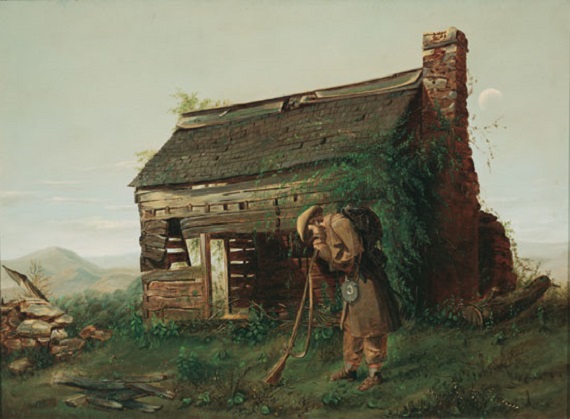
“The Legend of the Rebel Soldier” approaches the same condition from a different angle, narrowing the lens to a single dying figure whose war has ended not in reconciliation or victory, but in confinement and mortality. The soldier’s final concern is not the fate of the South as a cause, but whether death will permit the only form of return that history no longer allows in life. The South, like Scotland in Jacobite laments, becomes a homeland reachable only by those who will not come back. In this way, both songs echo the logic of “Loch Lomond” without imitation. One locates lament in the slow erosion of daily life, the other in the last moments before death, but both accept defeat as settled fact and turn instead toward memory, belonging, and the quiet recognition that some journeys can only be completed once the living road has ended.
What makes these songs especially relevant to the lament framework is their time frame within the point of view. Like “Loch Lomond,” they implicitly distinguish between different kinds of arrival. The singer imagines reunion as something that occurs internally, through memory and identity, rather than through movement in space. The homeland is reached not by traveling toward it, but by outliving it, carrying it forward while accepting that its original form cannot be reentered. In this sense, the Southern songs participate in the same post-defeat emotional economy as Jacobite laments, acknowledging that the distance between past and present is no longer measured in miles or years, but in irreversibility. The journey home has become metaphorical because history has already foreclosed the literal one.
Lament is not nostalgia. What these songs share with “Loch Lomond” is acceptance, and they are written, or re-understood, after the answer is already known. There is no expectation that the old order will be restored, no belief that suffering will be redeemed through eventual victory, and no attempt to convert grief into moral leverage. Nostalgia idealizes the past and softens its edges, while lament does the opposite. It acknowledges that the past is gone and grieves it precisely because it knows it will not return.
Musically, this clarity is reinforced. “Loch Lomond” employs a gentle, open melody that avoids harmonic aggression or dramatic leaps. The Southern songs that follow a similar path favor slow tempos, simple structures, and emotionally transparent phrasing. None of this is accidental. These are not songs designed for dancing. They are songs designed to sit with loss long enough for it to become survivable.
It is tempting and tragic for modern listeners to impose contemporary political expectations onto this material, to demand either condemnation or vindication, but doing so misunderstands the function of the music. These songs are not making arguments. They are bearing witness. They do not ask the listener to choose sides. They simply ask the listener for what the dead have always wanted—to be remembered.
That is why “Loch Lomond” endures, and why its Southern counterparts continue to resonate long after the conditions that produced them have vanished. They offer a model of grief that is both communal and restrained without being theatrical. They acknowledge that sometimes the most honest response to history is neither defiance nor repentance, but quiet recognition of the cost. Songs of lament are about continuity, not defeat. Not the continuity of political power, but the continuity of memory and life.
The views expressed at AbbevilleInstitute.org are not necessarily those of the Abbeville Institute.