

On January 1, 1772, Jefferson took as his wife the widow of Bathurst Skelton, Martha Wayles Skelton, at The Forest—the residence of John Wayles, father of Jefferson’s wife. Once married, the two set out for the long ride to Monticello. They drove their carriage in a light snow which became denser as they entered the Virginian countryside of Albemarle County. The snow, near Monticello, was from 18 to 24 inches in depth at about eight miles away from Monticello—Jefferson enters in his Garden Book on January 26 that the snow on that day was in places “about 3. f. deep”—and so the newly wedded couple quit the carriage and proceeded on horseback. Cold and exhausted, the newlyweds arrived late into the night. Monticello was cold and dreary, as all the servants had retired and all the fires were out.
Thomas and Martha Jefferson retired to the only habitable part of Monticello—the 20-foot-square South Pavilion. Because the servants had retired for the night, the newlyweds were without a fire or supper. Jefferson located a half bottle of wine on a shelf behind some books and the “ludicrous contre-temps, and the ‘horrible dreariness’ was lit up with song, and merriment, and laughter.”
Jefferson much loved his wife, who I note in chapter 1 must have attracted him because she resembled in mannerisms—she had a handsome voice and played well the piano forte—his older sister Jane. With his marriage, Jefferson’s life at Monticello had formally begun.
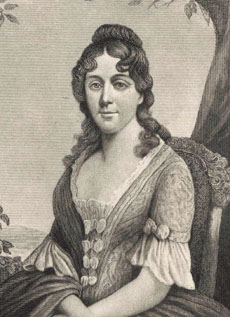
Though no portraits of her exist, Martha Jefferson (1748–1782) was known for her beauty. Slave Isaac Grander Jefferson describes her as “pretty.” Ellen Randolph Coolidge, Jefferson’s granddaughter, writes that her grandmother was a “very attractive person [and] a graceful, ladylike and accomplished woman.” Martha had wit, vivacity, and good manners. She was “a graceful, ladylike and accomplished woman, with considerable powers of conversation, some skill in music, all the habits of good society, and the art of welcoming her husband’s friends to perfection.” Coolidge adds that her grandmother “had a vivacity of temper which might sometimes border on tartness.” Sarah N. Randolph, granddaughter of daughter Martha, writes:
The youngest daughter, Mrs. Skelton, left a widow when scarcely advanced beyond her girlhood, was distinguished for her beauty, her accomplishments, and her solid merit. In person, she was a little above medium height, slightly but exquisitely formed. Her complexion was brilliant—her large expressive eyes of the richest shade of hazel—her luxuriant hair of the finest tinge of auburn. She walked, rode, and danced with admirable grace and spirit—sung, and played the spinet and harpsichord (the musical instruments of the Virginia ladies of that day) with uncommon skill. The more solid parts of her education had not been neglected. She was also well read and intelligent; conversed agreeably; possessed excellent sense and a lively play of fancy; and had a frank, warm-hearted, and somewhat impulsive disposition. Last, not least, she had already proved herself a true daughter of the Old Dominion in the department of housewifery.
Writes early biographer Henry Randall: “She was a little above medium height, slightly but exquisitely formed. Her complexion was brilliant—her large expressive eyes of the richest shade of hazel—her luxuriant hair of the finest tine of auburn. She walked, rode, and danced, with admirable grace and spirit—sung, and played the spinet and harpsichord … with uncommon skill.” During their courtship, Jefferson purchased for her a “Forte-piano … of fine mahogany, solid, not vineered [sic].”
Of uncommon beauty, grace, manners, Martha had many suitors after the untimely death of her husband. Randall tells a story of two suitors, who, having met in an anteroom of Mrs. Skelton’s home and having heard Jefferson and Martha singing together with the former playing his violin and the latter her harpsichord, retrieved their hats and retired in recognition that neither was a match for Jefferson.
The two were wed on the first of January, 1772, as I note at the beginning of this chapter and remained together for nearly 11 years, when they were separated by Martha’s untimely death. During that time, Martha gave birth to six children, only two of whom, Martha (b. 1772; aka Patsy) and Mary (b. 1778; aka Polly), survived. Martha was a devoted daughter throughout Jefferson’s life. Mary, with her mother’s looks and frailty of health, died after giving birth to her third child on April 17, 1804.
After the birth of their last child, Lucy Elizabeth Jefferson (b. May 8, 1782), Martha fell ill and became moribund. She died on September 6, 1782.
In the weeks prior to her passing, Jefferson doted on his moribund wife and seldom left her bedside. When she finally passed, Jefferson was inconsolably aggrieved. “Her loss was the bitterest grief my grandfather ever knew,” says Ellen Randolph Coolidge, “and no second wife was ever called to take her place.” Daughter Martha, who was certainly devastated herself, wrote of their final days.
During my mother’s life he (Jefferson) bestowed much time and attention on our education—our cousins, the Carrs, and myself—and after her death, during the first month of desolation which followed, I was his constant companion while we remained at Monticello…. As a nurse no female ever had more tenderness nor anxiety. He nursed my poor mother in turn with aunt Carr and her own sister—sitting up with her and administering her medicines and drink to the last. For four months that she lingered he was never out of calling; when not at her bedside, he was writing in a small room which opened immediately at the head of her bed. A moment before the closing scene, he was led from the room in a state of insensibility by his sister, Mrs. Carr, who, with great difficulty, got him into the library, where he fainted, and remained so long insensible that they feared he never would revive. The scene that followed I did not witness, but the violence of his emotion, when, almost by stealth, I entered his room by night, to this day I dare not describe to myself. He kept his room three weeks, and I was never a moment from his side. He walked almost incessantly night and day, only lying down occasionally, when nature was completely exhausted, on a pallet that had been brought in during his long fainting-fit. My aunts remained constantly with him for some weeks—I do not remember how many. When at last he left his room, he rode out, and from that time he was incessantly on horseback, rambling about the mountain, in the least frequented roads, and just as often through the woods. In those melancholy rambles I was his constant companion—a solitary witness to many a burst of grief, the remembrance of which has consecrated particular scenes of that lost home beyond the power of time to obliterate.
The violence of Jefferson’s reaction to his beloved wife’s death, it is reasonable to assert—and most scholars are in agreement on this—betrays the depth of feelings he had for her.
One exception to the scholarly consensus is Jon Kukla. “It is easy to suppose, especially in light of his unbearable grief when she died, that Thomas and Martha Jefferson probably were loving companions during their marriage—but no outsider’s estimate can ever get beyond probably.” That sentiment is largely understated. Jefferson’s inordinate grieving can only be sensibly taken as clear expression of the ardency of his love for his wife, and it is too much to believe that he could have loved her so without Martha in large part reciprocating that love. His inordinate grieving is also evidence of an “eternal separation”—Jefferson’s purchase of there being no hereafter, the topic of a later chapter.
There has, however, been little discussion of the excessiveness of his grief—he did know at some point in her illness of the inevitableness of her passing—and that takes us beyond the surface and into the depths of Jefferson’s mind.
Jack McLaughlin argues that excess grieving could only have been the result of “guilt and anger.” His anger is expressed by Jefferson’s expression “torn from him” on Martha’s tombstone. Yet he acknowledges, and I think reasonable, that anger cannot be the principal reason, as Jefferson knew of his wife’s illness for months and was certainly readied for the worst. In Elizabeth Kübler-Ross’ words in her book On Death and Dying, Jefferson at least mostly had passed beyond anger and was at least somewhat prepared for acceptance of the death of Martha We are left with guilt. “Throughout his life,” says McLaughlin, “he had practiced a stoic control over his passions, but the liberties of the marriage bed were a temptation he was unwilling or unable to check—even though he knew the inevitable pregnancies placed her seriously at risk. During his wife’s long illness, he had ample time to brood over his own complicity in her condition and to generate a monumental weight of guilt.” To the guilt of complicity, McLaughlin adds the guilt of failed amenities. “He had also failed to provide her with the amenities he had promised. … In the room Martha died in, Jefferson could look up at the bare walls and unadorned windows and doorways for which he had drawn decorative Palladian orders a decade before, but which had never been built.”
James Thompson offers, to my mind, the most plausible explanation of the primary reason for Jefferson’s inordinate grieving—one which does not rule out the guilt of complicity and the guilt of failed amenities as etiologically ancillary. Writes Thompson of Martha’s death and another reason for Jefferson’s guilt:
There was something peculiar about it, since it ended in a grief so black, so intense, that it can only be described as unnatural. It was less the anguish of a man who had lost his cherished companion than an expression of inconsolable remorse. It suggests a mind tortured by regrets. It is as though he finally admitted to himself that he had allowed his political crusades to replace his wife as the focus of his life. Martha’s death forced Thomas to confront that unspoken truth.
Thompson argues that Jefferson’s involvement in his “political crusades”—his time away from home in the service of the American Revolution—was a clear message to his wife that politics, often far from Monticello, was more important that his domestic responsibilities and his relationship with her. On her passing, Jefferson had to come to terms with the fact that he had failed his wife.
Returning to the surface, Jefferson’s grief is psychologically revelatory, since it marks one of the few times he gave uncensored expression to his emotions. The “many of burst of grief” shows Jefferson was a profoundly emotional man, and a man capable of great love. That he so infrequently gave vent to what he felt shows a man who dealt with his feelings through sublimation—viz., finding socially acceptable outlets, imperfect outlets, for what he felt.
Martha Jefferson’s tombstone reads thus:
To the memory of Martha Jefferson,
Daughter of John Wayles;
Born October 19th, 1748, O.S.
Intermarried with
Thomas Jefferson
January 1st, 1772;
Torn from him by death
September 6th, 1782:
This monument of his love is inscribed.
After the inscription, Jefferson adds a line from Homer’s Iliad, concerning the death of the great Trojan hero, Hector:
εἰ δὲ θανόντων περ καταλήθοντ᾽ εἰν Ἀΐδαο
αὐτὰρ ἐγὼ καὶ κεῖθι φίλου μεμνήσομ᾽ἑταίρου.[1]
As a final testament of his enduring love for his wife, Jefferson and his moribund wife copied a moving passage from Sterne’s Tristram Shandy (Vol. IX, chap. 8), prior to her death.
Time wastes too fast: every letter
I trace tells me with what rapidity
life follows my pen. The days and hours
of it …] are flying over our heads like
[light] clouds of windy day never to return—
more every thing presses on—and every
time I kiss thy hand to bid adieu, every absence which
follows it, are preludes to that eternal separation
which we are shortly to make!
The text without italics is in Martha Jefferson’s handwriting and the remainder of the text is in Jefferson’s. The passage, I have elsewhere argued, is additional evidence of Jefferson’s disbelief in an afterlife. Had Jefferson believed in an afterlife, it would be unlikely that they would have shared a passage mentioning “eternal separation.” Disbelief in an afterlife is also a reason for Jefferson’s excessive grieving on his wife’s passing. With her death, theirs was an “eternal separation.”
Happy Valentine’s Day, y’all! Enjoy the video below…
[1] Says Achilles about the corpse of the great Trojan hero, Hector: “Even in Hades men forget their dead, yet will I even there remember my dear comrade.” Homer, The Iliad, XXII: 389–90.
The views expressed at AbbevilleInstitute.org are not necessarily those of the Abbeville Institute.






Absolutely wonderful article Dr. Holowchak. It fills in details I have never seen or heard before. For the first time in my experience you showed Jefferson as a human being. YOU should be in charge of Monticello not the leftist political hacks that currently control Monticello and exploit Jefferson for cash and their agenda. Thank you, Sir!
Very kind words, James. Please post that beneath the video. The prez of Monticello is on mailing list. She might read your comments.
Will do.
Great interview….I enjoyed it and talking about, perhaps, the most important person in Jefferson’s life…….
BILL HYLAND