

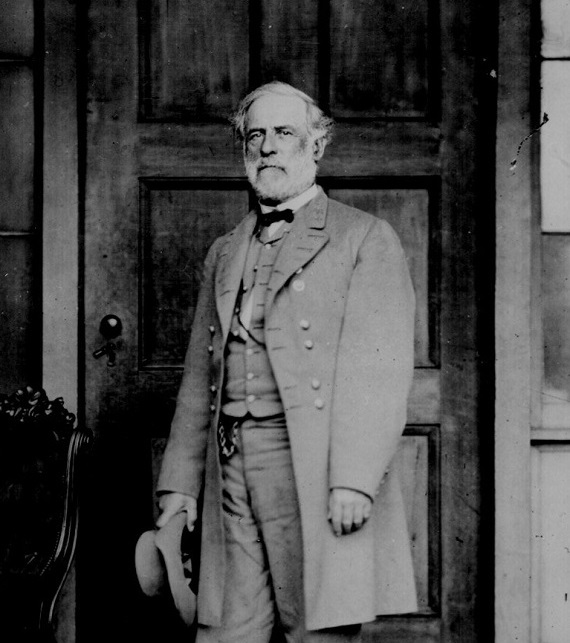
There is much that has been and still can be said of General Lee’s character. It is probably to the benefit of all modern readers that we explore and attempt to understand Lee, as our own era has more frequently been concerned with deconstructing the past rather than holding up honorable men to emulate and admire. Following a brief perusal of his life and personal correspondence, one of the most striking aspects of the man was his persistent humility and hope. This was significant, both in how it motivated the man and because of the litany of challenges he experienced throughout his life.
At first glance it may appear odd that the defeated General could encouragingly write that “It is history that teaches us to hope.” The track record of human history is not on its face an obvious endorsement of Lee’s optimism. The eighteenth-century British historian Edward Gibbon famously opined that “History is indeed little more than the register of the crimes, follies, and misfortunes of mankind.” This condition is given further credence when considering the “crimes, follies, and misfortunes” which Lee himself lived through both during and after the war, seemingly making his calm optimism even more baffling.
Upon further reflection, however, the General’s humble sensibilities in the wake of difficult circumstances make perfect sense, particularly in the context of his Christian faith. Lee’s trust in God was noteworthy and powerful even before the turmoil of Reconstruction. As his middle son Rooney was wounded and then captured by Federal forces in 1863, Lee urged resignation and firmness in faith to his daughter-in-law: “In His own good time He will relieve us and make all things work together for our good, if we give Him our love and place Him in our trust.” Of the same distressing incident Lee wrote to his wife, “We must bear this additional affliction with fortitude and resignation, and not repine at the will of God. It will eventuate in some good that we know not of now.” This manner of humble acceptance was a powerful aspect of Lee’s character which helped him carry the burden of his responsibilities whether they were military or civilian.
General Lee relied upon his faith to navigate the immense difficulties of the war, as well as the troubled years which followed. As his youngest son, Captain Robert E. Lee, Jr., described it, “His was a practical, every-day religion, which supported him all through his life, enabled him to bear with equanimity every reverse of fortune, and to accept her gifts without undue elation.” Likewise, in response to an English gentleman who gifted him a copy of the Bible, Lee thanked him for providing “a book in comparison with which all others in my eyes are of minor importance, and which in all my perplexities has never failed to give me light and strength.” In countless examples Lee demonstrated the power of faith and a calm trust in God, even during the restlessness of the post-war period.
It was with this type of spiritual fortitude that the General could explain his belief that “At present, the public mind is not prepared to receive the truth,” while also holding that amid all the trouble, it was “better to leave their correction to the return of reason and good feeling.” Anchored by his faith that God would ultimately oversee the victory of truth and right, Lee wrote hopefully in an 1867 letter to his son Rooney that “Although the future is still dark, and the prospects gloomy, I am confident that, if we all unite in doing our duty, and earnestly work to extract what good we can out of the evil that now hangs over our dear land, the time is not distant when the angry cloud will be lifted from our horizon and the sun in his pristine brightness again shine forth.” Of his family more generally he continued, “Let us all so live that we may be united in that world where there is no more separation, and where pain and sorrow never come.” He advised his youngest daughter Mildred to read history rather than fiction, in order to “Get correct views of life” and “see the world in its true light,” as it would “enable you to live pleasantly, to do good, and, when summoned away, to leave without regret.” As husband, father, and general, Robert E. Lee remained grounded in his faith even as the times were uncertain for himself, the South, and United States overall.
Perhaps we ought not be too surprised that a man who signed numerous letters throughout his vast correspondence, “Your Obedient Servant,” would be deeply rooted in humility and deference to God and His plans, rather than the whims of imperfect humans. While not a philosopher in the conventional sense of the term, Lee undoubtedly had a grasp of things that were beyond himself and were equally removed from the fleeting passions of the moment. As Richard Weaver superbly explained, “If one has respect for the order of things, it is then possible for him to accept failure as instruction rather than total repudiation. I do not see how Lee’s serenity in the face of crisis and his self-possession in the days of distress can be explained save through this conviction, which is in essence the answer of Christianity to the paradoxes of existence.” As Americans grapple with the uncertainties of our current era, we would do well to emulate Lee’s humble optimism for “the order of things” as much as we are able.
The views expressed at AbbevilleInstitute.org are not necessarily those of the Abbeville Institute.






Thank you for this, Mr. Madura. It is brilliant and important.
Faith in God is not “hope”. It is choosing to be on the winning side of a rigged game. God left nothing to chance.
Hope. The world’s apostle, Paul, talks a lot about “hope.”
In discussing the believer’s redemption of their body, the Lord through Paul says:
Romans 8:24 “..we are saved by hope: but hope that is seen is not hope: for what a man seeth, why doth he yet hope for?”
That hope is “faith in God:”
Hebrews 11:1 “…faith is the substance of things hoped for…”
God is “the winning side,” but one better believe on the Son. Without doing that there is no hope.
Romans 5:10 “…when we were enemies, we were reconciled to God by the death of his Son, much more, being reconciled, we shall be saved by his life.”
“Rigged.” Nothing is rigged (and it’s certainly not a “game”):
Adam had a choice in the Garden.
He made a very bad decision.
This world’s woes, everyone’s woes, has its beginning in Genesis 3.
It is definitely rigged and only games are rigged. Good does not require the presence of evil in order for good to exist; evil must have good or it destroys itself. Evil is illogical, unsustainable on its own. God wrote these instructions into the DNA of the universe. God is in control.
Sir,
I think that you might find it interesting that I – a 62 year old son of a first generation Irish Catholic American; a man that served served in the US Army Air Corp/OSS “Carpetbaggers” Unit – was lucky enough to be raised by a Father that thought extremely highly of Robert E. Lee. Actually, I believe that it is fair to say that – with the possible exception of Jim Braddock – I believe that General Lee was the only man whom my Father put on such a lofty pedestal. You see, what, on the surface, perhaps, made it appear counterintuitive & contrarian, was the fact that both of my parents were born & raised in Scranton PA – my Mother’s side of the Family has been in America since before the American Revolution; with relatives that fought for both the North as well as well as for the South – however, it was ALWAYS stressed to me and my brothers and sisters that our Confederate fore-bearers were GOOD, CHRISTIAN men and women of deep Faith, Honor, and Courage. Or, as my Dad, succinctly put it : “your cousins were born in Richmond – so, they wore Grey – your Mother’s immediate Family was from Pennsylvania; so, they wore Blue. End of story.”
Mr. Platt, the reason that my Father so revered General Lee – it is clear to me, looking through the eyes of an old man, now – is illuminated in your excellent piece. It was not simply Lee’s military Excellence which my Father so admired in the man (though, that was definitely a big part of my Father’s respect for the General.)
No; it was Mr. Lee’s Christian Ethos, and his Devotion to Excellence in all things, which so inspired my Dad. Simply put : Robert E. Lee was a Man that, through his Chivalry and Honorable Actions, inspired Men such as my Father – an individual who’s Carpetbaggers Unit was awarded the Distinguished Unit Citation, The French Cross of War, and The Congressional Gold Medal (though, my Father almost never spoke of his WW2 Actions) – and, that fact alone, speaks Volumes about the Legacy of Mr. Lee !
Lastly, growing up as a kid in Detroit, every Sunday Morning , the local ABC affiliate would
run a classic Abbot & Costello movie ( and, because this was pre-cable, the audience size was gigantic; as there were only a literal handful of channel options.) One of said movies was “Buck Privates” (which came out just prior to Dec. 7, 1941.) In “Buck Privates”, there is a famous science in which The Andrew’s Sisters sing a patriotic song : “You’re A Lucky Fella, Mr. Smith.” In the song, one of the lyrics proudly cites a History of famous American forebears; it goes like this : “Washington/Jefferson/Jackson AND Lee.” Therefore, Mr. Platt – at least among my generation, in Metro Detroit, we grew up with the (in my opinion, Factual) belief that General Robert E. Lee was a GREAT MAN.
God Bless,
Martin McNulty
Excellent summary of RE Lee and his faith, genuine and unshakeable in any event, public and private, great and small. It shouldn’t be difficult but it usually is misunderstood – willfully, certainly. Many are the times I’ve heard or read, Well, Lee lost, God didn’t answer his prayers. To answer, Lee didn’t ask for an outcome, being content that “God’s Will be Done”, is always met with silence.
A wonder, Mr. Madura is how you navigated a Masters program – in 2024 – with firm and positive understanding of Robert E. Lee?
Thanks for the comment. To answer your question, I suppose there is some truth to Mark Twain’s statement, “I have never let my schooling interfere with my education.”
Haha!
Wonderful write up. Thank you for your honesty and courage.
Funny,I have never heard anything of the views of Grant or Sherman on God,faith or religion.
I have to cite a famous quote by Lee, made in January of 1860: i.e. “Secession is nothing but Revolution.”
This may have been his albatross, since it precluded him from declaring the Union for what it was: i.e. a coup of international treason, in which the officials of each state betrayed their oaths of office; to seize power over their their sworn sovereign rulers: i.e. the respective peoples of their respective states, as well as those of the non-Union states (and sovereignty thereof).
If Lee had done so, he could not only have mounted a full-scale national defense of Virginia and the other states; but also appealed to the Union states themselves to rise up against this treachery.
Instead, Lee’s declaration essentially forfeited the Confederacy’s one trump-card: i.e. national sovereignty; while also forfeiting that of the Union states in failing to challenge them on this historical fact, since each Union state was a sovereign nation, while the Union itself never was.
And this is not hindsight, since South Carolina was the first state to secede, doing so expressly on the basis that each was not only sovereign, but retained this sovereignty under the Constitution (which the Union never denied, but falsely claimed that the states were never sovereign nations in the first place).
I have understood that Lee may have admitted his error in 1869, but I am not certain of this.
Mr. Evans,
You make an interesting point! Lee was a professional soldier. I have found that professional soldiers have had the focus of their allegiance shifted from the country, in Lee’s case as he would himself assert – Virginia, to the general government. Col. Lawrence Wilkerson, for whom I have great respect as an analyst, is a good example. Col. Wilkerson is, I believe, from South Carolina. In an interview, he rightly leveled scathing criticism at Senator Lindsey Graham for his support of the criminal activities against Venezuela. I was with Wilkerson until he added that Graham was of the same spirit as Jefferson Davis, meaning that Davis was a criminal for supporting secession. I do note, however, that the American Revolution was itself a defense of the act of secession, the colonies having seceded from the crown.
General Robert Edward Lee is one of my historical mentors. Others are Alfred the Great, St. Louis IX, Marcus Aurelius and Elijah, to name a select few.